IPC-TM-650 EN 2022 试验方法--.pdf - 第125页
The Institute for Int erconnecting and Packaging E lectronic Circuits 2215 S anders Road • Northbrook, IL 60062-6135 Material in this T est M ethods Manual was vol untaril y establis hed by T echni cal Committees of the …
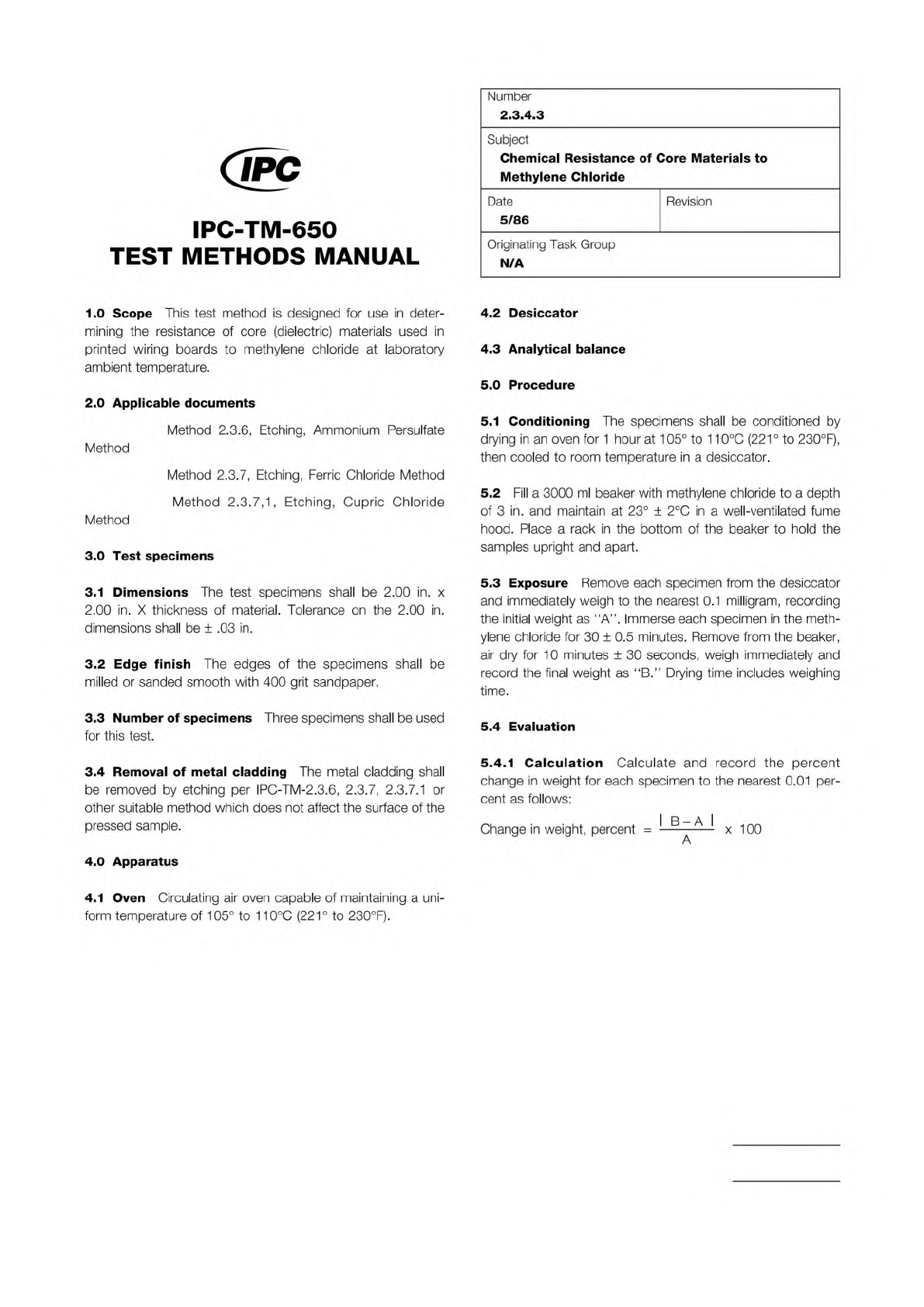
IPC-TM-650
IPC-TM-650
IPC-TM-650
The Institute for Interconnecting and Packaging Electronic Circuits
2215 Sanders Road • Northbrook, IL 60062-6135
Material in this Test Methods Manual was voluntarily established by Technical Committees of the IPC. This material is advisory only
and its use or adaptation is entirely voluntary. IPC disclaims all liability of any kind as to the use, application, or adaptation of this
material. Users are also wholly responsible for protecting themselves against all claims or liabilities for patent infringement.
Equipment referenced is for the convenience of the user and does not imply endorsement by the IPC.
Page 1 of 1
IPC-TM-650
TEST
METHODS
MANUAL
1
.0
Scope
This
test
method
is
designed
for
use
in
deter¬
mining
the
resistance
of
core
(dielectric)
materials
used
in
printed
wiring
boards
to
methylene
chloride
at
laboratory
ambient
temperature.
2
.0
Applicable
documents
Method
2.3.6,
Etching,
Ammonium
Persulfate
Method
Method
2.3.7,
Etching,
Ferric
Chloride
Method
Method
2.3.7,
1
,
Etching,
Cupric
Chloride
Method
3
.0
Test
specimens
3.1
Dimensions
The
test
specimens
shall
be
2.00
in.
x
2.00
in.
X
thickness
of
material.
Tolerance
on
the
2.00
in.
dimensions
shall
be
±
.03
in.
3.2
Edge
finish
The
edges
of
the
specimens
shall
be
milled
or
sanded
smooth
with
400
grit
sandpaper.
3.3
Number
of
specimens
Three
specimens
shall
be
used
for
this
test.
3.4
Removal
of
metal
cladding
The
metal
cladding
shall
be
removed
by
etching
per
IPC-TM-2.3.6,
2.3.7,
2.3.7.
1
or
other
suitable
method
which
does
not
affect
the
surface
of
the
pressed
sample.
4
.0
Apparatus
4.1
Oven
Circulating
air
oven
capable
of
maintaining
a
uni¬
form
temperature
of
105°
to
110℃
(221°
to
230°F).
Number
2.3.4.3
Subject
Chemical
Resistance
of
Core
Materials
to
Methylene
Chloride
Date
Revision
5/86
Originating
Task
Group
N/A
4.2
Desiccator
4.3
Analytical
balance
5
.0
Procedure
5.1
Conditioning
The
specimens
shall
be
conditioned
by
drying
in
an
oven
for
1
hour
at
1
05°
to
1
1
0
℃
(221
°
to
230°F),
then
cooled
to
room
temperature
in
a
desiccator.
5.2
Fill
a
3000
ml
beaker
with
methylene
chloride
to
a
depth
of
3
in.
and
maintain
at
23°
±
2
℃
in
a
well
-ventilated
fume
hood.
Place
a
rack
in
the
bottom
of
the
beaker
to
hold
the
samples
upright
and
apart.
5.3
Exposure
Remove
each
specimen
from
the
desiccator
and
immediately
weigh
to
the
nearest
0.1
milligram,
recording
the
initial
weight
as
"A".
Immerse
each
specimen
in
the
meth¬
ylene
chloride
for
30
±
0.5
minutes.
Remove
from
the
beaker,
air
dry
for
10
minutes
±
30
seconds,
weigh
immediately
and
record
the
final
weight
as
“B.”
Drying
time
includes
weighing
time.
5.4
Evaluation
5.4.1
Calculation
Calculate
and
record
the
percent
change
in
weight
for
each
specimen
to
the
nearest
0.01
per¬
cent
as
follows:
Change
in
weight,
percent
=
〔
〉
一
一
〔
x
1
00
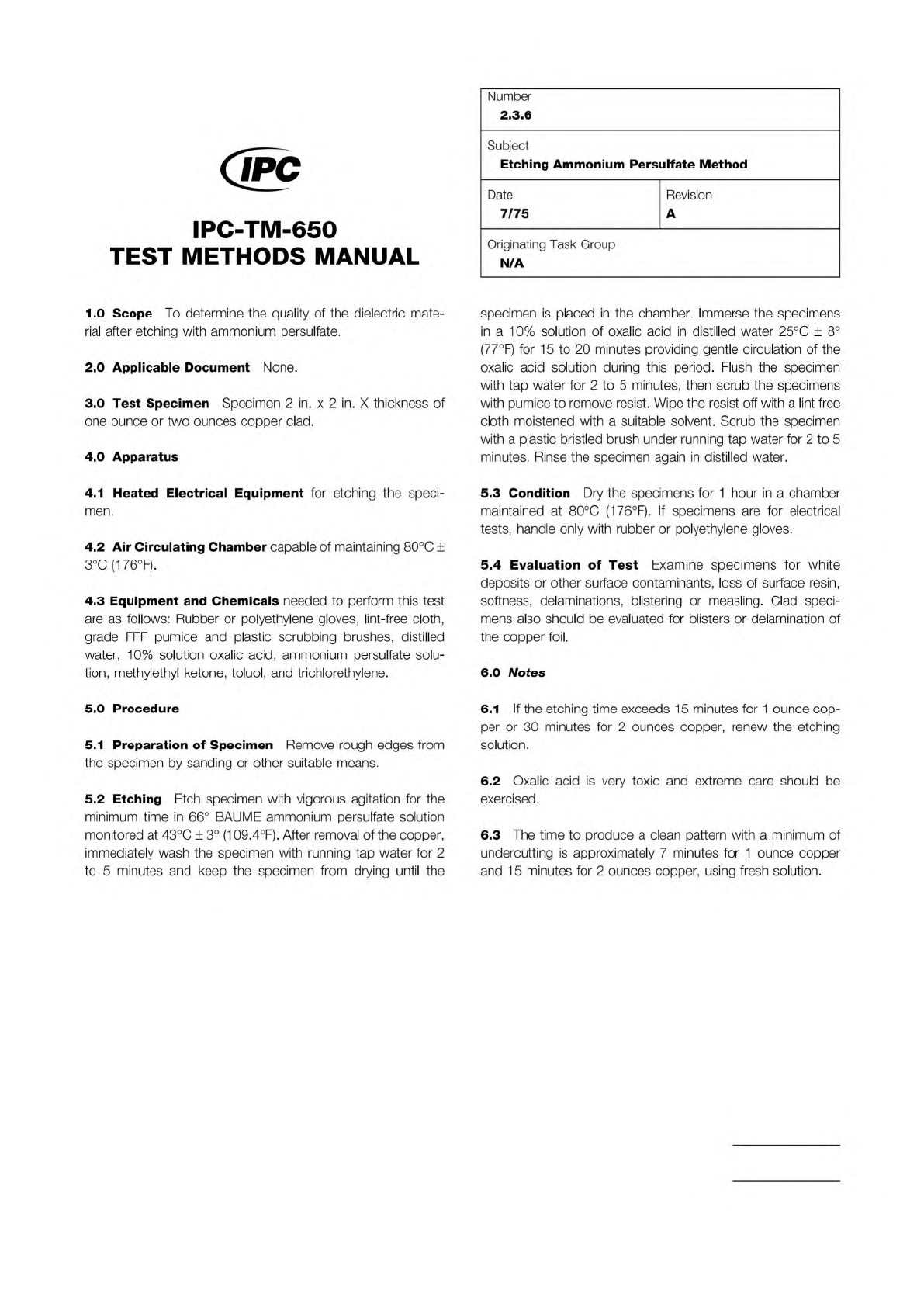
The Institute for Interconnecting and Packaging Electronic Circuits
2215 Sanders Road • Northbrook, IL 60062-6135
Material in this Test Methods Manual was voluntarily established by Technical Committees of the IPC. This material is advisory only
and its use or adaptation is entirely voluntary. IPC disclaims all liability of any kind as to the use, application, or adaptation of this
material. Users are also wholly responsible for protecting themselves against all claims or liabilities for patent infringement.
Equipment referenced is for the convenience of the user and does not imply endorsement by the IPC.
Page 1 of 1
IPC-TM-650
TEST
METHODS
MANUAL
Number
2.3.6
Subject
Etching
Ammonium
Persulfate
Method
Date
Revision
7/75
A
Originating
Task
Group
N/A
1
.0
Scope
To
determine
the
quality
of
the
dielectric
mate¬
rial
after
etching
with
ammonium
persulfate.
2
.0
Applicable
Document
None.
3
.0
Test
Specimen
Specimen
2
in.
x
2
in.
X
thickness
of
one
ounce
or
two
ounces
copper
clad.
4
.0
Apparatus
4.1
Heated
Electrical
Equipment
for
etching
the
speci¬
men.
4.2
Air
Circulating
Chamber
capable
of
maintaining
80℃
±
3
℃
(176°F).
4.3
Equipment
and
Chemicals
needed
to
perform
this
test
are
as
follows:
Rubber
or
polyethylene
gloves,
lint-free
cloth,
grade
FFF
pumice
and
plastic
scrubbing
brushes,
distilled
water,
10%
solution
oxalic
acid,
ammonium
persulfate
solu¬
tion,
methylethyl
ketone,
toluol,
and
trichlorethylene.
5
.0
Procedure
5.1
Preparation
of
Specimen
Remove
rough
edges
from
the
specimen
by
sanding
or
other
suitable
means.
5.2
Etching
Etch
specimen
with
vigorous
agitation
for
the
minimum
time
in
66°
BAUME
ammonium
persulfate
solution
monitored
at
43℃
土
3°
(1
09.4°F).
After
removal
of
the
copper,
immediately
wash
the
specimen
with
running
tap
water
for
2
to
5
minutes
and
keep
the
specimen
from
drying
until
the
specimen
is
placed
in
the
chamber.
Immerse
the
specimens
in
a
10%
solution
of
oxalic
acid
in
distilled
water
25℃
±
8°
(77°F)
for
1
5
to
20
minutes
providing
gentle
circulation
of
the
oxalic
acid
solution
during
this
period.
Flush
the
specimen
with
tap
water
for
2
to
5
minutes,
then
scrub
the
specimens
with
pumice
to
remove
resist.
Wipe
the
resist
off
with
a
lint
free
cloth
moistened
with
a
suitable
solvent.
Scrub
the
specimen
with
a
plastic
bristled
brush
under
running
tap
water
for
2
to
5
minutes.
Rinse
the
specimen
again
in
distilled
water.
5.3
Condition
Dry
the
specimens
for
1
hour
in
a
chamber
maintained
at
80℃
(1
76°F).
If
specimens
are
for
electrical
tests,
handle
only
with
rubber
or
polyethylene
gloves.
5.4
Evaluation
of
Test
Examine
specimens
for
white
deposits
or
other
surface
contaminants,
loss
of
surface
resin,
softness,
delaminations,
blistering
or
measling.
Clad
speci¬
mens
also
should
be
evaluated
for
blisters
or
delamination
of
the
copper
foil.
6
.0
Notes
6.1
If
the
etching
time
exceeds
1
5
minutes
for
1
ounce
cop¬
per
or
30
minutes
for
2
ounces
copper,
renew
the
etching
solution.
6.2
Oxalic
acid
is
very
toxic
and
extreme
care
should
be
exercised.
6.3
The
time
to
produce
a
clean
pattern
with
a
minimum
of
undercutting
is
approximately
7
minutes
for
1
ounce
copper
and
15
minutes
for
2
ounces
copper,
using
fresh
solution.
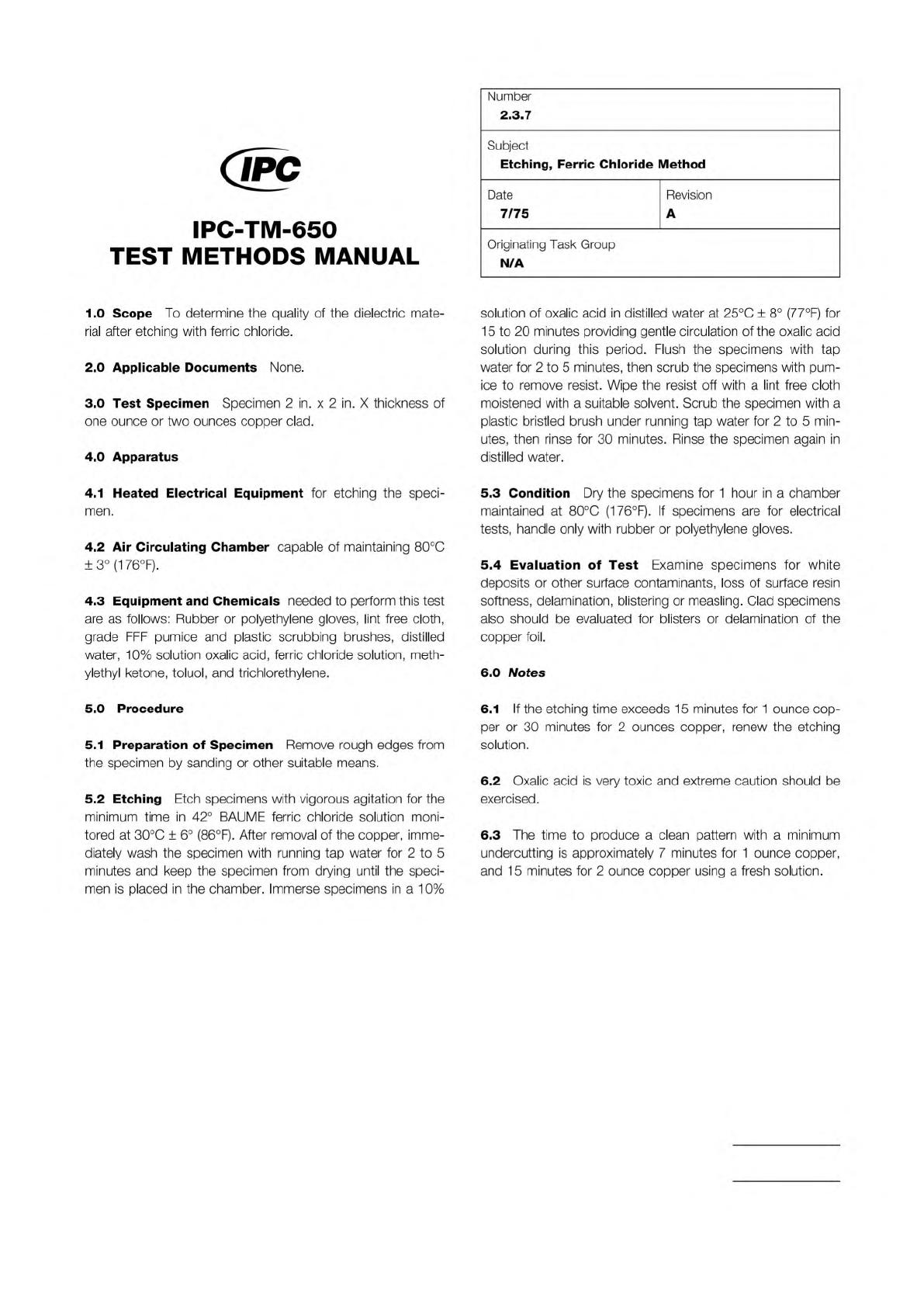
The Institute for Interconnecting and Packaging Electronic Circuits
2215 Sanders Road • Northbrook, IL 60062-6135
Material in this Test Methods Manual was voluntarily established by Technical Committees of the IPC. This material is advisory only
and its use or adaptation is entirely voluntary. IPC disclaims all liability of any kind as to the use, application, or adaptation of this
material. Users are also wholly responsible for protecting themselves against all claims or liabilities for patent infringement.
Equipment referenced is for the convenience of the user and does not imply endorsement by the IPC.
Page 1 of 1
IPC-TM-650
TEST
METHODS
MANUAL
Number
2.3.7
Subject
Etching,
Ferric
Chloride
Method
Date
Revision
7/75
A
Originating
Task
Group
N/A
1
.0
Scope
To
determine
the
quality
of
the
dielectric
mate¬
rial
after
etching
with
ferric
chloride.
2
.0
Applicable
Documents
None.
3
.0
Test
Specimen
Specimen
2
in.
x
2
in.
X
thickness
of
one
ounce
or
two
ounces
copper
clad.
4
.0
Apparatus
4.1
Heated
Electrical
Equipment
for
etching
the
speci¬
men.
4.2
Air
Circulating
Chamber
capable
of
maintaining
80℃
±
3°
(1
76°F).
4.3
Equipment
and
Chemicals
needed
to
perform
this
test
are
as
follows:
Rubber
or
polyethylene
gloves,
lint
free
cloth,
grade
FFF
pumice
and
plastic
scrubbing
brushes,
distilled
water,
10%
solution
oxalic
acid,
ferric
chloride
solution,
meth¬
ylethyl
ketone,
toluol,
and
trichlorethylene.
5
.0
Procedure
5.1
Preparation
of
Specimen
Remove
rough
edges
from
the
specimen
by
sanding
or
other
suitable
means.
5.2
Etching
Etch
specimens
with
vigorous
agitation
for
the
minimum
time
in
42°
BAUME
ferric
chloride
solution
moni¬
tored
at
30℃
±
6°
(86°
F).
After
removal
of
the
copper,
imme¬
diately
wash
the
specimen
with
running
tap
water
for
2
to
5
minutes
and
keep
the
specimen
from
drying
until
the
speci¬
men
is
placed
in
the
chamber.
Immerse
specimens
in
a
10%
solution
of
oxalic
acid
in
distilled
water
at
25℃
±
8°
(77°F)
for
1
5
to
20
minutes
providing
gentle
circulation
of
the
oxalic
acid
solution
during
this
period.
Flush
the
specimens
with
tap
water
for
2
to
5
minutes,
then
scrub
the
specimens
with
pum¬
ice
to
remove
resist.
Wipe
the
resist
off
with
a
lint
free
cloth
moistened
with
a
suitable
solvent.
Scrub
the
specimen
with
a
plastic
bristled
brush
under
running
tap
water
for
2
to
5
min¬
utes,
then
rinse
for
30
minutes.
Rinse
the
specimen
again
in
distilled
water.
5.3
Condition
Dry
the
specimens
for
1
hour
in
a
chamber
maintained
at
80℃
(1
76°F).
If
specimens
are
for
electrical
tests,
handle
only
with
rubber
or
polyethylene
gloves.
5.4
Evaluation
of
Test
Examine
specimens
for
white
deposits
or
other
surface
contaminants,
loss
of
surface
resin
softness,
delamination,
blistering
or
measling.
Clad
specimens
also
should
be
evaluated
for
blisters
or
delamination
of
the
copper
foil.
6
.0
Notes
6.1
If
the
etching
time
exceeds
1
5
minutes
for
1
ounce
cop¬
per
or
30
minutes
for
2
ounces
copper,
renew
the
etching
solution.
6.2
Oxalic
acid
is
very
toxic
and
extreme
caution
should
be
exercised.
6.3
The
time
to
produce
a
clean
pattern
with
a
minimum
undercutting
is
approximately
7
minutes
for
1
ounce
copper,
and
15
minutes
for
2
ounce
copper
using
a
fresh
solution.