IPC-TM-650 EN 2022 试验方法--.pdf - 第638页
1 Scope and Purpose 1.1 Sco pe This method is intended to si mulate exposure to the thermal co nditions by convection ref low a ssembly. 1.2 Pur pose This method be used to replicate the thermodynamic effects by as sembl…
7. When the thermocouple/ thermometer measures 150 °C,
record the resistance of the Sense net with a 4-wire cable
and a bench top multi-meter.
8. For validation, compare the resistance readings of the
manual measurements in the oven and the test machine
for each coupon.
6.5.1.2 Test Temperature/Resistance Validation
1. Verify the equipment is calibrated and ready for use.
2. Load coupons into all test heads on the test machine.
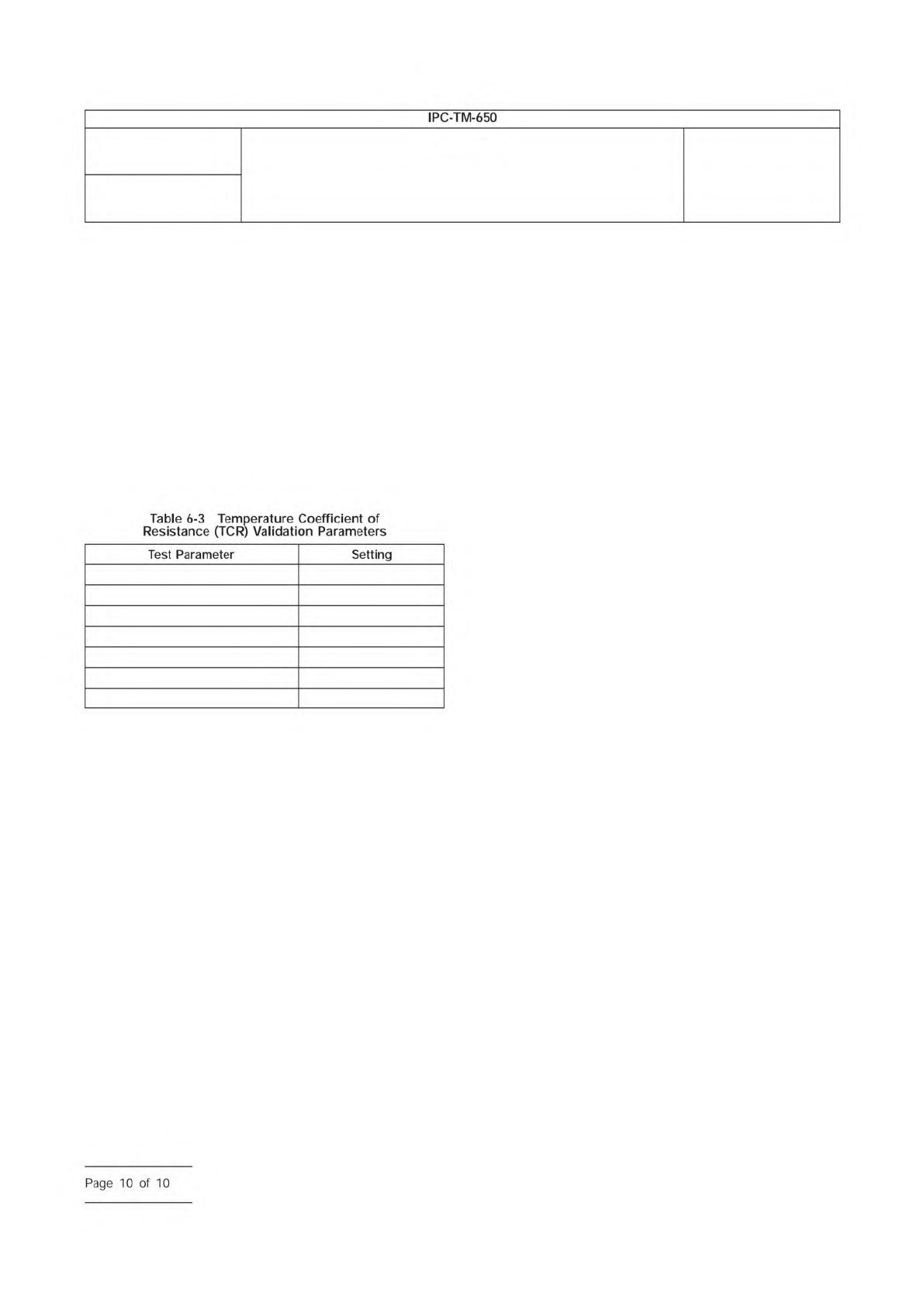
3. Enter the test parameters shown in Table 6-3 (or equiva-
lent) into the test machine.
4. For Cycle 2, measure the resistance at 150 °C and at room
temperature on the test machine.
5. For validation, compare the resistance measurement at
150 °C between test machines and at room temperature
between test machines.
6.5.2 Method B
6.5.2.1 Temperature Coefficient of Resistance (TCR)
Validation
1. Label coupons and record 4-wire resistance with bench
top multi-meter.
2. Measure the temperature and resistance at the following
equilibrium temperatures: 23, 75, 125, 150, 175, 200, and
220 °C. Calculate TCR for test temperature 23-220 °C.
3. For validation, compare the measured TCR values
between test machines.
6.5.2.2 Test Temperature/Resistance Validation
1. Run 3 cycles for test temperature 23-220 °C using the
mean TCR measured in 6.5.2.1.
2. For Cycle 3, record the calculated temperature T(calc,
high) at end of high temperature dwell.
3. For validation, compare the T(calc, high) value between
test machines.
Maximum # Cycles 5
Data Recorded 1
Test Temperature 150 °C
% Rejection Sense Circuit 10%
% Rejection Power Circuit 10%
Precycle Time 5
Compensation Calculated
Number
2.6.26
Subject
DC Current Induced Thermal Cycling Test
Date
5/14
Revision
A
IPC-TM-650
Table
6-3
Temperature
Coefficient
of
Resistance
(TCR)
Validation
Parameters
Test
Parameter
Setting
Page
10
of
10
1 Scope and Purpose
1.1 Scope
This method is intended to simulate exposure to
the thermal conditions by convection reflow assembly.
1.2 Purpose
This method be used to replicate the
thermodynamic effects by assembly on the test specimen.
The use of this method is intended to simulate those effects
that are the result of soldering thermal excursions.
1.2.1
This method be used for qualification testing of
an applicable test specimen. The evaluation of acceptability
for qualification
be in accordance with the requirements
defined in 5.3.
1.2.2
This method may be used for lot acceptance. The
evaluation for lot acceptability should be in accordance with
the requirements defined in 5.3 or as agreed upon between
user and supplier (AABUS).
2 Applicable Documents
Terms and Definitions
Generic Standard on Printed Board Design
Acceptability of Printed Boards
Printed Board Handling and Storage Guidelines
Qualification and Performance Specification for
Rigid Printed Boards
Qualification and Performance Specification for
Flexible Printed Boards
Qualification and Performance Specification for
High Frequency (Microwave) Printed Boards
Guidelines for Microsection Preparation
User’s Guide for IPC-TM-650, Method 2.6.27
Test Methods Manual
1
2.1.1 Microsectioning – Microsectioning, Manual and Semi
or Automatic Method
3 Test Specimen
3.1 Design/Construction Criteria
3.1.1
The test specimen be the A/B, AB-R, and/or the
D coupon as designed in accordance with the requirements of
IPC-2221 Appendix A or B. Use of alternate specimens
be AABUS.
3.1.2
The test specimen(s) be constructed with holes
contained in the printed board it represents as follows:
a. A/B, A/B-R and D coupons
be constructed with
both the largest plated through-holes (PTHs) and the
smallest vias.
b. Propagated B and D coupons
be constructed with
the intended via structure. (Multiple B and D coupons are
used for designs with multiple structures.)
3.1.2.1
The test specimen(s) contain the representa-
tive ground and power planes of the printed board design.
3.1.2.2
The test specimen(s) contain the representa-
tive filled through vias, applicable blind and/or buried vias,
including microvias, of the printed board design.
3.1.3
The test specimen(s) allow for microsection
evaluation of all the applicable, representative PTHs and vias
defined in 3.1.2 after exposure to the conditions of this Test
Method.
Special tooling may be required for potting an entire
‘‘D’’ Coupon for microsection examination.
3.1.4
Deviations to the test specimen design/construction
or use of an alternate test specimen such as the printed board
or a section of the printed board
be AABUS.
4 Apparatus
4.1 Drying Oven
4.1.1
The oven be capable of maintaining a uniform
set temperature within the 105 to 125 °C [221 to 257 °F]
range.
1. Current and revised IPC Test Methods are available on the IPC Web site (www.ipc.org/test-methods.aspx).
3000 Lakeside Drive, Suite 105N
Bannockburn, IL 60015-1249
IPC-TM-650
TEST METHODS MANUAL
Number
2.6.27
Subject
Thermal Stress, Convection Reflow Assembly
Simulation
Date
2/2020
Revision
B
Originating Task Group
Thermal Stress Test Methodology Subcommittee
(D-32)
Association
Connecting
Electronics
Industries
shall
shall
shall
shall
shall
shall
shall
shall
IPC-T-50
IPC-2221
IPC-A-600
IPC-1601
IPC-6012
IPC-6013
IPC-6018
IPC-9241
IPC-9631
IPC-TM-650
Note:
shall
shall
shall
shall
shall
Material
/n
this
Test
Methods
Manual
was
voluntarily
established
by
Technical
Committees
of
I
PC.
This
material
/s
advisory
only
and
"s
use
or
adaptation
,
s
entirely
voluntary.
IPC
disclaims
all
liability
of
any
kind
as
to
the
use,
application,
or
adaptation
of
this
material.
Users
are
also
wholly
responsible
for
protecting
themselves
against
all
claims
or
liabilities
for
patent
infringement.
Equipment
referenced
/s
for
the
convenience
of
the
user
and
does
not
imply
endorsement
by
IPC.
Page
1
of
10
ANSI/J-STD-001
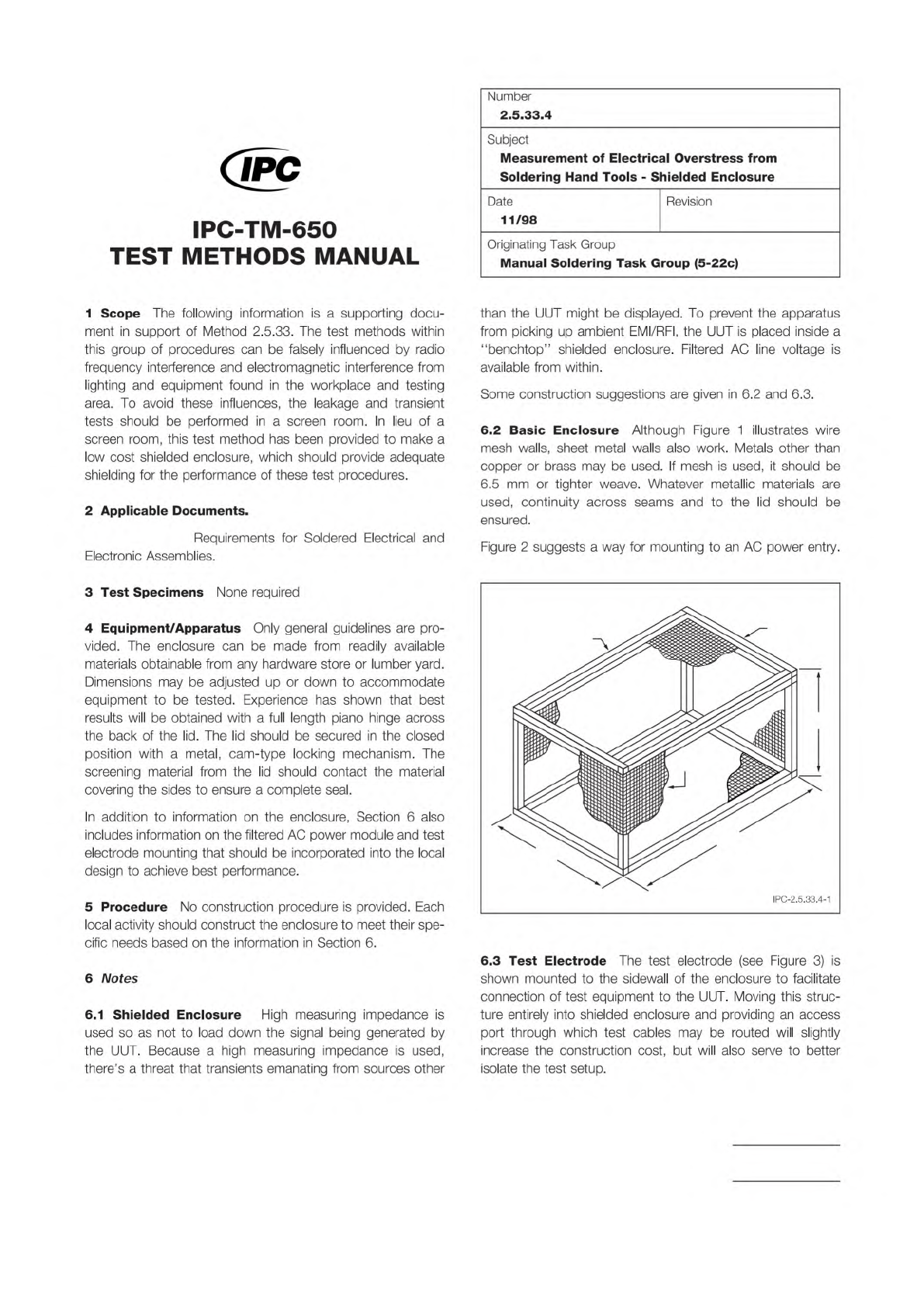
Figure 1 Enclosure Construction Suggestion
51 cm
81 cm
43 cm
LID
WOOD
SHEET METAL
OR WIRE MESH
The Institute for Interconnecting and Packaging Electronic Circuits
2215 Sanders Road • Northbrook, IL 60062
Material in this Test Methods Manual was voluntarily established by Technical Committees of the IPC. This material is advisory only
and its use or adaptation is entirely voluntary. IPC disclaims all liability of any kind as to the use, application, or adaptation of this
material. Users are also wholly responsible for protecting themselves against all claims or liabilities for patent infringement.
Equipment referenced is for the convenience of the user and does not imply endorsement by the IPC.
Page 1 of 3
Number
IPC-TM-650
TEST
METHODS
MANUAL
1
Scope
The
following
information
is
a
supporting
docu¬
ment
in
support
of
Method
2.5.33.
The
test
methods
within
this
group
of
procedures
can
be
falsely
influenced
by
radio
frequency
interference
and
electromagnetic
interference
from
lighting
and
equipment
found
in
the
workplace
and
testing
area.
To
avoid
these
influences,
the
leakage
and
transient
tests
should
be
performed
in
a
screen
room.
In
lieu
of
a
screen
room,
this
test
method
has
been
provided
to
make
a
low
cost
shielded
enclosure,
which
should
provide
adequate
shielding
for
the
performance
of
these
test
procedures.
2
Applicable
Documents.
Requirements
for
Soldered
Electrical
and
Electronic
Assemblies.
3
Test
Specimens
None
required
4
Equipment/Apparatus
Only
general
guidelines
are
pro¬
vided.
The
enclosure
can
be
made
from
readily
available
materials
obtainable
from
any
hardware
store
or
lumber
yard.
Dimensions
may
be
adjusted
up
or
down
to
accommodate
equipment
to
be
tested.
Experience
has
shown
that
best
results
will
be
obtained
with
a
full
length
piano
hinge
across
the
back
of
the
lid.
The
lid
should
be
secured
in
the
closed
position
with
a
metal,
cam-type
locking
mechanism.
The
screening
material
from
the
lid
should
contact
the
material
covering
the
sides
to
ensure
a
complete
seal.
In
addition
to
information
on
the
enclosure,
Section
6
also
includes
information
on
the
filtered
AC
power
module
and
test
electrode
mounting
that
should
be
incorporated
into
the
local
design
to
achieve
best
performance.
5
Procedure
No
construction
procedure
is
provided.
Each
local
activity
should
construct
the
enclosure
to
meet
their
spe¬
cific
needs
based
on
the
information
in
Section
6.
6
Notes
6.1
Shielded
Enclosure
High
measuring
impedance
is
used
so
as
not
to
load
down
the
signal
being
generated
by
the
UUT.
Because
a
high
measuring
impedance
is
used,
there's
a
threat
that
transients
emanating
from
sources
other
2.5.33.4
Subject
Measurement
of
Electrical
Overstress
from
Soldering
Hand
Tools
-
Shielded
Enclosure
Date
Revision
11/98
Originating
Task
Group
Manual
Soldering
Task
Group
(5-22c)
than
the
UUT
might
be
displayed.
To
prevent
the
apparatus
from
picking
up
ambient
EMI/RFI,
the
UUT
is
placed
inside
a
^,benchtop^^
shielded
enclosure.
Filtered
AC
line
voltage
is
available
from
within.
Some
construction
suggestions
are
given
in
6.2
and
6.3.
6.2
Basic
Enclosure
Although
Figure
1
illustrates
wire
mesh
walls,
sheet
metal
walls
also
work.
Metals
other
than
copper
or
brass
may
be
used.
If
mesh
is
used,
it
should
be
6.5
mm
or
tighter
weave.
Whatever
metallic
materials
are
used,
continuity
across
seams
and
to
the
lid
should
be
ensured.
Figure
2
suggests
a
way
for
mounting
to
an
AC
power
entry.
6.3
Test
Electrode
The
test
electrode
(see
Figure
3)
is
shown
mounted
to
the
sidewall
of
the
enclosure
to
facilitate
connection
of
test
equipment
to
the
UUT.
Moving
this
struc¬
ture
entirely
into
shielded
enclosure
and
providing
an
access
port
through
which
test
cables
may
be
routed
will
slightly
increase
the
construction
cost,
but
will
also
serve
to
better
isolate
the
test
setup.