IPC-TM-650 EN 2022 试验方法--.pdf - 第774页
5.3 Evaluation 5.3.1 M icrosection The test spe cimen be micr osec- tioned when this test method is used for thermal stress prior to structural integrity evaluation. Af ter the test specimen has b e en c o nd i ti o ne d…
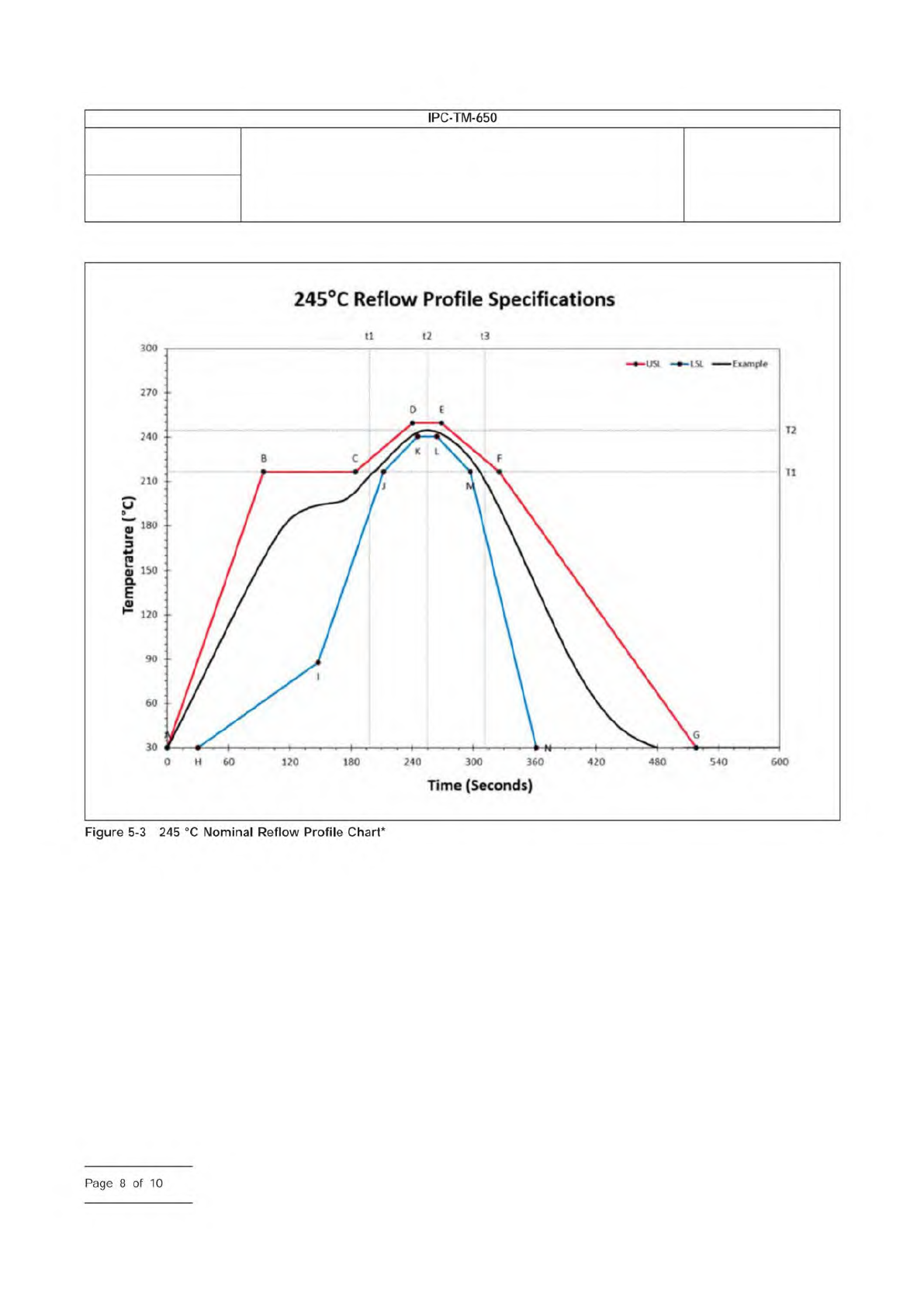
IPC-2627-5-3
* The times to t1, t2 and t3 may vary based on the mass of the sample test specimen.
Number
2.6.27
Subject
Thermal Stress, Convection Reflow Assembly Simulation
Date
2/2020
Revision
B
245
C
Reflow
Profile
Specifications
Time
(Seconds)
Figure
5-3
245
Nominal
Reflow
Profile
Chart*
IPC-TM-650
—
H
30
o
o
o
o
o
o
7
4
18b
29
2
2
2
1
1
1
W
L
Page
8
of
10

5.3 Evaluation
5.3.1 Microsection
The test specimen be microsec-
tioned when this test method is used for thermal stress prior
to structural integrity evaluation. After the test specimen has
been conditioned and reflowed in accordance with the
requirements of 5.1 and 5.2, microsection the test specimen
in accordance with IPC TM-650 Method 2.1.1. Inspect speci-
mens required for microsection (e.g., A, B, A/B, AB/R, etc.) for
compliance to the applicable performance specification
and/or AABUS requirement.
For guidelines on microsection preparation see IPC-
9241.
5.3.2 Resistance Change
Resistance change be
used to evaluate IPC-2221 Appendix A (latest revision)
D-coupons for performance-based evaluation of the samples
when specified. Microsectioning of D coupons which have
been evaluated by resistance change is not required.
5.3.2.1
Percent change in resistances of each sample’s
nets
be determined using the first cycle’s peak tempera-
ture resistance as the reference.
5.3.2.2
The maximum allowable percent change in resis-
tance after the test specimen has been conditioned and
reflowed in accordance with 5.1 and 5.2
be 5% maxi-
mum unless otherwise specified.
5.3.2.3
Cycles to failure, corresponding percent change of
the failure, and the percent change of the final cycle
be
documented.
5.3.3
Deviations to the stated requirements or additional
requirements defined here
be AABUS.
6 Notes
6.1
The design of the convection reflow system should be
flexible enough to facilitate the creation of the reflow profiles
depicted in Figure 5-1, Figure 5-2 and Figure 5-3 for all the
applicable test specimen designs encountered. Some issues
to consider are as follows:
• Thermal mass compensation capability (energy vs. time)
• Environmental control capability (heating and cooling)
• Reproducibility of parameters
• Preheat
• Conveyor speed (if applicable)
• Heating ramp rate
• Cool down rate
• Programming capability
• Profile memory
The IPC-TM-650 website provides a non-comprehensive list-
ing of providers of convection reflow systems suitable for
meeting the reflow profiles within this test method.
6.2
Deviations to the time and temperature specified in 5.1.1
should take into consideration maintaining the solderability of
the surface finish being utilized.
6.3 Example Drawing Notes
As this method addresses
assembly issues with printed boards, it is recommended that
the user of the printed board establish a drawing note in the
procurement documentation to provide the printed board fab-
ricators with guidance relative to the intended reflow process
of the printed board. An example of such a drawing note is
provided as follows:
A. IPC D COUPONS
BE DESIGNED IAW IPC-2221
APPENDIX A AND
INCLUDE COMPONENT (A),
VIA (B) AND ALL PROPAGATED B STRUCTURES. X OF
EACH COUPON DESIGN
BE TESTED PER
MANUFACTURING PANEL.
B. THE IPC D COUPONS
BE SUBJECTED TO 6
REFLOW SIMULATIONS IAW IPC-TM-650, METHOD
2.6.27 USING THE [230 °C, 245 °C, OR 260 °C] PRO-
FILE. ACCEPTANCE CRITERIA
BE < 5%
CHANGE IN RESISTANCE.
Number
2.6.27
Subject
Thermal Stress, Convection Reflow Assembly Simulation
Date
2/2020
Revision
B
IPC-TM-650
—
shall
Note:
shall
shall
shall
SHALL
SHALL
SHALL
SHALL
SHALL
Page
9
of
10

This Page Intentionally Left Blank
Number
2.6.27
Subject
Thermal Stress, Convection Reflow Assembly Simulation
Date
2/2020
Revision
B
IPC-TM-650
Page
10
of
10