IPC-TM-650 EN 2022 试验方法--.pdf - 第320页
Figure 1 DMA Modulus Plot IPC-TM-650 Number Subject Date Revision Page 2 of 5 Temperature IPC-24244-1 5.1.2 Specimens shall be cut to the specified size using appropriate procedures and equipment to minimize thermal shoc…
E 1640
D 4065
D 4092
The Institute for Interconnecting and Packaging Electronic Circuits
2215 Sanders Road • Northbrook, IL 60062-6135
Material in this Test Methods Manual was voluntarily established by Technical Committees of the IPC. This material is advisory only
and its use or adaptation is entirely voluntary. IPC disclaims all liability of any kind as to the use, application, or adaptation of this
material. Users are also wholly responsible for protecting themselves against all claims or liabilities for patent infringement.
Equipment referenced is for the convenience of the user and does not imply endorsement by the IPC.
Page 1 of 5
IPC-TM-650
TEST
METHODS
MANUAL
1
Scope
This
test
is
designed
to
determine
the
glass
tran¬
sition
temperature
(Tg)
and
room
temperature
storage
modu¬
lus
(E‘)
of
dielectric
materials
used
in
High
Density
Intercon¬
nect
(HDI)
and
Microvias
by
the
use
of
dynamic
mechanical
analysis
(DMA).
When
testing
a
stand
alone
HDI
dielectric
layer,
DMA
will
pro¬
vide
modulus
as
a
function
of
temperature
and
glass
transition
for
this
layer.
When
DMA
is
used
on
built-up
constructions,
the
data
will
be
a
complex
curve
representing
the
composite
moduli
and
glass
transitions.
Two
methods
are
presented:
•
Method
A
for
thick
specimens
•
Method
B
for
thin
specimens
(recommended
for
HDIS
and
Microvia
dielectric
layers).
For
anisotropic
materials
(reinforced
dielectrics),
the
x
and
y
directions
will
have
different
modulus
vs.
temperature
behav¬
ior.
Anisotropic
materials
shall
be
tested
in
both
the
x
and
y
directions.
2
Applicable
Documents
2.1
ASTM
Documents
Test
Method
for
Assignment
of
the
Glass
Transition
Temperature
by
Dynamic
Mechanical
Analysis
Standard
Practice
for
Determining
and
Reporting
Dynamic
Mechanical
Properties
for
Plastics
Standard
Terminology
Relating
to
Dynamic
Mechani¬
cal
Measurements
on
Plastics
3
Test
Specimen
3.1
Size
Method
A
Flexural
bending
geometry
-
thick
specimens
(>0.5
mm):
Specimens
shall
be
approximately
8
mm
to
12
mm
wide,
20
mm
to
40
mm
long,
and
1
mm
to
2
mm
thick.
The
thickness
shall
be
a
minimum
of
0.5
mm;
for
thicknesses
<0.50
mm,
use
Method
B.
An
aspect
ratio
of
length/thickness
二
10/1
or
greater
should
be
maintained.
Exact
specimen
dimensions
should
be
determined
by
the
apparatus
used.
Number
2.4.24.4
Subject
Glass
Transition
and
Modulus
of
Materials
Used
in
High
Density
Interconnection
(HDI)
and
Microvias
-
DMA
Method
Date
11/98
Revision
Originating
Task
Group
HDI
Test
Methods
Task
Group
(D-42a)
Method
B
Thin
film
tension
geometry
-
thin
specimens
(<0.50
mm):
Specimens
shall
be
approximately
15
mm
to
20
mm
long
and
2
mm
wide.
The
minimum
thickness
is
deter¬
mined
by
the
strength
of
the
material;
it
should
not
break
dur¬
ing
testing.
Exact
specimen
dimensions
may
be
determined
by
the
apparatus
used.
3.2
All
specimens
should
be
fully
cured
according
to
manu¬
facturer's
recommendations.
Thick
specimens
may
be
made
by
use
of
multiple
lamination/cure
cycles
if
required.
3.3
Unless
otherwise
specified,
one
specimen
shall
be
tested,
to
be
taken
from
a
random
location
in
the
material
in
question.
4
Apparatus
or
Material
4.1
A
DMA
capable
of
determination
of
modulus
to
+1%
precision
and
tan
8
resolution
of
0.01
over
the
specified
tem¬
perature
range.
The
DMA
will
preferably
have
computer
data
acquisition
and
analysis.
The
DMA
must
have
an
environmen¬
tal
chamber
capable
of
having
inert
flush
gas
and
capable
of
heating
the
specimen
to
at
least
31
0
℃.
4.2
Diamond
blade
or
saw,
sanding
equipment,
or
equiva¬
lent
to
provide
specimens
of
the
size
and
edge
quality
required
for
Method
A
4.3
Scissors,
razor
blades,
or
equivalent
to
provide
speci¬
mens
of
size
and
edge
quality
for
Method
B
4.4
Air
circulating
oven
capable
of
maintaining
1
05℃
±
2
℃
4.5
Dessicator
capable
of
an
atmosphere
<30%
RH
at
23℃
4.6
Etching
system
capable
of
complete
removal
of
metallic
cladding
5
Procedure
5.1.1
Metallic
clad
specimens
shall
be
tested
without
the
cladding.
Etch
and
dry
using
appropriate procedures
and
equipment.
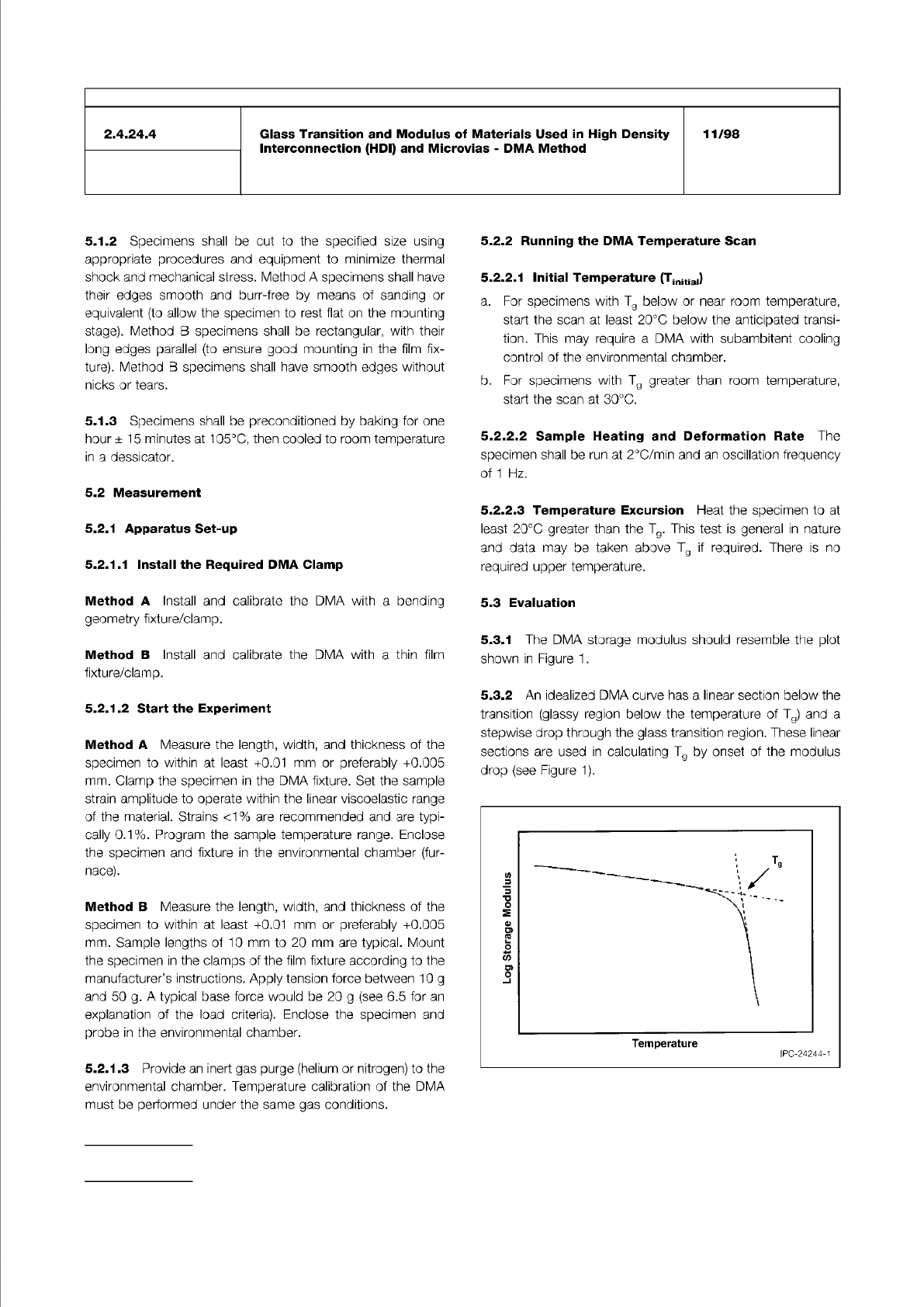
Figure 1 DMA Modulus Plot
IPC-TM-650
Number
Subject Date
Revision
Page 2 of 5
Temperature
IPC-24244-1
5.1.2
Specimens
shall
be
cut
to
the
specified
size
using
appropriate
procedures
and
equipment
to
minimize
thermal
shock
and
mechanical
stress.
Method
A
specimens
shall
have
their
edges
smooth
and
burr-free
by
means
of
sanding
or
equivalent
(to
allow
the
specimen
to
rest
flat
on
the
mounting
stage).
Method
B
specimens
shall
be
rectangular,
with
their
long
edges
parallel
(to
ensure
good
mounting
in
the
film
fix¬
ture).
Method
B
specimens
shall
have
smooth
edges
without
nicks
or
tears.
5.1.3
Specimens
shall
be
preconditioned
by
baking
for
one
hour
±
1
5
minutes
at
1
05℃,
then
cooled
to
room
temperature
in
a
dessicator.
5.2
Measurement
5.2.1
Apparatus
Set-up
5.2.1.
1
Install
the
Required
DMA
Clamp
Method
A
Install
and
calibrate
the
DMA
with
a
bending
geometry
fixture/clamp.
Method
B
Install
and
calibrate
the
DMA
with
a
thin
film
fixture/clamp.
5.2.1.
2
Start
the
Experiment
Method
A
Measure
the
length,
width,
and
thickness
of
the
specimen
to
within
at
least
+0.01
mm
or
preferably
+0.005
mm.
Clamp
the
specimen
in
the
DMA
fixture.
Set
the
sample
strain
amplitude
to
operate
within
the
linear
viscoelastic
range
of
the
material.
Strains
<1
%
are
recommended
and
are
typi¬
cally
0.1
%.
Program
the
sample
temperature
range.
Enclose
the
specimen
and
fixture
in
the
environmental
chamber
(fur¬
nace).
Method
B
Measure
the
length,
width,
and
thickness
of
the
specimen
to
within
at
least
+0.01
mm
or
preferably
+0.005
mm.
Sample
lengths
of
10
mm
to
20
mm
are
typical.
Mount
the
specimen
in
the
clamps
of
the
film
fixture
according
to
the
manufacturer's
instructions.
Apply
tension
force
between
10
g
and
50
g.
A
typical
base
force
would
be
20
g
(see
6.5
for
an
explanation
of
the
load
criteria).
Enclose
the
specimen
and
probe
in
the
environmental
chamber.
5.2.1.
3
Provide
an
inert
gas
purge
(helium
or
nitrogen)
to
the
environmental
chamber.
Temperature
calibration
of
the
DMA
must
be
performed
under
the
same
gas
conditions.
5.2.2
Running
the
DMA
Temperature
Scan
5.2.2.1
Initial
Temperature
(Tinitia|)
a.
For
specimens
with
Tg
below
or
near
room
temperature,
start
the
scan
at
least
20℃
below
the
anticipated
transi¬
tion.
This
may
require
a
DMA
with
subambitent
cooling
control
of
the
environmental
chamber.
b.
For
specimens
with
Tg
greater
than
room
temperature,
start
the
scan
at
30℃.
5.2.
2.
2
Sample
Heating
and
Deformation
Rate
The
specimen
shall
be
run
at
2
℃/min
and
an
oscillation
frequency
of
1
Hz.
5.2.2.3
Temperature
Excursion
Heat
the
specimen
to
at
least
20℃
greater
than
the
Tg.
This
test
is
general
in
nature
and
data
may
be
taken
above
Tg
if
required.
There
is
no
required
upper
temperature.
5.3
Evaluation
5.3.1
The
DMA
storage
modulus
should
resemble
the
plot
shown
in
Figure
1
.
5.3.2
An
idealized
DMA
curve
has
a
linear
section
below
the
transition
(glassy
region
below
the
temperature
of
Tg)
and
a
stepwise
drop
through
the
glass
transition
region.
These
linear
sections
are
used
in
calculating
Tg
by
onset
of
the
modulus
drop
(see
Figure
1).
2.4.24.4
Glass
Transition
and
Modulus
of
Materials
Used
in
High
Density
Interconnection
(HDI)
and
Microvias
-
DMA
Method
11/98
ASTM D 3386
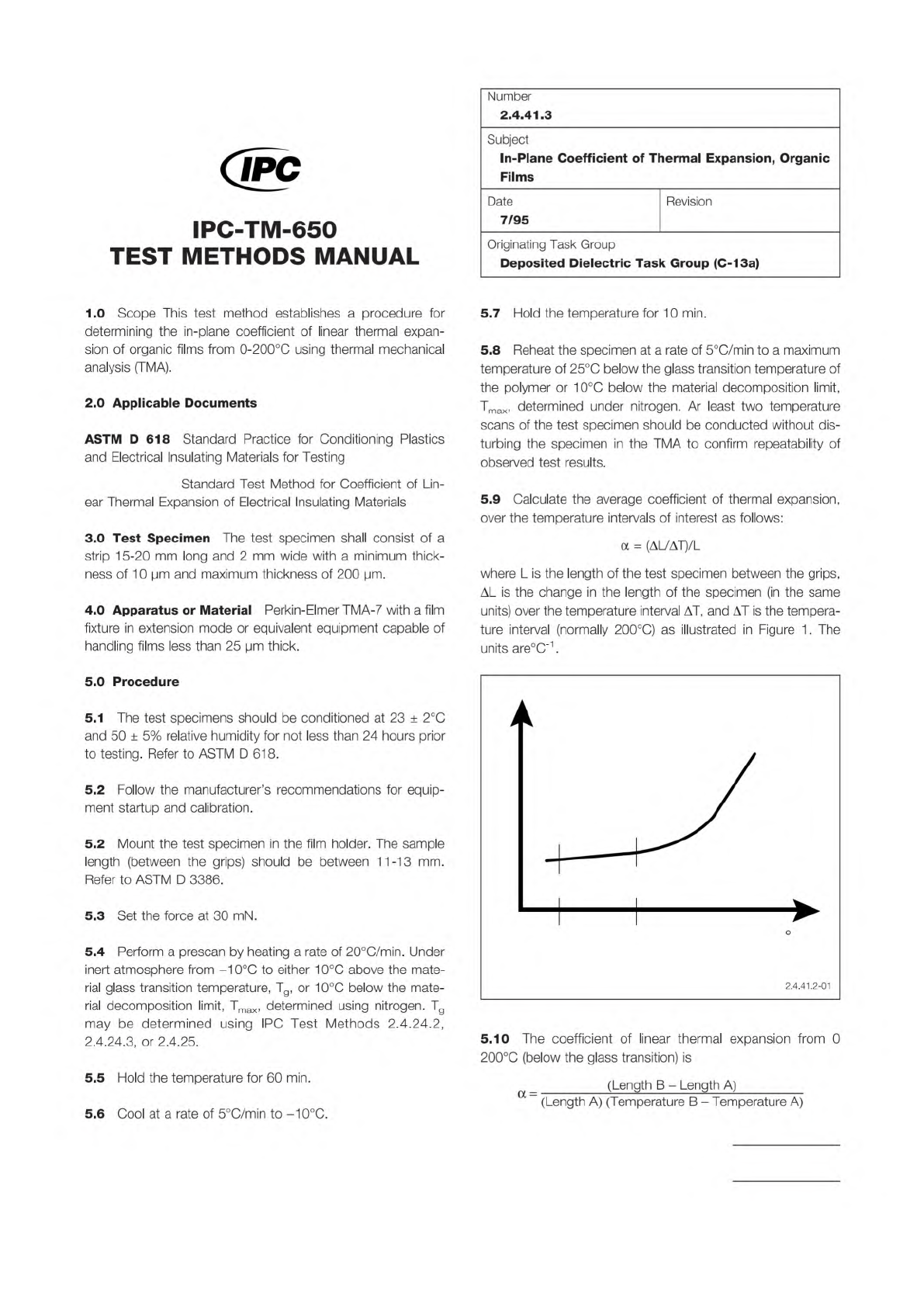
Figure 1
T
emperature (
C)
A
0
B
200
Extension
The Institute for Interconnecting and Packaging Electronic Circuits
2215 Sanders Road • Northbrook, IL 60062-6135
Material in this Test Methods Manual was voluntarily established by Technical Committees of the IPC. This material is advisory only
and its use or adaptation is entirely voluntary. IPC disclaims all liability of any kind as to the use, application, or adaptation of this
material. Users are also wholly responsible for protecting themselves against all claims or liabilities for patent infringement.
Equipment referenced is for the convenience of the user and does not imply endorsement by the IPC.
Page 1 of 2
IPC-TM-650
TEST
METHODS
MANUAL
1
.0
Scope
This
test
method
establishes
a
procedure
for
determining
the
in-plane
coefficient
of
linear
thermal
expan¬
sion
of
organic
films
from
0-200℃
using
thermal
mechanical
analysis
(TMA).
2
.0
Applicable
Documents
ASTM
D
618
Standard
Practice
for
Conditioning
Plastics
and
Electrical
Insulating
Materials
for
Testing
Standard
Test
Method
for
Coefficient
of
Lin¬
ear
Thermal
Expansion
of
Electrical
Insulating
Materials
3
.0
Test
Specimen
The
test
specimen
shall
consist
of
a
strip
15-20
mm
long
and
2
mm
wide
with
a
minimum
thick¬
ness
of
1
0
pm
and
maximum
thickness
of
200
pm.
4
.0
Apparatus
or
Material
Perkin-Elmer
TMA-7
with
a
film
fixture
in
extension
mode
or
equivalent
equipment
capable
of
handling
films
less
than
25
pm
thick.
5
.0
Procedure
5.1
The
test
specimens
should
be
conditioned
at
23
土
2
℃
and
50
±
5%
relative
humidity
for
not
less
than
24
hours
prior
to
testing.
Refer
to
ASTM
D
618.
5.2
Follow
the
manufacturer's
recommendations
for
equip¬
ment
startup
and
calibration.
5.2
Mount
the
test
specimen
in
the
film
holder.
The
sample
length
(between
the
grips)
should
be
between
11-13
mm.
Refer
to
ASTM
D
3386.
5.3
Set
the
force
at
30
mN.
5.4
Perform
a
prescan
by
heating
a
rate
of
20℃/min.
Under
inert
atmosphere
from
-10℃
to
either
10℃
above
the
mate¬
rial
glass
transition
temperature,
Tg,
or
10℃
below
the
mate¬
rial
decomposition
limit,
Tmax,
determined
using
nitrogen.
Tg
may
be
determined
using
IPC
Test
Methods
2.4.24.2,
2.4.24.3,
or
2.4.25.
5.5
Hold
the
temperature
for
60
min.
Number
2.4.41.3
Subject
In-Plane
Coefficient
of
Thermal
Expansion,
Organic
Films
Date
Revision
7/95
Originating
Task
Group
Deposited
Dielectric
Task
Group
(C-13a)
5.7
Hold
the
temperature
for
10
min.
5.8
Reheat
the
specimen
at
a
rate
of
5
℃/min
to
a
maximum
temperature
of
25℃
below
the
glass
transition
temperature
of
the
polymer
or
10℃
below
the
material
decomposition
limit,
Tmax,
determined
under
nitrogen.
Ar
least
two
temperature
scans
of
the
test
specimen
should
be
conducted
without
dis¬
turbing
the
specimen
in
the
TMA
to
confirm
repeatability
of
observed
test
results.
5.9
Calculate
the
average
coefficient
of
thermal
expansion,
over
the
temperature
intervals
of
interest
as
follows:
a
二
(AUAT)/L
where
L
is
the
length
of
the
test
specimen
between
the
grips,
AL
is
the
change
in
the
length
of
the
specimen
(in
the
same
units)
over
the
temperature
interval
AT,
and
AT
is
the
tempera¬
ture
interval
(normally
200℃)
as
illustrated
in
Figure
1.
The
units
are℃-1
.
5.10
The
coefficient
of
linear
thermal
expansion
from
0
200℃
(below
the
glass
transition)
is
(Length
B
-
Length
A)
-
(Length
A)
(Temperature
B
-
Temperature
A)
5.6
Cool
at
a
rate
of
5
℃/min
to
-10℃.