IPC-TM-650 EN 2022 试验方法--.pdf - 第751页
5.2 Tes t Procedures 5.2.1 Environmen tal T est Chamber Contro ls Tight con- trol of the test chamber t emperature and humidity is critical for this test method. A difference of 5% relative humi dit y can result in a 0.5…
4.6 Other Dedicated Fixtures
Hard-wiring is the default
connection method. Other dedicated fixtures may be used,
provided that the fixture does not change the resistance by
more than 0.1 decade compared to a comparable hard-wired
system when measured at the test conditions. These fixtures
should be checked for their resistance values frequently.
5 Procedure
5.1 Test Specimen Preparation
5.1.1 Sample Identification
Use a method for identifying
each test board that does not cause contamination, such as
a scribe, making marks away from the biased area(s) of the
specimen. Test boards
be handled by the edges of the
board only, and the use of noncontaminating gloves is recom-
mended. Each board
be clearly marked to identify the
simulated assembly reflow and reword processing, and other
differentiating parameters, completed prior to CAF resistance
testing.
5.1.2 Prescreen fo r Opens and Shorts
Perform
as-received insulation resistance measurements using a mul-
timeter to make connection to each net, and check for gross
defects. Check for shorts at a 1.0 megohm setting. No opens
are allowed in connected nets.
5.1.3 Simulated Assembly & Rework
CAF test samples
go through representative assembly and rework thermal
cycling for the application. Default lead-free simulated assem-
bly and rework is 6X at 260 °C. Default simulated eutectic tin-
lead assembly and rework is 6X at 230 °C. For reference see
IPC-TM-650, 2.6.27 (method for assembly simulation).
5.1.4 Cleaning
Entirely clean each sample (CAF test
board) per IPC-TM-650, Method 2.3.25, Detection and Mea-
surement of Ionizable Surface Contaminants by Resistivity of
Solvent Extract by immersion washing until the level of ionic
contamination is reduced to less than 1.0 microgram NaCl
equivalent per square centimeter and for a maximum of 20
minutes. Boards not achieving this level of cleanliness within
20 minutes
be scrapped for the purposes of this test.
See IPC-TM-650, Method 2.6.27, Thermal Stress, Convection
Reflow Assembly Simulation.
5.1.5 Connecting Wire
Plated through holes near one
edge of the board may be used for connecting wire to each
test circuit. The test board
be covered with noncontami-
nating film to prevent flux spattering during the wire attach
process. After stripping back the wire insulation, use water
white rosin (per J-STD-004, Type B) and best soldering tech-
nique (per J-STD-001, Class 1 or 2) to solder (per J-STD-006,
Type Sn63) PTFE- or PFE-insulated wires to the connection
points on each test board. Ensure against damaging PWB
laminate material adjacent to the plated holes during soldering
by using appropriate time/temperature parameters for the sol-
dering iron.
5.1.6 Cleaning After Attachment
Perform appropriate
local cleaning and rinsing after the attachment of the connect-
ing wires. Isolation resistance between connecting wire
attachment sites should remain excellent through 96 hours
conditioning. Note: Each CAF test failure that does occur dur-
ing subsequent testing should be checked to determine
whether the connecting wire attach area is the low resistance
site. If the connecting wire attach area rather than the daisy
chain area is the low insulation resistance site, then that test
sample is no longer valid for data analysis.
5.1.7 Dry
Bake sample boards for a minimum of 30 min-
utes in a clean oven at 105 ± 2 °C [221.0 ± 3.6 °F].
5.1.8 Precondition
Precondition test board samples in a
bias-free state (no electrical potential applied to any test pat-
tern) for 30 minutes minimum at 23 ± 2 °C [73.4 ± 3.6 °F] and
50 ± 5% relative humidity prior to any initial insulation resis-
tance measurements [measuring insulation resistance of each
daisy-chain net on each test board before starting the first 96
hours (± 30 minutes) of bias-free temperature and humidity
conditioning].
5.1.9 Temperature/Humidity/Bias ( T/H/B ) Chamber
Place the specimens in the environmental test chamber in a
vertical position such that the air flow is parallel to the direc-
tion of all test boards in the chamber. Allow at least approxi-
mately 2.5 cm [nominally 1.0 in] between each test board.
Place the test boards, as much as possible, toward the cen-
ter of the chamber to help ensure against nonoptimum air flow
and/or drops of condensation falling onto the test boards.
Dress all wiring away from the test patterns, keeping the wires
away from the test patterns as they are routed to the outside
of the chamber. Also, wire should not impede airflow around
the samples. Set the chamber temperature and humidity with
a ramp rate of one hour.
Number
2.6.25
Subject
Conductive Anodic Filament (CAF) Resistance Test: X-Y Axis
Date
02/21
Revision
C
IPC-TM-650
shall
shall
shall
shall
Page
6
of
11
5.2 Test Procedures
5.2.1 Environmental Test Chamber Controls
Tight con-
trol of the test chamber temperature and humidity is critical for
this test method. A difference of 5% relative humidity can
result in a 0.5 to 1.0 decade difference in measured resis-
tance. If condensation occurs on the test specimens within
the environmental chamber while the samples are under volt-
age, other dendritic growth can occur. Water spotting may
also be observed in some ovens where the air flow in the
chamber is from back to front, when water condensation on a
cooler oven window can be blown around the oven as very
small droplets that deposit on test specimens. This contrib-
utes to dendritic growth.
5.2.1.1 Test Interrupt
In the event that the environmental
test chamber deviates from the controlled environment, a
drop in relative humidity may be permitted for short periods
not to exceed 15 minutes, provided that the chamber air tem-
perature does not exceed board temperature by more than
5 °C. Boards or coupons being added to a chamber
be
pre-heated to the temperature of the chamber.
5.2.2 Resistance Measurements
Measure the insulation
resistance of each test board daisy-chain net using 50 VDC
per second rate of rise and minimum hold time of 60 seconds
at 100 VDC test voltage. The polarity of the bias (conditioning)
voltage and the polarity of the test (measurement) voltage
always be the same. 100 VDC applied voltage is used
as the test voltage for insulation resistance measurements.
5.2.3
After initial insulation resistance measurements are
taken, close the environmental test chamber and allow the
test boards to stabilize for 96 hours (± 30 minutes) at the
specified 65 ± 2 °C [149 ± 3.6 °F] or 85 ± 2 °C [185 ± 3.6 °F]
with 87 +3/-2% relative humidity and no bias applied. After the
96 hour (± 30 minutes) stabilization period, insulation resis-
tance measurements
be made between each daisy-
chain net and ground.
5.2.4
Ensure that all test board samples are connected and
that the appropriate current limiting resistor is in series with
each corresponding test circuit. Then, connect the test
boards to the power supply to begin the T/H/B portion of the
CAF testing.
5.2.5
Verify that the appropriate voltage bias is being
applied for the duration of the test. For comparing the CAF
resistance of different laminate materials and processes, the
10 VDC and 100 VDC bias are standards. For correlating test
results to expected life in the field, the bias voltage selected
should be two times the maximum operating voltage differen-
tial for a given application. Higher voltage almost linearly
affects time to failure, however higher voltage may offset the
impact of humidity due to localized heating and should be
avoided since humidity is a key part of the failure mechanism.
5.2.6
The bias polarity should always be the same as the
polarity used when measuring the insulation resistance after
the 96-hour stabilization period.
5.2.7
It is recommended that resistance monitoring mea-
surements be taken every 24 to 100 hours of bias (condition-
ing) voltage during the duration of the test, ensuring that the
polarity of the insulation measurement voltage and the bias
voltage are always the same. Decade drops in resistance,
observed when these intermediate measurements are taken,
also count as failures and improve the accuracy of the test
since CAF filaments are very thin and are easily destroyed.
Also when over 50% of the parts have failed, the test can be
stopped. As CAF forms, the voltage delivered across the CAF
failure site will drop as the resistance decreases. This
becomes significant as the resistance of the net approaches
the resistance of the current-limiting resistor, so adjustments
to the voltage during the test are not required.
5.2.8
After 500 hours of applied bias (596 hours total), per-
form the insulation resistance measurements, as before.
5.2.9
Additional temperature/humidity/bias conditioning may
be performed after 500 hours of bias, sometimes up to 1000
hours or more. However, the 500 hours bias testing results
provide a minimum standard for reporting CAF testing
results when using this procedure.
5.2.10
Suspect CAF test failures may be checked to deter-
mine whether the connecting wire attach area is the low resis-
tance site rather than the daisy-chain area. This requires
cutting the trace near the daisy chain (destructive). After all
testing is completed, if the connecting wire attach area rather
than the daisy chain area is then found to be the low insula-
tion resistance site, then that test sample is no longer valid for
data analysis.
Number
2.6.25
Subject
Conductive Anodic Filament (CAF) Resistance Test: X-Y Axis
Date
02/21
Revision
C
IPC-TM-650
shall
shall
shall
shall
Page
7
of
11
5.3 Data Handling and Analysis
5.3.1
Lognormal plots are recommended for plotting per-
cent of samples above an insulation resistance value, versus
insulation resistance. Use the log value of the insulation resis-
tance.
5.3.2
If lognormal plots are not used, a test circuit failure
be determined by more than a decade drop in insulation
resistance as a result of the applied bias. The baseline for the
decade drop
be the average insulation resistance at 96
hours for each coupon (A-1, A-2, etc.).
5.3.3
Test board nets with less than 10 megohms insulation
resistance (high resistance short) after the 96-hour stabiliza-
tion
be excluded, since these failures are due to poor
PTH hole quality or laminate capability.
5.3.4
The insulation resistance baseline (before bias condi-
tioning) value for a given daisy-chain net (same design spac-
ing)
be the average resistance of those un-shorted
daisy-chain nets on all test boards in the valid sample group
as measured after the 96-hours stabilization period.
5.3.5
The percent failure rate for a given sample group and
subsequent test condition is the percent of test boards that
show more than a decade drop in resistance compared with
the baseline value for daisy-chain nets with the same design
spacing.
5.3.6
For a given sample lot, there may be binomial failure
distributions where assignable causes exist along with differ-
ent levels of capability.
5.4 Visual Examination
After completion of the test, the
test boards
be removed from the environmental cham-
ber and examined at 10X magnification for evidence of sur-
face insulation resistance failure (i.e., discoloration, corrosion),
handling or processing defects other than CAF.
5.4.1 Assignable Cause
Where an assignable cause of
low insulation resistance can be properly attributed to a han-
dling or processing defect other than CAF (i.e., contamination
on the insulating surface of the board, scratches, cracks, or
other obvious damage affecting the insulation resistance
between the conductors), then such a value should be
excluded.
5.4.2 CAF Microsections
Since CAF filaments form along
the interface between resin and the woven reinforcement,
these filaments can be very small and easily disrupted by a
relatively low current flow or other causes. Microsectioning to
observe CAF filaments can be a tedious process with a low
success rate.
5.5 Reporting Results
5.5.1
The percent failure rate at 500 hours for each spacing
in sections A and B are the results of interest. Generally PWB
processing has the greatest impact on reduced CAF resis-
tance at smaller plated-through hole-to-plated-through hole
(PTH-PTH) spacings, while the laminate material has the
greatest impact at larger PTH-PTH spacings. However, the
laminate material used can also affect the extent of fracturing
and copper wicking near a PTH.
5.5.2
There are several additional factors that can affect
CAF resistance. See APPENDIX A for the list of PCB manu-
facturing parameters that may affect CAF resistance and that
should be documented.
6 Notes
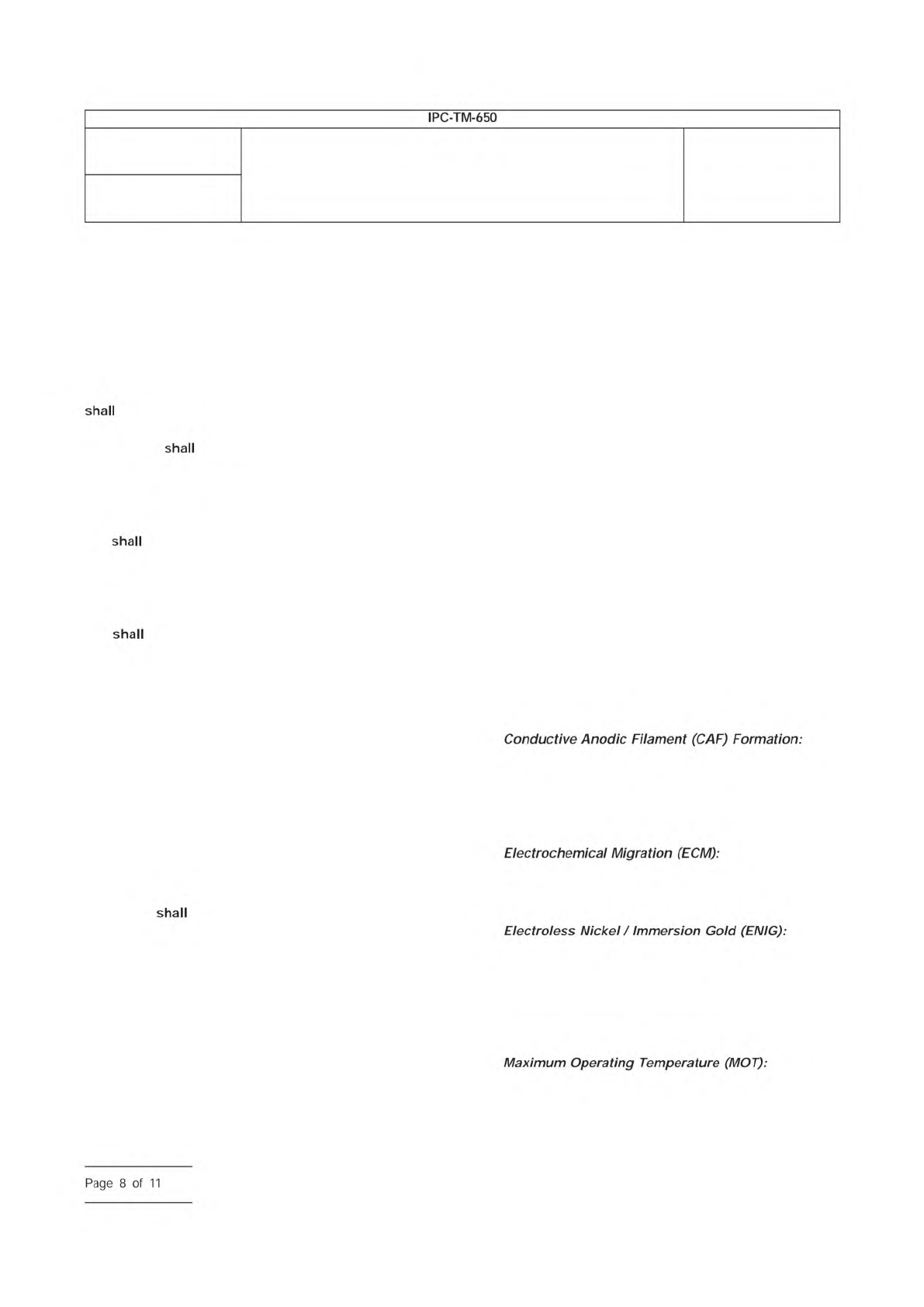
6.1 Definitions [Only those terms not already included in IPC-
T-50.]
a)
The growth of metallic conductive salt filaments by means
of an electrochemical migration process involving the
transport of conductive chemistries across a nonmetallic
substrate under the influence of an applied electric field,
thus producing Conductive Anodic Filaments.
b)
The growth of conductive metal filaments across or
through a dielectric material in the presence of moisture
and under the influence of voltage bias.
c)
This is a multi-functional surface finish wherein the electro-
less nickel layer is capped with a thin layer of immersion
gold. It is applicable to soldering, aluminum wire bonding,
press fit connections and as a contact surface. The
immersion gold protects the underlying nickel from
oxidation/passivation over its intended life.
d)
An underwriters Laboratories Inc. (UL) requirement value
of laminate materials as determined by the results of tests
performed by UL.
Number
2.6.25
Subject
Conductive Anodic Filament (CAF) Resistance Test: X-Y Axis
Date
02/21
Revision
C
IPC-TM-650
shall
shall
shall
shall
Conductive
Anodic
Filament
(CAF)
Formation:
Electrochemical
Migration
(ECM):
shall
Electroless
Nickel
/
Immersion
Gold
(ENIG):
Maximum
Operating
Temperature
(MOT):
Page
8
of
11