IPC-TM-650 EN 2022 试验方法--.pdf - 第187页
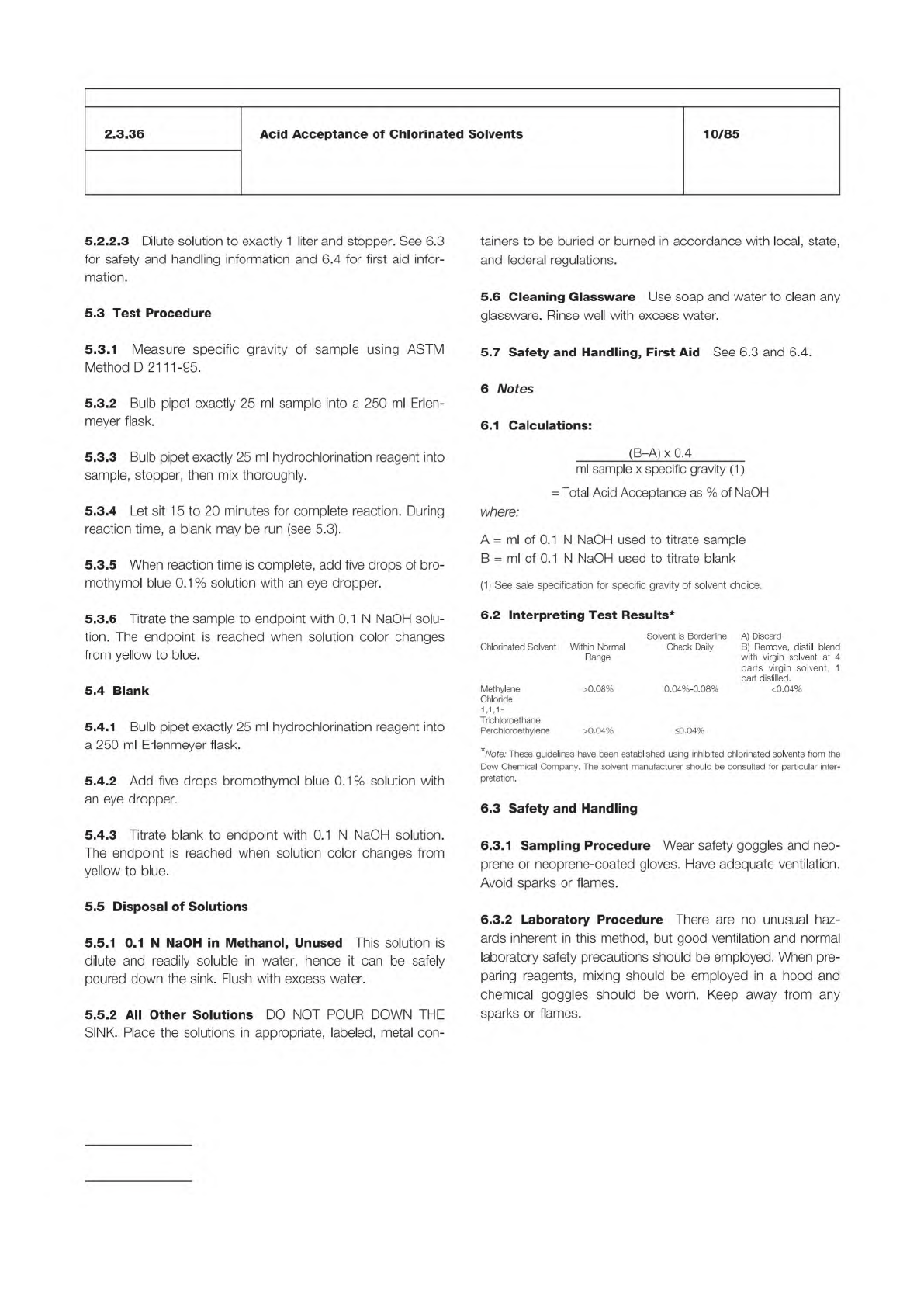
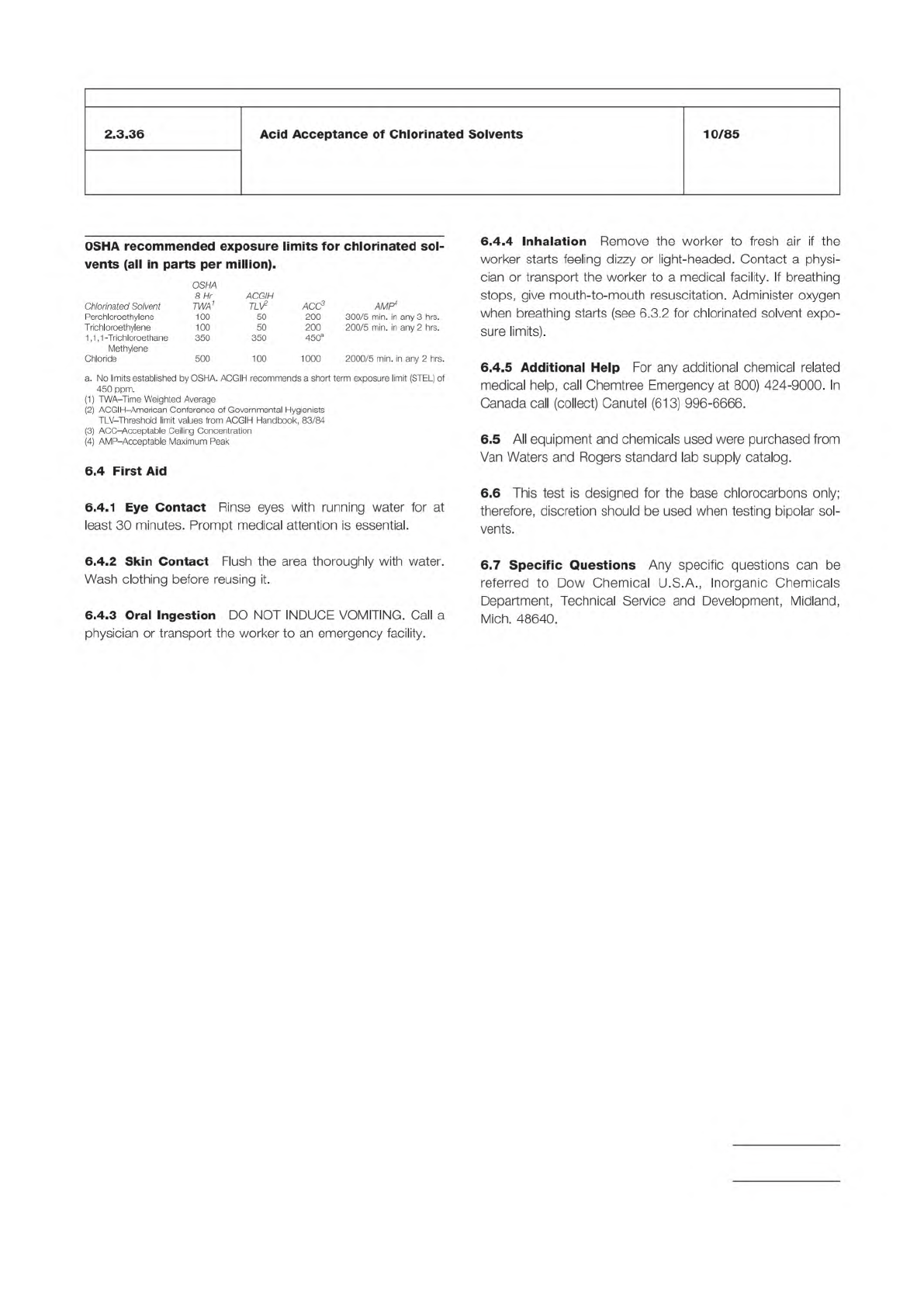
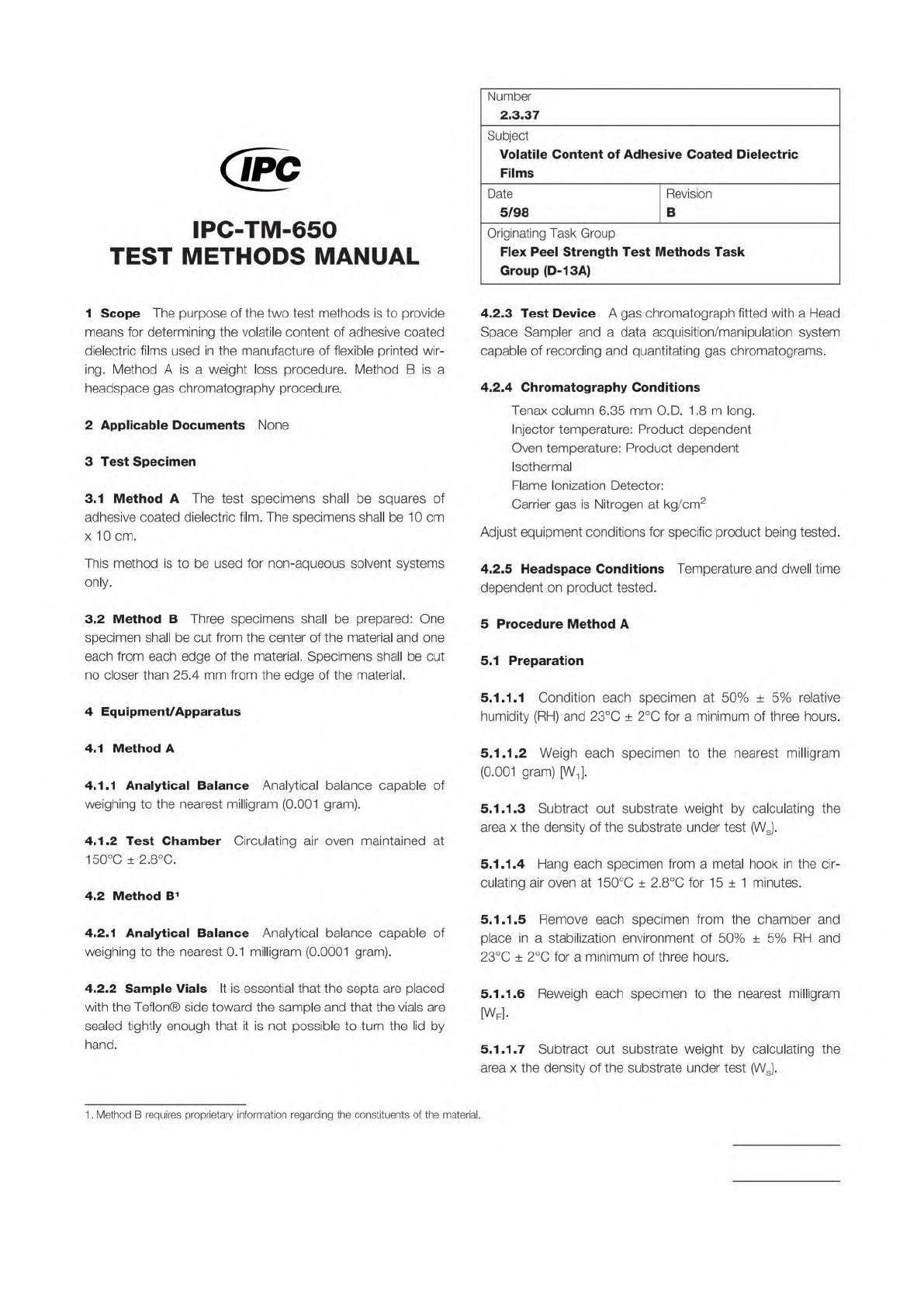
IPC-TM-650 Number Subject Date Revision Page 3 of 3 2.3.36 Acid Acceptance of Chlorinated Solvents 10/85 OSHA recommended exposure limits for chlorinated sol vents (all in parts per million). OSHA 8 Hr ACGIH Chlorinated …
IPC-TM-650
Number
Subject Date
Revision
Page 2 of 3
2.3.36
Acid
Acceptance
of
Chlorinated
Solvents
10/85
5.2.2.3
Dilute
solution
to
exactly
1
liter
and
stopper.
See
6.3
for
safety
and
handling
information
and
6.4
for
first
aid
infor¬
mation.
5.3
Test
Procedure
5.3.1
Measure
specific
gravity
of
sample
using
ASTM
Method
D
2111-95.
5.3.2
Bulb
pipet
exactly
25
ml
sample
into
a
250
ml
Erlen-
meyer
flask.
5.3.3
Bulb
pipet
exactly
25
ml
hydrochlorination
reagent
into
sample,
stopper,
then
mix
thoroughly.
5.3.4
Let
sit
15
to
20
minutes
for
complete
reaction.
During
reaction
time,
a
blank
may
be
run
(see
5.3).
5.3.5
When
reaction
time
is
complete,
add
five
drops
of
bro¬
mothymol
blue
0.1
%
solution
with
an
eye
dropper.
5.3.6
Titrate
the
sample
to
endpoint
with
0.1
N
NaOH
solu¬
tion.
The
endpoint
is
reached
when
solution
color
changes
from
yellow
to
blue.
5.4
Blank
5.4.1
Bulb
pipet
exactly
25
ml
hydrochlorination
reagent
into
a
250
ml
Erlenmeyer
flask.
5.4.2
Add
five
drops
bromothymol
blue
0.1
%
solution
with
an
eye
dropper.
5.4.3
Titrate
blank
to
endpoint
with
0.1
N
NaOH
solution.
The
endpoint
is
reached
when
solution
color
changes
from
yellow
to
blue.
5.5
Disposal
of
Solutions
5.5.1
0.1
N
NaOH
in
Methanol,
Unused
This
solution
is
dilute
and
readily
soluble
in
water,
hence
it
can
be
safely
poured
down
the
sink.
Flush
with
excess
water.
5.5.2
All
Other
Solutions
DO
NOT
POUR
DOWN
THE
SINK.
Place
the
solutions
in
appropriate,
labeled,
metal
con¬
tainers
to
be
buried
or
burned
in
accordance
with
local,
state,
and
federal
regulations.
5.6
Cleaning
Glassware
Use
soap
and
water
to
clean
any
glassware.
Rinse
well
with
excess
water.
5«7
Safety
and
Handling,
First
Aid
See
6.3
and
6.4.
6
Notes
6.1
Calculations:
(B-A)
x
0.4
ml
sample
x
specific
gravity
(1)
=
Total
Acid
Acceptance
as
%
of
NaOH
where:
A
=
ml
of
0.1
N
NaOH
used
to
titrate
sample
B
=
ml
of
0.1
N
NaOH
used
to
titrate
blank
(1)
See
sale
specification
for
specific
gravity
of
solvent
choice.
6.2
Interpreting
Test
Results*
*
Note:
These
guidelines
have
been
established
using
inhibited
chlorinated
solvents
from
the
Dow
Chemical
Company.
The
solvent
manufacturer
should
be
consulted
for
particular
inter¬
pretation.
Solvent
is
Borderline
A)
Discard
Chlorinated
Solvent
Within
Normal
Check
Daily
B)
Remove,
distill
blend
Range
Methylene
>0.08%
Chloride
1,1,1-
Trichloroethane
Perchloroethylene
>0.04%
0.04%-0.08%
©04%
with
virgin
solvent
at
4
parts
virgin
solvent,
1
part
distilled.
<0.04%
6.3
Safety
and
Handling
6.3.1
Sampling
Procedure
Wear
safety
goggles
and
neo¬
prene
or
neoprene-coated
gloves.
Have
adequate
ventilation.
Avoid
sparks
or
flames.
6.3.2
Laboratory
Procedure
There
are
no
unusual
haz¬
ards
inherent
in
this
method,
but
good
ventilation
and
normal
laboratory
safety
precautions
should
be
employed.
When
pre¬
paring
reagents,
mixing
should
be
employed
in
a
hood
and
chemical
goggles
should
be
worn.
Keep
away
from
any
sparks
or
flames.
IPC-TM-650
Number
Subject Date
Revision
Page 3 of 3
2.3.36
Acid
Acceptance
of
Chlorinated
Solvents
10/85
OSHA
recommended
exposure
limits
for
chlorinated
sol
vents
(all
in
parts
per
million).
OSHA
8
Hr
ACGIH
Chlorinated
Solvent
TWA1
TLV2
ACC3
AMP4
Perchloroethylene
100
50
200
300/5
min.
in
any
3
hrs.
Trichloroethylene
100
50
200
200/5
min.
in
any
2
hrs.
1,1,1
-Trichloroethane
350 350
450a
Methylene
Chloride
500
100
1000
2000/5
min.
in
any
2
hrs.
a.
No
limits
established
by
OSHA.
ACGIH
recommends
a
short
term
exposure
limit
(STEL)
of
450
ppm.
TWA-Time
Weighted
Average
ACGIH-American
Conference
of
Governmental
Hygienists
TLV-Threshold
limit
values
from
ACGIH
Handbook,
83/84
(3)
ACC-Acceptable
Ceiling
Concentration
AMP-Acceptable
Maximum
Peak
6.4
First
Aid
6.4.1
Eye
Contact
Rinse
eyes
with
running
water
for
at
least
30
minutes.
Prompt
medical
attention
is
essential.
6.4.2
Skin
Contact
Flush
the
area
thoroughly
with
water.
Wash
clothing
before
reusing
it.
6.4.3
Oral
Ingestion
DO
NOT
INDUCE
VOMITING.
Call
a
physician
or
transport
the
worker
to
an
emergency
facility.
6.4.4
Inhalation
Remove
the
worker
to
fresh
air
if
the
worker
starts
feeling
dizzy
or
light-headed.
Contact
a
physi¬
cian
or
transport
the
worker
to
a
medical
facility.
If
breathing
stops,
give
mouth-to-mouth
resuscitation.
Administer
oxygen
when
breathing
starts
(see
6.3.2
for
chlorinated
solvent
expo¬
sure
limits).
6.4.5
Additional
Help
For
any
additional
chemical
related
medical
help,
call
Chemtree
Emergency
at
800)
424-9000.
In
Canada
call
(collect)
Canutel
(613)
996-6666.
6.5
All
equipment
and
chemicals
used
were
purchased
from
Van
Waters
and
Rogers
standard
lab
supply
catalog.
6.6
This
test
is
designed
for
the
base
chlorocarbons
only;
therefore,
discretion
should
be
used
when
testing
bipolar
sol¬
vents.
6.7
Specific
Questions
Any
specific
questions
can
be
referred
to
Dow
Chemical
U.S.A.,
Inorganic
Chemicals
Department,
Technical
Service
and
Development,
Midland,
Mich.
48640.
The Institute for Interconnecting and Packaging Electronic Circuits
2215 Sanders Road • Northbrook, IL 60062-6135
Material in this Test Methods Manual was voluntarily established by Technical Committees of the IPC. This material is advisory only
and its use or adaptation is entirely voluntary. IPC disclaims all liability of any kind as to the use, application, or adaptation of this
material. Users are also wholly responsible for protecting themselves against all claims or liabilities for patent infringement.
Equipment referenced is for the convenience of the user and does not imply endorsement by the IPC.
Page 1 of 3
IPC-TM-650
TEST
METHODS
MANUAL
1
Scope
The
purpose
of
the
two
test
methods
is
to
provide
means
for
determining
the
volatile
content
of
adhesive
coated
dielectric
films
used
in
the
manufacture
of
flexible
printed
wir¬
ing.
Method
A
is
a
weight
loss
procedure.
Method
B
is
a
headspace
gas
chromatography
procedure.
2
Applicable
Documents
None
3
Test
Specimen
3.1
Method
A
The
test
specimens
shall
be
squares
of
adhesive
coated
dielectric
film.
The
specimens
shall
be
1
0
cm
x
10
cm.
This
method
is
to
be
used
for
non-aqueous
solvent
systems
only.
3.2
Method
B
Three
specimens
shall
be
prepared:
One
specimen
shall
be
cut
from
the
center
of
the
material
and
one
each
from
each
edge
of
the
material.
Specimens
shall
be
cut
no
closer
than
25.4
mm
from
the
edge
of
the
material.
4
Equipment/Apparatus
4.1
Method
A
4.1.1
Analytical
Balance
Analytical
balance
capable
of
weighing
to
the
nearest
milligram
(0.001
gram).
4.1.2
Test
Chamber
Circulating
air
oven
maintained
at
150℃
±
2.8℃.
4.2
Method
B1
4.2.1
Analytical
Balance
Analytical
balance
capable
of
weighing
to
the
nearest
0.1
milligram
(0.0001
gram).
4.2.2
Sample
Vials
It
is
essential
that
the
septa
are
placed
with
the
Teflon®
side
toward
the
sample
and
that
the
vials
are
sealed
tightly
enough
that
it
is
not
possible
to
turn
the
lid
by
hand.
Number
2.3.37
Subject
Volatile
Content
of
Adhesive
Coated
Dielectric
Films
Date
Revision
5/98
B
Originating
Task
Group
Flex
Peel
Strength
Test
Methods
Task
Group
(D-13A)
4.2.3
Test
Device
A
gas
chromatograph
fitted
with
a
Head
Space
Sampler
and
a
data
acquisition/manipulation
system
capable
of
recording
and
quantitating
gas
chromatograms.
4.2.4
Chromatography
Conditions
Tenax
column
6.35
mm
O.D.
1
.8
m
long.
Injector
temperature:
Product
dependent
Oven
temperature:
Product
dependent
Isothermal
Flame
Ionization
Detector:
Carrier
gas
is
Nitrogen
at
kg/cm2
Adjust
equipment
conditions
for
specific
product
being
tested.
4.2.5
Headspace
Conditions
Temperature
and
dwell
time
dependent
on
product
tested.
5
Procedure
Method
A
5.1
Preparation
5.1.
1.1
Condition
each
specimen
at
50%
±
5%
relative
humidity
(RH)
and
23℃
士
2
℃
for
a
minimum
of
three
hours.
5.
1.1.2
Weigh
each
specimen
to
the
nearest
milligram
(0.001
gram)
[WJ
5.1.
1.3
Subtract
out
substrate
weight
by
calculating
the
area
x
the
density
of
the
substrate
under
test
(Ws).
5.1.
1.4
Hang
each
specimen
from
a
metal
hook
in
the
cir¬
culating
air
oven
at
150℃
±
2.8℃
for
15
±
1
minutes.
5.1.
1.5
Remove
each
specimen
from
the
chamber
and
place
in
a
stabilization
environment
of
50%
土
5%
RH
and
23℃
±
2
℃
for
a
minimum
of
three
hours.
5.1.
1.6
Reweigh
each
specimen
to
the
nearest
milligram
[WF].
5.1.
1.7
Subtract
out
substrate
weight
by
calculating
the
area
x
the
density
of
the
substrate
under
test
(Ws).
1
.
Method
B
requires
proprietary
information
regarding
the
constituents
of
the
material.