IPC-TM-650 EN 2022 试验方法--.pdf - 第419页
The t ransfer st andard have precision coax connec tors that match the test cables and probes. T he uncertainty in the nominal characteristic impedance of the transfer standards be less than or equal to ± 0.015 Z ref , w…
IPC-TM-650
Number Subject Date
Revision
Page 6 of 7
2.4.54
TestMethodforThermalTransmissionPropertiesof
09/2022
MetalBasedPrintedBoards(MBPB)
N/A
Equation 14). With the thickness from the microsection it is possible
to calculate the apparent thermal conductivity of the dielectric
layer (Table 1 Equation 16). This calculated value must be shown
in the measurement report including the dimensions (mm²K/W)
(Table 1 Equation 15) as well as the apparent thermal conductivity
in W/(mK) (Table 1 Equation 16) and the thicknesses in µm.
5.10
Measure three identical samples across the board and list
all results in the measurement report. In addition, the mean value
and the standard deviation must be listed as well in the report.
5.11
To measure the DIE thickness a cross section according to
IPC-TM-650 Test Method 2.1.1 should to be made.
5.12
To embed the sample, the specimen is first cut in half using
a e.g., metal saw. Afterwards the specimen gets embedded,
grinded and polished.
5.13
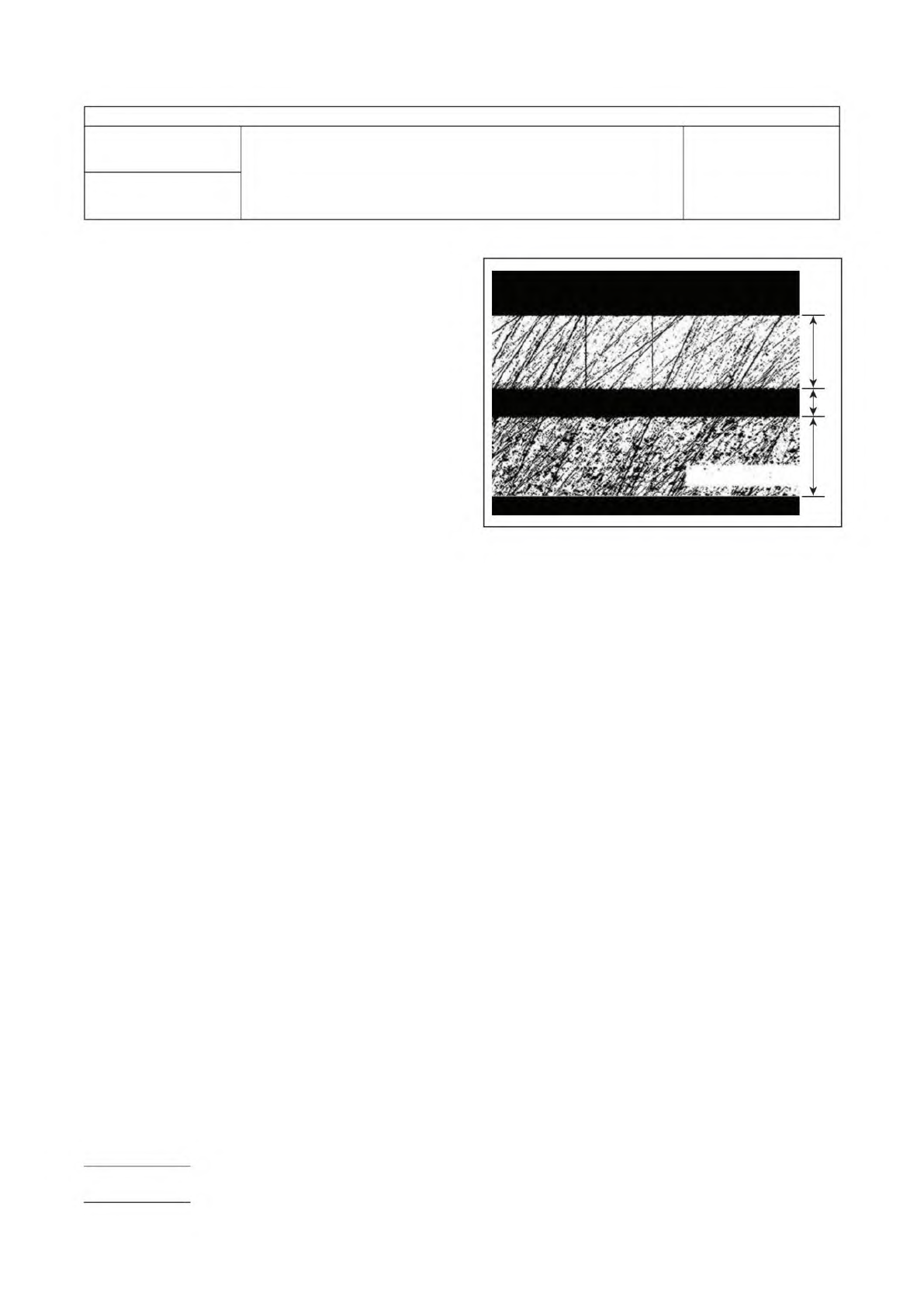
The thicknesses of the top and dielectric layer are measured
in the microsection on five different points using a microscope.
Calculate the middle value of the five measured values for each
layer. From the total thickness of the sample, the thickness of
the base layer can be determined by subtraction (see Table 1
Equation 17).
1
2
3
Figure5LayerStructureofaMetal-BasedBoard
Note1: Top layer: d
top,
see 1.3.1
Note2: Dielectric layer: d
die
Note3: Base layer: d
base

The transfer standard have precision coax connectors
that match the test cables and probes. The uncertainty in the
nominal characteristic impedance of the transfer standards
be less than or equal to ± 0.015 Z
ref
, where Z
ref
is the
characteristic impedance of the transfer standard (nominally
50 Ω.)
4.3.7 Check Standards
The method makes use of two
precision coaxial air lines of two different lengths to verify the
operation of a test set-up (see 5.2.1.2). The air lines are pre-
cision coaxial lines where the center conductors are held in
place with an isolation bead or the center pins of the end
connectors, and are not filled with any other dielectric mate-
rial. The coaxial air lines serve as a precise delay standard that
can be measured during field checks (see 5.2.1.2) to verify the
measurement set-up. The coaxial air line standards are avail-
able commercially with any of the precision coaxial connec-
tors. Probe contact to coaxial transitions must be fabricated
to use with a given probe tip configuration.
5 Procedures
In TDR, the observed voltage waveform is
the sum of incident and reflected signals. The reflections are
related to the difference between the characteristic imped-
ance Z
0
of a transmission line and any impedance discontinui-
ties along the transmission line or at its end.
The method procedures establish the means of determining a
time delay per unit length t
d
from TDR measurements of two
transmission lines that differ in length. The transmission lines
are the interconnect test structures fabricated in PB materials
as specified. The far end of the transmission line is either
electrically open- or short-circuited in order to create a clearly
observable reflection feature in the measured TDR waveform.
The procedures in this section establish the propagation delay
per unit length as the differential propagation time obtained
using the TDR measurements of two interconnect test lines
divided by the length of the same interconnects:
t
d
= t
p
/ 2L
p
Here, t
p
is the measured propagation time difference given by
t
p
=
?
t
T1
− t
T2
?
,
where t
T1
is the round-trip propagation time for the first trans-
mission line and t
T2
is the round-trip propagation time of the
second transmission line.
L
p
is the propagation length difference of the transmission line
pair given by
L
p
=
?
L
T1
− L
T2
?
,
where L
T1
is the length of the first transmission line and L
T2
is
the length of the second transmission line.
5.1 Measurement Preliminaries
This section provides
common considerations for the calibration and initial configu-
ration of the TDR measurement system, and the method to
establish the waveform epoch (time window) used in the delay
measurements (see 5.2 and 5.3).
5.1.1 System Calibrations
5.1.1.1 Manufacturer Calibrations
The TDR oscilloscope
or other TDR equipment used
be calibrated and ser-
viced following the recommended schedule of the instrument
manufacturers.
5.1.1.2 Field Calibrations
Manufacturer ecommended
field calibrations
be performed in addition to scheduled
factory calibrations. TDR system field calibrations
be
performed at the frequency recommended by the instrument
manufacturers and after a change of any system component,
such as a sampler of TDR source unit. The user must ensure
adequate system warm-up time before performing field cali-
brations, as specified by the instrument manufacturers.
Users-accessible field calibrations for TDR oscilloscopes may
include the application of an internal voltage calibration for
each sampler and TDR source. Though not required for this
method, TDR field calibrations may also include a reflection
coefficient or impedance normalization/calibration procedure
where standards are connected to the instrument’s test port
following a menu-driven procedure. Field calibrations are
required for the following reasons:
a. TDR instrument specifications vary with temperature
b. TDR instrument specifications vary with time (drift)
c. TDR instrument specifications vary due to minor ESD dam-
age
d. TDR instrument factory calibration usually does not include
user supplied auxiliary components (i.e., cables, probes,
etc.)
Number
2.5.5.11
Subject
Propagation Delay of Lines on Printed Boards by TDR
Date
04/2009
Revision
IPC-TM-650
shall
shall
shall
shall
Page
8
of
16

5.1.2 Pre-Measurement Checks
5.1.2.1 Instrument Warm-Up and Stability
Before per-
forming delay measurements, the user
ensure adequate
instrument warm-up time as specified by the instrument
manufacturers, and ensure that the TDR waveform is not drift-
ing in amplitude or time.
5.1.2.2 Environmental Conditions
The user ensure
that the temperature and humidity of the test environment is
within TDR instrument specifications and that the conditions
will be stable for the duration of the measurements. If the test
environment is substantially different than that used for speci-
men conditioning (see 3.3), the user document this in
the test reports.
5.1.2.3 Test Structure Isolation
The user ensure
that the signal line and reference planes of the test structures
are located an adequate distance from objects and surfaces
(such as the work surface of a test bench) that could electri-
cally couple or interact with the test structure and probes. If
surface layer microstrip lines are used, the recommendation is
to keep extraneous objects and surfaces at least 6 w from the
test coupon or PB, were w is the width of the signal line. If the
tests are being conducted with hand probes, care must be
taken to ensure that the hands and arms of the operator do
not come in close proximity to the coupon or PB being tested.
Any fixtures used to ensure electrical isolation of the test fix-
tures must also be sufficiently strong to accommodate the
probing force required for repeatable electrical connections.
5.1.3 Suitable Waveform Epochs
The waveform epoch is
the measurement interval over which the propagation time for
a given discontinuity will be computed. The time epoch may
be described in terms of the TDR instrument parameters delay
and time per division. The user
ensure that the instru-
ment settings can be adjusted so the waveform epochs can
contain the arrival of the far end reflection signals of both the
shorter line and the longer line in the test structure; the user
must ensure an epoch includes the reflection signal and suffi-
cient pre- and post-waveform data to establish the required
reference amplitude levels; and the user
ensure that the
delay and time/div settings can re-adjusted to repeat the
desired epochs. This requires probing both test structures
using the TDR measurement set-up (similar to that depicted in
Figure 5-1). As shown in Figure 5-1, the user may first find the
arrival point of the reflection signal for the open-circuit probe
to help locate the subsequent reflection signal of the intercon-
nection test structure.
5.1.4 Suitable Amplitude Resolution
In order to com-
pute propagation delay, this method requires the recording of
the instants when the TDR waveform crosses a specified volt-
age reference level. The reference level, V
REF
, is given gener-
ally by:
V
REF
= xV
refl
+ V
off,refl
where V
refi
is the amplitude of the reflected pulse (measured
when it is superimposed on an incident step pulse), x is the
fraction of V
refl
used to determine the transition instant (for
example, x = 0.5 corresponds to the 50% reflection amplitude
value), and V
off, refl
is the amplitude of an incident TDR step
pulse.
This method specifies two possible values for x:
x
5%
= 0.05
x
50%
= 0.50
The method also allows the user to specify their own x as long
as the same value of x is used in all delay measurements and
verification field tests. The user must document which value of
x is used in the test reports.
The user
ensure that the TDR equipment amplitude set-
tings can be adjusted to capture the reference level V
REF
with
sufficient resolution to minimize errors in recording time of the
crossing instant.
5.2 Propagation Delay TDR Measurement Procedures
This section contains the methods for measuring the propa-
gation delay of single-ended transmission lines. The following
steps should be used when the interconnect test structures
under test are unbalanced (single-ended) transmission lines.
This process can be followed or automated (recommended).
Additionally, the use of quality fixtures based or robotic prob-
ing systems may reduce probe placement uncertainty com-
pared to hand probe techniques of certain users.
5.2.1 Multiple Line Method
To mitigate the effects of
imperfect measurement system cables, probes, and contact
pad discontinuities, the propagation delay measurements are
defined using the ratio of differences of two measurements
made on separate lines that are very similar except for their
physical length. Therefore, the procedure requires careful and
repeatable connections and measurements of TDR waveform
from two lines of the interconnection test structure.
Number
2.5.5.11
Subject
Propagation Delay of Lines on Printed Boards by TDR
Date
04/2009
Revision
IPC-TM-650
shall
shall
shall
shall
shall
shall
Page
9
of
16