IPC-TM-650 EN 2022 试验方法--.pdf - 第144页
Note: IPC-TM-650 Page 2 of 3 Number 2.3.13 Subject Determination of Acid Value of Liquid Solder Flux - Potentiometric and Visual Titration Methods Date 06/04 Revision A 4.3.5 Potassium hydroxide solution, 0.1 M in alcoho…
ISO 9455
IPC-TM-650
IPC J-STD-004
Material in this Test Methods Manual was voluntarily established by Technical Committees of IPC. This material is advisory only
and its use or adaptation is entirely voluntary. IPC disclaims all liability of any kind as to the use, application, or adaptation of this
material. Users are also wholly responsible for protecting themselves against all claims or liabilities for patent infringement.
Equipment referenced is for the convenience of the user and does not imply endorsement by IPC.
Page 1 of 3
r
ASSOCIATION
CONNECTING
/
ELECTRONICS
INDUSTRIES
®
221
5
Sanders
Road
Northbrook,
IL
60062-6135
IPC-TM-650
TEST
METHODS
MANUAL
1
Scope
This
test
method
specifies
two
methods
for
the
determination
of
the
acid
value
of
a
flux
of
type
L,
M
or
H.
Method
A
is
a
potentiometric
titration
method
and
is
to
be
considered
the
reference
method.
Method
B
is
an
alternative,
visual
end-point,
titration
method.
2
Applicable
Documents
Soft
Soldering
Fluxes,
Test
Methods
Test
Methods
Manual
2
.3.34
Solids
Content,
Flux
Requirements
for
Soldering
Fluxes
3
Test
Specimen
A
minimum
of
2.0
grams
of
liquid
flux,
1
0
grams
of
solder
paste,
150
grams
of
cored
wire
or
10
grams
of
solder
preforms.
4
Apparatus
and
Reagents
4.1
General
4.1.1
Use
only
reagents
of
recognized
analytical
quality
and
only
deionized
water.
4.1.2
Ordinary
laboratory
apparatus.
4.2
For
Potentiometric
Titration
Method
(Method
A)
4.2.1
Tetrabutyl
ammonium
hydroxide,
0.1
M
(0.1
mole/L).
Use
a
commercially
available
standard
solution
or
one
pre¬
pared
from
a
commercially
available
concentrated
standard
solution
by
dilution
with
2-propanol
(4.2.2).
Alternatively,
pre¬
pare
a
0.1
M
tetrabutyl
ammonium
hydroxide
solution
by
dilut¬
ing
a
commercial
concentrated
solution
with
2-propanol
and
standardize
this
solution
against
an
accurately
weighed
amount
of
benzoic
acid
(about
0.5
g)
dissolved
in
dimethylfor¬
mamide,
previously
neutralized
to
thymol
blue.
4.2.2
2-Propanol.
Neutralized
with
tetrabutyl
ammonium
hydroxide
solution
(4.2.1)
to
a
faint
pink
color
using
phenol¬
phthalein
as
an
indicator.
Number
2.3.13
Subject
Determination
of
Acid
Value
of
Liquid
Solder
Flux
-
Potentiometric
and
Visual
Titration
Methods
Date
Revision
06/04
A
Originating
Task
Group
Flux
Specifications
Task
Group
(5-24a)
4.2.3
Ethanol,
anhydrous.
Neutralized
with
tetrabutyl
ammo¬
nium
hydroxide
solution
(4.2.1)
to
a
faint
pink
color
using
phe¬
nolphthalein
as
an
indicator.
4.2.4
Toluene.
Neutralized
with
tetrabutyl
ammonium
hydroxide
solution
(4.2.1)
to
a
faint
pink
color
using
phenol¬
phthalein
as
an
indicator.
4.2.5
Ethanol/toluene
mixture.
Mix
equal
volumes
of
the
neutralized
anhydrous
ethanol
(4.2.3)
and
neutralized
toluene
(4.2.4).
4.2.6
Phenolphthalein
Indicator.
4.2.7
Millivoltmeter
or
pH
meter.
4.2.8
Glass
electrode.
4.2.9
Saturated
calomel,
or
silver
chloride/silver,
electrode.
4.2.10
Magnetic
or
mechanical
stirrer
with
variable
speed
drive.
4.2.11
Burette
capable
of
delivering
aliquots
of
0.1
ml
to
1.0
ml.
4.3
For
Titration
with
Visual
End-Point
(Method
B)
4.3.1
Ethanol,
anhydrous.
Neutralized
with
potassium
hydroxide,
0.1
M
in
alcohol
(4.3.5),
to
a
faint
pink
color
using
phenolphthalein
as
an
indicator.
4.3.2
Toluene.
Neutralized
with
potassium
hydroxide,
0.1
M
in
alcohol
(4.3.5),
to
a
faint
pink
color
using
phenolphthalein
as
an
indicator.
4.3.3
Ethanol/toluene
mixture.
Mix
equal
volumes
of
the
neutralized
anhydrous
ethanol
(4.3.1)
and
neutralized
toluene
(4.3.2).
4.3.4
2-Propanol.
Neutralized
with
potassium
hydroxide,
0.1
M
in
alcohol
(4.3.5),
to
a
faint
pink
color
using
phenolphthalein
as
an
indicator.
Note:
IPC-TM-650
Page 2 of 3
Number
2.3.13
Subject
Determination
of
Acid
Value
of
Liquid
Solder
Flux
-
Potentiometric
and
Visual
Titration
Methods
Date
06/04
Revision
A
4.3.5
Potassium
hydroxide
solution,
0.1
M
in
alcohol.
Use
a
commercially
available
standard
solution
or
one
prepared
from
a
commercially
available
concentrated
standard
solution
by
dilution
with
ethanol
(4.3.1).
Alternatively,
prepare
an
approxi¬
mate
0.1
M
potassium
hydroxide
solution
by
dissolving
3
±
0.1
g
potassium
hydroxide
(KOH)
in
500
ml
of
ethanol
(4.3.1),
and
standardize
this
solution
against
an
accurately
weighed
amount
of
benzoic
acid
(about
0.5
g)
dissolved
in
ethanol
(4.3.1).
4.3.6
Phenolphthalein
indicator
solution.
Add
1g
of
phenol¬
phthalein
to
approximately
50
ml
methanol
and
mix.
When
dissolved,
dilute
to
100
ml
with
methanol
and
mix.
5
Procedures
5.1
Potentiometric
Titration
(Method
A)
5.1.1
By
preliminary
experiments,
determine
whether
the
sample
is
soluble
in
2-propanol,
anhydrous
ethanol,
toluene
or
the
ethanol/toluene
mixture.
If
the
sample
is
not
completely
soluble
in
any
of
these
solvents,
select
the
one
in
which
the
sample
appears
to
be
the
most
soluble.
If
the
sample
is
equally
soluble
in
all
four
solvents,
then
use
neutralized
2-propanol
(4.2.2).
5.1.2
Carry
out
the
following
procedure,
in
triplicate,
on
the
flux
sample.
5.1.2.1
Weigh,
to
the
nearest
0.001
g,
2
to
5
g
of
the
liquid
flux
sample,
taking
steps
to
prevent
loss
of
volatile
matter
during
the
weighing.
The
larger
size
(~5
g)
sample
is
required
for
very
low
solids
fluxes.
Transfer
the
weighed
sample
to
a
250
ml
low
form
beaker.
5.1.
2.2
Dilute
the
sample
to
100
ml
with
2-propanol
(4.2.2),
or
the
selected
solvent
(4.2.3
to
4.2.5),
according
to
the
solu¬
bility
characteristics
of
the
flux.
Cover
with
a
watch
glass
and
dissolve
the
flux
by
gentle
agitation.
5.1.
2.3
Place
the
beaker
on
the
stand
of
the
titration
assem¬
bly
with
the
electrodes,
stirrer
and
burette
in
position.
Adjust
the
speed
of
the
stirrer
to
give
vigorous
stirring
without
splash¬
ing.
Titrate
with
the
0.1
M
tetrabutyl
ammonium
hydroxide
solution
(4.2.1),
adding
1.0
ml
portions
and
recording
the
pH
or
mV
meter
reading
after
each
addition.
As
the
end-point
is
approached,
reduce
the
additions
of
titrant
to
0.1
ml
and
con¬
tinue
titrating
past
the
end-point.
5.1
.2.4
Plot
the
pH
or
potential
values
against
the
volume
of
titrant
added
to
obtain
the
titration
curve.
The
point
of
inflec¬
tion
of
the
curve
corresponds
to
the
end-point
of
the
titration.
The
point
of
inflection
of
the
curve
may
conveniently
be
determined
by
using
the
derivative
curve.
5.1.
2.5
Carry
out
a
blank
determination,
using
reagents
only,
for
comparison
purposes.
5.2
Visual
Titration
(Method
B)
5.2.1
By
preliminary
experiments,
determine
whether
the
sample
is
soluble
in
2-propanol,
anhydrous
ethanol,
toluene
or
the
ethanol/toluene
mixture.
If
the
sample
is
not
completely
soluble
in
any
of
these
solvents,
select
the
one
in
which
the
sample
appears
to
be
the
most
soluble.
If
the
sample
is
equally
soluble
in
all
four
solvents,
then
use
neutralized
etha¬
nol
(4.3.1)
as
the
selected
solvent.
5.2.2
Carry
out
the
following
procedure,
in
triplicate,
on
the
flux
sample.
5.2.2.1
Weigh,
to
the
nearest
0.001
g,
sufficient
flux
sample
to
correspond
to
approximately
1
g
of
nonvolatile
matter
(see
IPC-TM-650,
Test
Method
2.3.34),
taking
steps
in
the
case
of
liquid
flux
samples
to
prevent
loss
of
volatile
matter
during
the
weighing.
5.2.2.2
Transfer
the
weighed
sample
to
a
suitable
flask
or
beaker
and
add
1
00
ml
of
the
selected
solvent.
Stir
until
the
sample
has
dissolved
as
completely
as
possible.
Do
not
heat.
S.2.2.3
Add
three
drops
of
phenolphthalein
indicator
solu¬
tion
(4.3.6)
and
titrate
with
the
0.1
M
potassium
hydroxide
solution
(4.3.5)
until
a
faint
pink
color
persists
throughout
the
titrated
solution
for
1
5
seconds.
5.2.2.4
Carry
out
a
blank
determination,
using
reagents
only,
for
comparison
purposes.
5.3
Calculation
of
Results
The
acid
value
is
expressed
in
milligrams
of
potassium
hydroxide
per
gram
of
nonvolatile
matter,
regardless
of
the
alkali
used
to
perform
the
titration.
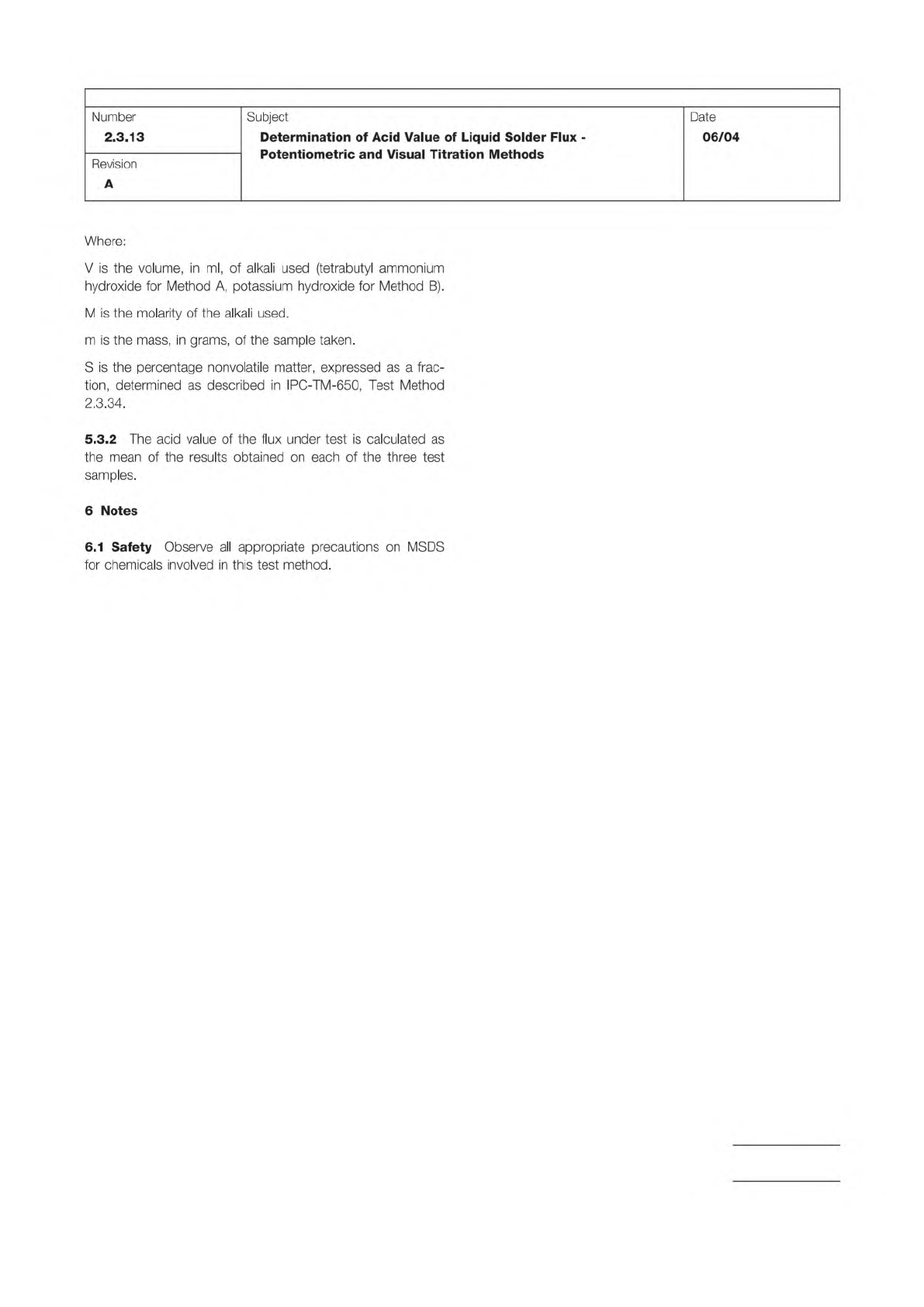
5.3.1
The
acid
value
(expressed
in
milligrams
of
potassium
hydroxide
per
gram
of
nonvolatile
matter)
is
given
by:
56.1
mS
IPC-TM-650
Page 3 of 3
Number
2.3.13
Subject
Determination
of
Acid
Value
of
Liquid
Solder
Flux
-
Potentiometric
and
Visual
Titration
Methods
Date
06/04
Revision
A
Where:
V
is
the
volume,
in
ml,
of
alkali
used
(tetrabutyl
ammonium
hydroxide
for
Method
A,
potassium
hydroxide
for
Method
B).
M
is
the
molarity
of
the
alkali
used.
m
is
the
mass,
in
grams,
of
the
sample
taken.
S
is
the
percentage
nonvolatile
matter,
expressed
as
a
frac¬
tion,
determined
as
described
in
IPC-TM-650,
Test
Method
2.3.34.
5.3.2
The
acid
value
of
the
flux
under
test
is
calculated
as
the
mean
of
the
results
obtained
on
each
of
the
three
test
samples.
6
Notes
6.1
Safety
Observe
all
appropriate
precautions
on
MSDS
for
chemicals
involved
in
this
test
method.