IPC-TM-650 EN 2022 试验方法--.pdf - 第20页
T a ble 5: M easurement System Scorecard Results T ester 1 2 3 4 5 6 7 8 9 10 T otal T a ble 6: M easurement System Effectiveness Metric Calculation Result Acceptable Needs Improvement T e st ef fectiveness (%) Probabili…
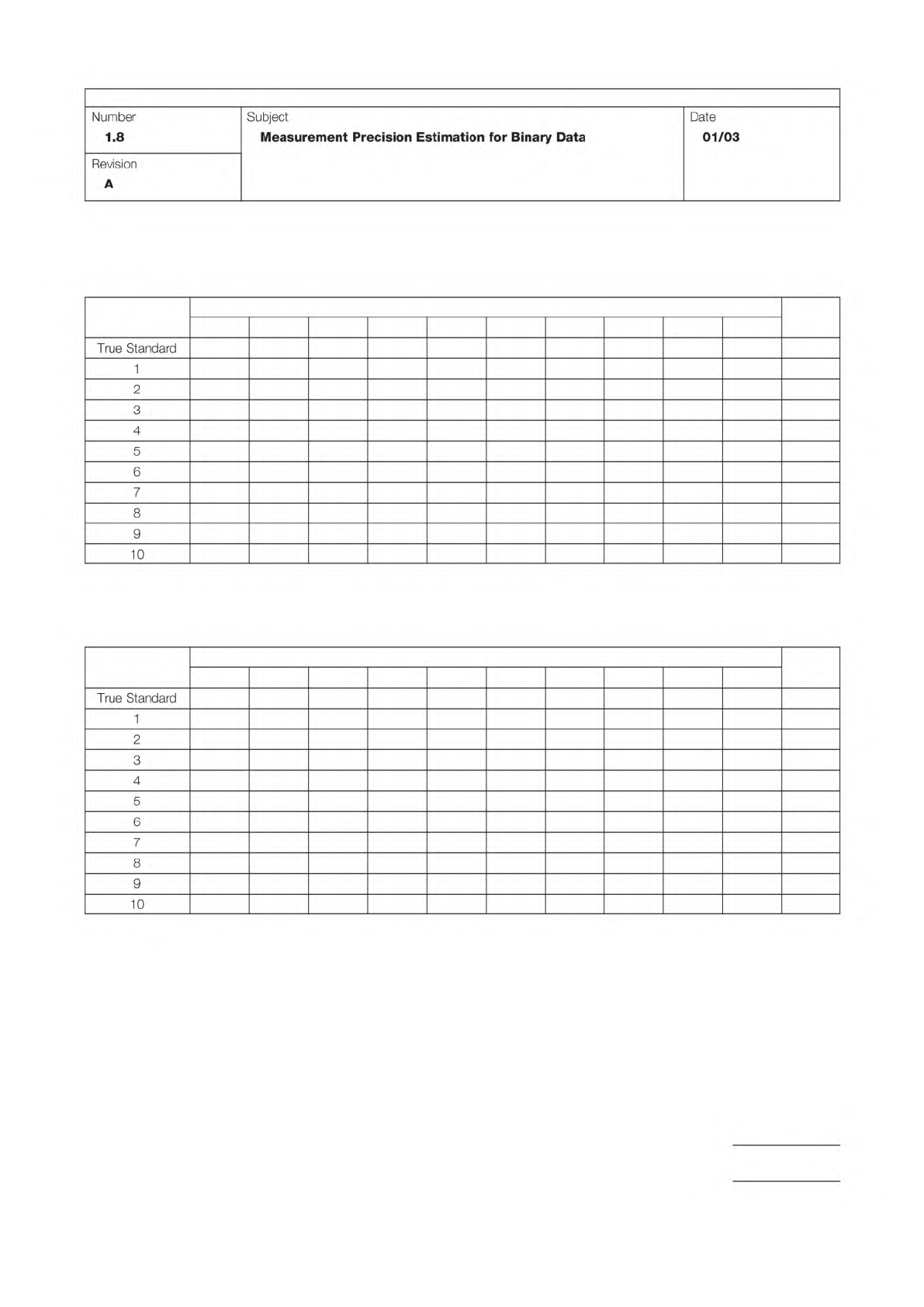
Table 3: Good Parts That Were Rejected
Score a ‘‘1’’ where good parts were rejected in Table 1 above.
Score a ‘‘0’’ everywhere else.
Note the scores for each tester in the table below.
Tester
Samples
1 2 3 4 5 6 7 8 9 10 Total
Table 4: Bad Parts That Were Accepted
Score a ‘‘1’’ where bad parts were accepted in Table 1 above.
Score a ‘‘0’’ everywhere else.
Tester
Samples
1 2 3 4 5 6 7 8 9 10 Total
IPC-TM-650
Page 5 of 6
Number
1.8
Subject
Measurement
Precision
Estimation
for
Binary
Data
Date
01/03
Revision
A
True
Standard
1
2
3
4
5
6
7
8
9
10
True
Standard
1
2
3
4
5
6
7
8
9
10
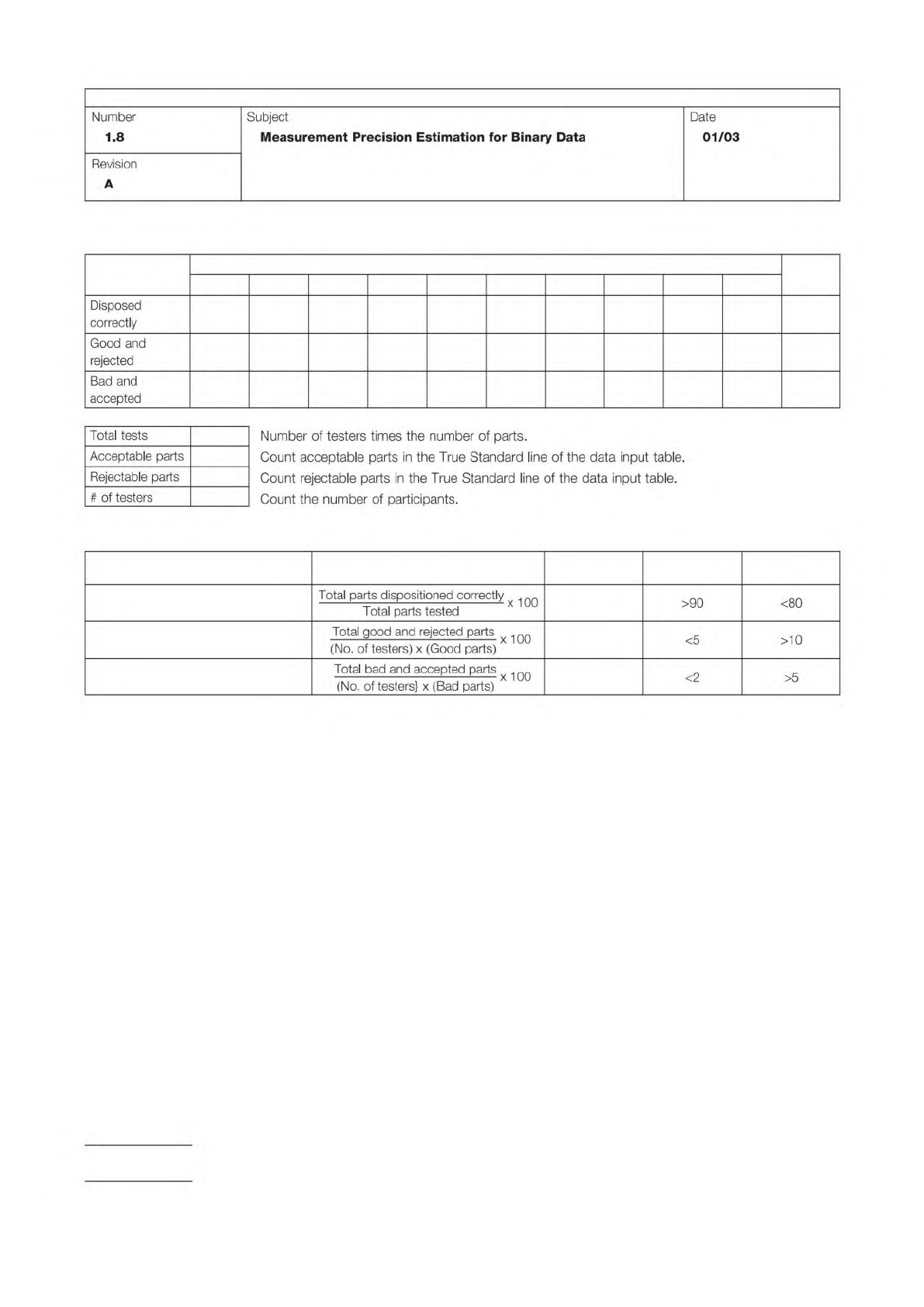
Table 5: Measurement System Scorecard
Results
Tester
1 2 3 4 5 6 7 8 9 10 Total
Table 6: Measurement System Effectiveness
Metric Calculation Result Acceptable
Needs
Improvement
Test effectiveness (%)
Probability of false rejects (%)
Probability of false acceptance (%)
IPC-TM-650
Page 6 of 6
Number
1.8
Subject
Measurement
Precision
Estimation
for
Binary
Data
Date
01/03
Revision
A
Disposed
correctly
Good
and
rejected
Bad
and
accepted
Total
tests
Number
of
testers
times
the
number
of
parts.
Acceptable
parts
Count
acceptable
parts
in
the
True
Standard
line
of
the
data
input
table.
Rejectable
parts
Count
rejectable
parts
in
the
True
Standard
line
of
the
data
input
table.
#
of
testers
Count
the
number
of
participants.
Total
parts
dispos
用
oond
correctly
x
也。
Total
parts
tested
>90
<80
Total
good
acd
rejected
parts
x
死。
(No.
of
testers)
x
(Good
parts)
<5
>10
Total
bad
and
accepted
parts
死。
(No.
of
testers}
x
(Bad
parts)
<2
>5
For Use with Test Method 1.8,
Measurement Systems Analysis for Binary Data
(IPC Measurement Precision Task Group (7-11a), Version 1.0)
Welcome to the Measurement Precision Calculator. This utility will help perform the calculations for Measurement Systems
Analysis (MSA) described in the IPC Test Method IPC-TM-1.8.
This software is useful in cases where the test or inspection results are recorded as binary data, resulting in one of two out-
comes, such as pass/fail or go/no-go. The calculations allow for results on up to 10 samples by up to 10 test conditions or
test laboratories.
Please refer to the test method before beginning the study. The test method defines the terms and equations used. This User
Guide provides instructions for analyzing the MSA data on the Measurement Precision Calculator, and how to draw conclu-
sions.
This software is an Excel workbook and includes the following:
• A blank spreadsheet to enter measurements
• A spreadsheet with example data
• A form for manual data entry, if desired.
The goal in preparing this workbook was to keep it as simple and easy to implement as possible, but still provide a good
basic MSA. This procedure has been used many times and can often be completed with as little as an hour’s work on each
of three consecutive days. This method provides a good initial assessment. It is quick and easy enough to be used on all
tests, current and new. It can help isolate cases where further analysis is needed. It is useful both on current production tests
and as a validation review for new designs.
This spreadsheet has been tested with the Excel versions included with Office 97 and Office 2000. It does not use macros,
so compatibility problems have been minimized. The sheets were formatted to print on 8-1/2 by 11 pages on most laser and
ink jet printers.
Begin by determining the measurement processes to be evaluated. All inspections are candidates for a study. In every case
where one performs a test or inspection, one deserves to know its effectiveness. What portion of the bad units will one miss?
What portion of the failed units will be good?
The secret to performing a good MSA is to prepare well. The first step in preparing the MSA is to identify all the MSA
candidates. Begin by identifying the inspections being performed. List the equipment needed, the parts tested, and the set-
ups required. For each piece of equipment, note the ranges used. The complete list of MSA candidates includes all combi-
nations of all tests, equipment, set-ups, ranges and all products.
As in many cases, this list probably includes far more potential candidates for an MSA than time or budget restrictions will
allow. So one must identify the top candidates and make sure the MSA begins with the most critical first.
The second step in preparing an MSA is to prioritize the candidates. The best ranking method for one’s situation will prob-
ably be unique, but there are several factors to consider.
1
January
2003
Users
Guide
Measurement
Precision
Calculator
Users
Guide
Introduction
Preparing
for
the
study