IPC-TM-650 EN 2022 试验方法--.pdf - 第145页
IPC-TM-650 Page 3 of 3 Number 2.3.13 Subject Determination of Acid Value of Liquid Solder Flux - Potentiometric and Visual Titration Methods Date 06/04 Revision A Where: V is the volume, in ml, of alkali used (tetrabutyl…
Note:
IPC-TM-650
Page 2 of 3
Number
2.3.13
Subject
Determination
of
Acid
Value
of
Liquid
Solder
Flux
-
Potentiometric
and
Visual
Titration
Methods
Date
06/04
Revision
A
4.3.5
Potassium
hydroxide
solution,
0.1
M
in
alcohol.
Use
a
commercially
available
standard
solution
or
one
prepared
from
a
commercially
available
concentrated
standard
solution
by
dilution
with
ethanol
(4.3.1).
Alternatively,
prepare
an
approxi¬
mate
0.1
M
potassium
hydroxide
solution
by
dissolving
3
±
0.1
g
potassium
hydroxide
(KOH)
in
500
ml
of
ethanol
(4.3.1),
and
standardize
this
solution
against
an
accurately
weighed
amount
of
benzoic
acid
(about
0.5
g)
dissolved
in
ethanol
(4.3.1).
4.3.6
Phenolphthalein
indicator
solution.
Add
1g
of
phenol¬
phthalein
to
approximately
50
ml
methanol
and
mix.
When
dissolved,
dilute
to
100
ml
with
methanol
and
mix.
5
Procedures
5.1
Potentiometric
Titration
(Method
A)
5.1.1
By
preliminary
experiments,
determine
whether
the
sample
is
soluble
in
2-propanol,
anhydrous
ethanol,
toluene
or
the
ethanol/toluene
mixture.
If
the
sample
is
not
completely
soluble
in
any
of
these
solvents,
select
the
one
in
which
the
sample
appears
to
be
the
most
soluble.
If
the
sample
is
equally
soluble
in
all
four
solvents,
then
use
neutralized
2-propanol
(4.2.2).
5.1.2
Carry
out
the
following
procedure,
in
triplicate,
on
the
flux
sample.
5.1.2.1
Weigh,
to
the
nearest
0.001
g,
2
to
5
g
of
the
liquid
flux
sample,
taking
steps
to
prevent
loss
of
volatile
matter
during
the
weighing.
The
larger
size
(~5
g)
sample
is
required
for
very
low
solids
fluxes.
Transfer
the
weighed
sample
to
a
250
ml
low
form
beaker.
5.1.
2.2
Dilute
the
sample
to
100
ml
with
2-propanol
(4.2.2),
or
the
selected
solvent
(4.2.3
to
4.2.5),
according
to
the
solu¬
bility
characteristics
of
the
flux.
Cover
with
a
watch
glass
and
dissolve
the
flux
by
gentle
agitation.
5.1.
2.3
Place
the
beaker
on
the
stand
of
the
titration
assem¬
bly
with
the
electrodes,
stirrer
and
burette
in
position.
Adjust
the
speed
of
the
stirrer
to
give
vigorous
stirring
without
splash¬
ing.
Titrate
with
the
0.1
M
tetrabutyl
ammonium
hydroxide
solution
(4.2.1),
adding
1.0
ml
portions
and
recording
the
pH
or
mV
meter
reading
after
each
addition.
As
the
end-point
is
approached,
reduce
the
additions
of
titrant
to
0.1
ml
and
con¬
tinue
titrating
past
the
end-point.
5.1
.2.4
Plot
the
pH
or
potential
values
against
the
volume
of
titrant
added
to
obtain
the
titration
curve.
The
point
of
inflec¬
tion
of
the
curve
corresponds
to
the
end-point
of
the
titration.
The
point
of
inflection
of
the
curve
may
conveniently
be
determined
by
using
the
derivative
curve.
5.1.
2.5
Carry
out
a
blank
determination,
using
reagents
only,
for
comparison
purposes.
5.2
Visual
Titration
(Method
B)
5.2.1
By
preliminary
experiments,
determine
whether
the
sample
is
soluble
in
2-propanol,
anhydrous
ethanol,
toluene
or
the
ethanol/toluene
mixture.
If
the
sample
is
not
completely
soluble
in
any
of
these
solvents,
select
the
one
in
which
the
sample
appears
to
be
the
most
soluble.
If
the
sample
is
equally
soluble
in
all
four
solvents,
then
use
neutralized
etha¬
nol
(4.3.1)
as
the
selected
solvent.
5.2.2
Carry
out
the
following
procedure,
in
triplicate,
on
the
flux
sample.
5.2.2.1
Weigh,
to
the
nearest
0.001
g,
sufficient
flux
sample
to
correspond
to
approximately
1
g
of
nonvolatile
matter
(see
IPC-TM-650,
Test
Method
2.3.34),
taking
steps
in
the
case
of
liquid
flux
samples
to
prevent
loss
of
volatile
matter
during
the
weighing.
5.2.2.2
Transfer
the
weighed
sample
to
a
suitable
flask
or
beaker
and
add
1
00
ml
of
the
selected
solvent.
Stir
until
the
sample
has
dissolved
as
completely
as
possible.
Do
not
heat.
S.2.2.3
Add
three
drops
of
phenolphthalein
indicator
solu¬
tion
(4.3.6)
and
titrate
with
the
0.1
M
potassium
hydroxide
solution
(4.3.5)
until
a
faint
pink
color
persists
throughout
the
titrated
solution
for
1
5
seconds.
5.2.2.4
Carry
out
a
blank
determination,
using
reagents
only,
for
comparison
purposes.
5.3
Calculation
of
Results
The
acid
value
is
expressed
in
milligrams
of
potassium
hydroxide
per
gram
of
nonvolatile
matter,
regardless
of
the
alkali
used
to
perform
the
titration.
5.3.1
The
acid
value
(expressed
in
milligrams
of
potassium
hydroxide
per
gram
of
nonvolatile
matter)
is
given
by:
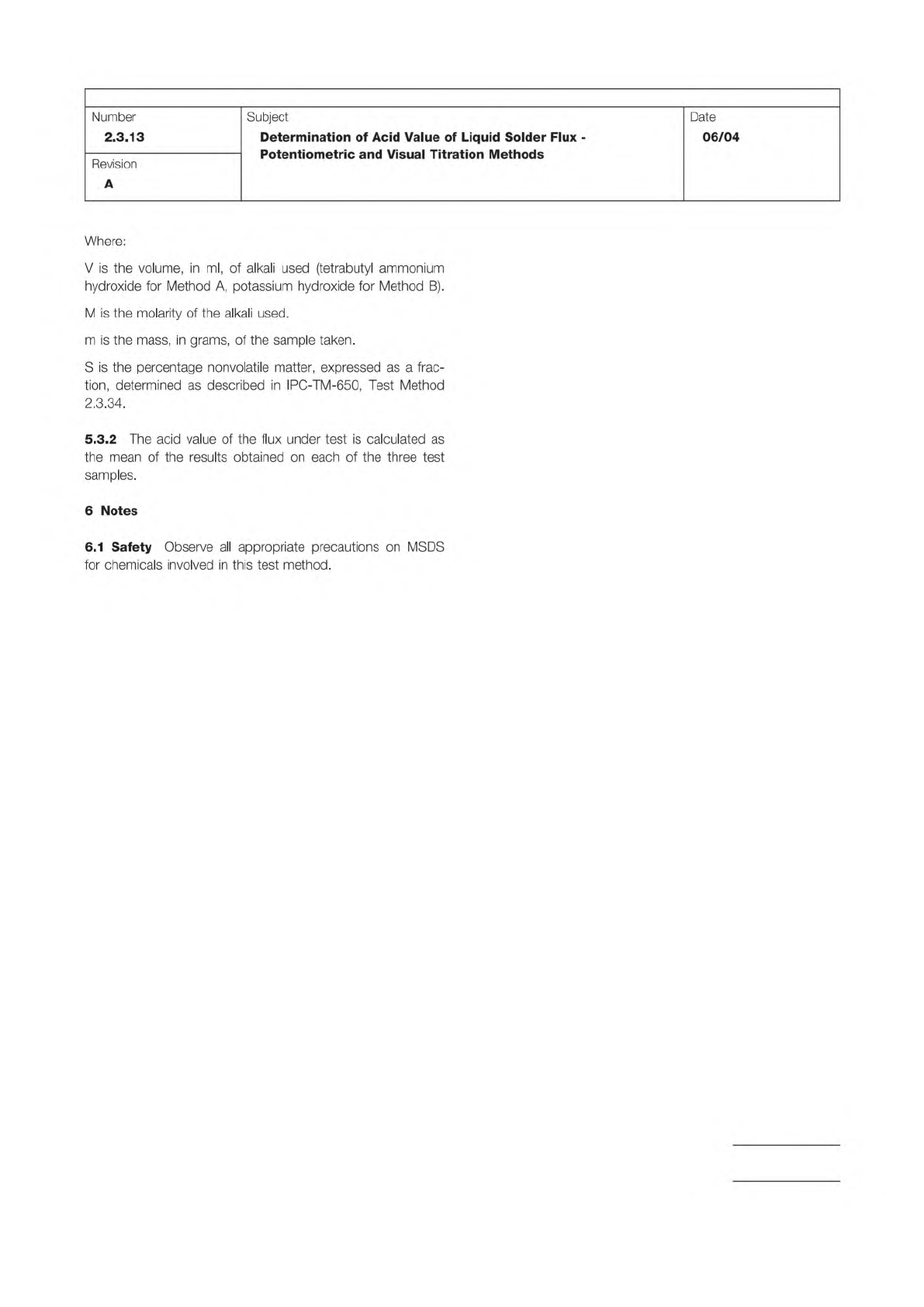
56.1
mS
IPC-TM-650
Page 3 of 3
Number
2.3.13
Subject
Determination
of
Acid
Value
of
Liquid
Solder
Flux
-
Potentiometric
and
Visual
Titration
Methods
Date
06/04
Revision
A
Where:
V
is
the
volume,
in
ml,
of
alkali
used
(tetrabutyl
ammonium
hydroxide
for
Method
A,
potassium
hydroxide
for
Method
B).
M
is
the
molarity
of
the
alkali
used.
m
is
the
mass,
in
grams,
of
the
sample
taken.
S
is
the
percentage
nonvolatile
matter,
expressed
as
a
frac¬
tion,
determined
as
described
in
IPC-TM-650,
Test
Method
2.3.34.
5.3.2
The
acid
value
of
the
flux
under
test
is
calculated
as
the
mean
of
the
results
obtained
on
each
of
the
three
test
samples.
6
Notes
6.1
Safety
Observe
all
appropriate
precautions
on
MSDS
for
chemicals
involved
in
this
test
method.
IPC-TM-650 Test Methods Manual
MIL-P-13949
The Institute for Interconnecting and Packaging Electronic Circuits
2215 Sanders Road • Northbrook, IL 60062-6135
Material in this Test Methods Manual was voluntarily established by Technical Committees of the IPC. This material is advisory only
and its use or adaptation is entirely voluntary. IPC disclaims all liability of any kind as to the use, application, or adaptation of this
material. Users are also wholly responsible for protecting themselves against all claims or liabilities for patent infringement.
Equipment referenced is for the convenience of the user and does not imply endorsement by the IPC.
Page 1 of 2
IPC-TM-650
TEST
METHODS
MANUAL
Number
2.3.14
Subject
Print,
Etch,
and
Plate
Test
Date
Revision
4/73
Originating
Task
Group
N/A
1
Scope
This
test
method
provides
a
standard
method
for
evaluating
the
effect
of
established
processing
operations
used
in
the
manufacture
of
PWBs
on
materials
that
are
con¬
sidered
for
use
in
the
manufacture
of
PWBs.
Specific
criteria
for
the
acceptability
are
based
on
copper
foil
adhesion
and
visual
surface
condition
of
the
base
laminate.
2
Applicable
Documents
2
.4.8
Peel
Strength
of
Metallic
Clad
Laminates
3
Test
Specimens
3.1
Copper-clad
epoxy
glass
laminate
materials
ranging
from
0.8
mm
to
6.5
mm
thick,
clad
on
one
or
both
sides.
3.2
Three
specimens
shall
be
tested
from
each
material,
except
in
the
case
where
the
material
is
clad
on
both
sides,
and
then
six
specimens
shall
be
processed
for
each
material.
Each
specimen
will
have
four
readings
for
peel
strength
(see
IPC-TM-650,
Method
2.4.8).
4
Equipment/Apparatus
4.1
Etching
Typical
production
printing,
etching,
and
plat¬
ing
equipment
and
materials
4.2
Tester
For
peel
strength
equipment
(see
IPC-TM-650,
Method
2.4.8)
5
Procedure
5.1
Print
and
Etch
5.1.1
Sand
the
edges
of
the
test
specimens
to
remove
burrs,
allowing
close
contact
between
the
specimen,
nega¬
tive,
and
frame
glass,
resulting
in
a
better
defined
etched
pat¬
tern.
5.1.2
Scrub
the
copper
surface(s)
with
FFF
pumice
and
a
brush
to
remove
any
contamination
on
the
surface
of
the
specimen
until
it
passes
a
water
break
test.
5.1.3
Dry
the
specimens
using
compressed
filtered
air.
5.1
.4
Dip
the
specimens
in
the
following
photoresist
solution
at
room
temperature:
One
part
by
volume
KPR
III
One
part
by
volume
toluene
One
part
by
volume
acetone
The
specific
gravity
of
the
solution
is
0.920.
5.1
.5
Hold
the
specimen
by
one
corner
when
dipping.
Allow
excess
solution
to
drain
until
dripping
stops.
5.1.6
Put
the
specimens
on
rack
(after
draining)
into
80℃
oven
from
three
to
five
minutes
to
dry
and
harden
KPR.
5.1.7
Remove
the
rack
from
the
oven
and
allow
the
speci¬
mens
to
cool
to
room
temperature.
5.1.8
Place
the
specimens
upon
the
negative
in
the
printing
frame
with
the
copper
side
against
the
negative.
5.1.9
Expose
the
mounted
specimen
76
mm
from
the
fluo¬
rescent
black
light
for
seven
minutes.
5.1.10
Develop
in
trichlorethylene
vapor
for
15
seconds.
It
may
require
two
to
six
cycles
until
the
pattern
is
clear.
Air-dry
the
specimen
after
developing.
Note:
Use
the
test
pattern
in
Method
2.4.8.
5.2
Etching
Process
and
Etchant
Removal
5.2.1
Method
A
5.2.1.
1
Etch
the
specimens
with
vigorous
aeration
for
the
minimum
time
(the
time
to
produce
a
clean
pattern
with
a
minimum
of
undercutting
is
approximately
seven
minutes
for
34
mm
and
1
5
minutes
for
69
mm
copper,
using
fresh
ferric
chloride
solution)
in
42°
Baume
(be)
ferric
chloride
solution
maintained
at
24℃
to
38℃.
The
etching
solution
shall
be
renewed
when
the
etching
time
exceeds
15
minutes
for
34
mm
copper
or
30
minutes
for
69
mm
copper.
5.2.1.
2
After
removal
of
the
copper,
immediately
wash
the
specimens
with
running
tap
water
at
16℃
to
32℃
for
two
to
five
minutes.
Thereafter,
keep
the
specimens
from
drying
until
reaching
step
5.2.1
.7.