IPC-TM-650 EN 2022 试验方法--.pdf - 第227页
Figure 2 Classification 5 None 4 3 2 1 0 Greater than 65% Surface of cross-cut area from which flaking has occurred. (Example for six paralleled cuts) IPC-TM-650 Number Subject Date Revision Page 2 of 2 2.4.1. 6 Adhesion…
/
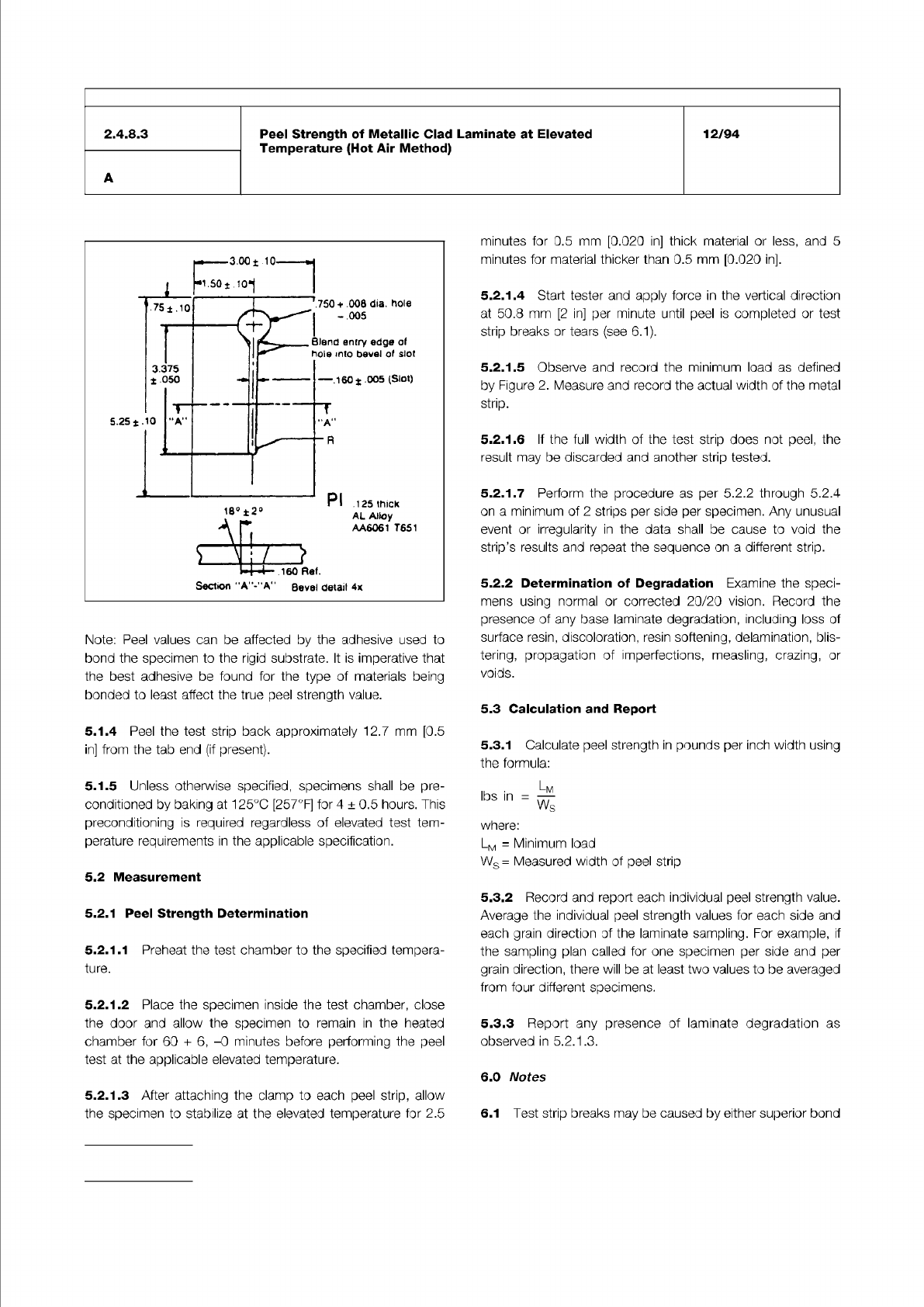
Figure 1
IPC-TM-650
Number
Subject Date
Revision
Page 2 of 3
2.4.8.3
Peel
Strength
of
Metallic
Clad
Laminate
at
Elevated
Temperature
(Hot
Air
Method)
12/94
A
Note:
Peel
values
can
be
affected
by
the
adhesive
used
to
bond
the
specimen
to
the
rigid
substrate.
It
is
imperative
that
the
best
adhesive
be
found
for
the
type
of
materials
being
bonded
to
least
affect
the
true
peel
strength
value.
5.1.4
Peel
the
test
strip
back
approximately
12.7
mm
[0.5
in]
from
the
tab
end
(if
present).
5.1.5
Unless
otherwise
specified,
specimens
shall
be
pre¬
conditioned
by
baking
at
125℃
[257°F]
for
4
±
0.5
hours.
This
preconditioning
is
required
regardless
of
elevated
test
tem¬
perature
requirements
in
the
applicable
specification.
5.2
Measurement
5.2.1
Peel
Strength
Determination
5.2.1.
1
Preheat
the
test
chamber
to
the
specified
tempera¬
ture.
5.2.1.
2
Place
the
specimen
inside
the
test
chamber,
close
the
door
and
allow
the
specimen
to
remain
in
the
heated
chamber
for
60
+
6,
-0
minutes
before
performing
the
peel
test
at
the
applicable
elevated
temperature.
5.2.1.
3
After
attaching
the
clamp
to
each
peel
strip,
allow
the
specimen
to
stabilize
at
the
elevated
temperature
for
2.5
minutes
for
0.5
mm
[0.020
in]
thick
material
or
less,
and
5
minutes
for
material
thicker
than
0.5
mm
[0.020
in].
5.2.1.
4
Start
tester
and
apply
force
in
the
vertical
direction
at
50.8
mm
[2
in]
per
minute
until
peel
is
completed
or
test
strip
breaks
or
tears
(see
6.1).
5.2.1.
5
Observe
and
record
the
minimum
load
as
defined
by
Figure
2.
Measure
and
record
the
actual
width
of
the
metal
strip.
5.2.1.
6
If
the
full
width
of
the
test
strip
does
not
peel,
the
result
may
be
discarded
and
another
strip
tested.
5.2.1.
7
Perform
the
procedure
as
per
5.2.2
through
5.2.4
on
a
minimum
of
2
strips
per
side
per
specimen.
Any
unusual
event
or
irregularity
in
the
data
shall
be
cause
to
void
the
strip's
results
and
repeat
the
sequence
on
a
different
strip.
5.2.2
Determination
of
Degradation
Examine
the
speci¬
mens
using
normal
or
corrected
20/20
vision.
Record
the
presence
of
any
base
laminate
degradation,
including
loss
of
surface
resin,
discoloration,
resin
softening,
delamination,
blis¬
tering,
propagation
of
imperfections,
measling,
crazing,
or
voids.
5.3
Calculation
and
Report
5.3.1
Calculate
peel
strength
in
pounds
per
inch
width
using
the
formula:
.
Lm
lbs
"
屈
where:
Lm
=
Minimum
load
Ws=
Measured
width
of
peel
strip
5.3.2
Record
and
report
each
individual
peel
strength
value.
Average
the
individual
peel
strength
values
for
each
side
and
each
grain
direction
of
the
laminate
sampling.
For
example,
if
the
sampling
plan
called
for
one
specimen
per
side
and
per
grain
direction,
there
will
be
at
least
two
values
to
be
averaged
from
four
different
specimens.
5.3.3
Report
any
presence
of
laminate
degradation
as
observed
in
5.2.1
.3.
6.0
Notes
6.1
Test
strip
breaks
may
be
caused
by
either
superior
bond
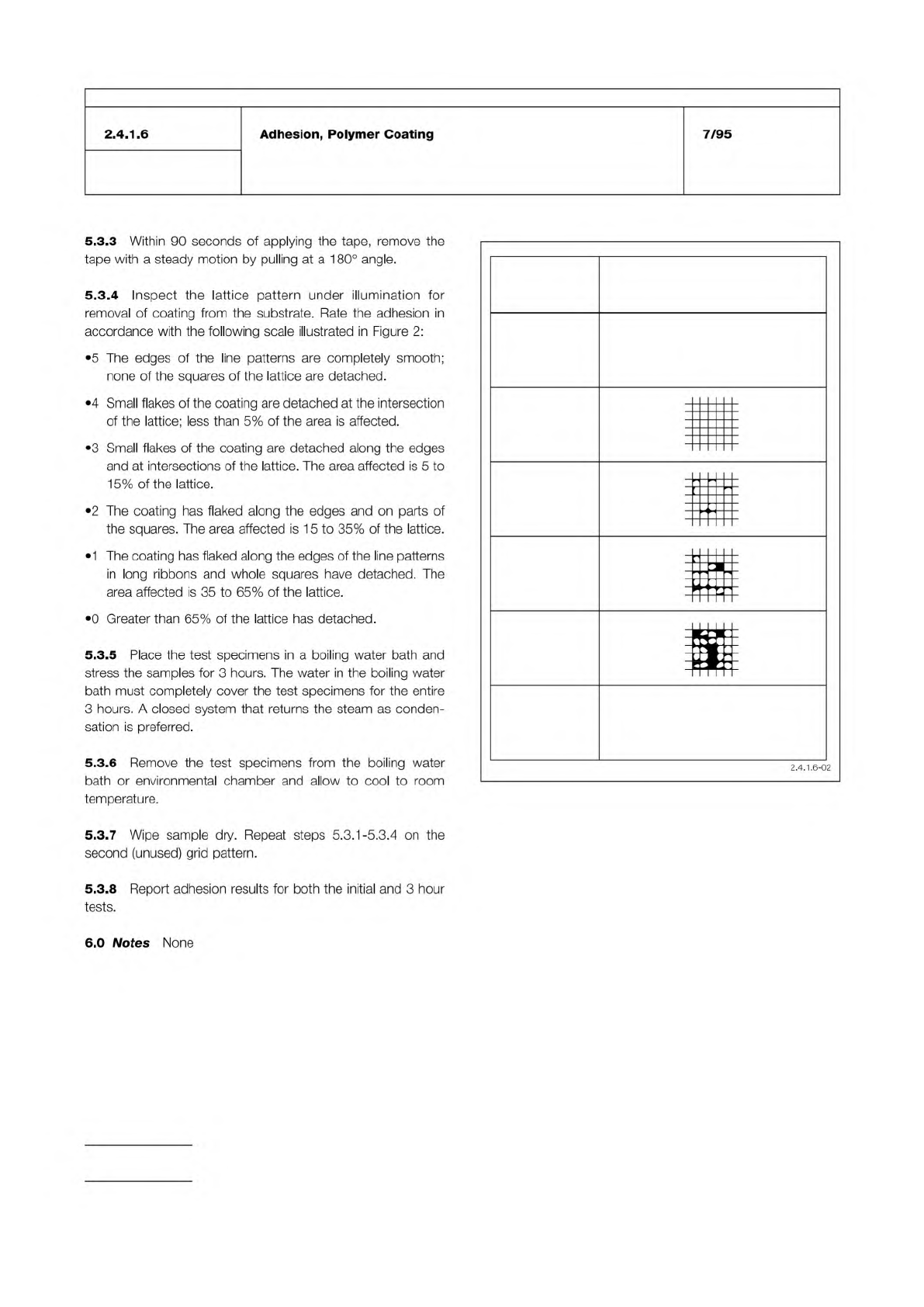
Figure 2
Classification
5 None
4
3
2
1
0 Greater than 65%
Surface of cross-cut area from
which flaking has occurred.
(Example for six paralleled cuts)
IPC-TM-650
Number
Subject Date
Revision
Page 2 of 2
2.4.1.
6
Adhesion,
Polymer
Coating
7/95
5.3.3
Within
90
seconds
of
applying
the
tape,
remove
the
tape
with
a
steady
motion
by
pulling
at
a
1
80°
angle.
5.3.4
Inspect
the
lattice
pattern
under
illumination
for
removal
of
coating
from
the
substrate.
Rate
the
adhesion
in
accordance
with
the
following
scale
illustrated
in
Figure
2:
•
5
The
edges
of
the
line
patterns
are
completely
smooth;
none
of
the
squares
of
the
lattice
are
detached.
•
4
Small
flakes
of
the
coating
are
detached
at
the
intersection
of
the
lattice;
less
than
5%
of
the
area
is
affected.
•
3
Small
flakes
of
the
coating
are
detached
along
the
edges
and
at
intersections
of
the
lattice.
The
area
affected
is
5
to
1
5%
of
the
lattice.
•
2
The
coating
has
flaked
along
the
edges
and
on
parts
of
the
squares.
The
area
affected
is
1
5
to
35%
of
the
lattice.
•
1
The
coating
has
flaked
along
the
edges
of
the
line
patterns
in
long
ribbons
and
whole
squares
have
detached.
The
area
affected
is
35
to
65%
of
the
lattice.
•
0
Greater
than
65%
of
the
lattice
has
detached.
5.3.5
Place
the
test
specimens
in
a
boiling
water
bath
and
stress
the
samples
for
3
hours.
The
water
in
the
boiling
water
bath
must
completely
cover
the
test
specimens
for
the
entire
3
hours.
A
closed
system
that
returns
the
steam
as
conden¬
sation
is
preferred.
5.3.6
Remove
the
test
specimens
from
the
boiling
water
bath
or
environmental
chamber
and
allow
to
cool
to
room
temperature.
5.3.7
Wipe
sample
dry.
Repeat
steps
5.3.1
-5.3.4
on
the
second
(unused)
grid
pattern.
5.3.8
Report
adhesion
results
for
both
the
initial
and
3
hour
tests.
—
"I
二
r
—
s
2.4.1.6-02
6.0
Notes
None
NOTE:
The Institute for Interconnecting and Packaging Electronic Circuits
2215 Sanders Road • Northbrook, IL 60062-6135
Material in this Test Methods Manual was voluntarily established by Technical Committees of the IPC. This material is advisory only
and its use or adaptation is entirely voluntary. IPC disclaims all liability of any kind as to the use, application, or adaptation of this
material. Users are also wholly responsible for protecting themselves against all claims or liabilities for patent infringement.
Equipment referenced is for the convenience of the user and does not imply endorsement by the IPC.
Page 1 of 1
IPC-TM-650
TEST
METHODS
MANUAL
1
Scope
Ductility
values
are
determined
by
measuring
the
bulge
height
on
a
Mullen
bulge
tester
or
equivalent.
Measure¬
ments
are
made
in
mm.
2
Applicable
Documents
None
3
Test
Specimen
Three
clean,
smooth
pieces
of
copper
foil
10
cm
x
10
cm
area
or
any
non-overlapping
equivalent
areas.
4
Apparatus
Mullens
Bulge
Tester
by
B.
F.
Perkins
&
Son,
Inc.,
Model
A
to
be
1
0
RPM
at
large
shaft
between
gear
box
and
diaphragm,
or
equivalent.
5
Procedure
5.1
Preparation
Raise
upper
clamping
ring
by
rotating
the
hand
wheel.
Place
a
10
cm
x
10
cm
by
0.15
mm
thick
steel
plate
that
is
perfectly
flat
over
the
diaphragm
and
lower
the
upper
clamping
ring
applying
sufficient
pressure
to
prevent
slippage.
Zero
the
dial
indicator.
Raise
the
upper
clamping
ring
and
remove
the
10
cm
x
10
cm
by
0.15
mm
steel
plate.
The
above
operation
should
be
done
once
every
eight-hour
shift.
Start
the
motor
and
move
the
ball-handled
control
lever
to
the
right
to
be
certain
that
the
diaphragm
is
returned
to
its
start¬
ing
position.
Number
2.4.2
Subject
Ductility
of
Copper
Foil
Date
Revision
3/76
A
Originating
Task
Group
N/A
5.2
Test
5.2.1
Place
a
sample
of
the
copper
foil
to
be
tested
over
the
diaphragm
with
the
matte
side
up.
5.2.2
Lower
the
clamping
ring,
applying
sufficient
pressure
to
prevent
slippage
of
the
sample
between
the
plates.
5.2.3
Move
the
ball-handled
control
lever
to
the
left.
The
operator
should
keep
his
hand
on
the
lever
in
readiness
to
stop
or
reverse
the
machine
at
any
time
during
the
test
and
when
the
test
is
complete.
During
the
test,
the
operator
should
be
watching
the
dial
indicator
and,
at
the
instant
burst¬
ing
occurs,
should
note
the
reading
on
the
dial
indicator
and
the
ball-handled
control
lever
should
be
moved
as
far
to
the
right
as
it
will
go
and
be
released.
This
will
return
the
dia¬
phragm
to
its
starting
position
and
automatically
shut
off
the
pump.
5.3
Evaluation
5.3.1
Record
the
reading
from
the
dial
indicator.
5.3.2
Rotate
the
hand
wheel
to
raise
the
clamping
ring
and
remove
the
sample.
Avoid
overlapping
of
the
clamping
areas
and
disregard
any
single
reading
that
is
not
reasonably
con¬
sistent
with
those
taken
in
neighboring
areas,
and
repeat
the
test.