IPC-TM-650 EN 2022 试验方法--.pdf - 第511页
th e c on nec to r. T ab le 4 -3 p ro vi de s t he ty pi ca l co nne c tor torque specifications. 4.3.2 C abling All t est cables be high-q uality, low- phase delay coax and with a nominal characteristic imped- ance of 5…
Intermediate values can be linearly interpolated from Table 4-1
or using:
t
sys
≤
L
TL
2
1
v
p
.
For example, if the test structure was a 32.0 mm [1.26 in] long
transmission line, then a TDR system with t
sys
≤ 80 ps must
be used. Note that, if the probe launch and test set-up cables
cause excessive ringing in the TDR waveform, or if the vari-
ance in connection delay is significant, then t
sys
must be made
sufficiently small to clearly observe the desired discontinuities
in the TDR waveforms.
4.2 TDR Requirements
4.2.1 Impedance
The TDR source and measurement ports
be electrically terminated with precision 50 Ω loads. This
is normally the case with high-quality TDR instrumentation
maintained on the manufacturer’s maintenance and calibra-
tion schedules.
4.2.2 Voltage Step Repeatability
For all passive electrical
terminations, the TDR source
repeat its voltage wave-
form to within 0.5% of the TDR pulse amplitude V
step
.
4.2.3 Timebase Accuracy
When oscilloscopes are used
in the TDR measurement system, errors in the reported time
of the samples may arise due to imperfections in the counters
and clock sources used to establish the timebase. These are
systematic errors and may depend on the exact time/div and
delay settings of the scope. When applying this method, the
TDR system’s timebase accuracy must be better than 8 ps +
0.01% of the measured interval.
4.2.4 Timebase Repeatability (Jitter)
The RMS value of
random timing uncertainty in measured voltage samples
be less than 10% of t
sys
.
4.2.5 Waveform Averaging
The TDR equipment
perform waveform or sample averaging to reduce jitter and
electrical noise effects in the recorded waveform measure-
ments.
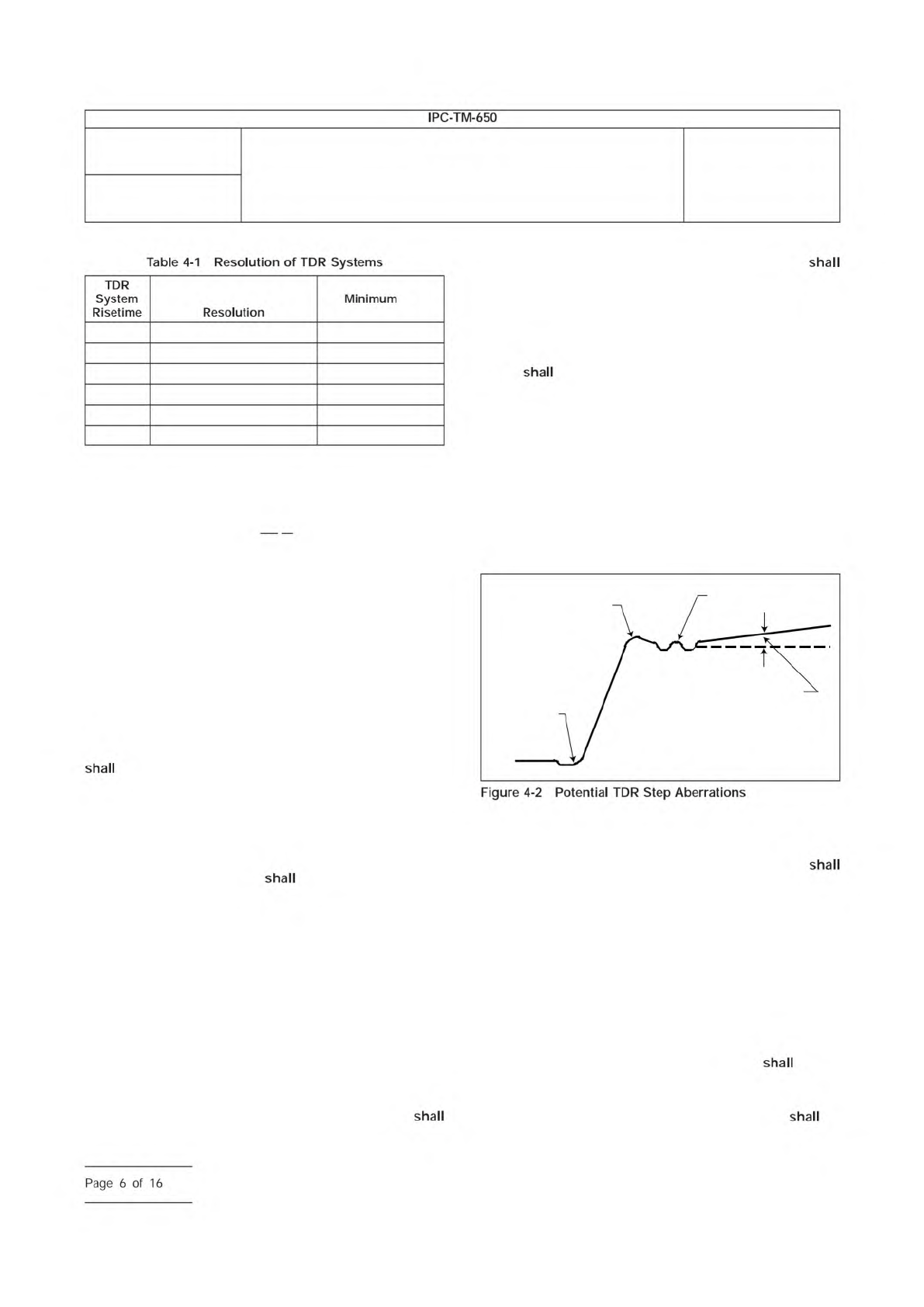
4.2.6 Step Aberrations
The TDR source waveform aber-
rations
be less than 1% of the total step amplitude V
step
.
The ability of the TDR instrument to measure transmission line
discontinuities is related to how well the instrument can mini-
mize aberrations (ringing, overshoot, undershoot, settling,
etc.). These aberrations (see Figure 4-2) can cause significant
errors in determining the instant that the waveform crosses a
user-defined voltage value. Additionally, low frequency step
aberrations may produce a ramp in measurement zone and
this can cause a significant bias in the computed propagation
delay value.
4.3 Other Equipment Requirements
4.3.1 Connectors
Propagation delay test set-ups
use precision coaxial connectors whenever possible. TDR
systems typically come with SMA, 3.5 mm [0.138 in],
2.92 mm [0.115 in], or 2.4 mm [0.094 in] connectors at their
measurement ports. These connectors are all 50 Ω connec-
tors. They are precision connectors (they have a low imped-
ance uncertainty due to their mechanical precision) whose
bandwidth must be great enough so that the connectors do
not limit the accuracy of the TDR measurement. The useable
bandwidth of these connectors are approximately 33 GHz,
40 GHz, and 50 GHz, respectively. The reflection and insertion
losses of all connectors used in the test set up
be less
than 27 dB and 0.3 dB, respectively. Other connectors with
comparable or better performance may be used, but must be
specified and documented. All coaxial connections
be
tightened with a calibrated torque wrench to specification of
L
TL
4x Resolution
10 ps 5 ps / 1.0 mm [0.04 in] 4.0 mm [0.16 in]
20 ps 10 ps / 2.0 mm [0.08 in] 8.0 mm [0.31 in]
30 ps 15 ps / 3.0 mm [0.12 in] 12.0 mm [0.47 in]
100 ps 50 ps / 10.0 mm [0.39 in] 40.0 mm [1.57 in]
200 ps 100 ps / 20.0 mm [0.79 in] 80.0 mm [3.15 in]
500 ps 250 ps / 50.0 mm [1.97 in] 200.0 mm [7.87 in]
IPC-25511-4-2
overshoot
undershoot
ringing
low frequency drift
Number
2.5.5.11
Subject
Propagation Delay of Lines on Printed Boards by TDR
Date
04/2009
Revision
IPC-TM-650
—
Table
4-1
Resolution
of
TDR
Systems
TDR
System
Risetime
Resolution
Minimum
shall
shall
shall
shall
shall
shall
shall
Page
6
of
16
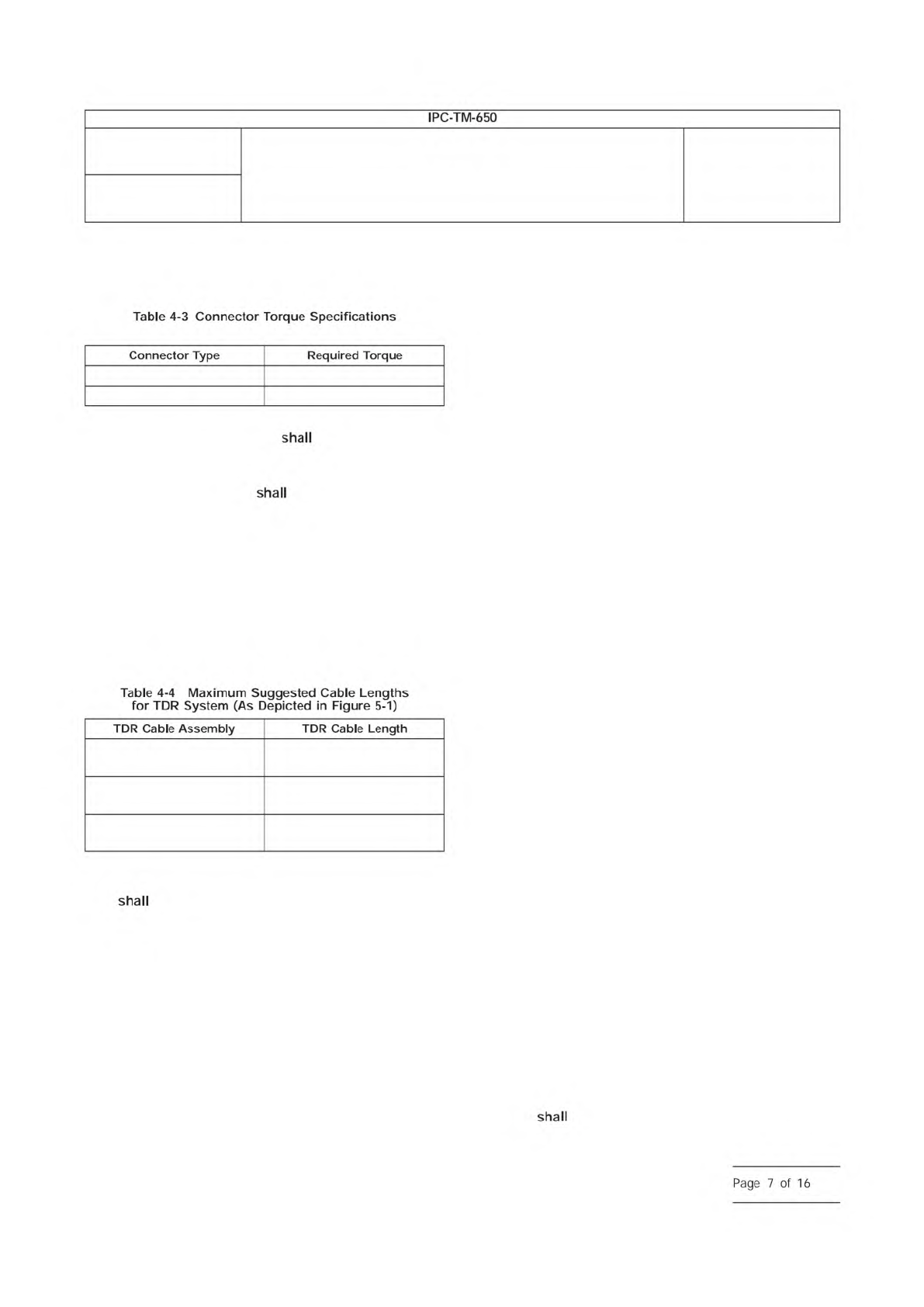
the connector. Table 4-3 provides the typical connector
torque specifications.
4.3.2 Cabling
All test cables be high-quality, low-
phase delay coax and with a nominal characteristic imped-
ance of 50 Ω. Cables used in the measurement circuit of the
transmission line under test
have connectors that are
compatible with the instrument and probes. The bandwidth of
the cable must be great enough so that the cable does not
limit the accuracy of the propagation delay measurement. The
length of the cables should be kept to a minimum. The total
insertion loss (including connector loss) of the cabling con-
necting the transmission line under test to the TDR should be
kept to less than 3.3 dB/m (1db/foot) at 26.5 GHz. Table 4-4
contains suggested maximum cable lengths for the TDR test
set up as depicted in Figure 5-1 and described in 5.2.
4.3.3 Probes
The probe assembly characteristic imped-
ance
either be 50 Ω or the same value as the charac-
teristic impedance of the transmission line under test, with an
uncertainty of ± 1.0 Ω or less. The probe tips should be of
sufficient diameter and pitch (spacing between signal and
ground tips) to provide accurate and repeatable connections
to the desired probe contact pad geometry (see IPC-2141 for
additional recommendations on probe landing layouts for TDR
coupons). Single-ended probes should contain two electrode
tips, one each for the signal and ground lines. The probe tips
should have moderately sharp edges to cut through any
oxides. The probe bandwidth should be sufficient for the
desired temporal/spatial resolution (see 4.1.2). The probe
response time should be sufficiently short so as not to
increase the duration of the measurement period. The overall
performance of the probe can be incorporated into the TDR
system response for computing TDR system temporal/spatial
resolution (see 4.1.2). Inconsistent probe force and placement
is common and can cause a significant yet unknown error in
t
d
. Probe connections to the measurement system cables
should be tightened with a torque wrench following the con-
nector specifications. For hand held probe assemblies, the
probe handle should be ergonomically shaped.
4.3.4 Terminations
TDR sources are not perfect voltage
source generators; they may perform differently under differ-
ent electrical load conditions. Therefore, the termination con-
ditions of any verification experiments should match those of
the interconnection test structures, and all test structures in a
given specimen should be of the same design. For example, if
the propagation delay test is to be performed on lines that are
electrically open at their far end, all lines should be terminated
in electrically open circuits, and any TDR field verification tests
(see 5.2.1.2) should be made using open circuit terminations.
4.3.5 ESD Protection
Static build up on specimens and
test cables prior to test can damage the signal samplers in the
TDR equipment; ESD protection and transmission line dis-
charging procedures must be used. ESD protection can be
supplied internally to the TDR system or externally using a
Static Isolation Unit (SIU). If supplied externally using a coaxial
switch (as shown in Figure 5-1), the switch should be placed
between the transmission line under test and the TDR instru-
mentation. The SIU should have a return loss and insertion
loss less than 16 dB and 0.3 dB, respectively, at 18 GHz. A
maximum of 30.0 cm [11.8 in] of high quality, high frequency
cable may be used to connect the TDR instrument to the SIU
protection switch. Test interconnections should be first
grounded with the SIU and/or passed through some type of
deionization device prior to testing to remove any residual
static electrical charge. Use of proper ESD control methods,
control components and humidity control will help reduce
electrostatic discharge damage to the measurement system.
Automation software can be used to enhance the effective-
ness of the static isolation unit by switching the static isolation
unit on/off as required to minimize the amount of time that the
TDR sampling unit is exposed to potential ESD.
4.3.6 Transfer Standard
The TDR measurement system
(see Figure 5-1) specified for measuring propagation delay
requires a precision coaxial transmission line to set the refer-
ence impedance of the reflectometer measurements. This
standard
be a rigid, or semi-rigid, cable not more than
10 cm long with a uniform impedance profile along its length.
[The conversion factor is 0.1128 N-m/(lb-in)]
SMA 0.56 N-m (5 lb-in)
3.5, 2.92, and 2.4 mm 0.90 N-m (8 lb-in)
Sampling Unit to Static
Isolation Unit
30.0 cm [11.8 in]
Static Isolation Unit to In-Line
Secondary Standard
91.0 cm [35.83 in]
Transfer Standard (such as
semi-rigid coaxial cable)
10.0 cm [3.94 in]
Number
2.5.5.11
Subject
Propagation Delay of Lines on Printed Boards by TDR
Date
04/2009
Revision
IPC-TM-650
―
Table
4-3
Connector
Torque
Specifications
Connector
Type
Required
Torque
Table
4-4
Maximum
Suggested
Cable
Lengths
for
TDR
System
(As
Depicted
in
Figure
5-1)
TDR
Cable
Assembly
TDR
Cable
Length
shall
Page
7
of
16

The transfer standard have precision coax connectors
that match the test cables and probes. The uncertainty in the
nominal characteristic impedance of the transfer standards
be less than or equal to ± 0.015 Z
ref
, where Z
ref
is the
characteristic impedance of the transfer standard (nominally
50 Ω.)
4.3.7 Check Standards
The method makes use of two
precision coaxial air lines of two different lengths to verify the
operation of a test set-up (see 5.2.1.2). The air lines are pre-
cision coaxial lines where the center conductors are held in
place with an isolation bead or the center pins of the end
connectors, and are not filled with any other dielectric mate-
rial. The coaxial air lines serve as a precise delay standard that
can be measured during field checks (see 5.2.1.2) to verify the
measurement set-up. The coaxial air line standards are avail-
able commercially with any of the precision coaxial connec-
tors. Probe contact to coaxial transitions must be fabricated
to use with a given probe tip configuration.
5 Procedures
In TDR, the observed voltage waveform is
the sum of incident and reflected signals. The reflections are
related to the difference between the characteristic imped-
ance Z
0
of a transmission line and any impedance discontinui-
ties along the transmission line or at its end.
The method procedures establish the means of determining a
time delay per unit length t
d
from TDR measurements of two
transmission lines that differ in length. The transmission lines
are the interconnect test structures fabricated in PB materials
as specified. The far end of the transmission line is either
electrically open- or short-circuited in order to create a clearly
observable reflection feature in the measured TDR waveform.
The procedures in this section establish the propagation delay
per unit length as the differential propagation time obtained
using the TDR measurements of two interconnect test lines
divided by the length of the same interconnects:
t
d
= t
p
/ 2L
p
Here, t
p
is the measured propagation time difference given by
t
p
=
?
t
T1
− t
T2
?
,
where t
T1
is the round-trip propagation time for the first trans-
mission line and t
T2
is the round-trip propagation time of the
second transmission line.
L
p
is the propagation length difference of the transmission line
pair given by
L
p
=
?
L
T1
− L
T2
?
,
where L
T1
is the length of the first transmission line and L
T2
is
the length of the second transmission line.
5.1 Measurement Preliminaries
This section provides
common considerations for the calibration and initial configu-
ration of the TDR measurement system, and the method to
establish the waveform epoch (time window) used in the delay
measurements (see 5.2 and 5.3).
5.1.1 System Calibrations
5.1.1.1 Manufacturer Calibrations
The TDR oscilloscope
or other TDR equipment used
be calibrated and ser-
viced following the recommended schedule of the instrument
manufacturers.
5.1.1.2 Field Calibrations
Manufacturer ecommended
field calibrations
be performed in addition to scheduled
factory calibrations. TDR system field calibrations
be
performed at the frequency recommended by the instrument
manufacturers and after a change of any system component,
such as a sampler of TDR source unit. The user must ensure
adequate system warm-up time before performing field cali-
brations, as specified by the instrument manufacturers.
Users-accessible field calibrations for TDR oscilloscopes may
include the application of an internal voltage calibration for
each sampler and TDR source. Though not required for this
method, TDR field calibrations may also include a reflection
coefficient or impedance normalization/calibration procedure
where standards are connected to the instrument’s test port
following a menu-driven procedure. Field calibrations are
required for the following reasons:
a. TDR instrument specifications vary with temperature
b. TDR instrument specifications vary with time (drift)
c. TDR instrument specifications vary due to minor ESD dam-
age
d. TDR instrument factory calibration usually does not include
user supplied auxiliary components (i.e., cables, probes,
etc.)
Number
2.5.5.11
Subject
Propagation Delay of Lines on Printed Boards by TDR
Date
04/2009
Revision
IPC-TM-650
shall
shall
shall
shall
Page
8
of
16