IPC-TM-650 EN 2022 试验方法--.pdf - 第726页
Note: IPC-TM-650 Page 2 of 3 Number 2.6.15 Subject Corrosion, Flux Date 06/04 Revision C 5.3.3 Immerse in 5% sulfuric acid (by volume) at 65 ± 5 [149 ± 9 °F] for one minute to remove the tarnish film. 5.3.4 Immerse in a …
IPC J-STD-004
IPC-TM-650
IEC 61189-5
Material in this Test Methods Manual was voluntarily established by Technical Committees of IPC. This material is advisory only
and its use or adaptation is entirely voluntary. IPC disclaims all liability of any kind as to the use, application, or adaptation of this
material. Users are also wholly responsible for protecting themselves against all claims or liabilities for patent infringement.
Equipment referenced is for the convenience of the user and does not imply endorsement by IPC.
Page 1 of 3
r
ASSOCIATION
CONNECTING
/
ELECTRONICS
INDUSTRIES
®
221
5
Sanders
Road
Northbrook,
IL
60062-6135
IPC-TM-650
TEST
METHODS
MANUAL
1
Scope
This
test
method
is
designed
to
determine
the
corrosive
properties
of
flux
residues
under
extreme
environ¬
mental
conditions.
A
pellet
of
solder
is
melted
in
contact
with
the
test
flux
on
a
sheet
metal
test
piece.
The
solder
is
then
exposed
to
prescribed
conditions
of
humidity
and
the
result¬
ing
corrosion,
if
any,
is
assessed
visually.
2
Applicable
Documents
Requirements
for
Soldering
Fluxes
Test
Methods
Manual
2
.3.34
Solids
Content,
Flux
for
Fluxes
for
Soft
Soldering
Test
Methods
for
Electrical
Materials,
Intercon¬
nection
Structures
and
Assemblies
-
Part
5:
Test
Methods
for
Printed
Board
Assemblies
3
Test
Specimen
At
least
0.035
g
of
flux
solids,
0.3
g
sol¬
der
paste,
1
g
wire,
or
1
g
preform
with
an
equivalent
amount
of
solids.
Flux
solids
are
defined
as
the
residue
described
in
IPC-TM-650,
Test
Method
2.3.34,
Solids
Content,
Fluxes.
All
solvent
must
have
been
evaporated
from
the
specimen
in
a
chemical
fume
hood.
4
Apparatus
and
Reagents
4.1
Apparatus
4.1.1
Solder
pot.
4.1.2
Humidity
chamber
capable
of
achieving
40
±
3
[104
土
5.4
°F]
and
93
土
5%
relative
humidity.
4.1.3
Air
circulating
drying
oven.
4.1.4
Microscope
having
20X
minimum.
4.1.5
Analytical
balance
capable
of
weighing
0.001
g.
4.1.6
Three
50
mm
x
50
mm
x
0.5
mm
[1
.969
in
x
1
.969
in
x
0.00197
in]
99%
pure
copper
sheets.
4.1.7
19
mm
[0.748
in]
steel
ball
(approximate).
4.1.8
Laboratory
press.
Number
2.6.15
Subject
Corrosion,
Flux
Date
Revision
06/04
C
Originating
Task
Group
Flux
Specifications
Task
Group,
(5-24a)
4.1.9
Tongs.
4.2
Reagents
All
chemicals
must
be
reagent
grade
and
water
must
be
deionized
(2
megohm-cm
minimum
resistivity
recommended).
4,2,1
Ammonium
persulphate.
4.2.2
Sulfuric
acid,
relative
density
1
.84.
4.2.3
Degreasing
agent:
acetone,
or
petroleum
ether.
5
Procedures
5.1
Chemicals
5.1.1
Ammonium
persulphate
(25%
m/v
in
0.5%
v/v
sulfuric
acid).
Dissolve
250
g
of
ammonium
persulphate
in
water
and
add
cautiously
5
ml
of
5%
sulfuric
acid
(relative
density
1
.84).
Mix,
cool,
dilute
to
1
liter
and
mix.
This
solution
should
be
freshly
prepared.
5.1.2
Sulfuric
acid
(5%
v/v).
To
400
ml
of
water
cautiously
add
50
ml
of
sulfuric
acid
(relative
density
1
.84).
Mix,
cool,
dilute
to
1
liter
and
mix.
5.2
Test
Panel
5.2.1
Form
a
3.0
mm
[0.018
in]
(approximate)
deep
circular
depression
in
the
center
of
the
copper
test
panel
by
forcing
a
19.0
mm
[0.018
in]
steel
ball
into
a
25
(approximate)
mm
hole
to
form
a
cup.
5.2.2
Bend
one
corner
of
the
test
panel
up
to
facilitate
sub¬
sequent
handling
with
tongs.
5.3
Test
Panel
Pretreatment
5.3.1
Immediately
before
performing
test,
pretreat
as
follows
using
clean
tongs
for
handling.
5.3.2
Degrease
with
a
suitable
neutral
organic
solvent
such
as
acetone,
or
petroleum
ether.
Note:
IPC-TM-650
Page 2 of 3
Number
2.6.15
Subject
Corrosion,
Flux
Date
06/04
Revision
C
5.3.3
Immerse
in
5%
sulfuric
acid
(by
volume)
at
65
±
5
[149
±
9
°F]
for
one
minute
to
remove
the
tarnish
film.
5.3.4
Immerse
in
a
solution
of
25%
m/v
ammonium
persul¬
phate
(in
0.5%
v/v
sulfuric
acid)
at
23
±
2
[73.4
土
3.6
°F]
for
one
minute
to
etch
the
surface
uniformly.
5.3.5
Wash
in
running
tap
water
for
five
seconds.
Immerse
in
5%
sulfuric
acid
(by
volume)
at
23
土
2
℃
[73.4
土
3.6
°F]
for
one
minute.
5.3.6
Wash
for
five
seconds
in
running
tap
water,
then
rinse
thoroughly
in
deionized
water.
5.3.7
Rinse
with
acetone.
5.3.8
Allow
to
dry
in
clean
air.
Use
the
test
piece
as
soon
as
possible
or
store
up
to
one
hour
in
a
closed
container.
5.4
Solder
for
Liquid
or
Paste
Flux
Test
5.4.1
Weigh
a
1
.00
±
0.05
gram
specimen
of
solid
solder.
5.4.2
Degrease
the
solder
specimen
with
a
suitable
neutral
organic
solvent
such
as
acetone,
or
petroleum
ether.
5.4.3
Solder
may
be
in
the
form
of
pellets
or
tight
spirals
of
solid
solder
wire.
5.5
Test
5.5.1
Heat
solder
pot
so
that
solder
bath
stabilizes
at
235
±
5
[455
±
9
°F]-
5.5.2
Liquid
or
Paste
Flux
5.5.2.1
Place
0.035
g
of
flux
solids
into
the
depression
in
the
test
panel.
Add
the
solid
solder
pellets
or
spirals.
5.5.2.2
Using
tongs,
lower
the
test
panel
onto
the
surface
of
the
molten
solder.
5.5.2.3
Allow
the
test
panel
to
remain
in
contact
with
the
bath
until
the
solder
specimen
in
the
depression
of
the
test
panel
melts.
Maintain
this
position
for
5
±
1
seconds
before
removing
the
test
panel
from
the
bath.
Cool
the
test
panel
to
room
temperature.
5.5.3
Cored
Wire
or
Cored
Preform
5.5.3.
1
Place
1
gram
of
flux
cored
wire
or
perform
into
the
depression
in
the
test
panel.
5.5.3.2
Using
tongs,
lower
the
test
panel
onto
the
surface
of
the
molten
solder.
5.5.3.3
Allow
the
test
panel
to
remain
in
contact
with
the
bath
until
the
solder
specimen
in
the
depression
of
the
test
panel
melts.
Maintain
this
position
for
5
±
1
seconds
before
removing
the
test
panel
from
the
bath.
Cool
the
test
panel
to
room
temperature.
5.5.4
Solder
Paste
5.5.4.
1
Place
0.3
g
of
solder
paste
into
the
depression
in
the
test
panel.
5.5.4.2
Allow
the
test
panels
to
remain
in
contact
with
the
bath
until
the
solder
specimen
in
the
depression
of
the
test
panel
melts.
Maintain
this
position
for
60
±
5
seconds
before
removing
the
test
panel
from
the
bath.
Cool
the
test
panel
to
room
temperature.
5.5.4.3
Alternately,
process
the
panels
through
a
reflow
sol¬
dering
process
using
the
temperature
profile
recommended
by
the
vendor.
5.6
Humidity
Exposure
5.6.1
Carefully
examine
the
test
specimen
at
20X
magnifica¬
tion
for
subsequent
comparison
after
humidity
exposure.
Record
observations,
especially
any
discoloration
(see
8.2).
5.6.2
Preheat
test
panel
to
40
±
1
[104
±
1
.8
°F]
for
30
土
2
minutes.
5.6.3
Humidity
Soak
5.6.3.1
Place
the
test
specimen
vertically
in
a
preset
humid¬
ity
chamber
at
40
±
1
[104
±
1.8
°F]
and
93
土
2%
relative
humidity.
5.6.3.2
Alternately,
the
specimen
may
be
placed
in
a
tem¬
perature
humidity
chamber
and
heated
to
40
[1
.8
°F]
and
minor
major
IPC-TM-650
Page 3 of 3
Number
2.6.15
Subject
Corrosion,
Flux
Date
06/04
Revision
C
held
for
30
minutes.
The
humidity
should
then
be
increased
to
93%RH.
5.6.3.3
Expose
specimen
to
the
above
environment
for
240
hours
(10
days).
M
and
H
fluxes
may
be
tested
in
the
cleaned,
as
well
as
uncleaned,
condition.
Specimens
shall
be
cleaned
per
the
manufacturers
instructions.
5.7
Evaluation
5.7.1
After
the
exposure
period,
remove
test
specimens
from
humidity
chamber,
examine
at
20X
magnification
and
compare
with
observations
noted
in
6.5
(see
8.2).
5.7.2
For
purposes
of
this
test
method,
the
following
defini¬
tion
of
corrosion
shall
prevail:
"A
chemical
reaction
between
the
copper,
the
solder,
and
the
constituents
of
the
flux
resi¬
dues,
which
occurs
after
soldering
and
during
exposure
to
the
above
environmental
conditions.*
*
Corrosion
for
this
test
is
classified
as
follows:
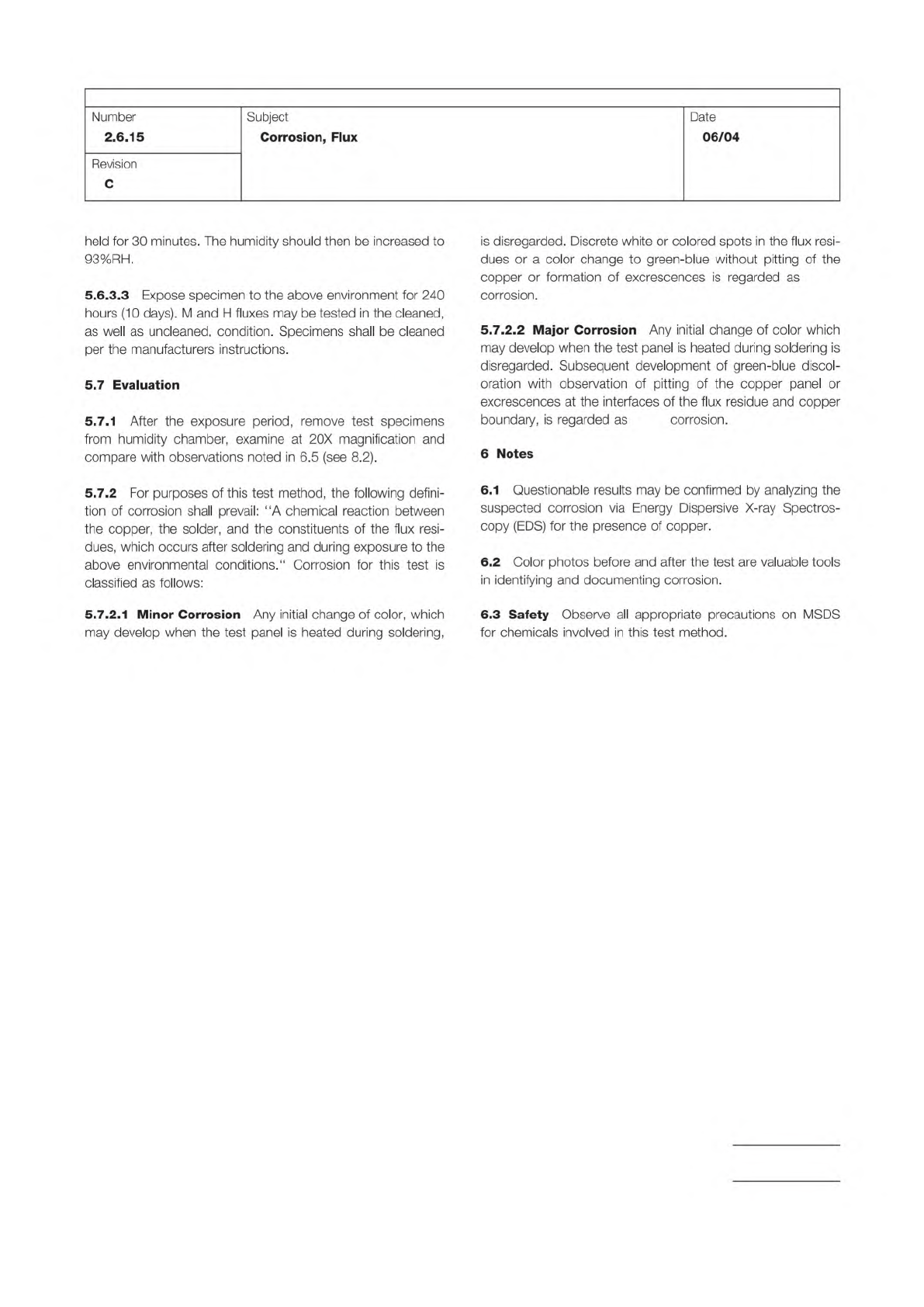
5.7.2.1
Minor
Corrosion
Any
initial
change
of
color,
which
may
develop
when
the
test
panel
is
heated
during
soldering,
is
disregarded.
Discrete
white
or
colored
spots
in
the
flux
resi¬
dues
or
a
color
change
to
green-blue
without
pitting
of
the
copper
or
formation
of
excrescences
is
regarded
as
corrosion.
5.7.2.2
Major
Corrosion
Any
initial
change
of
color
which
may
develop
when
the
test
panel
is
heated
during
soldering
is
disregarded.
Subsequent
development
of
green-blue
discol¬
oration
with
observation
of
pitting
of
the
copper
panel
or
excrescences
at
the
interfaces
of
the
flux
residue
and
copper
boundary,
is
regarded
as
corrosion.
6
Notes
6・1
Questionable
results
may
be
confirmed
by
analyzing
the
suspected
corrosion
via
Energy
Dispersive
X-ray
Spectros¬
copy
(EDS)
for
the
presence
of
copper.
6.2
Color
photos
before
and
after
the
test
are
valuable
tools
in
identifying
and
documenting
corrosion.
6.3
Safety
Observe
all
appropriate
precautions
on
MSDS
for
chemicals
involved
in
this
test
method.