IPC-TM-650 EN 2022 试验方法--.pdf - 第281页
5 Conditioning 5.1 Conditio ning The test specimens be conditioned at 23 °C ± 2 °C (73.4 ° F ± 3 .6 °F) and 50% ± 5 % relative humidity for not less than 24 hours prior to test. 5.2 Tes t Conditions Conduct t ests i n th…
1 Scope
This method covers the determination of the force
required to initiate tearing in flexible insulating materials. It is
based on ASTM D1004.
2 Applicable Documents
Standard Test Methods for Thickness of Solid
Electrical Insulation
Standard Test Method for Tear Resistance
(Graves Tear) of Plastic Film and Sheeting
3 Test Specimens
3.1
The specimens be prepared using flexible dielec-
tric material. If the flexible dielectric is clad, the copper foil
be etched using standard commercial practices.
3.2
Ten specimens, five in the transverse and five in the lon-
gitudinal (machine) directions,
be cut from the sample
material.
3.3
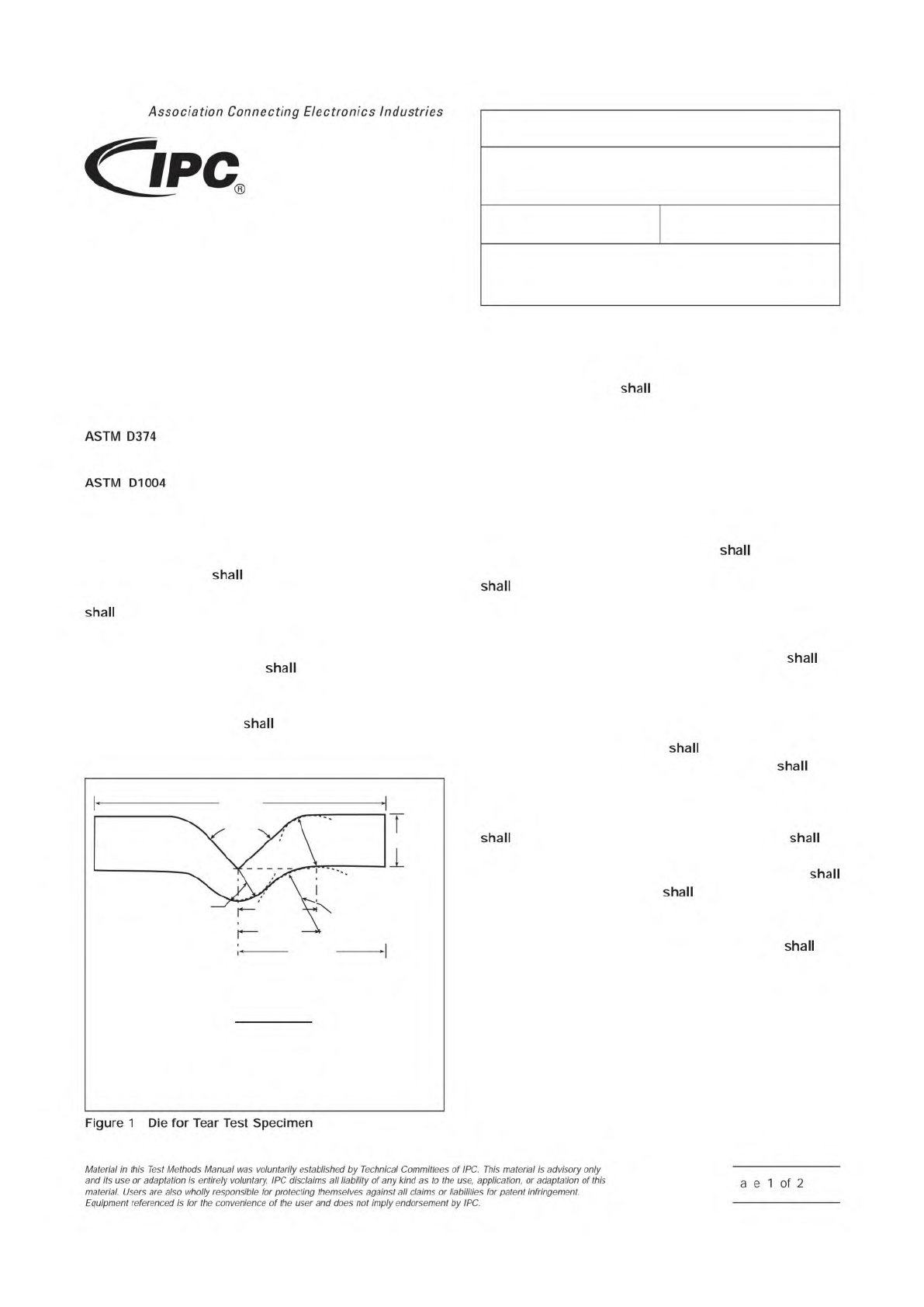
The test specimens conform to the dimensions
shown in Figure 1.
4 Test Equipment
4.1 Testing Machines
A power driven machine of either of
the two following types
be used.
4.1.1 Static Weighing
Constant rate of grip separation
type, negligible movement of the upper jaw.
4.1.2 Pendulum Weighing
Constant rate of grip motion
type, constant rate of lower jaw movement, variable upper jaw
movement. Either maximum load indicating devices or record-
ers are permissible in the testing machine. The applied load,
as indicated by a recorder, dial or scale,
be accurate to
within 12 percent. If an indicating device is used, the indicator
remain at the point of maximum load after rupture of the
test specimen.
4.2 Grips
A gripping system that minimizes both slippage
and uneven stress distribution on the specimen
be
used.
4.3 Thickness Measuring Devices
Suitable calibrated
ratchet/friction thimble machinist’s micrometer reading to
0.0025 mm [0.0001 in] or less
be used for measuring
the thickness of the specimens. The micrometer
con-
form to ASTM D374.
4.4 Die
A die having the dimensions shown in Figure 1
be used to cut all specimens. The 90° angle be
honed sharp with no radius or have a minimum practical
radius, as per ASTM D1004. The cutting edge of the die
have a 5° negative rake, and be kept sharp and free
from nicks to avoid leaving ragged edges on the specimen.
Cutting may be facilitated by wetting the surface of the sample
and cutting edges of the die with water. The sample
rest
on a smooth, slightly yielding surface that will not injure the die
blade. Lightweight cardboard or a piece of leather belting is
suitable. Care should be taken that the cut edges of the speci-
men are perpendicular to its other surfaces and that the
edges have a minimum of concavity. NOTE: The test speci-
men results depend on the quality of the die used.
IPC-2416-1
101.60mm
26.95mm (x2)
25.40mm radius (x2)
Dimensional tolerances ±0.051mm [0.002 in]
Table of Metric-to-Imperial Equivalents
in.
4.0
0.750
1.061
1.000
1.118
2.0
0.500
101.60
19.05
26.95
25.40
28.40
50.80
12.70
mm
28.40mm (x2)
50.80mm (x2)
19.05mm (x2)
19.05mm
radius (x2)
12.70mm radius (x2)
90º±0.5º
3000 Lakeside Drive, Suite 309S
Bannockburn, IL 60015-1249
IPC-TM-650
TEST METHODS MANUAL
Number
2.4.16
Subject
Initiation Tear Strength, Flexible Insulating
Materials
Date
03/14
Revision
B
Originating Task Group
Flexible Circuits Test Methods Subcommittee
(D-15)
P g
Association
Connecting
Electronics
Industries
ASTM
D374
ASTM
D1004
shall
shall
shall
shall
shall
shall
shall
Figure
1
Die
for
Tear
Test
Specimen
shall
shall
shall
shall
shall
shall
Material
/n
this
Test
Methods
Manual
was
voluntarily
established
by
Technical
Committees
of
I
PC.
This
material
/s
advisory
only
and
"s
use
or
adaptation
,
s
entirely
voluntary.
IPC
disclaims
all
liability
of
any
kind
as
to
the
use,
application,
or
adaptation
of
this
material.
Users
are
also
wholly
responsible
for
protecting
themselves
against
all
claims
or
liabilities
for
patent
infringement.
Equipment
referenced
/s
for
the
convenience
of
the
user
and
does
not
imply
endorsement
by
IPC.
a
e
1
of
2
5 Conditioning
5.1 Conditioning
The test specimens be conditioned
at 23 °C ± 2 °C (73.4 °F ± 3.6 °F) and 50% ± 5% relative
humidity for not less than 24 hours prior to test.
5.2 Test Conditions
Conduct tests in the Standard Labo-
ratory Atmosphere of 23 °C ± 2 °C (73.4 °F ± 3.6 °F) and 50
± 10 percent relative humidity.
6 Speed of Testing
A jaw separation of 25.4 mm [1 in]
be used. The rate of travel of the power activated grip
be 51 mm [2 in]/minute and be uniform at all
times.
7 Procedure
7.1
Measure the thickness of the specimen at several points
to the accuracy limits of the measuring devices specified in
4.3. Record the average thickness in millimeters or microns
[in].
7.2
Place the specimen in the grips of the testing machine
so that the long axes of the enlarged ends of the specimen
are in line with the points of attachment of the grips to the
machine.
7.3
Apply the load at 51 mm [2 in]/minute rate of grip sepa-
ration. After complete rupture of the specimen, the maximum
tearing load in grams [ounces]
be noted from the dial
scale or recorder chart and recorded. Data from specimens
which break at some obvious flaw or which break in or at the
edges of the grips
be discarded and retests made.
8 Calculation
The average resistance to tearing be
calculated from five specimens tested in each principal direc-
tion of orientation. Data
be recorded as grams [ounces]
of tearing resistance.
9 Report
9.1
Report the average thickness of all specimens.
9.2
Report the average transverse and the average longitu-
dinal initiation tear strength values.
Number
2.4.16
Subject
Initiation Tear Strength, Flexible Insulating Materials
Date
03/14
Revision
B
P g
IPC-TM-650
shall
shall
shall
shall
shall
shall
shall
shall
a
e
2
of
2
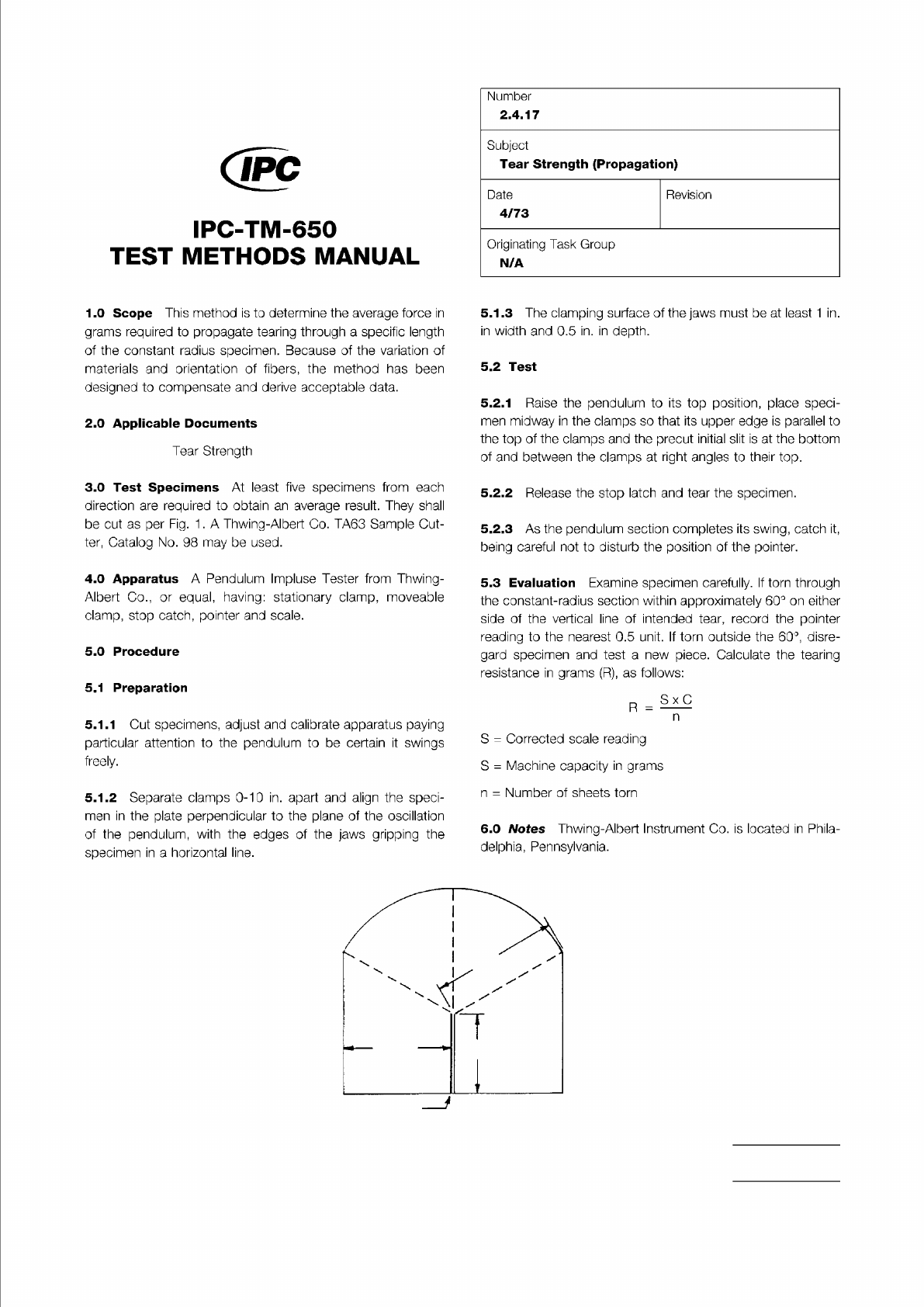
ASTM-D-689
Figure 1
The Institute for Interconnecting and Packaging Electronic Circuits
2215 Sanders Road • Northbrook, IL 60062-6135
Material in this Test Methods Manual was voluntarily established by Technical Committees of the IPC. This material is advisory only
and its use or adaptation is entirely voluntary. IPC disclaims all liability of any kind as to the use, application, or adaptation of this
material. Users are also wholly responsible for protecting themselves against all claims or liabilities for patent infringement.
Equipment referenced is for the convenience of the user and does not imply endorsement by the IPC.
Page 1 of 1
Number
2.4.17
回
IPC-TM-650
TEST
METHODS
MANUAL
Subject
Tear
Strength
(Propagation)
Date
4/73
Revision
Originating
Task
Group
N/A
1
.0
Scope
This
method
is
to
determine
the
average
force
in
grams
required
to
propagate
tearing
through
a
specific
length
of
the
constant
radius
specimen.
Because
of
the
variation
of
materials
and
orientation
of
fibers,
the
method
has
been
designed
to
compensate
and
derive
acceptable
data.
2
.0
Applicable
Documents
Tear
Strength
3
.0
Test
Specimens
At
least
five
specimens
from
each
direction
are
required
to
obtain
an
average
result.
They
shall
be
cut
as
per
Fig.
1
.
A
Thwing-Albert
Co.
TA63
Sample
Cut¬
ter,
Catalog
No.
98
may
be
used.
4
.0
Apparatus
A
Pendulum
Impluse
Tester
from
Thwing-
Albert
Co.,
or
equal,
having:
stationary
clamp,
moveable
clamp,
stop
catch,
pointer
and
scale.
5
.0
Procedure
5.1
Preparation
5.1.1
Cut
specimens,
adjust
and
calibrate
apparatus
paying
particular
attention
to
the
pendulum
to
be
certain
it
swings
freely.
5.1.2
Separate
clamps
0-10
in.
apart
and
align
the
speci¬
men
in
the
plate
perpendicular
to
the
plane
of
the
oscillation
of
the
pendulum,
with
the
edges
of
the
jaws
gripping
the
specimen
in
a
horizontal
line.
5.1.3
The
clamping
surface
of
the
jaws
must
be
at
least
1
in.
in
width
and
0.5
in.
in
depth.
5.2
Test
5.2.1
Raise
the
pendulum
to
its
top
position,
place
speci¬
men
midway
in
the
clamps
so
that
its
upper
edge
is
parallel
to
the
top
of
the
clamps
and
the
precut
initial
slit
is
at
the
bottom
of
and
between
the
clamps
at
right
angles
to
their
top.
5.2.2
Release
the
stop
latch
and
tear
the
specimen.
5.2.3
As
the
pendulum
section
completes
its
swing,
catch
it,
being
careful
not
to
disturb
the
position
of
the
pointer.
5.3
Evaluation
Examine
specimen
carefully.
If
torn
through
the
constant-radius
section
within
approximately
60°
on
either
side
of
the
vertical
line
of
intended
tear,
record
the
pointer
reading
to
the
nearest
0.5
unit.
If
torn
outside
the
60°,
disre¬
gard
specimen
and
test
a
new
piece.
Calculate
the
tearing
resistance
in
grams
(R),
as
follows:
R
二
n
S
=
Corrected
scale
reading
S
二
Machine
capacity
in
grams
n
=
Number
of
sheets
torn
6
.0
Notes
Thwing-Albert
Instrument
Co.
is
located
in
Phila¬
delphia,
Pennsylvania.