IPC-TM-650 EN 2022 试验方法--.pdf - 第123页
IPC-TM-650 Number Subject Date Revision Page 4 of 4 2.3.4.2 Chemical Resistance of Laminates, Prepreg, and Coated Foil Products, by Solvent Exposure 12/94 A pan. If the balance door is closed immediately after sample ent…
IPC-TM-650
Number
Subject Date
Revision
Page 3 of 4
2.3.4.2
Chemical
Resistance
of
Laminates,
Prepreg,
and
Coated
Foil
Products,
by
Solvent
Exposure
12/94
A
5.5.7
After
60
+5,-0
seconds
from
the
time
of
removal
from
the
solution,
note
the
weight
of
the
specimen
and
record
it
as
W2.
5.5.8
Repeat
5.5.5
-
5.5.7
for
the
remaining
specimens
insuring
the
immersion
time
of
each
specimen
is
kept
within
the
tolerance.
5.5.9
A
fresh
batch
of
solvent
shall
be
used
for
no
more
than
1
8
specimens
or
for
a
period
of
time
no
longer
than
8
hours.
5.6
Evaluation
5.6.1
Weight
Gain
5.6.1
.1
Subtract
the
dry
weight
of
each
specimen,
W
〕
,
from
the
final
weight,
W2
of
each
specimen
after
immersion.
Record
the
weight
gain
in
mg.
5.6.1.
2
Calculate
the
average
weight
gain
in
mg.
5.6.2
Appearance
Examine
the
specimens
using
20/20
vision
for
any
changes
to
the
appearance
of
the
material,
such
as
hazing,
whitening
or
swelling.
5.7
Report
5.7.1
Report
the
average
weight
gain
in
milligrams
for
the
material
tested.
5.7.2
Report
the
measured
specimen
thickness.
5.7.3
Report
actual
test
conditions
for
temperature
and
humidity
and
the
solvent
temperature.
5.7.4
Report
any
anomalies
in
the
test
or
any
variations
from
the
specified
procedures
or
tolerances.
5.7.5
Report
any
changes
in
the
visual
quality
of
the
speci¬
mens
as
determined
in
5.6.2.
6.0
Notes
6.1
Safety
Considerations
See
the
MSDS
sheet
for
the
solvent
used
before
running
this
test.
6.1.1
During
test,
the
beaker
with
the
test
solvent
should
be
covered
or
under
a
ventilation
hood.
6.1.2
Dispose
of
the
spent
solvent
in
accordance
with
local
regulations.
6.2
Factors
Affecting
Tests
6.2.1
Sample
6.2.1.
1
Same
Sample
The
results
obtained
on
the
same
sheet
of
material
may
be
significantly
affected
by
the
degree
of
cure
of
the
material
and
the
thermal
history
of
the
sample.
6.2.1.
2
Variation
Due
to
Thickness
of
Sample
There
is
a
very
small
difference
due
to
sample
thickness.
This
is
under
10%
on
typical
epoxy
materials
for
0.2
mm
[0.008
in]
to
1.5
mm
[0.060
in]
and
under
5%
on
more
chemical
resistant
material
from
0.13
mm
[0.005
in]
to
1.5
mm
[0.060
in].
6.2.2
Accuracy
Since
there
are
no
standards
for
this
type
of
test,
the
accuracy
of
the
method
cannot
be
established.
6.2.3
Precision
the
reproducibility
of
this
test
depends
on
the
degree
of
control
over
the
controlled
variables
and
some
other
variables
such
as
atmospheric
pressure,
which
are
gen¬
erally
not
controlled
in
industrial
laboratories.
Precision
between
laboratories
with
20%
to
50%
RH
was
10%
at
the
90
mg
level
and
16%
at
the
25
mg
level.
6.2.4
Desiccants
Desiccants
capable
of
0.002
mg
mois¬
ture
levels
include
P205>
Mg
(C1
04)
2
,
anhydrous
BaO
and
fused
KOH.
Some
other
desiccants
such
as
CaCI2
result
in
considerably
higher
moisture
levels
and
may
not
be
used
in
this
test.
(See
Weast
R.C.,
ORC
Handbook
of
Chemistry
and
Physics,
65th
edition,
E-37,
1
984.)
6.2.5
Humidity
Considerations
6.2.5.1
Effect
of
Humidity
Higher
humidity
will
produce
higher
solvent
pickup
due
to
retarded
solvent
evaporation.
6.2.5.2
Control
of
Humidity
Control
of
the
critical
environ¬
ment
can
be
obtained
in
uncontrolled
laboratories
using
an
enclosed
balance
with
a
saturated
salt
solution
of
Mg(No3)2,
6H
2
。
(for
50%
RH).
All
significant
openings
in
the
enclosure
are
sealed
with
tape
and
an
inner
door
is
fabricated
with
a
small
opening
for
sample
entry
and
exit.
A
shallow
pan
is
fabricated
to
occupy
most
of
the
balance
floor
without
contacting
the
weighing
IPC-TM-650
Number
Subject Date
Revision
Page 4 of 4
2.3.4.2
Chemical
Resistance
of
Laminates,
Prepreg,
and
Coated
Foil
Products,
by
Solvent
Exposure
12/94
A
pan.
If
the
balance
door
is
closed
immediately
after
sample
entry
and
exit,
50
土
5%
RH
can
be
maintained.
Verification
of
conditions
in
the
enclosure
during
a
simulated
test
can
be
made
using
a
rapid
response
humidity
probe;
however,
this
should
be
done
with
unconditioned
specimens
since
solvents
will
affect
the
response
of
many
humidity
probes.
6.2.6
Temperature
Considerations
The
effect
of
the
sol¬
vent
temperature
on
results
is
severe.
A
variation
of
5
℃
[9°F]
can
result
in
an
error
as
high
as
50%
relative
to
values
deter¬
mined
at
23℃
[73°F].
6.3
Consideration
of
Other
Test
Parameters
6.3.1
Using
Same
Solvent
Shorter
dwell
times,
e.g.,
3
minutes,
generally
result
in
better
discrimination
between
material
of
varying
chemical
resistance.
However,
test
variabil¬
ity
is
generally
increased.
Shorter
tests
are
excellent
for
side
by
side
comparisons
of
materials.
Longer
tests,
e.g.,
30
minutes,
often
do
not
differentiate
adequately
between
materials,
and
while
useful
on
homoge¬
neous
material,
variability
on
material
with
surface
coatings
may
be
excessive.
6.3.2
Other
Solvent
Blends
Other
solvents
and
various
methylene
chloride
based
combinations
have
been
commonly
used
in
the
industry.
However,
results
and
precision
of
the
test
may
vary
significantly
and
the
added
problem
of
variability
in
solution
make-up
is
introduced.
6.4
Supercession
This
test
method
supersedes
2.3.42
dated
5/86,
and
2.3.4.3,
dated
5/86.
6.5
Desiccator
Conditions
The
Test
Methods
Task
Group
determined
that
a
great
majority
of
test
laboratories
are
unable
to
consistently
hold
the
Relative
Humidity
in
a
desiccator
to
less
than
20%.
Based
on
data
from
participating
company
lab
management,
the
lowest
practically
feasible
RH
for
use
with
the
affected
IPG
Test
Methods
is
30%
maximum.
IPC-TM-650
IPC-TM-650
IPC-TM-650
The Institute for Interconnecting and Packaging Electronic Circuits
2215 Sanders Road • Northbrook, IL 60062-6135
Material in this Test Methods Manual was voluntarily established by Technical Committees of the IPC. This material is advisory only
and its use or adaptation is entirely voluntary. IPC disclaims all liability of any kind as to the use, application, or adaptation of this
material. Users are also wholly responsible for protecting themselves against all claims or liabilities for patent infringement.
Equipment referenced is for the convenience of the user and does not imply endorsement by the IPC.
Page 1 of 1
IPC-TM-650
TEST
METHODS
MANUAL
1
.0
Scope
This
test
method
is
designed
for
use
in
deter¬
mining
the
resistance
of
core
(dielectric)
materials
used
in
printed
wiring
boards
to
methylene
chloride
at
laboratory
ambient
temperature.
2
.0
Applicable
documents
Method
2.3.6,
Etching,
Ammonium
Persulfate
Method
Method
2.3.7,
Etching,
Ferric
Chloride
Method
Method
2.3.7,
1
,
Etching,
Cupric
Chloride
Method
3
.0
Test
specimens
3.1
Dimensions
The
test
specimens
shall
be
2.00
in.
x
2.00
in.
X
thickness
of
material.
Tolerance
on
the
2.00
in.
dimensions
shall
be
±
.03
in.
3.2
Edge
finish
The
edges
of
the
specimens
shall
be
milled
or
sanded
smooth
with
400
grit
sandpaper.
3.3
Number
of
specimens
Three
specimens
shall
be
used
for
this
test.
3.4
Removal
of
metal
cladding
The
metal
cladding
shall
be
removed
by
etching
per
IPC-TM-2.3.6,
2.3.7,
2.3.7.
1
or
other
suitable
method
which
does
not
affect
the
surface
of
the
pressed
sample.
4
.0
Apparatus
4.1
Oven
Circulating
air
oven
capable
of
maintaining
a
uni¬
form
temperature
of
105°
to
110℃
(221°
to
230°F).
Number
2.3.4.3
Subject
Chemical
Resistance
of
Core
Materials
to
Methylene
Chloride
Date
Revision
5/86
Originating
Task
Group
N/A
4.2
Desiccator
4.3
Analytical
balance
5
.0
Procedure
5.1
Conditioning
The
specimens
shall
be
conditioned
by
drying
in
an
oven
for
1
hour
at
1
05°
to
1
1
0
℃
(221
°
to
230°F),
then
cooled
to
room
temperature
in
a
desiccator.
5.2
Fill
a
3000
ml
beaker
with
methylene
chloride
to
a
depth
of
3
in.
and
maintain
at
23°
±
2
℃
in
a
well
-ventilated
fume
hood.
Place
a
rack
in
the
bottom
of
the
beaker
to
hold
the
samples
upright
and
apart.
5.3
Exposure
Remove
each
specimen
from
the
desiccator
and
immediately
weigh
to
the
nearest
0.1
milligram,
recording
the
initial
weight
as
"A".
Immerse
each
specimen
in
the
meth¬
ylene
chloride
for
30
±
0.5
minutes.
Remove
from
the
beaker,
air
dry
for
10
minutes
±
30
seconds,
weigh
immediately
and
record
the
final
weight
as
“B.”
Drying
time
includes
weighing
time.
5.4
Evaluation
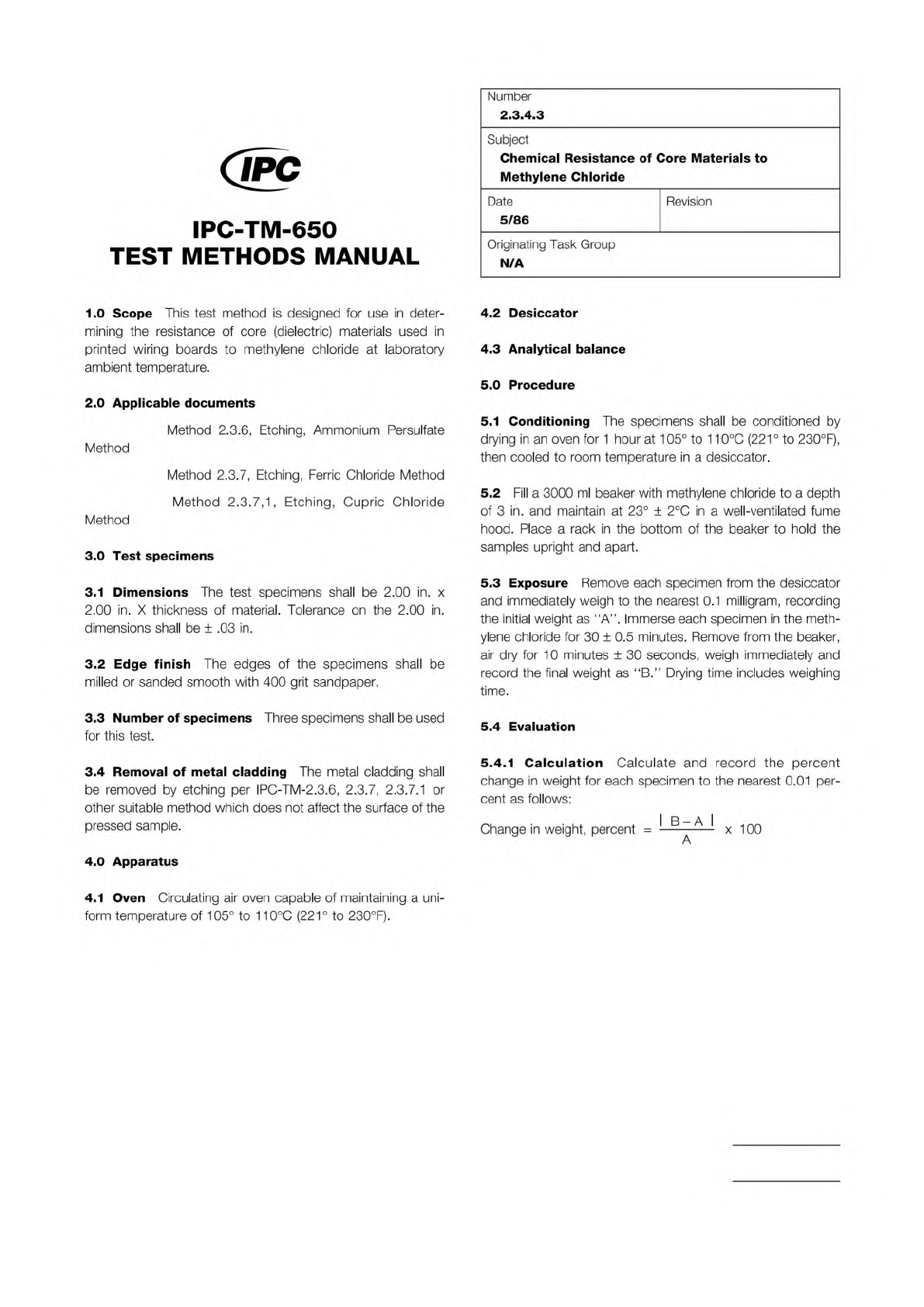
5.4.1
Calculation
Calculate
and
record
the
percent
change
in
weight
for
each
specimen
to
the
nearest
0.01
per¬
cent
as
follows:
Change
in
weight,
percent
=
〔
〉
一
一
〔
x
1
00