IPC-TM-650 EN 2022 试验方法--.pdf - 第162页
T able 1 Prepreg (1) Material T ype Oven (1) T e mperature T est (1) Time Difunctional Epoxy , T etrafunctional Epoxy , Multifunctional Ep oxy , Polyimide Blend 163°C ( 325°F) 1 5 ± 1 minute Polyimide 225°C ( 437°F) 3 0 …
The Institute for Interconnecting and Packaging Electronic Circuits
2215 Sanders Road • Northbrook, IL 60062-6135
Material in this Test Methods Manual was voluntarily established by Technical Committees of the IPC. This material is advisory only
and its use or adaptation is entirely voluntary. IPC disclaims all liability of any kind as to the use, application, or adaptation of this
material. Users are also wholly responsible for protecting themselves against all claims or liabilities for patent infringement.
Equipment referenced is for the convenience of the user and does not imply endorsement by the IPC.
Page 1 of 1
IPC-TM-650
TEST
METHODS
MANUAL
1
.0
Scope
1.1
The
purpose
of
this
test
method
is
to
provide
a
proce¬
dure
for
determining
the
gel
time
of
resin
preimpregnated
“B”
Stage
glass
fabric.
2
.0
Applicable
Documents
None.
3
.0
Test
Specimen
3.1
Sufficient
quantity
of
prepreg
to
yield
approximately
1
000
milligrams
of
dry
resin
powder.
4
.0
Equipment/Apparatus
4.1
Platen,
hot
plate
or
melting
point
apparatus
capable
of
maintaining
a
temperature
of
171°
±
0.5℃
(340°
F
±
0.9°F).
4.2
Timer,
capable
of
determining
time
within
±
1
second.
4.3
Toothpicks.
4.4
Plastic/polyethylene
bags
or
suitable
container.
4.5
Analytical
balance
capable
of
weighing
within
±
20
milli¬
grams.
4.6
Wire
Mesh
—
60
mesh.
4.7
Montan
Wax.
5
.0
Procedure
5.1
Place
the
prepreg
(B-Stage)
in
a
plastic
bag
or
other
suitable
container,
and
extract
the
dry
resin
from
the
B-Stage
by
folding
or
crushing.
5.2
Allow
the
B-Stage
resin
to
collect
in
the
bottom
of
the
plastic
bag.
5.3
Pour
the
collected
resin
into
a
container
through
60
wire
mesh,
to
remove
any
fiber
glass
particles.
Number
2.3.18
Subject
Gel
Time,
Prepreg
Materials
Date
Revision
4/86
A
Originating
Task
Group
N/A
5.5
Using
the
analytical
balance
weigh
out
200
±
20
milli¬
grams
of
resin
on
to
3
in.
x
3
in.
sheet
of
wax
paper
or
a
suit¬
able
container.
5.6
Make
sure
that
the
melting
point
apparatus
is
clean;
mold
released
with
montan
wax
or
equivalent;
and
wiped
free
of
any
visible
mold
release.
5.7
Pour
200
milligram
sample
of
resin
on
the
center
of
the
melting
point
apparatus
and
start
the
timing
device
immedi¬
ately.
5.8
Place
the
tapered
end
of
a
round
toothpick
against
the
surface
of
the
cure
plate
(end
of
the
toothpick
not
in
contact
with
surface
of
the
cure
plate
will
have
to
be
elevated
slightly).
5.9
Roll
toothpick
back
and
forth,
maintaining
contact
with
the
surface
of
the
cure
plate
until
20
seconds
have
elapsed.
5.10
At
this
time
start
stroking
the
resin
immediately,
using
a
circular
motion
3/8
in.
to
1/2
in.
in
diameter.
Stroke
in
such
a
manner
that
every
circle
moves
part
of
the
resin
from
the
center
of
the
pool
to
the
outside,
and
part
of
the
resin
from
the
outside
of
the
pool
toward
the
center.
Care
should
be
taken
to
limit
the
pool
size
to
an
area
3/4
in.
to
7/8
in.
in
diameter.
5.1
1
Keep
the
toothpick
in
contact
with
resin
and
surface
of
the
cure
plate
at
all
times.
As
the
resin
becomes
stiff,
it
will
not
be
possible
to
continue
exchanging
outside
resin
with
inside
resin,
but
continue
stroking
with
as
much
exchange
as
pos¬
sible
without
breaking
the
toothpick.
5.12
If
the
resin
breaks
up,
continue
stroking
the
largest
piece.
If
this
piece
breaks
up,
continue
stroking
the
largest
remaining
piece
of
this
portion
even
though
now
a
larger
piece
of
the
original
pool
may
be
present
at
some
other
place
on
the
hot
plate.
5.13
When
the
stroked
piece
separates
from
the
hot
plate,
stop
the
watch.
This
is
the
end
point,
and
the
total
elapsed
time
in
the
gel
time.
5.4
Set
the
melting
point
apparatus
at
171°
±
0.5℃
(340°
±
0.9°F)
and
allow
to
stabilize
at
that
temperature.
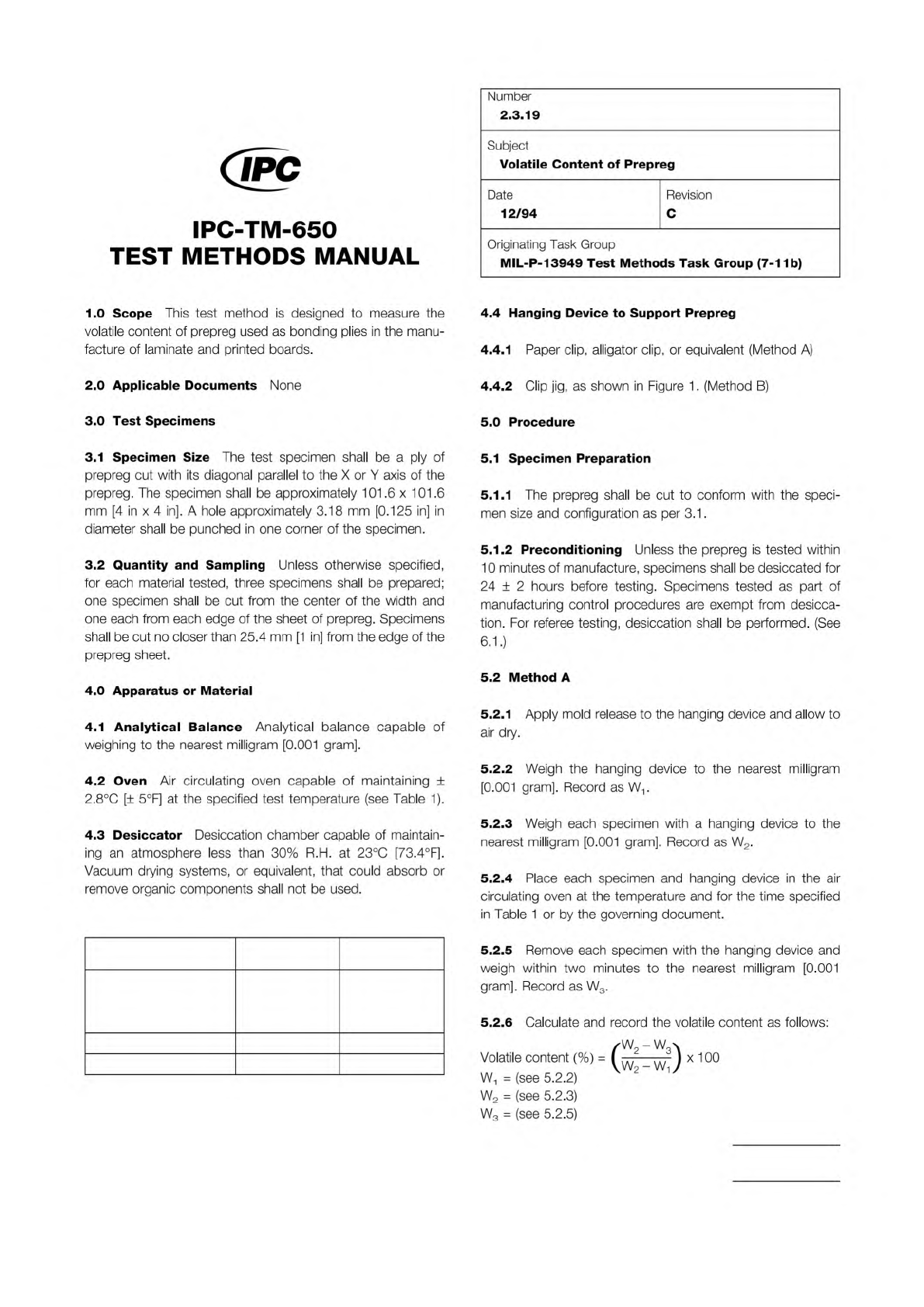
Table 1
Prepreg
(1)
Material Type
Oven
(1)
Temperature
Test
(1)
Time
Difunctional Epoxy,
Tetrafunctional Epoxy,
Multifunctional Epoxy,
Polyimide Blend
163°C (325°F) 15 ± 1 minute
Polyimide 225°C (437°F) 30 ± 1 minute
Cyanate Ester 145°C (293°F) 15 ± 1 minute
(1) For material types that do not conform to the types listed,
follow the manufacturer’s instructions for temperature and
time.
The Institute for Interconnecting and Packaging Electronic Circuits
2215 Sanders Road • Northbrook, IL 60062-6135
Material in this Test Methods Manual was voluntarily established by Technical Committees of the IPC. This material is advisory only
and its use or adaptation is entirely voluntary. IPC disclaims all liability of any kind as to the use, application, or adaptation of this
material. Users are also wholly responsible for protecting themselves against all claims or liabilities for patent infringement.
Equipment referenced is for the convenience of the user and does not imply endorsement by the IPC.
Page 1 of 3
IPC-TM-650
TEST
METHODS
MANUAL
1
.0
Scope
This
test
method
is
designed
to
measure
the
volatile
content
of
prepreg
used
as
bonding
plies
in
the
manu¬
facture
of
laminate
and
printed
boards.
2
.0
Applicable
Documents
None
3
.0
Test
Specimens
3.1
Specimen
Size
The
test
specimen
shall
be
a
ply
of
prepreg
cut
with
its
diagonal
parallel
to
the
X
or
Y
axis
of
the
prepreg.
The
specimen
shall
be
approximately
101
.6
x
101
.6
mm
[4
in
x
4
in].
A
hole
approximately
3.18
mm
[0.125
in]
in
diameter
shall
be
punched
in
one
corner
of
the
specimen.
3.2
Quantity
and
Sampling
Unless
otherwise
specified,
for
each
material
tested,
three
specimens
shall
be
prepared;
one
specimen
shall
be
cut
from
the
center
of
the
width
and
one
each
from
each
edge
of
the
sheet
of
prepreg.
Specimens
shall
be
cut
no
closer
than
25.4
mm
[1
in]
from
the
edge
of
the
prepreg
sheet.
4
.0
Apparatus
or
Material
4.1
Analytical
Balance
Analytical
balance
capable
of
weighing
to
the
nearest
milligram
[0.001
gram].
4.2
Oven
Air
circulating
oven
capable
of
maintaining
±
2.8℃
[±
5°F]
at
the
specified
test
temperature
(see
Table
1).
4.3
Desiccator
Desiccation
chamber
capable
of
maintain¬
ing
an
atmosphere
less
than
30%
R.H.
at
23℃
[73.
4°
F].
Vacuum
drying
systems,
or
equivalent,
that
could
absorb
or
remove
organic
components
shall
not
be
used.
Number
2.3.19
Subject
Volatile
Content
of
Prepreg
Date
Revision
12/94
C
Originating
Task
Group
MIL-P-13949
Test
Methods
Task
Group
(7-1
1b)
4.4
Hanging
Device
to
Support
Prepreg
4.4.1
Paper
clip,
alligator
clip,
or
equivalent
(Method
A)
4.4.2
Clip
jig,
as
shown
in
Figure
1
.
(Method
B)
5.0
Procedure
5.1
Specimen
Preparation
5.1.1
The
prepreg
shall
be
cut
to
conform
with
the
speci¬
men
size
and
configuration
as
per
3.1
.
5.1.2
Preconditioning
Unless
the
prepreg
is
tested
within
10
minutes
of
manufacture,
specimens
shall
be
desiccated
for
24
±
2
hours
before
testing.
Specimens
tested
as
part
of
manufacturing
control
procedures
are
exempt
from
desicca¬
tion.
For
referee
testing,
desiccation
shall
be
performed.
(See
6.1.)
5.2
Method
A
5.2.1
Apply
mold
release
to
the
hanging
device
and
allow
to
air
dry.
5.2.2
Weigh
the
hanging
device
to
the
nearest
milligram
[0.001
gram].
Record
as
W
「
5.2.3
Weigh
each
specimen
with
a
hanging
device
to
the
nearest
milligram
[0.001
gram].
Record
as
W2.
5.2.4
Place
each
specimen
and
hanging
device
in
the
air
circulating
oven
at
the
temperature
and
for
the
time
specified
in
Table
1
or
by
the
governing
document.
5.2.5
Remove
each
specimen
with
the
hanging
device
and
weigh
within
two
minutes
to
the
nearest
milligram
[0.001
gram].
Record
as
W3.
5.2.6
Calculate
and
record
the
volatile
content
as
follows:
Volatile
content
(%)
二
一
寻)
x
100
=
(see
5.2.2)
V
2
"
W2
=
(see
523)
W3
=
(see
5.2.5)
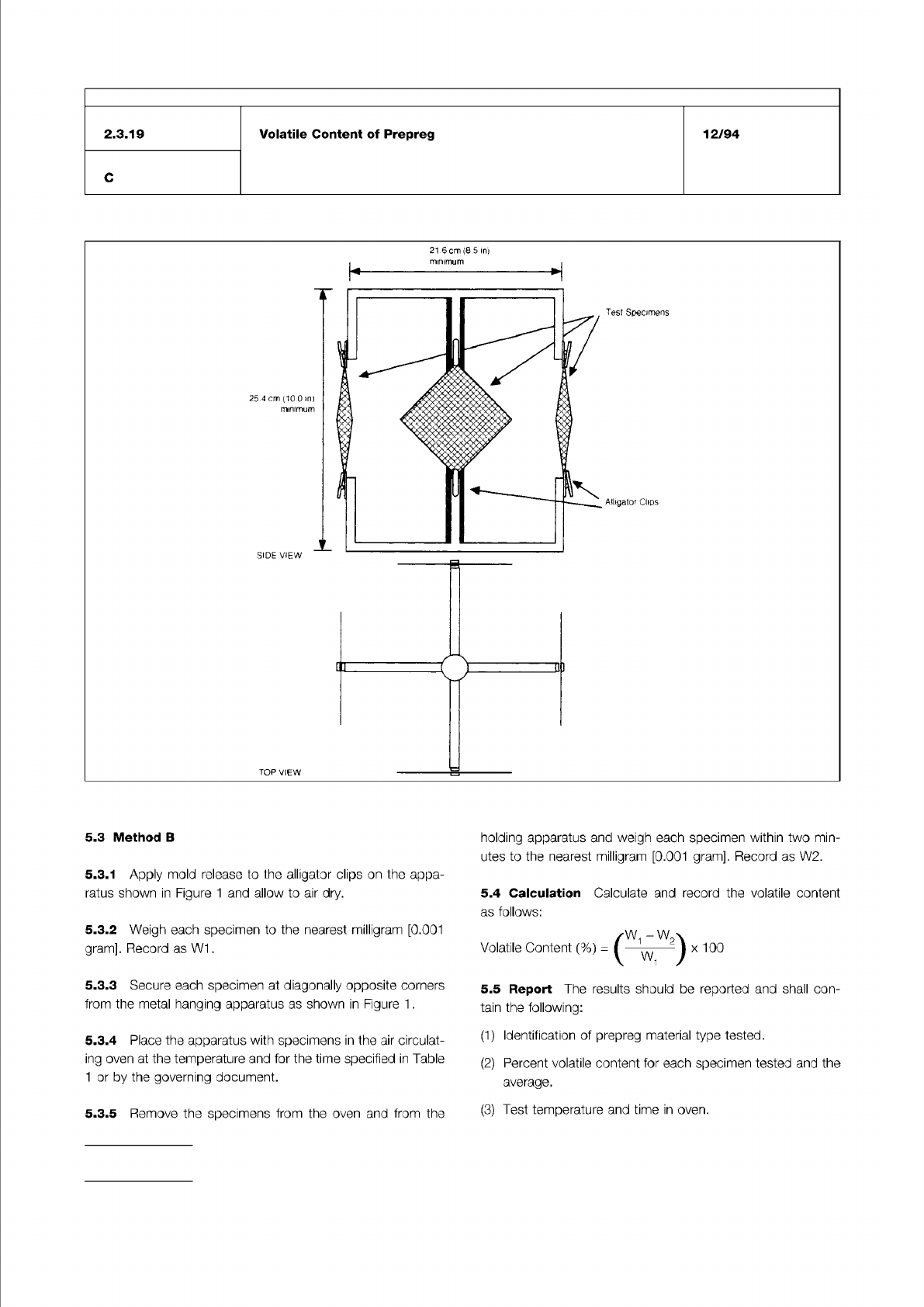
Figure 1 Method of holding device
IPC-TM-650
Number
Subject Date
Revision
Page 2 of 3
2.3.19
Volatile
Content
of
Prepreg
12/94
C
21
6
cm
(8
5
inj
minimum
TOP
VIEW
5.3
Method
B
5.3.1
Apply
mold
release
to
the
alligator
clips
on
the
appa¬
ratus
shown
in
Figure
1
and
allow
to
air
dry.
5.3.2
Weigh
each
specimen
to
the
nearest
milligram
[0.001
gram].
Record
as
W1
.
5.3.3
Secure
each
specimen
at
diagonally
opposite
comers
from
the
metal
hanging
apparatus
as
shown
in
Figure
1
.
5.3.4
Place
the
apparatus
with
specimens
in
the
air
circulat¬
ing
oven
at
the
temperature
and
for
the
time
specified
in
Table
1
or
by
the
governing
document.
5.3.5
Remove
the
specimens
from
the
oven
and
from
the
holding
apparatus
and
weigh
each
specimen
within
two
min¬
utes
to
the
nearest
milligram
[0.001
gram].
Record
as
W2.
5.4
Calculation
Calculate
and
record
the
volatile
content
as
follows:
,叫-
W2x
Volatile
Content
(%)
二
(
一
—
——
)
x
100
5.5
Report
The
results
should
be
reported
and
shall
con¬
tain
the
following:
(1)
Identification
of
prepreg
material
type
tested.
(2)
Percent
volatile
content
for
each
specimen
tested
and
the
average.
(3)
Test
temperature
and
time
in
oven.