IPC-TM-650 EN 2022 试验方法--.pdf - 第572页
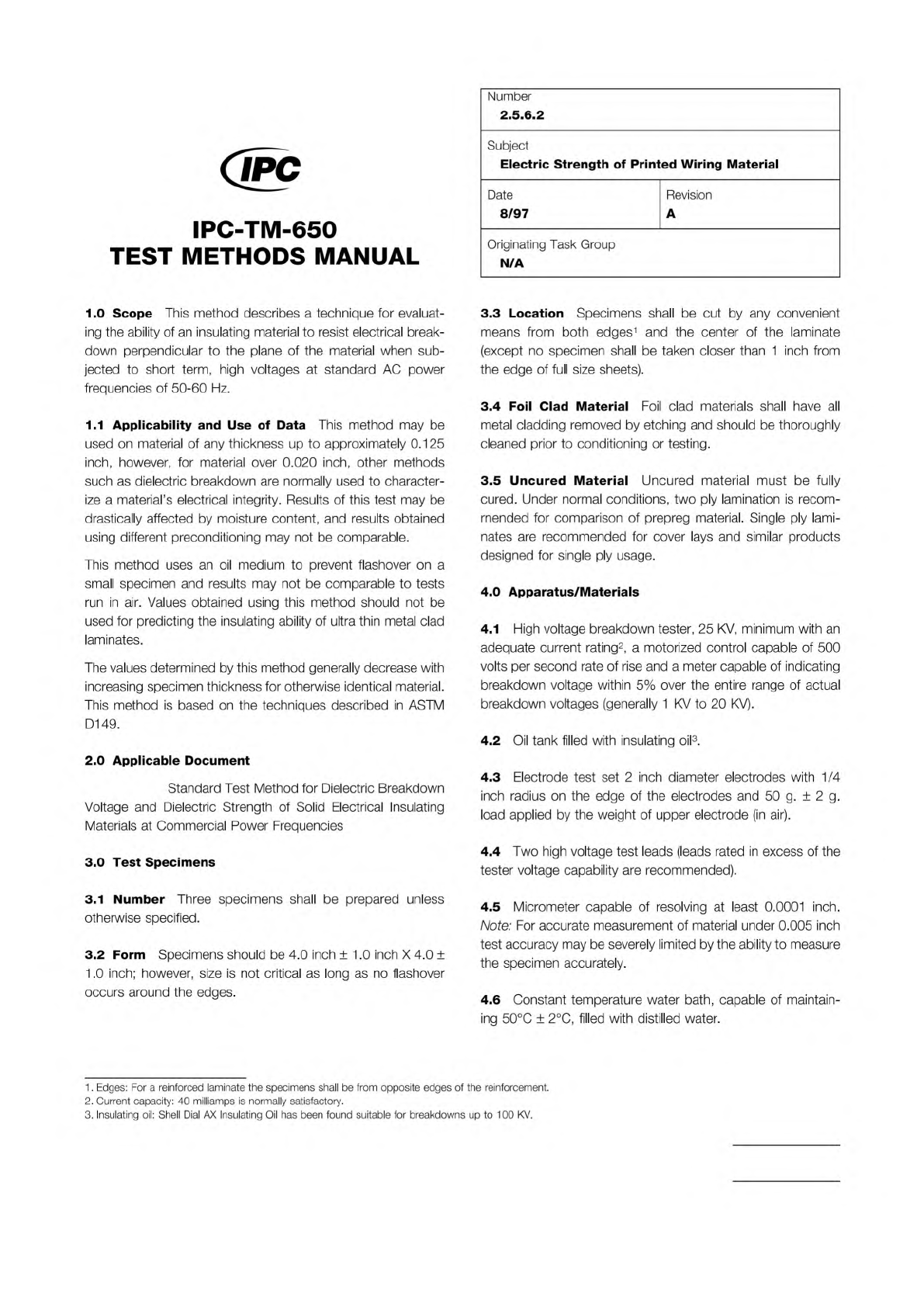
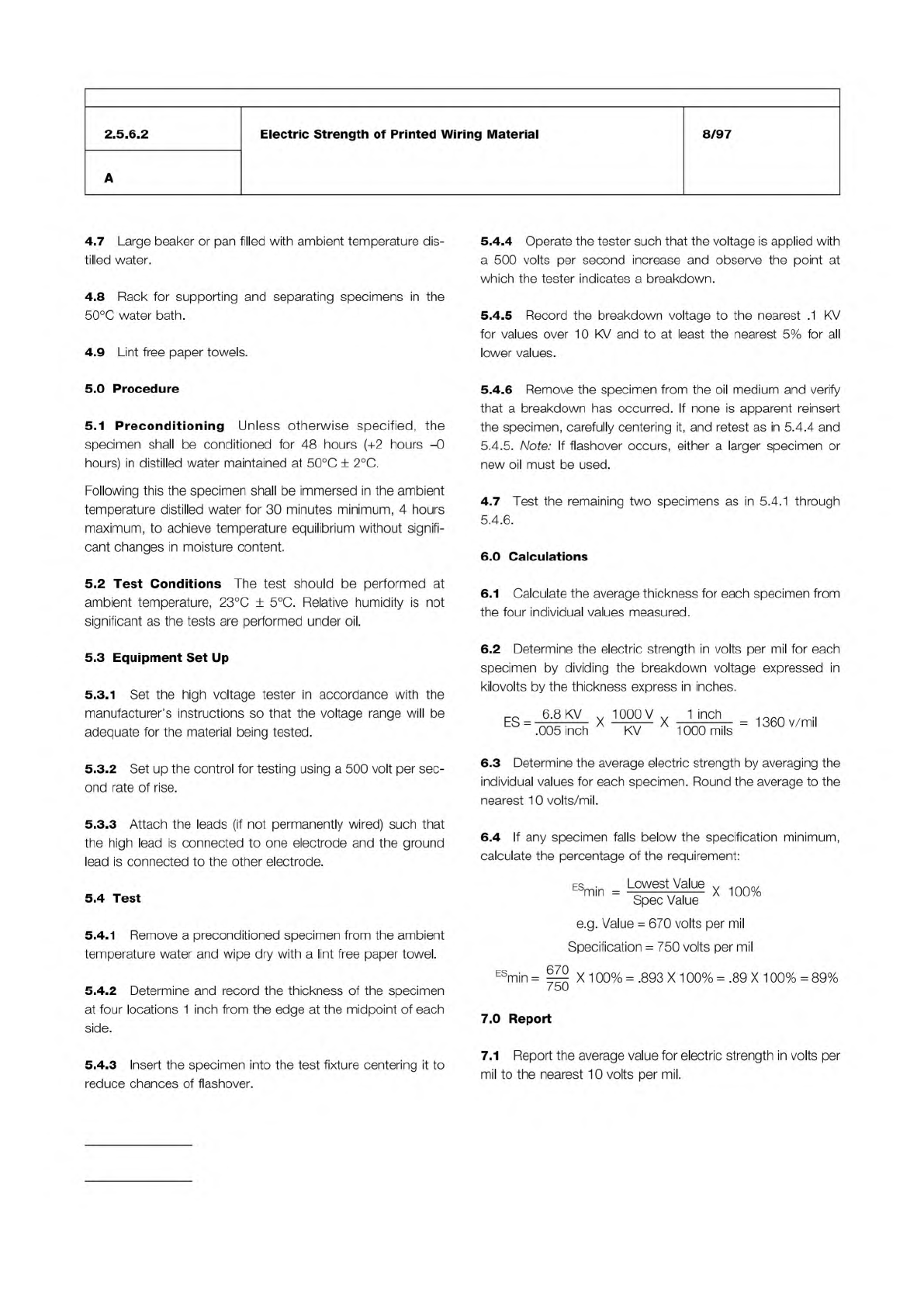
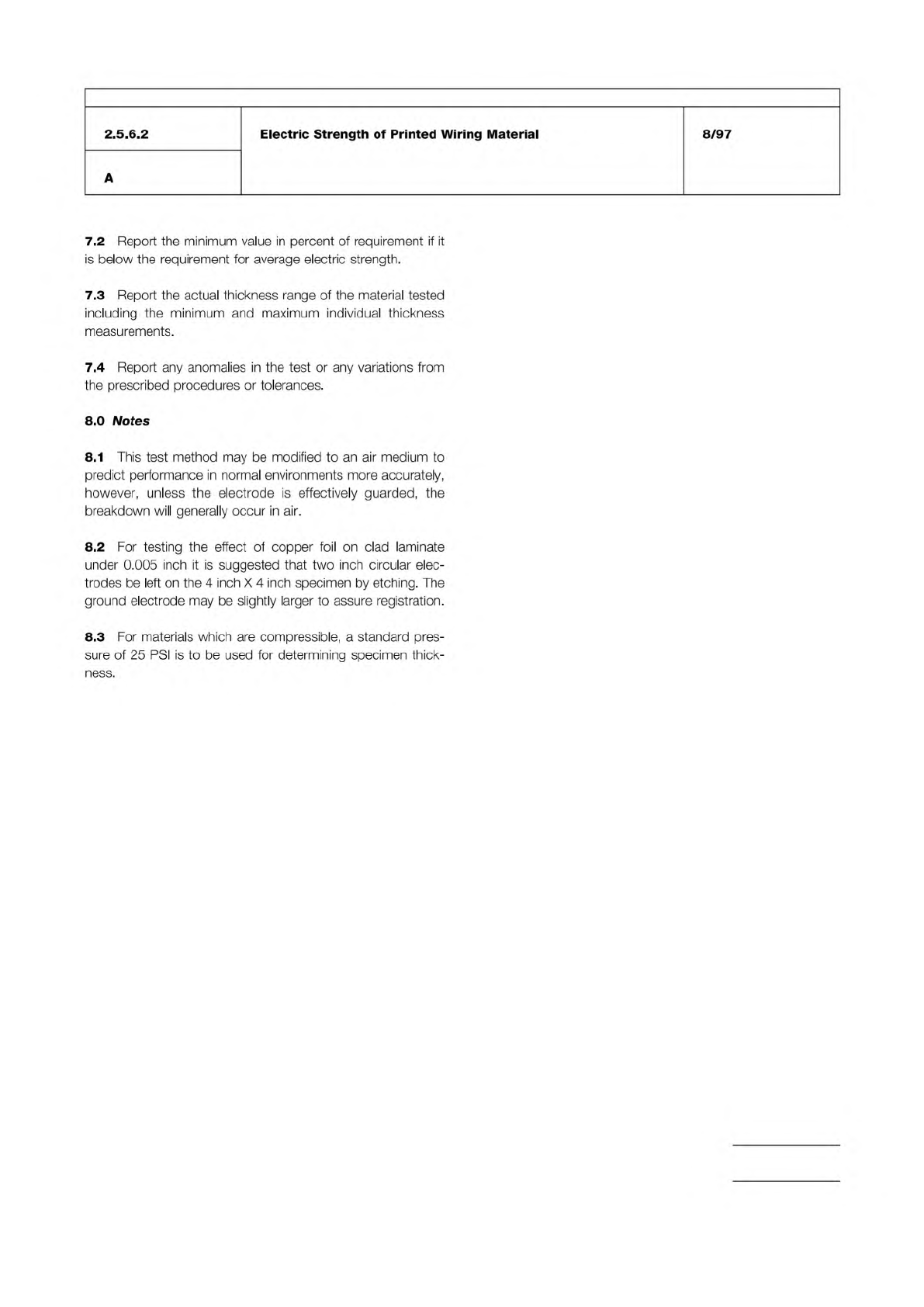
IPC-TM-650 Number Subject Date Revision Page 2 of 3 2.5.6.2 Electric Strength of Printed Wiring Material 8/97 A 4.7 Large beaker or pan filled with ambient temperature dis¬ tilled water. 4.8 Rack for supporting and separ…
ASTM D149
The Institute for Interconnecting and Packaging Electronic Circuits
2215 Sanders Road • Northbrook, IL 60062
Material in this Test Methods Manual was voluntarily established by Technical Committees of the IPC. This material is advisory only
and its use or adaptation is entirely voluntary. IPC disclaims all liability of any kind as to the use, application, or adaptation of this
material. Users are also wholly responsible for protecting themselves against all claims or liabilities for patent infringement.
Equipment referenced is for the convenience of the user and does not imply endorsement by the IPC.
Page 1 of 3
IPC-TM-650
TEST
METHODS
MANUAL
1
.0
Scope
This
method
describes
a
technique
for
evaluat¬
ing
the
ability
of
an
insulating
material
to
resist
electrical
break¬
down
perpendicular
to
the
plane
of
the
material
when
sub¬
jected
to
short
term,
high
voltages
at
standard
AC
power
frequencies
of
50-60
Hz.
1.1
Applicability
and
Use
of
Data
This
method
may
be
used
on
material
of
any
thickness
up
to
approximately
0.125
inch,
however,
for
material
over
0.020
inch,
other
methods
such
as
dielectric
breakdown
are
normally
used
to
character¬
ize
a
material's
electrical
integrity.
Results
of
this
test
may
be
drastically
affected
by
moisture
content,
and
results
obtained
using
different
preconditioning
may
not
be
comparable.
This
method
uses
an
oil
medium
to
prevent
flashover
on
a
small
specimen
and
results
may
not
be
comparable
to
tests
run
in
air.
Values
obtained
using
this
method
should
not
be
used
for
predicting
the
insulating
ability
of
ultra
thin
metal
clad
laminates.
The
values
determined
by
this
method
generally
decrease
with
increasing
specimen
thickness
for
otherwise
identical
material.
This
method
is
based
on
the
techniques
described
in
ASTM
D149.
2
.0
Applicable
Document
Standard
Test
Method
for
Dielectric
Breakdown
Voltage
and
Dielectric
Strength
of
Solid
Electrical
Insulating
Materials
at
Commercial
Power
Frequencies
3
.0
Test
Specimens
3.1
Number
Three
specimens
shall
be
prepared
unless
otherwise
specified.
3.2
Form
Specimens
should
be
4.0
inch
±
1.0
inch
X
4.0
±
1
.0
inch;
however,
size
is
not
critical
as
long
as
no
flashover
occurs
around
the
edges.
Number
2.5.6.2
Subject
Electric
Strength
of
Printed
Wiring
Material
Date
Revision
8/97
A
Originating
Task
Group
N/A
3.3
Location
Specimens
shall
be
cut
by
any
convenient
means
from
both
edges1
and
the
center
of
the
laminate
(except
no
specimen
shall
be
taken
closer
than
1
inch
from
the
edge
of
full
size
sheets).
3.4
Foil
Clad
Material
Foil
clad
materials
shall
have
all
metal
cladding
removed
by
etching
and
should
be
thoroughly
cleaned
prior
to
conditioning
or
testing.
3.5
Uncured
Material
Uncured
material
must
be
fully
cured.
Under
normal
conditions,
two
ply
lamination
is
recom¬
mended
for
comparison
of
prepreg
material.
Single
ply
lami¬
nates
are
recommended
for
cover
lays
and
similar
products
designed
for
single
ply
usage.
4
.0
Apparatus/Materials
4.1
High
voltage
breakdown
tester,
25
KV,
minimum
with
an
adequate
current
rating2,
a
motorized
control
capable
of
500
volts
per
second
rate
of
rise
and
a
meter
capable
of
indicating
breakdown
voltage
within
5%
over
the
entire
range
of
actual
breakdown
voltages
(generally
1
KV
to
20
KV).
4.2
Oil
tank
filled
with
insulating
oil3.
4.3
Electrode
test
set
2
inch
diameter
electrodes
with
1/4
inch
radius
on
the
edge
of
the
electrodes
and
50
g.
±
2
g.
load
applied
by
the
weight
of
upper
electrode
(in
air).
4.4
Two
high
voltage
test
leads
(leads
rated
in
excess
of
the
tester
voltage
capability
are
recommended).
4.5
Micrometer
capable
of
resolving
at
least
0.0001
inch.
Note:
For
accurate
measurement
of
material
under
0.005
inch
test
accuracy
may
be
severely
limited
by
the
ability
to
measure
the
specimen
accurately.
4.6
Constant
temperature
water
bath,
capable
of
maintain¬
ing
50℃
±
2
℃,
filled
with
distilled
water.
1
.
Edges:
For
a
reinforced
laminate
the
specimens
shall
be
from
opposite
edges
of
the
reinforcement.
2.
Current
capacity:
40
milliamps
is
normally
satisfactory.
3.
Insulating
oil:
Shell
Dial
AX
Insulating
Oil
has
been
found
suitable
for
breakdowns
up
to
100
KV.
IPC-TM-650
Number
Subject Date
Revision
Page 2 of 3
2.5.6.2
Electric
Strength
of
Printed
Wiring
Material
8/97
A
4.7
Large
beaker
or
pan
filled
with
ambient
temperature
dis¬
tilled
water.
4.8
Rack
for
supporting
and
separating
specimens
in
the
50℃
water
bath.
4.9
Lint
free
paper
towels.
5.0
Procedure
5.1
Preconditioning
Unless
otherwise
specified,
the
specimen
shall
be
conditioned
for
48
hours
(+2
hours
-0
hours)
in
distilled
water
maintained
at
50℃
±
2
℃.
Following
this
the
specimen
shall
be
immersed
in
the
ambient
temperature
distilled
water
for
30
minutes
minimum,
4
hours
maximum,
to
achieve
temperature
equilibrium
without
signifi¬
cant
changes
in
moisture
content.
5.2
Test
Conditions
The
test
should
be
performed
at
ambient
temperature,
23℃
土
5
℃.
Relative
humidity
is
not
significant
as
the
tests
are
performed
under
oil.
5.3
Equipment
Set
Up
5.3.1
Set
the
high
voltage
tester
in
accordance
with
the
manufacturer's
instructions
so
that
the
voltage
range
will
be
adequate
for
the
material
being
tested.
5.3.2
Set
up
the
control
for
testing
using
a
500
volt
per
sec¬
ond
rate
of
rise.
5.3.3
Attach
the
leads
(if
not
permanently
wired)
such
that
the
high
lead
is
connected
to
one
electrode
and
the
ground
lead
is
connected
to
the
other
electrode.
5.4
Test
5.4.1
Remove
a
preconditioned
specimen
from
the
ambient
temperature
water
and
wipe
dry
with
a
lint
free
paper
towel.
5.4.2
Determine
and
record
the
thickness
of
the
specimen
at
four
locations
1
inch
from
the
edge
at
the
midpoint
of
each
side.
5.4.3
Insert
the
specimen
into
the
test
fixture
centering
it
to
reduce
chances
of
flashover.
5.4.4
Operate
the
tester
such
that
the
voltage
is
applied
with
a
500
volts
per
second
increase
and
observe
the
point
at
which
the
tester
indicates
a
breakdown.
5.4.5
Record
the
breakdown
voltage
to
the
nearest
.1
KV
for
values
over
1
0
KV
and
to
at
least
the
nearest
5%
for
all
lower
values.
5.4.6
Remove
the
specimen
from
the
oil
medium
and
verify
that
a
breakdown
has
occurred.
If
none
is
apparent
reinsert
the
specimen,
carefully
centering
it,
and
retest
as
in
5.4.4
and
5.4.5.
Note:
If
flashover
occurs,
either
a
larger
specimen
or
new
oil
must
be
used.
4.7
Test
the
remaining
two
specimens
as
in
5.4.1
through
5.4.6.
6.0
Calculations
6.1
Calculate
the
average
thickness
for
each
specimen
from
the
four
individual
values
measured.
6.2
Determine
the
electric
strength
in
volts
per
mil
for
each
specimen
by
dividing
the
breakdown
voltage
expressed
in
kilovolts
by
the
thickness
express
in
inches.
i-o
6.8
KV
-
.005
inch
1000
V
v
x
1
inch
1
000
mils
=
1360
v/mil
6.3
Determine
the
average
electric
strength
by
averaging
the
individual
values
for
each
specimen.
Round
the
average
to
the
nearest
1
0
volts/mil.
6.4
If
any
specimen
falls
below
the
specification
minimum,
calculate
the
percentage
of
the
requirement:
es
•
Lowest
Value
2m
in
=
—
—
——
X
100%
Spec
Value
e.g.
Value
=
670
volts
per
mil
Specification
=
750
volts
per
mil
ESmin
=
染
X
1
00%
=
.893
X
1
00%
=
.89
X
1
00%
=
89%
7.0
Report
7.1
Report
the
average
value
for
electric
strength
in
volts
per
mil
to
the
nearest
10
volts
per
mil.
IPC-TM-650
Number
Subject Date
Revision
Page 3 of 3
2.5.6.2
Electric
Strength
of
Printed
Wiring
Material
8/97
A
7.2
Report
the
minimum
value
in
percent
of
requirement
if
it
is
below
the
requirement
for
average
electric
strength.
7.3
Report
the
actual
thickness
range
of
the
material
tested
including
the
minimum
and
maximum
individual
thickness
measurements.
7.4
Report
any
anomalies
in
the
test
or
any
variations
from
the
prescribed
procedures
or
tolerances.
8.0
Notes
8.1
This
test
method
may
be
modified
to
an
air
medium
to
predict
performance
in
normal
environments
more
accurately,
however,
unless
the
electrode
is
effectively
guarded,
the
breakdown
will
generally
occur
in
air.
8.2
For
testing
the
effect
of
copper
foil
on
clad
laminate
under
0.005
inch
it
is
suggested
that
two
inch
circular
elec¬
trodes
be
left
on
the
4
inch
X
4
inch
specimen
by
etching.
The
ground
electrode
may
be
slightly
larger
to
assure
registration.
8.3
For
materials
which
are
compressible,
a
standard
pres¬
sure
of
25
PSI
is
to
be
used
for
determining
specimen
thick¬
ness.