IPC-TM-650 EN 2022 试验方法--.pdf - 第643页
plating, circuit developing baths and soldering re-flows. Mate- rials so affected should be brought to eq uilibrium with ap pro- pri ate at mosphere and temperatu re control before test ing. Description of the conditioni…
1 Scope
The Power Density Rating (PDR) for Embedded
Resistors test method covers procedures for the demonstra-
tion of the ability to operate the embedded device safely, with-
out a permanent change in the electrical characteristic of the
device. The procedure consists of monitoring a resistance
change from its nominal value as a function of the dissipated
power. During the test, the applied voltage or current stimulus
is held until the device temperature is stable, the steady resis-
tance reading is reached, and the dissipated power is mea-
sured. This process is repeated with higher dissipated power
until the measured resistance change exceeds the specifica-
tion limits. The results are presented in terms of the dissipated
power density rating (PDR) factor for the embedded resistive
device.
This document describes testing procedure for power density
rating of embedded resistive devices, which operate in com-
plex electrical and thermal environments, and for which exist-
ing procedures are not adequate or inapplicable.
2 Applicable Documents
Specification for Embedded Passive Device Resis-
tor Materials for Rigid and Multilayer Printed Boards
Test Methods Manual
1.3 Ambient Conditions
3 Terminology
When current passes through a resistor,
electrical energy is dissipated by the resistor in the form of
heat. A resistor can be used at any combination of voltage
and current as long as its dissipating power (P) does not
exceed the maximum power rating (P
max
) indicating how
much power the resistor can convert into heat and absorb
or/and transfer away without any damage to itself or to the
surrounding circuitry.
3.1 Electrical Resistance,
R = V / I (1)
R is a ratio of voltage V over current I, (Ohm’s law), the unit of
measure is ohm [Ω].
3.2 Dissipated Power,
Direct current (DC):
P = V I; P = V
2
/ R; P = I
2
R (2)
Alternating current (AC):
P = V* I* cos (ϕ) (3)
V* and I* are voltage and current amplitudes, and ϕ is the
phase angle between V* and I*.
3.3 Power Density Rating
The power density rating (PDR)
is defined as the total dissipated power normalized by the
effective surface area (heat flux cross sectional area).
PDR = P
max
/ S (4)
where, S is the area of the embedded resistor or device
defined as one-side of the heat flux area.
3.4 Power Density Rating Comments
• The power that can be dissipated by a resistor is limited by
the size of the resistor and the maximum operational tem-
perature of the resistive material.
• The power ratings depend on thermal management of the
heat generated from the resistor.
• The use of heat sinks can lower the device’s operating tem-
perature and consequently increase the power rating.
• Higher glass transition temperature laminate materials in
which the resistive device is embedded can allow higher
operating temperatures.
4 Test Specimen
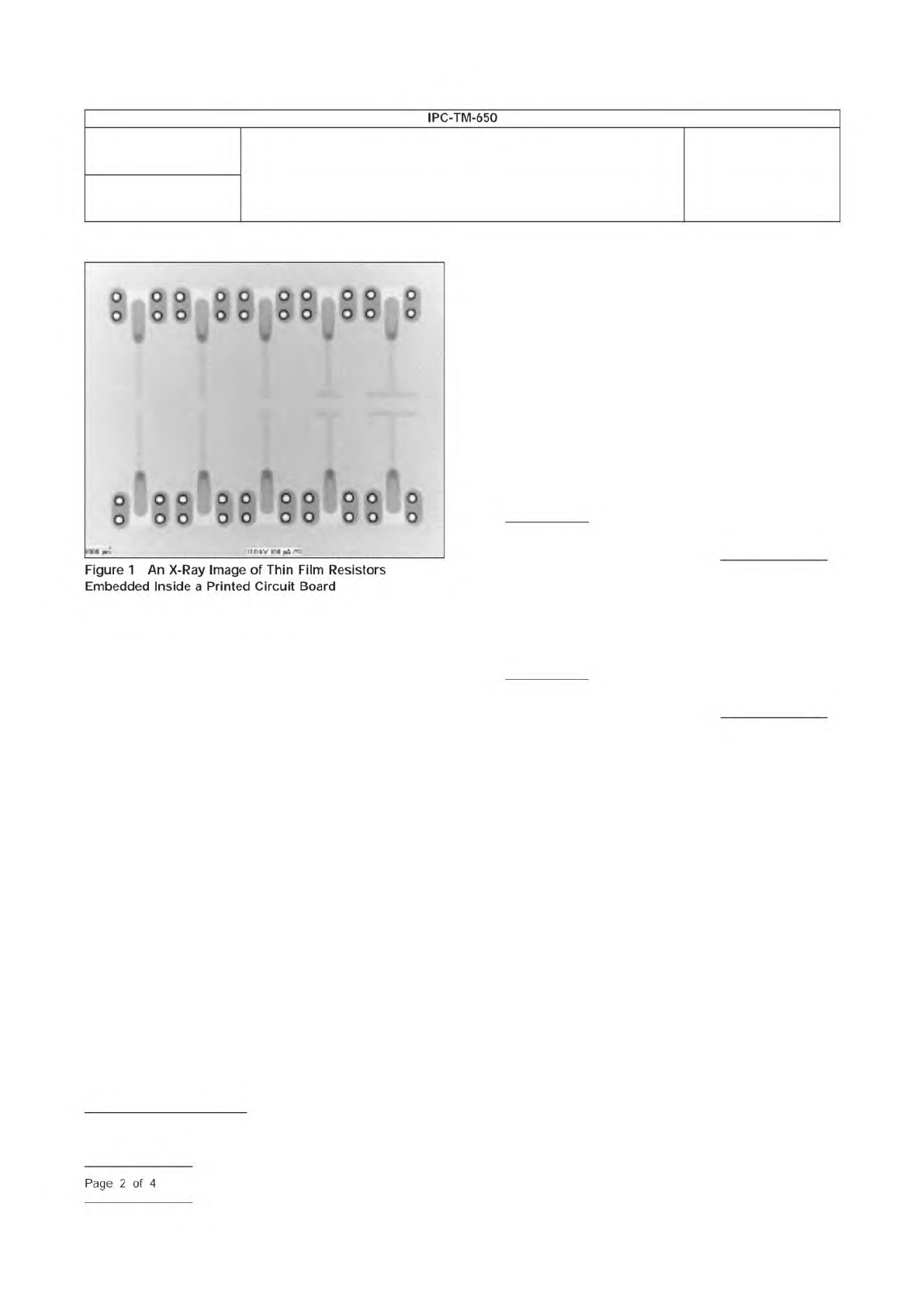
This method recommends testing the
embedded resistors in configurations that reflect the actual
functional application (Figure 1).
The recommended geometrical attributes of the embedded
resistors are specified in the IPC-4811.
4.1 Sampling
The sampling procedure for the tested
specimen should be defined in the specification for that
device. The sampling procedure should provide sufficient data
to estimate the average quality and the variability of the lot
being examined.
4.2 Conditioning
The test results can be influenced by
temperature, moisture content and other electrically active
residuals originating from the processing conditions such as
3000 Lakeside Drive, Suite 309S
Bannockburn, IL 60015-1249
IPC-TM-650
TEST METHODS MANUAL
Number
2.5.34
Subject
Power Density Rating for Embedded Resistors
Date
07/12
Revision
Originating Task Group
Embedded Devices Test Methods Subcommittee
(D-54)
Association
Connecting
Electronics
Industries
IPC-4811
IPC-TM-650
R
P
Material
/n
this
Test
Methods
Manual
was
voluntarily
established
by
Technical
Committees
of
I
PC.
This
material
/s
advisory
only
and
"s
use
or
adaptation
,
s
entirely
voluntary.
IPC
disclaims
all
liability
of
any
kind
as
to
the
use,
application,
or
adaptation
of
this
material.
Users
are
also
wholly
responsible
for
protecting
themselves
against
all
claims
or
liabilities
for
patent
infringement.
Equipment
referenced
/s
for
the
convenience
of
the
user
and
does
not
imply
endorsement
by
IPC.
Page
1
of
4
plating, circuit developing baths and soldering re-flows. Mate-
rials so affected should be brought to equilibrium with appro-
priate atmosphere and temperature control before testing.
Description of the conditioning should be included in the test-
ing report.
5 Apparatus
The method requires a power source meter
and electrical resistance meter, such as Keithley
1
Source
Meter or equivalent, for sourcing the applied DC power and
measuring the resulting current resistance. The resolution
of resistance measurements should be in the range of about
0.1 Ω or better.
5.1 Power requirements
The power capacity of the
power sourcing instrumentation should be sufficient to main-
tain the test power until it reaches the value defined in the test
failure/acceptance criteria where the specimen-maximum
power will be dissipated. The voltage level should be stable to
within ± 0.1% of the set value during the testing time. An out-
put current of 1 µA to 1 A is usually sufficient for most testing
conditions. The power dissipated during the test may vary
depending on the specimen resistance thermal characteris-
tics, and the failure mechanism.
5.2 Circuit controls
The apparatus should be equipped
with a circuit breaking device with adjustable current/voltage
sensors, and be capable of disconnecting the power source
in the case of overloading conditions. The current/voltage-
sensing circuit should measure the specimen power and allow
for adjustment consistent with the specimen characteristics.
The sensing device should respond at the power level that is
indicative of the test conditions reaching the failure criteria.
5.3 Power level controls
The power level should be
adjustable with the possibility of setting discrete power level
values in at least 20 steps. It is recommended that the initial
power P
0
is set at 1/10 of the nominal operational power of
the device. A computerized experimental set-up is recom-
mended to carry out the test.
In the case of sourcing voltage, the initial voltage, V
0
=
√
0.1
*
P
nom
*
R
0
. For example, if the initial value of R
0
= 50
Ω and P
nom
= 0.1 W then the initial voltage V
0
corresponding
to 0.1 of P
nom
(i.e., P
0
= 0.010 W), is
√
0.1
*
0.1 W
*
50 Ω ≈
0.7 V. The voltage level V
n
should be increased in steps of V
s
≤ V
0
, each step having duration of about 60 s. The specimen
current I
n
should be monitored and recorded at every power
step (see 5.3.1).
In the case of sourcing current, the initial current, I
0
=
√
0.1
*
P
nom
/ R
0
. For example, if the initial value of R
0
= 50
Ω and P
nom
= 0.1 W, then the initial voltage V
0
corresponding
to 0.1 of P
nom
(i.e., P
0
= 0.010 W), is
√
0.1
*
0.1 W / 50 Ω ≈
0.014 A. The current level I
n
should be increased in steps of I
s
≤ I
0
, each step having a duration of about 60 s. The specimen
voltage V
n
should be monitored and recorded at every power
step (see 5.3.2).
5.3.1 Linear Voltage Steps
Increasing voltage in constant
voltage steps will result in a quadratic increase of power. At
the n
th
voltage step the power P
n
is given by (5):
P
n
= (V
0
+ nV
s
)
2
/ R
n
(5)
Example: R
n
= R
0
= 50 Ω, V
0
= 0.7 V, V
s
= 0.3 V. At n = 11
step V
11
= 4 V and the corresponding applied power P
11
=
(0.7 V + 11
*
0.3V)
2
/ 50 Ω = 0.32 W.
5.3.2 Linear Current Steps
Increasing current from I
0
by
adding a constant current step, I
s
, will result in a quadratic
increase of applied power. At the n
th
current step the power
P
n
is given by (6):
P
n
= (I
0
+ nI
s
)
2
*
R
n
(6)
1. Certain commercial equipment and materials are identified in this document in order to specify adequately the experimental procedure. In no case does such
identification imply recommendations nor does it imply that the material or equipment identified is necessarily the best available for this purpose.
Number
2.5.34
Subject
Power Density Rating for Embedded Resistors
Date
07/12
Revision
IPC-TM-650
o
o
o
o
o
o
o
o
o
o
o
Figure
1
An
X-Ray
Image
of
Thin
Film
Resistors
Embedded
Inside
a
Printed
Circuit
Board
Page
2
of
4
Example: R
n
= R
0
= 50 Ω, I
0
= 14 mA, I
s
= 6 mA. At n = 11
step I
11
= 80 mA and the corresponding applied power P
11
=
(0.014 A + 11
*
0.006 A)
2
*
50 Ω = 0.32 W.
5.3.3 Linear Power Steps
Setting the voltage or current
stimulus for linear increase in the applied power is given by (7)
and (8) respectively:
V
n
=
√
(P
0
+ nP
s
)
*
R
n
(7)
I
n
=
√
(P
0
+ nP
s
) / R
n
(8)
Example: R
n
= R
0
= 50 Ω, P
0
= 0.01 W, P
s
= 0.01 W. At step
n = 11 the applied power P
11
= 0.01 + 11
*
0.01 = 0.12 W.
The corresponding voltage stimulus V
11
=
√
0.12 W
*
50 Ω ≈
2.5 V. In the case of sourcing current the corresponding cur-
rent stimulus I
11
=
√
0.12 W / 50 Ω ≈ 0.048 A.
6 Procedure
Testing should be performed at ambient con-
ditions; temperature (t
0
) = 22 °C ± 3 °C [71.6 °F ± 5.4 °F] and
relative humidity (RH
0
) = 50% ± 10% (see IPC-TM-650,
Method 1.3, Ambient Conditions).
6.1
Measure the initial stable resistance, R
0
at the ambient
temperature (t
0
) and relative humidity (RH
0
).
6.2
Apply a constant power step P
n
for a period of 60 s,
until temperature stabilizes and a steady current reading is
reached (see 5.3).
6.3
Record voltage V
n
and the resulting current I
n
. Calculate
the actual P
n
from equation (2).
6.4
Disconnect the power for a period of time sufficient for
the device to return to the ambient temperature conditions t
0
.
Measure the device resistance R
n
. Calculate the relative differ-
ence between the measured resistance and the nominal resis-
tance:
(∆R)
r
= (R
n
− R
0
) / R
0
(9)
6.5
Continue stepping up the applied power (6.2 - 6.4) for
P
max
and/or P
failure
until the relative change in resistance, (∆R)
r
= (R
n
- R
0
) / R
0
approaches a value indicative of failure or
acceptance criteria.
6.6
After recording P
max
, calculate PDR using equation (4).
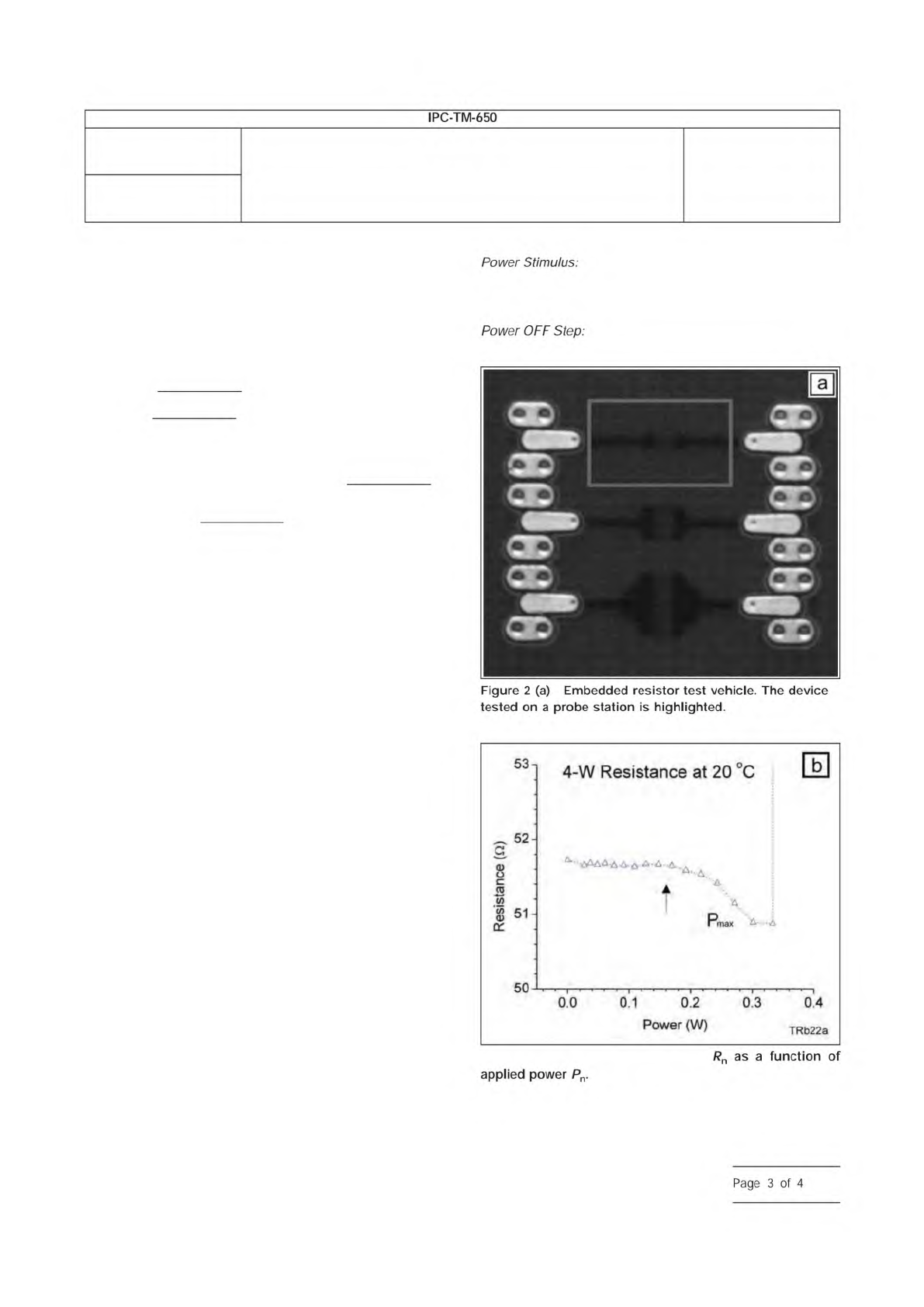
7 Test Example
An embedded resistor R
0
= 50 Ω, S =
0.77 mm
*
0.58 mm ≈ 0.44 mm
2
, shown in Figure 2a was
tested under the following conditions:
Linear voltage steps (5.3.1), P
0
= 0.01 W, V
0
= 0.7 V, V
s
= 0.2 V, power step ON = 60 s.
Recording: current I
n
, voltage V
n
, power P
n
.
20 s (typical). Recording 4-W resistance R
n
.
Figure 2b illustrates the test results. The stable resistance
value R
0
is about 51.7 Ω. It remains stable until the power
Figure 2 (b) Recorded resistance
Number
2.5.34
Subject
Power Density Rating for Embedded Resistors
Date
07/12
Revision
IPC-TM-650
—
Power
Stimulus:
Power
OFF
Step:
Figure
2
(a)
Embedded
resistor
test
vehicle.
The
device
tested
on
a
probe
station
is
highlighted.
4-W
Resistance
at
20
°C
国
50
-
•
I
J
1
*
1
I
1
r
•
i
1
1
'
*
I
•
'
•
-
k
0.0
0.1
0.2
0.3
0,4
Power
(W)
trm;
applied
power
Pn.
Rn
as
a
function
of
Page
3
of
4