IPC-TM-650 EN 2022 试验方法--.pdf - 第391页
IPC-TM-650 Page 4 of 25 Number 2.5.5.5 Subject Stripline Test for Permittivity and Loss Tangent (Dielectric Constant and Dissipation Factor) at X-Band Date 3/98 Revision C The test pattern card shall have a permittivity …
IPC-TM-650
Page 3 of 25
Number
2.5.5.5
Subject
Stripline
Test
for
Permittivity
and
Loss
Tangent
(Dielectric
Constant
and
Dissipation
Factor)
at
X-Band
Date
3/98
Revision
C
•
Sweep
Frequency
Generator
Mainframe
HP.
8350B
•
RF
Plug-In,
0.01
to
20
GHz
H.P.
83592A.
A
plug-in
of
nar¬
rower
frequency
range
(X-band)
may
be
selected
at
consid¬
erable
cost
savings.
83545A
5.9
12.4
GH
乙
•
Power
Splitter
H.P.
1
1
667A
•
Automatic
Frequency
Counter
H.P.
5343A
•
Source
Synchronizer
H.P.
5344A.
Obtained
as
an
intercon¬
nected
assembly
with
the
counter.
•
Coaxial
cables
and
adapters.
•
10
dB
Attenuator
H.P.
8491
B
•
8.9
kN
Dillon
Force
Gauge,
Compression
Model
X,
Part
Number
381612301
,
with
±1%
full
scale
accuracy.
•
Vise
or
press
that
is
able
to
exert
controlled
4.45
kN
force
on
the
test
fixture
and
that
opens
at
least
1
27
mm
to
accept
the
force
gauge
and
test
fixture.
•
Programmable
Power
Meter
H.P.
436A
•
Power
Sensor
H.P.
8484A
with
70
to
10
dBm
range.
•
IEEE
488
(GPIB)
cables
•
Controlling
computer
with
GPIB
interface.
The
above
equipment
is
connected
as
follows
as
illustrated
in
Figure
2:
•
RF
connections.
The
power
splitter
connects
directly
to
the
RF
plug-in
output.
One
output
of
the
splitter
connects
by
RF
cable
to
the
counter
input.
The
other
output
is
connected
by
RF
cable
to
the
attenuator
which
connects
to
one
of
the
test
fixture
probe
lines.
•
Control
connections.
Connections
between
counter
and
synchronizer
are
provided
as
specified
by
the
manufacturer.
The
FM
output
from
the
synchronizer
connects
by
BNC
to
the
FM
input
on
the
sweeper.
GPIB
cables
connect
in
par¬
allel
to
sweeper,
synchronizer,
power
meter,
and
computer
interface.
•
Other
connections.
The
power
sensor
is
connected
to
the
other
probe
of
the
fixture
and
its
special
cable
connects
into
the
power
meter.
•
A
synthesized
CW
generator
can
be
used
to
replace
the
sweeper,
plug-in,
power
splitter,
connector,
and
source
syn¬
chronizer
for
the
simpler
set-up
shown
in
Figure
3.
4.3
Automated
Network
Analyzer
for
the
Test
Setup
The
instrumentation
described
in
4.1
or
4.2
may
be
replaced
with
either
a
scalar
or
vector
network
analyzer
with
test
cables
connected
to
the
test
fixture
of
5.0
as
the
device
under
test
(DUT).
Examples
of
automated
network
analyzers
known
to
be
suitable
include
the
Hewlett-Packard
8510
vector
network
analyzer
or
the
Wiltron
Model
561
scalar
network
analyzer.
These
or
equivalent
may
be
used.
Such
instruments
may
be
operated
either
manually
or
under
computer
control
with
suitable
programming
to
locate
the
resonant
frequency
and
the
frequencies
above
and
below
resonance
where
transmitted
power
is
3
dB
below
that
at
resonance.
Network
analyzers
have
several
advantages
over
the
instrumentation
described
in
4.1
and
4.2.
Data
collection
is
rapid
and
may
be
continuously
refreshed
with
averaging.
The
log
magnitude
response
curve
for
ratio
of
transmitted
to
incident
power
(the
S21
parameter)
as
dB
versus
frequency
is
visible
on
a
screen
for
easy
verification
of
a
valid
resonance.
A
large
number
of
dB
frequency
data
points
near
the
resonance
are
readily
available
for
optional
use
of
non-linear
regression
analysis
techniques
to
determine
the
frequency
and
Q
values
with
statistically
better
degrees
of
uncertainty
than
those
attainable
by
the
three
point
(fr,
f
〕
and
f2)
method
in
either
section
6.2
or
6.3.
5.0
Test
Fixture
5.1
Recommended
Fixture
Design
An
improved
test
fix¬
ture
design
is
shown
that
facilitates
changing
test
pattern
cards
and
lends
itself
to
control
of
temperature.
The
test
fix¬
ture
shall
be
constructed
as
shown
in
Figure
4
through
Figure
14.
The
resonator
circuit
shown
in
Figure
4
is
an
example
of
a
test
pattern
designed
for
a
material
with
a
permittivity
of
2.20.
For
other
permittivity
values,
different
pattern
dimensions
will
be
required
as
outlined
in
Table
1.
It
shall
be
defined
on
one
side
of
a
material
of
similar
type
to
that
being
tested,
a
laminate
with
dielectric
thickness
of
0.216
mm
±
.018
mm.
The
clad¬
ding
thickness
is
normally
specified
as
MF-150F
designation
1
copper
(nominal
thickness
of
0.036
mm
but
designation
down
to
Q
(0.010
mm)
may
also
be
used.
Designation
Q
is
preferred
for
high
permittivity
materials
as
covered
in
4.2
and
9.7,
Note.
The
reverse
side
of
the
circuit
board
has
all
copper
removed.
The
copper
foil
shall
be
of
IPC-MF-150,
type
1
,
electro¬
deposited,
type
5,
wrought,
or
type
7,
wrought-annealed.
The
type
of
copper
foil
and
the
treatment
for
adhesion
will
affect
the
Q
measurement.
The
1/Qc
values
in
Table
1
do
not
take
into
account
surface
treatments
or
higher
resistivity
values
for
the
conductor
that
are
encountered
with
the
specified
foil
types.
IPC-TM-650
Page 4 of 25
Number
2.5.5.5
Subject
Stripline
Test
for
Permittivity
and
Loss
Tangent
(Dielectric
Constant
and
Dissipation
Factor)
at
X-Band
Date
3/98
Revision
C
The
test
pattern
card
shall
have
a
permittivity
equal
to
the
nominal
value
of
the
type
being
tested
with
a
tolerance
of
±
2.5%
of
the
nominal
value
(measured
by
stacking
sufficient
plies
to
the
total
thickness
requirement
of
a
specimen
as
above.
Use
a
photo
resist
and
etching
method
capable
of
reproducing
circuit
dimensions
with
±
0.025
mm
tolerance.
All
copper
shall
be
removed
from
the
other
side
of
the
test
pat¬
tern
card.
See
9.7,
Note,
for
special
treatment
of
ceramic-
PTFE
substrate
types.
The
pattern
card
of
Figure
4
is
68.6
mm
wide
by
55.4
mm
high
and
is
designed
for
the
fixture
hardware
in
Figure
5
through
Figure
14.
The
length
is
cut
so
that
when
the
pattern
card
is
clamped
for
the
lap
joint
with
the
striplines
on
the
base
card,
the
resonator
is
centered
in
the
51
mm
high
area
above
the
base
plates
of
the
fixture.
For
materials
with
permittivity
values
higher
than
the
nominal
2.50
shown
in
Table
1
,
please
see
5.2
for
a
discussion
of
recommended
fixture
modifica¬
tions.
Probe
line
widths
are
based
on
ground
plane
spacing
taken
as
twice
the
nominal
thickness
of
the
two
specimens
plus
thickness
of
the
pattern
card
and
its
0.034
mm
copper
foil
pattern
and
computed
as
if
the
stripline
were
centered
between
ground
planes0
,3).
Chamfer
values
are
based
on
published
design
curves(2).
The
length
of
the
four
node
resonator
is
given
in
Table
1
.
Resonators
of
lower
node
values
for
the
purpose
of
measur¬
ing
AL
according
to
6.1
,
will
be
proportionately
shorter
with
the
probe
lengths
modified
so
that
the
gap
is
the
same.
The
values
for
conductor
loss,
1/QC,
in
Table
1
are
calculated
from
known
properties
of
copper,
the
test
frequency,
the
cal¬
culated
characteristic
impedance
of
the
section
of
stripline
comprising
the
resonator,
and
its
cross-sectional
geometry
using
published
formulas
The
values
shown
are
usually
biased
low
giving
a
high
bias
to
loss
tangent
results,
because
conductor
actually
used
may
not
have
a
smooth
surface
and
may
include
oxides,
microvoids,
or
other
sources
of
higher
resistivity.
5.2
Fixture
Modifications
for
High
Permittivity
Materi¬
als
Modification
of
the
fixture
design
of
Figure
5
through
Fig¬
ure
14
and
pattern
card
dimensions
in
Figure
4
are
recom¬
mended
to
overcome
problems
experienced
with
extraneous
transmissions
and
resonances
at
frequencies
near
the
desired
resonant
peak.
5.2.1
Replace
the
coax-stripline
launcher
shown
in
Figure
7.
The
part
suggested
has
a
tab
width
of
1.27
mm
and
may
be
replaced
with
Omni-Spectra
Part
No.
2070-5029-02,
or
equivalent,
intended
for
1
.57
mm
ground
plane
spacing
and
with
a
tab
width
of
0.635
mm.
A
further
acceptable
alternative
is
to
redesign
the
base
plates
to
accept
another
type
of
coaxial
fitting
such
as
a
flange
mount
jack,
which
can
be
modified
to
provide
a
smooth,
low-reflection
transition
from
3.0
mm
semirigid
cable
with
Zo
=
50
Ohm,
low
permittivity
insulation
into
stripline
with
Zo
=
50
Ohm,
and
high
permittiv¬
ity
insulation
in
the
fixture.
5.2.2
If
the
stripline
launcher
in
5.2.1
is
used,
the
edge
at
the
step
to
accommodate
the
launcher
body
on
the
base
plate
should
be
machined
with
a
slight
undercut
for
an
acute
included
angle
of
about
80°.
This,
combined
with
a
means
to
press
the
launcher
body
axially
against
the
edge,
will
assure
a
well-defined
ground
connection
from
coax
to
stripline.
A
poorly
defined
ground
connection
with
ground
current
path
length
varying
or
longer
than
that
of
the
signal
conductor
has
been
found
to
give
rise
to
scattering,
reflections,
and
reso¬
nances
in
the
open
ended
probe
line
that
are
evident
as
extra¬
neous
fixture
transmissions
that
may
distort
the
resonant
peak
to
be
measured.
5.2.3
Omit
the
conductor
lap
joints
but
keep
the
extended
base
cards
in
the
fixture
assembly.
See
figures
13
and
14.
With
high
permittivity
materials,
the
lap
joint
also
gives
rise
to
unwanted
scattering,
reflections,
and
resonances
in
the
open-
ended
probe
line,
as
discussed
in
5.2.2.
For
this
purpose
the
resonator
pattern
card
will
have
a
longer
vertical
dimension
to
extend
down
to
the
launcher
pin
replacing
the
spacer
board
in
Figure
13.
It
should
still
center
the
resonator
in
the
clamp¬
ing
block
area.
The
base
dielectric
boards
will
be
etched
free
of
metal.
The
ground
plane
foils
will
also
extend
down
to
the
launcher.
The
feature
of
extending
the
base
dielectric
boards
upward
above
the
base
plates
is
to
be
retained
as
a
means
to
prevent
premature
damage
to
the
resonator
pattern
card
with
repeated
loading
and
unloading
of
the
fixture.
The
base
plate
with
the
deeper
step
will
be
on
the
side
toward
which
the
resonator
pattern
faces
to
avoid
straining
the
offset
launcher
tab
during
assembly.
5.2.4
Scale
down
the
fixture
dimensions
to
move
remaining
probe
line
resonances
away
from
the
resonant
frequency
of
interest.
For
£r
=
10.5
material,
the
following
dimensions
were
found
effective.
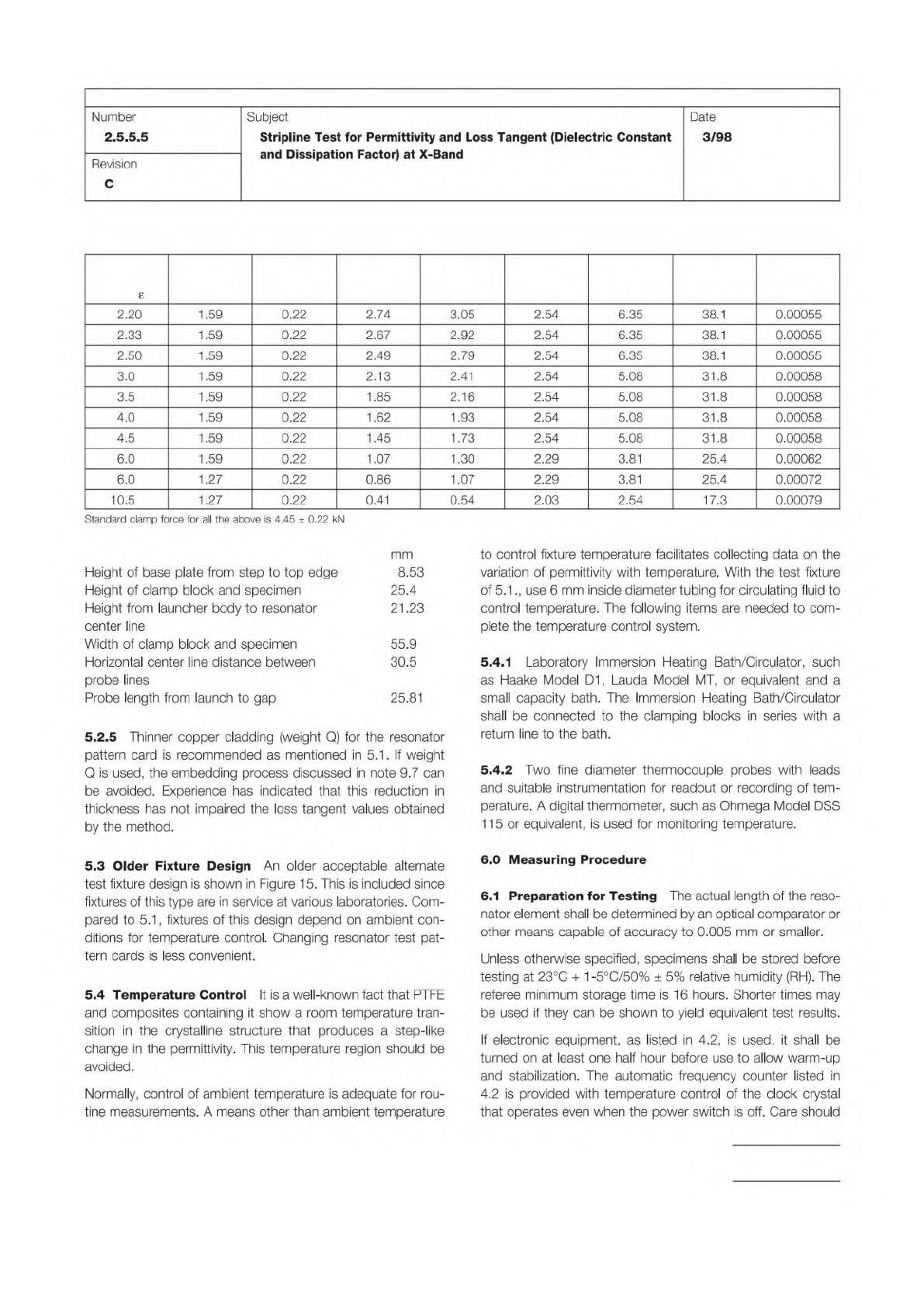
Table 1 Dimensions for Stripline Test Pattern Cards in Millimeters
Nom.
r
Nom.
Thk.
Pattern
Card Thk.
Probe
Width
Chamfer
X, Y
Probe
Gap
Resonator
Width
Resonator
Length 4
Node
1/Q
C
Conductor
Loss
IPC-TM-650
Page 5 of 25
Number
2.5.5.5
Subject
Stripline
Test
for
Permittivity
and
Loss
Tangent
(Dielectric
Constant
and
Dissipation
Factor)
at
X-Band
Date
3/98
Revision
C
Standard
clamp
force
for
all
the
above
is
4.45
±
0.22
kN
£
2.20
1.59
0.22
2.74
3.05
2.54
6.35
38.1
0.00055
2.33
1.59
0.22
2.67
2.92
2.54
6.35
38.1
0.00055
2.50
1.59
0.22
2.49 2.79
2.54
6.35
38.1
0.00055
3.0
1.59
0.22
2.13
2.41
2.54
5.08
31.8
0.00058
3.5
1.59
0.22
1.85
2.16
2.54
5.08
31.8
0.00058
4.0
1.59
0.22
1.62
1.93
2.54
5.08
31.8
0.00058
4.5
1.59
0.22
1.45
1.73
2.54
5.08
31.8
0.00058
6.0
1.59
0.22
1.07
1.30
2.29
3.81
25.4
0.00062
6.0
1.27
0.22
0.86
1.07
2.29
3.81
25.4
0.00072
10.5
1.27
0.22
0.41
0.54
2.03
2.54
17.3
0.00079
mm
Height
of
base
plate
from
step
to
top
edge
8.53
Height
of
clamp
block
and
specimen
25.4
Height
from
launcher
body
to
resonator
21
.23
center
line
Width
of
clamp
block
and
specimen
55.9
Horizontal
center
line
distance
between
30.5
probe
lines
Probe
length
from
launch
to
gap
25.81
5.2
.5
Thinner
copper
cladding
(weight
Q)
for
the
resonator
pattern
card
is
recommended
as
mentioned
in
5.1.
If
weight
Q
is
used,
the
embedding
process
discussed
in
note
9.7
can
be
avoided.
Experience
has
indicated
that
this
reduction
in
thickness
has
not
impaired
the
loss
tangent
values
obtained
by
the
method.
5.3
Older
Fixture
Design
An
older
acceptable
alternate
test
fixture
design
is
shown
in
Figure
15.
This
is
included
since
fixtures
of
this
type
are
in
service
at
various
laboratories.
Com¬
pared
to
5.1
,
fixtures
of
this
design
depend
on
ambient
con¬
ditions
for
temperature
control.
Changing
resonator
test
pat¬
tern
cards
is
less
convenient.
5.4
Temperature
Control
It
is
a
well-known
fact
that
PTFE
and
composites
containing
it
show
a
room
temperature
tran¬
sition
in
the
crystalline
structure
that
produces
a
step-like
change
in
the
permittivity.
This
temperature
region
should
be
avoided.
Normally,
control
of
ambient
temperature
is
adequate
for
rou¬
tine
measurements.
A
means
other
than
ambient
temperature
to
control
fixture
temperature
facilitates
collecting
data
on
the
variation
of
permittivity
with
temperature.
With
the
test
fixture
of
5.1
use
6
mm
inside
diameter
tubing
for
circulating
fluid
to
control
temperature.
The
following
items
are
needed
to
com¬
plete
the
temperature
control
system.
5.4.1
Laboratory
Immersion
Heating
Bath/Circulator,
such
as
Haake
Model
D1
,
Lauda
Model
MT,
or
equivalent
and
a
small
capacity
bath.
The
Immersion
Heating
Bath/Circulator
shall
be
connected
to
the
clamping
blocks
in
series
with
a
return
line
to
the
bath.
5.4.2
Two
fine
diameter
thermocouple
probes
with
leads
and
suitable
instrumentation
for
readout
or
recording
of
tem¬
perature.
A
digital
thermometer,
such
as
Ohmega
Model
DSS
1
15
or
equivalent,
is
used
for
monitoring
temperature.
6.0
Measuring
Procedure
6.1
Preparation
for
Testing
The
actual
length
of
the
reso¬
nator
element
shall
be
determined
by
an
optical
comparator
or
other
means
capable
of
accuracy
to
0.005
mm
or
smaller.
Unless
otherwise
specified,
specimens
shall
be
stored
before
testing
at
23℃
+
1
-5℃/50%
±
5%
relative
humidity
(RH).
The
referee
minimum
storage
time
is
1
6
hours.
Shorter
times
may
be
used
if
they
can
be
shown
to
yield
equivalent
test
results.
If
electronic
equipment,
as
listed
in
4.2,
is
used,
it
shall
be
turned
on
at
least
one
half
hour
before
use
to
allow
warm-up
and
stabilization.
The
automatic
frequency
counter
listed
in
4.2
is
provided
with
temperature
control
of
the
clock
crystal
that
operates
even
when
the
power
switch
is
off.
Care
should