IPC-TM-650 EN 2022 试验方法--.pdf - 第337页
The Institute for Int erconnecting and Packaging E lectronic Circuits 2215 S anders Road • Northbrook, IL 60062-6135 Material in this T est M ethods Manual was vol untaril y establis hed by T echni cal Committees of the …
Note 1:
Table 1 Process Sequence
Temp (°C) Time (Min)
Conditioner 32 4
Rinse 16-27 2-3
Etch 66 6.5
Air Dry – 0.75
Triple Rinse 16-27 3-5
Neutralizer 52 2.5
Rinse 25 5
Air Dry 25 Overnight
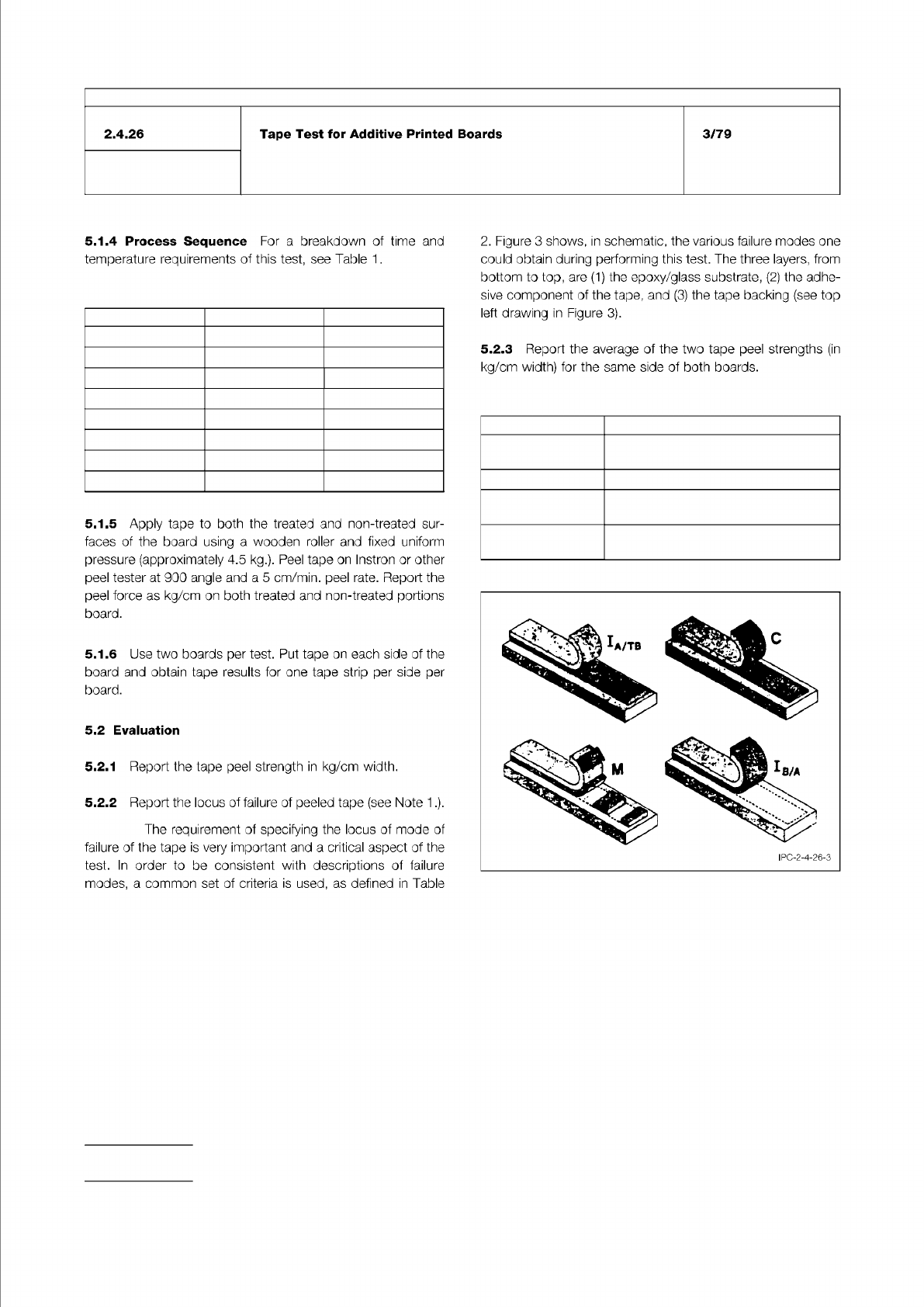
Table 2 Modes of Failure Shown in Figure 3
Notation
Meaning of Failure Mode
I
A/-TB
Interfacial failure, between adhesive
and tape backing
C Cohesive failure within tape adhesive
M Mixed failure mode, a combination of
the other types
I
B/A
Interfacial failure, between the board
and the adhesive of the tape.
Figure 3 Modes of Failure
IPC-TM-650
Number
Subject Date
Revision
Page 2 of 2
2.4.26
Tape
Test
for
Additive
Printed
Boards
3/79
5.1.4
Process
Sequence
For
a
breakdown
of
time
and
temperature
requirements
of
this
test,
see
Table
1
.
5.1.5
Apply
tape
to
both
the
treated
and
non-treated
sur¬
faces
of
the
board
using
a
wooden
roller
and
fixed
uniform
pressure
(approximately
4.5
kg.).
Peel
tape
on
Instron
or
other
peel
tester
at
900
angle
and
a
5
cm/min.
peel
rate.
Report
the
peel
force
as
kg/cm
on
both
treated
and
non-treated
portions
board.
5.1.6
Use
two
boards
per
test.
Put
tape
on
each
side
of
the
board
and
obtain
tape
results
for
one
tape
strip
per
side
per
board.
5.2
Evaluation
5.2.1
Report
the
tape
peel
strength
in
kg/cm
width.
5.2.2
Report
the
locus
of
failure
of
peeled
tape
(see
Note
1
.).
The
requirement
of
specifying
the
locus
of
mode
of
failure
of
the
tape
is
very
important
and
a
critical
aspect
of
the
test.
In
order
to
be
consistent
with
descriptions
of
failure
modes,
a
common
set
of
criteria
is
used,
as
defined
in
Table
2.
Figure
3
shows,
in
schematic,
the
various
failure
modes
one
could
obtain
during
performing
this
test.
The
three
layers,
from
bottom
to
top,
are
the
epoxy/glass
substrate,
(2)
the
adhe¬
sive
component
of
the
tape,
and
(3)
the
tape
backing
(see
top
left
drawing
in
Figure
3).
5.2.3
Report
the
average
of
the
two
tape
peel
strengths
(in
kg/cm
width)
for
the
same
side
of
both
boards.
The Institute for Interconnecting and Packaging Electronic Circuits
2215 Sanders Road • Northbrook, IL 60062-6135
Material in this Test Methods Manual was voluntarily established by Technical Committees of the IPC. This material is advisory only
and its use or adaptation is entirely voluntary. IPC disclaims all liability of any kind as to the use, application, or adaptation of this
material. Users are also wholly responsible for protecting themselves against all claims or liabilities for patent infringement.
Equipment referenced is for the convenience of the user and does not imply endorsement by the IPC.
Page 1 of 1
Number
2.4.27.1
Subject
Abrasion
(Taber
Method)
Solder
Mask
and
Conformal
Coating
IPC-TM-650
TEST
METHODS
MANUAL
Date
1/95
Revision
B
Originating
Task
Group
Conformal
Coating
Task
Group
(5-33a)
1
.0
Scope
This
method
is
designed
to
evaluate
the
resis¬
tance
of
solder
mask
or
conformally
coated
surfaces
to
rub¬
bing
abrasion.
2
.0
Applicable
Documents
None
3
.0
Test
Specimen
An
I
PC
Multipurpose
Test
Board,
Number
IPC-B-25
or
any
preproduction
or
production
board
10.8
cm
x
10.8
cm
[4%
in.
x
4%
in.]
in
size
and
coated
with
solder
mask
or
conformal
coating.
4
.0
Apparatus
4.1
Taber
Abraser
Model
5130
4.2
1
000
gram
load
for
each
wheel
4.3
CS-10
Calibrase
wheels
5
.0
Procedure
5.1
Preparation
5.1.1
Drill
or
punch
hole
in
middle
of
specimen
for
mounting
specimen
on
Taber
Abraser.
5.1.2
Mount
calibrase
wheels
and
pressure
load
(1000
grams)
on
equipment.
5.1.3
Clean
calibrase
wheels
(CS-10)
according
to
recom¬
mended
procedures
in
Taber
Abraser
Manual.
5.2
Test
Place
sample
on
abraser
and
test
specimen
to
the
required
number
of
cycles
of
abrasion.
5.3
Evaluation
Examine
the
coated
board
for
break¬
through
to
the
conductive
pattern
or
base
material.
6
.0
Notes
Taber
Abraser
Model
5130,
available
from
Tele¬
dyne
Taber,
455
Bryant
St.,
N.
Tonawanda,
NY
14120
or
Pacific
Scientific,
Gardner
Neotech
Division,
2431
Linden
Lane,
Silver
Springs,
MD
20910
or
equivalent.
1 Scope
This test method defines the procedure for deter-
mining the adhesion of solder resists (masks) used over melt-
ing metals, (such as solder plated and reflowed solder printed
boards both prior to and after soldering), nonmelting metals,
and printed board substrates.
2 Applicable Documents
Solderability Test Methods for Printed Boards.
Design Standard for Rigid Printed Boards.
3 Test Specimens
The test specimen used shall be the
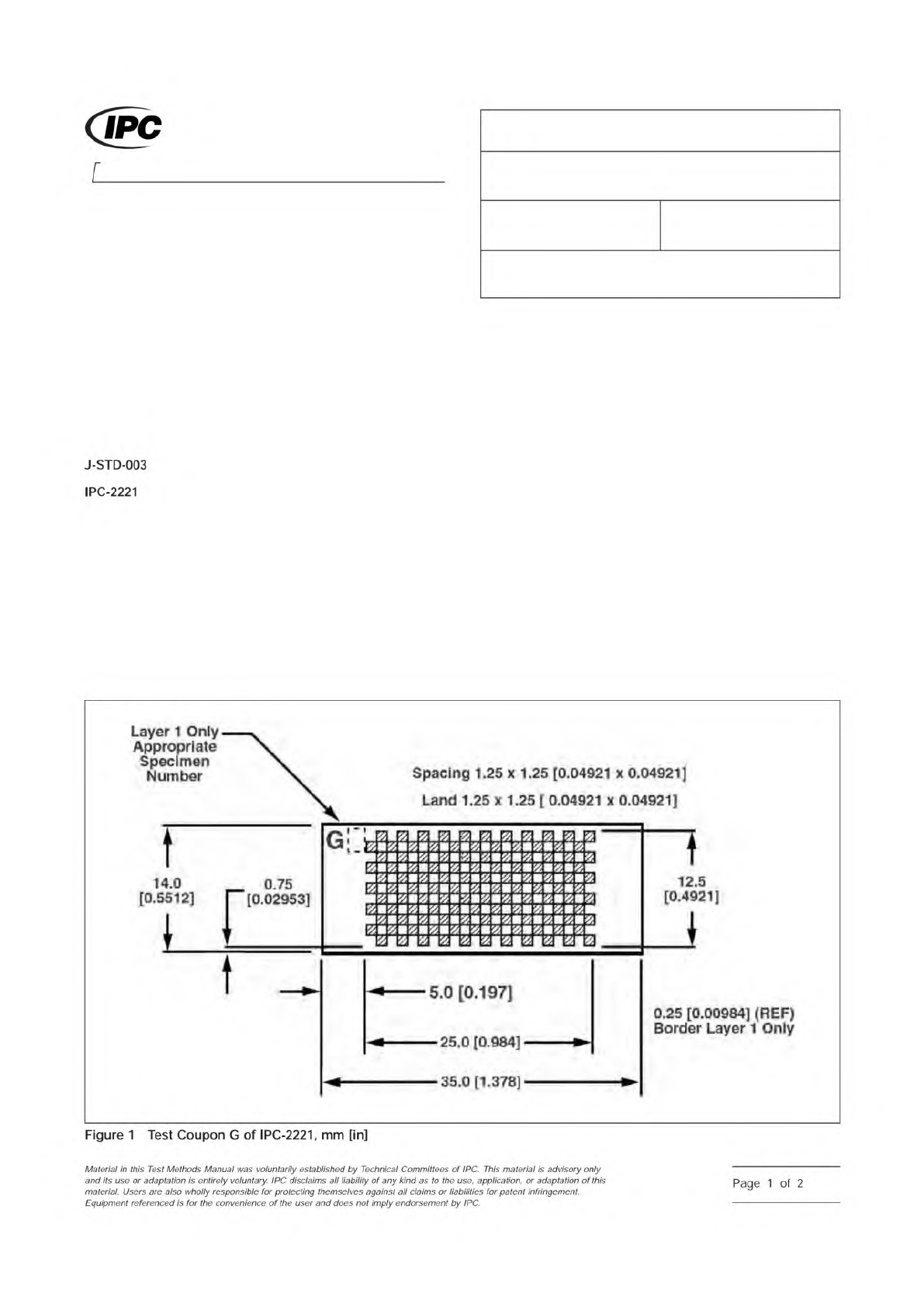
test coupon shown in Figure 1, which has the plated metal
surface that is applicable, and coated with solder resist.
4 Apparatus or Material
4.1 Tape
A roll of pressure sensitive self-adhesive film tape
1.3 cm [0.5 in] wide exhibiting an adhesive strength of at least
44 N/100 mm [40 oz-force/in] but no more than 66 N/100 mm
[60 oz-force/in] as tested per ASTM D3330, as amended. If
the tape has an advertised expiration date or shelf life it shall
not be used after the expiration date. If no such date exists,
the product may be used up to one year from date of pur-
chase. A noncomprehensive list of tapes meeting this require-
ment can be found at ‘‘Pull Test Tapes’’ under ‘‘Technical
Resources’’ at the IPC web site: www.ipc.org.
5 Procedure
5.1 Preparation
5.1.1
For qualification testing, test specimens are to be pre-
pared by processing 34.0 µm [1,339 µin], double clad epoxy
glass laminate through the standard plating process for the
metal coatings that are applicable. For production testing, the
coupons shall be representative of the board.
IPC-24281-1
3000 Lakeside Drive, Suite 309S
Bannockburn, IL 60015-1249
IPC-TM-650
TEST METHODS MANUAL
Number
2.4.28.1
Subject
Solder Mask Adhesion - Tape Test Method
Date
03/07
Revision
F
Originating Task Group
Solder Mask Performance Task Group (5-33B)
ASSOCIATION CONNECTING
ELECTRONICS INDUSTRIES
®
12.5
[0.4921]
0.25
[0.00984]
(REF)
Border
Layer
1
Only
—
0.75
|
[0.02953]
Spacing
1.25
X
1.25
[0.04921
x
0.04921]
Land
1.25
X
1.25
[
0.04921
X
0.04921]
Layer
1
Only
Appropriate
Specimen
Number
5.0
[0.197]
25.0
[0.984]
35.0
[1.378]
J-STD-003
IPC-2221
Figure
1
Test
Coupon
G
of
IPC-2221,
mm
[in]
Material
/n
this
Test
Methods
Manual
was
voluntarily
established
by
Technical
Committees
of
IPC.
This
material
,
s
advisory
only
and
"s
use
or
adaptation
,
s
entirely
voluntary.
IPC
disclaims
all
liability
of
any
kind
as
to
the
use,
application,
or
adaptation
of
this
material.
Users
are
also
wholly
responsible
for
protecting
themselves
against
all
claims
or
liabilities
for
patent
infringement.
Equipment
referenced
is
for
the
convenience
of
the
user
and
does
not
imply
endorsement
by
IPC.
Page
1
of
2