IPC-TM-650 EN 2022 试验方法--.pdf - 第788页
NOTE: NOTE: CAUTION: NOTE: Material in this T est Methods Manual was voluntarily established by T echnical Committees of the IPC. Thi s mate rial is ad visory o nly and its use or adaptation is entirely voluntary . IPC d…
WARNING:
CAUTION:
Material in this Test Methods Manual was voluntarily established by Technical Committees of the IPC. This material is advisory only
and its use or adaptation is entirely voluntary. IPC disclaims all liability of any kind as to the use, application, or adaptation of this
material. Users are also wholly responsible for protecting themselves against all claims or liabilities for patent infringement.
Equipment referenced is for the convenience of the user and does not imply endorsement by the IPC.
Page 1 of 1
r
ASSOCIATION
CONNECTING
/
ELECTRONICS
INDUSTRIES
2215
Sanders
Road
Northbrook,
IL
60062-6135
IPC-TM-650
TEST
METHODS
MANUAL
1
.0
Scope
1.1
To
determine
the
resistance
to
current
leakage
offered
by
the
insulation
materials
and
the
various
seals
of
a
connec¬
tor
to
a
DC
potential
tending
to
produce
such
leakage
through
or
on
the
surface
of
these
members.
The
test
is
especially
useful
in
determining
the
extent
to
which
insulating
properties
are
affected
by
deteriorative
influences,
such
as
heat,
mois¬
ture,
contamination,
or
loss
of
volatile
materials.
2
.0
Reference
Documents
2.1
Information
in
this
section
is
intended
to
parallel
the
test
method
described
in
EIA-RS-364ATP-21
.
3
.0
Test
Specimen
3.1
A
plug,
receptacle,
or
mated
connector
as
specified
in
the
individual
connector
specification.
4
.0
Apparatus
4.1
Megohmmeter
4.1.1
Resistance
measurement
accuracy
shall
be
such
that
the
value
being
measured
is
accurate
to
5
percent.
4.1.2
Test
voltage
shall
be
adjustable
to
within
±
2
percent
of
required
value.
5
.0
Procedure
POTENTIALS
USED
DURING
THIS
TEST
MAY
PROVE
HAZARDOUS
TO
PERSONNEL
TAKE
PRECAU¬
TIONS
TO
PROTECT
PERSONNEL
FROM
ACCIDENTAL
EXPOSURE
TO
THESE
TEST
POTENTIALS.
Number
3.6
Subject
Insulation
Resistance,
Connectors
Date
Revision
7/75
A
Originating
Task
Group
N/A
5
J
If,
required
by
the
individual
connector
specification,
the
plug
and/or
receptacle
shall
be
cleaned
prior
to
the
test
to
insure
that
it
is
free
from
excess
dust,
oil,
moisture,
or
other
surface
contaminants;
all
observed
conditions
shall
be
recorded.
5
.2
Samples
that
have
been
subjected
to
environmental
conditions
shall
be
measured
within
1/2
to
3
hours
after
removal
from
the
chamber,
unless
otherwise
specified.
5
.3
The
insulation
resistance
shall
be
measured
between
individual
pairs
of
immediately
adjacent
contacts
and
between
the
shell
and/or
engaging
hardware
(if
they
exist)
and
the
clos¬
est
individual
contact(s).
NOTE:
The
same
contact
locations
for
a
given
connector
shall
be
used
each
time
the
insulation
resistance
test
is
per¬
formed.
5
.4
The
specified
test
potential
(or
500
volts
DC
if
no
poten¬
tial
is
specified)
shall
be
applied
for
a
two-minute
period.
Immediately
after
this
electrification
period,
the
insulation
resistance
shall
be
measured.
If,
during
the
two-minute
period
the
instrument
indicates
that
the
insulation
resistance
meets
the
specified
minimum
and
is
steady
or
increasing,
the
test
may
be
terminated
before
the
end
of
the
electri
力
cation
period.
EXERCISE
CARE
TO
AVOID
A
DIRECT
SHORT
CIRCUIT
OF
THE
TESTING
APPARATUS
SINCE
DAMAGE
TO
THE
INSTRUMENT
MAY
RESULT.
6.0
Notes
6.1
Acceptance
criteria
shall
be
established
as
the
minimum
level
of
insulation
resistance
compatible
with
end-item
usage
of
the
connector.
This
resistance
is
an
inherent
characteristic
of
connector
geometry
(e.g.,
contact
spacing)
and
materials.
NOTE:
NOTE:
CAUTION:
NOTE:
Material in this Test Methods Manual was voluntarily established by Technical Committees of the IPC. This material is advisory only
and its use or adaptation is entirely voluntary. IPC disclaims all liability of any kind as to the use, application, or adaptation of this
material. Users are also wholly responsible for protecting themselves against all claims or liabilities for patent infringement.
Equipment referenced is for the convenience of the user and does not imply endorsement by the IPC.
Page 1 of 2
r
ASSOCIATION
CONNECTING
/
ELECTRONICS
INDUSTRIES
2215
Sanders
Road
Northbrook,
IL
60062-6135
IPC-TM-650
TEST
METHODS
MANUAL
1
.0
Scope
1.1
To
evaluate
the
contact
resistance
of
electrical
contacts
where
the
applied
voltage
and
current
are
low.
2
.0
Reference
Documents
2.1
Information
in
this
section
is
intended
to
parallel
the
test
method
described
in
EIA-RS-364/TP-23.
3
.0
Test
Specimen
3.1
The
mated
contacts
of
a
connector
mounted
and,
when
required,
terminated
in
its
normal
manner
or
a
mated
pair
of
individual
contacts.
When
mated
contact
pairs,
not
requiring
housings,
are
tested,
they
shall
be
rigidly
mounted
in
a
fixture
to
provide
mechanical
stability
and
to
insure
proper
mating
and
orienta¬
tion.
3.2
Voltage
connections
shall
be
attached
permanently
by
soldering,
crimping,
or
wire-wrapping
as
appropriate
and
shall
be
positioned
as
follows:
A.
Wire
Hole
—
On
the
contact
within
1/8
inch
of
insulator.
B.
WrapPost
—
On
the
wrap-post
adjacent
to
the
outer
turn
of
wire.
C.
Crimp
—
Crimped
to
the
contact
simultaneously
with
the
current
lead.
D.
Solder
Tab
—
On
the
printed
wiring
traces
as
close
to
the
termination
as
practicable.
E.
Press-Fit
——
On
the
pad
of
the
plated-th
rough
hole
as
close
to
the
termination
as
practicable.
If
the
pad
of
the
printed
wiring
board
constitutes
one-half
of
the
mated
contact
pair,
the
voltage
connection
shall
be
sol¬
dered
to
the
pad
immediately
adjacent
to,
but
not
touching,
the
mating
contact.
In
case
of
environment
resistant
(sealed)
connector,
the
voltage
connections
shall
be
attached
as
close
to
the
seal¬
ing
grommets
as
practicable.
Number
3.7
Subject
Low
Level
Circuit
Connectors
Date
Revision
7/75
A
Originating
Task
Group
N/A
3.3
Unless
otherwise
specified
in
the
individual
contact
or
connector
specification,
the
test
samples
shall
not
be
cleaned
by
any
means
prior
to
the
test
nor
shall
any
lubricants
or
other
coatings
be
applied.
4
.0
Apparatus
4.1
Microvoltmeter
The
meter
accuracy
shall
be
such
that
the
voltage
value
is
measured
within
2
percent.
4.2
Milliammeter
(optional)
The
meter
accuracy
shall
be
such
that
the
current
value
is
measured
within
2
percent.
4.3
0.001
OHM
resistor
accurate
to
±
1
percent.
4.4
Power
supply
capable
of
delivering
1
milliampere
at
1
.35
volts
DC
potential.
5
.0
Procedure
THE
CONTACTS
UNDER
TEST
SHALL
NOT
BE
SUBJECTED
TO
A
POTENTIAL
GREATER
THAN
20
MILLI¬
VOLTS
DC
(OR
20
MILLIVOLTS
PEAK
AC)
EITHER
PRIOR
TO
OR
DURING
THE
TEST.
5.1
The
low
level
test
shall
be
conducted
using
a
circuit
comparable
to
that
shown
in
Figure
1
,
which
will
deliver
a
one
milliampere
sample
current
when
the
variable
resistor
is
adjusted
to
provide
a
20
millivolt
open
circuit
potential
between
Tl
and
T2.
The
3-position
switch
shown
in
Figure
1
shall
be
opened
before
each
measurement
to
zero
the
voltme¬
ter.
The
total
resistance
between
points
T1
and
T2
shall
be
less
than
1
00
milliohms.
5.2
The
voltage
drop
across
each
pair
of
mated
contacts
with
the
current
successively
in
both
directions
through
the
test
specimen
shall
be
measured.
The
contact
resistance
shall
be
calculated,
in
both
the
forward
and
reverse
direction,
by
dividing
the
voltage
drop
reading
by
the
current
reading.
The
average
of
the
two
resistance
values
thus
obtained
for
each
contact
shall
not
exceed
the
maximum
allowable
contact
resistance
as
defined
in
the
individual
contact
or
connector
specification.
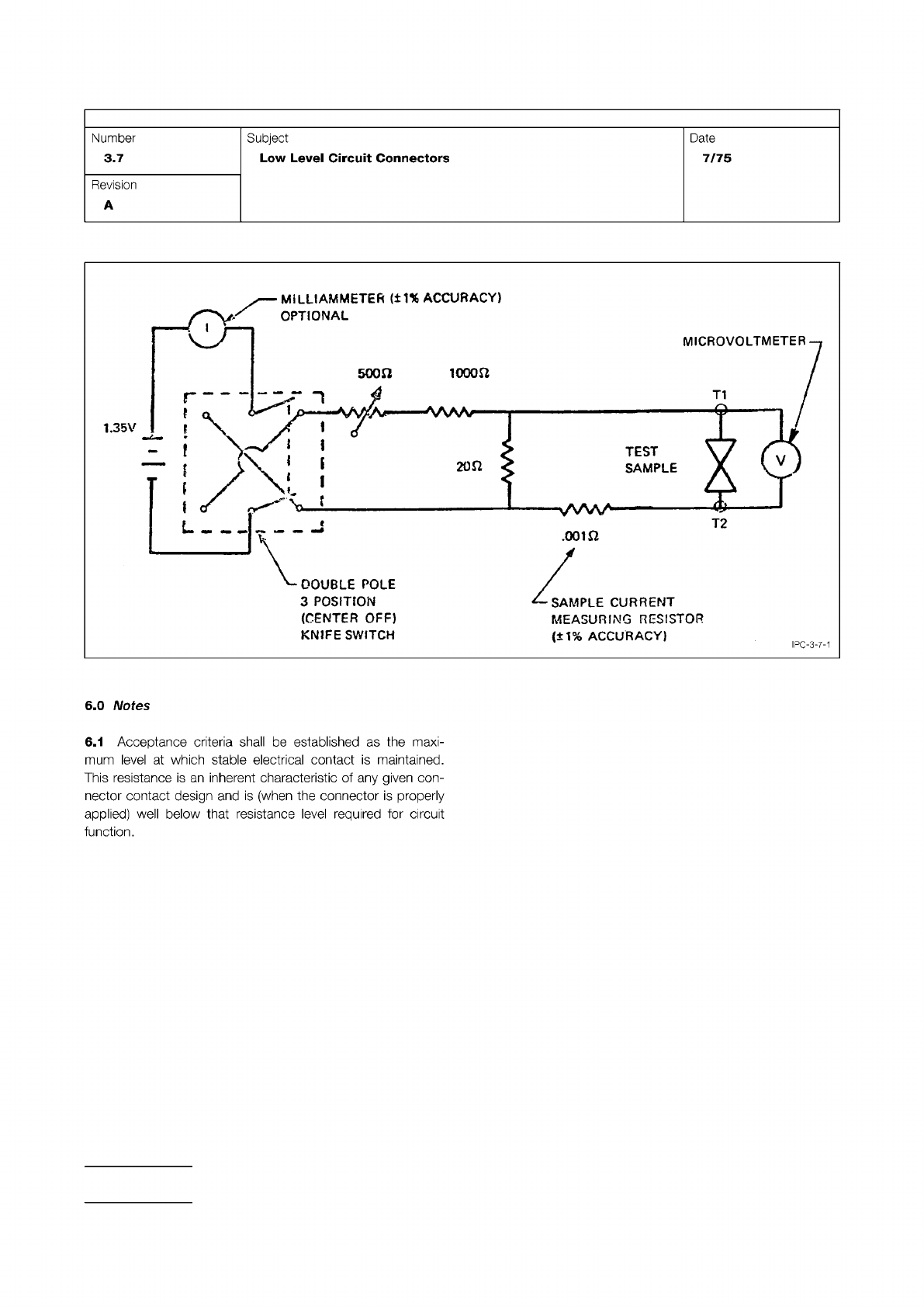
Figure 1
IPC-TM-650
Page 2 of 2
1.35V
3
POSITION
(CENTER
OFF)
KNIFESWITCH
MICROVOLTMETER
TEST
SAMPLE
MEASURING
RESISTOR
(+1%
ACCURACY)
IPC-3-7-1
6.0
Notes
6.1
Acceptance
criteria
shall
be
established
as
the
maxi¬
mum
level
at
which
stable
electrical
contact
is
maintained.
This
resistance
is
an
inherent
characteristic
of
any
given
con¬
nector
contact
design
and
is
(when
the
connector
is
properly
applied)
well
below
that
resistance
level
required
for
circuit
function.
Number
3.7
Subject
Low
Level
Circuit
Connectors
Date
7/75
Revision
A