IPC-TM-650 EN 2022 试验方法--.pdf - 第243页
IPC-CC-830 FED-STD-141 Material in this T est M ethods Manual was voluntarily establis hed by T echni cal Committees of IPC. Thi s mat erial is a dvisory only and its use or adaptation is entirely voluntary . IPC disclai…
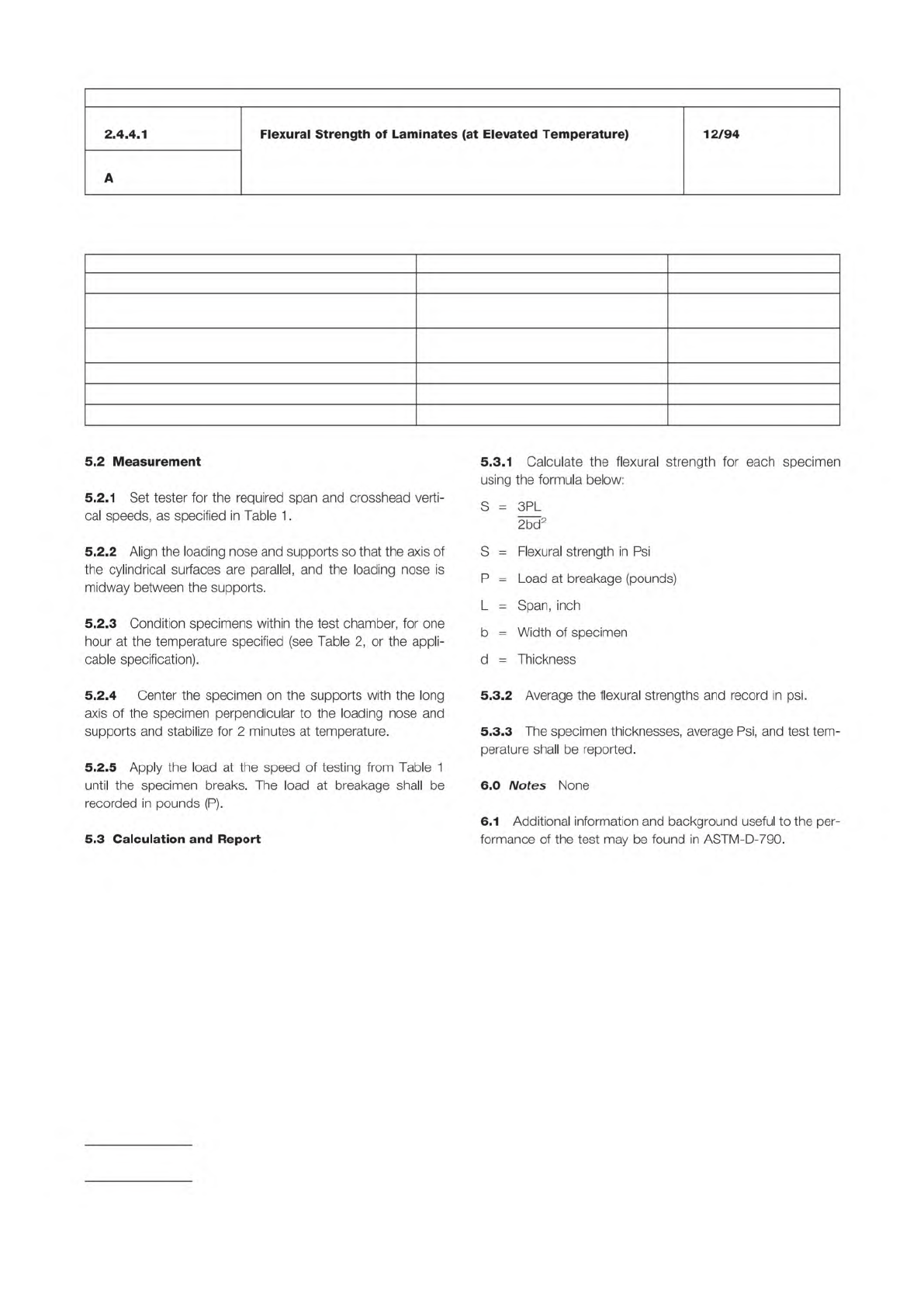
Table 2
Resin Type Thickness Test Temperature
Difunctional, tetrafunctional epoxies ALL 125°C
Hot Strength Retention Epoxies
High Temperature Epoxies
Up to 1.6 mm [0.063 inch]
1.6 mm [0.063 inch] and over
190°C
170°C
BT- epoxies
Modified epoxies
ALL 170°C
Polyimide of T
g
greater than 250°C
1
ALL 204°C
Polyimides of T
g
less than or equal to 250°C
1
ALL 170°C
Cyanate Esters ALL 204°C
1
T
g
measured by IPC-TM-650, Test Method 2.4.25
IPC-TM-650
Number
Subject Date
Revision
Page 2 of 2
2.4.4.1
Flexural
Strength
of
Laminates
(at
Elevated
Temperature)
12/94
A
5.2
Measurement
5.2.1
Set
tester
for
the
required
span
and
crosshead
verti¬
cal
speeds,
as
specified
in
Table
1
.
5.2.2
Align
the
loading
nose
and
supports
so
that
the
axis
of
the
cylindrical
surfaces
are
parallel,
and
the
loading
nose
is
midway
between
the
supports.
5.2.3
Condition
specimens
within
the
test
chamber,
for
one
hour
at
the
temperature
specified
(see
Table
2,
or
the
appli¬
cable
specification).
5.2.4
Center
the
specimen
on
the
supports
with
the
long
axis
of
the
specimen
perpendicular
to
the
loading
nose
and
supports
and
stabilize
for
2
minutes
at
temperature.
5.2.5
Apply
the
load
at
the
speed
of
testing
from
Table
1
until
the
specimen
breaks.
The
load
at
breakage
shall
be
recorded
in
pounds
(P).
5.3
Calculation
and
Report
5.3.1
Calculate
the
flexural
strength
for
each
specimen
using
the
formula
below:
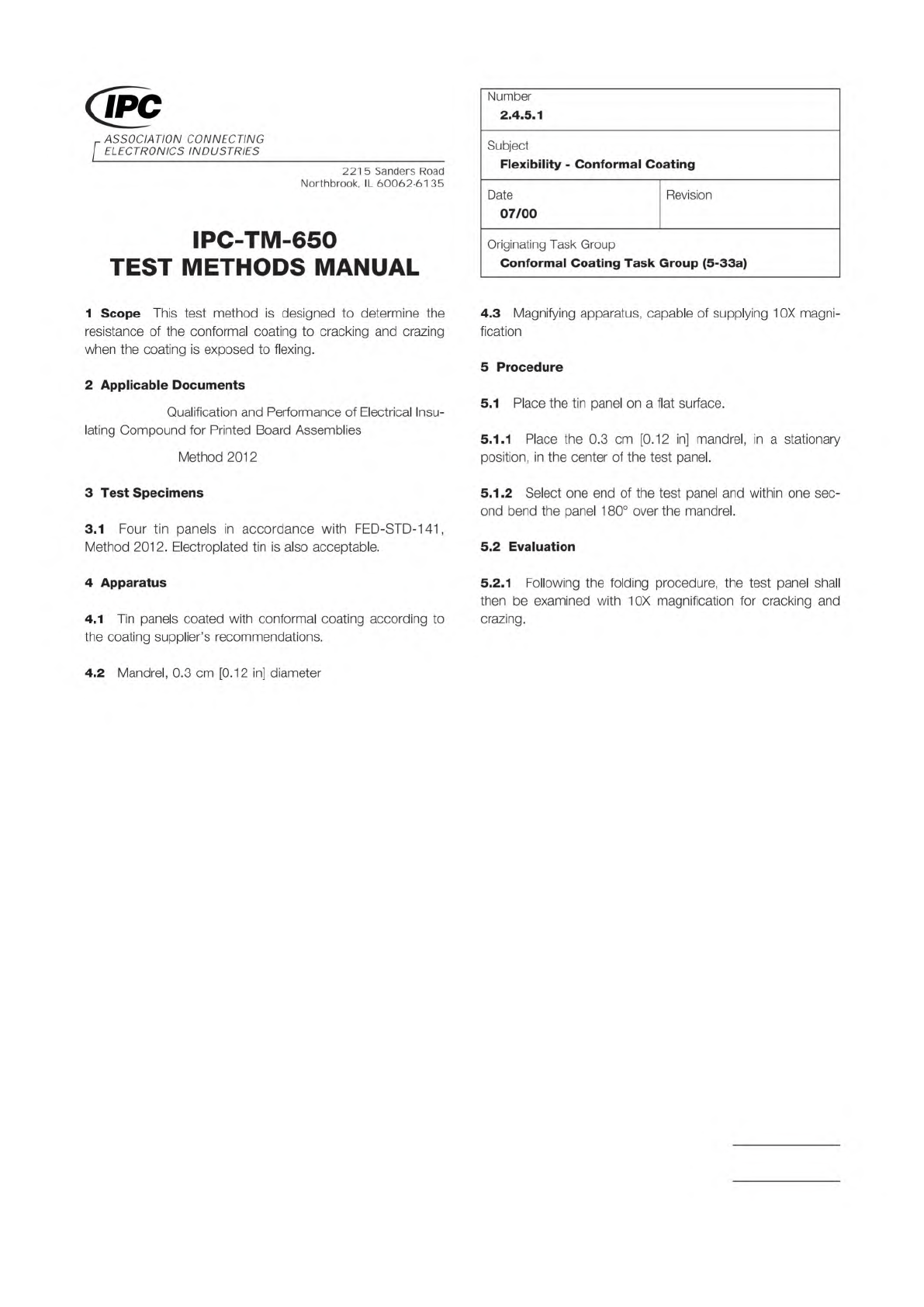
S
=
3PL
2bd2
S
二
Flexural
strength
in
Psi
P
二
Load
at
breakage
(pounds)
L
=
Span,
inch
b
=
Width
of
specimen
d
=
Thickness
5.3.2
Average
the
flexural
strengths
and
record
in
psi.
5.3.3
The
specimen
thicknesses,
average
Psi,
and
test
tem¬
perature
shall
be
reported.
6.0
Notes
None
6.1
Additional
information
and
background
useful
to
the
per¬
formance
of
the
test
may
be
found
in
ASTM-D-790.
IPC-CC-830
FED-STD-141
Material in this Test Methods Manual was voluntarily established by Technical Committees of IPC. This material is advisory only
and its use or adaptation is entirely voluntary. IPC disclaims all liability of any kind as to the use, application, or adaptation of this
material. Users are also wholly responsible for protecting themselves against all claims or liabilities for patent infringement.
Equipment referenced is for the convenience of the user and does not imply endorsement by IPC.
Page 1 of 1
r
ASSOCIATION
CONNECTING
/
ELECTRONICS
INDUSTRIES
221
5
Sanders
Road
Northbrook,
IL
60062-6135
IPC-TM-650
TEST
METHODS
MANUAL
Number
2.4.5.
1
Subject
Flexibility
-
Conformal
Coating
Date
Revision
07/00
Originating
Task
Group
Conformal
Coating
Task
Group
(5-33a)
1
Scope
This
test
method
is
designed
to
determine
the
resistance
of
the
conformal
coating
to
cracking
and
crazing
when
the
coating
is
exposed
to
flexing.
2
Applicable
Documents
Qualification
and
Performance
of
Electrical
Insu¬
lating
Compound
for
Printed
Board
Assemblies
Method
2012
3
Test
Specimens
3.1
Four
tin
panels
in
accordance
with
FED-STD-141
,
Method
2012.
Electroplated
tin
is
also
acceptable.
4
Apparatus
4.1
Tin
panels
coated
with
conformal
coating
according
to
the
coating
supplier's
recommendations.
4.3
Magnifying
apparatus,
capable
of
supplying
1
0X
magni¬
fication
5
Procedure
5.1
Place
the
tin
panel
on
a
flat
surface.
5.1.1
Place
the
0.3
cm
[0.12
in]
mandrel,
in
a
stationary
position,
in
the
center
of
the
test
panel.
5.1.2
Select
one
end
of
the
test
panel
and
within
one
sec¬
ond
bend
the
panel
180°
over
the
mandrel.
5.2
Evaluation
5.2.1
Following
the
folding
procedure,
the
test
panel
shall
then
be
examined
with
10X
magnification
for
cracking
and
crazing.
4.2
Mandrel,
0.3
cm
[0.12
in]
diameter
The Institute for Interconnecting and Packaging Electronic Circuits
2215 Sanders Road • Northbrook, IL 60062-6135
Material in this Test Methods Manual was voluntarily established by Technical Committees of the IPC. This material is advisory only
and its use or adaptation is entirely voluntary. IPC disclaims all liability of any kind as to the use, application, or adaptation of this
material. Users are also wholly responsible for protecting themselves against all claims or liabilities for patent infringement.
Equipment referenced is for the convenience of the user and does not imply endorsement by the IPC.
Page 1 of 1
IPC-TM-650
TEST
METHODS
MANUAL
1
.0
Scope
The
determination
of
lamination
bond
quality
by
immersion
in
an
oil
stabilizing
high
temperature
bath.
2
.0
Applicable
Documents
None
3
.0
Test
Specimen
Use
each
of
the
four
I
PC
test
pattern
specimens
H
in
Figures
1
through
7
shown
in
part
5.8.3
of
this
publication.
Any
other
sample
of
the
production
boards
may
be
used
by
mutual
agreement
between
the
vendor
and
the
customer.
4
.0
Apparatus
4.1
Test
Oil
Commercial
grade
oil
having
a
boiling
and
flash
point
higher
than
300℃
(572°F).
4.2
Container
Heating
container
capable
of
heating
oil
to
300°
土
10℃
(572°F).
4.3
Stopwatch
4.4
Chamber
Circulating
air
chamber
capable
of
attaining
200℃
(392°F).
5
.0
Procedure
Number
2.4.6
Subject
Hot
Oil
Date
Revision
4/73
Originating
Task
Group
N/A
5.1.1
Saw
the
four
coupons
from
specimen
H.
Do
not
cut
coupons
so
as
to
introduce
any
shearing,
bending,
or
break¬
ing
stresses.
5.1.2
Condition
specimens
by
suspending
in
a
circulating
chamber
at
1
35°
±
1
5
℃
for
one
hour.
5.2
Test
5.2.1
Specimens
must
be
tested
within
two
minutes
after
removal
from
the
chamber
to
preclude
ambient
moisture
from
returning
to
specimens
before
flotation.
5.2.2
Remove
the
specimens
one
at
a
time
and
float
on
the
surface
of
the
hot
oil
bath,
preset
at
260°
+6°
-3°
for
20
sec¬
onds
+1
-0
seconds.
5.2.3
After
removal
from
the
hot
oil
and
cooling,
immerse
specimens
in
chlorethene-NU
or
trichlorethylene
for
a
few
seconds,
then
dry
with
compressed
air.
5.2.4
Rinse
in
clean
isopropyl
alcohol
and
again
blow
dry
before
examination.
5.1
Preparation
5.3
Evaluation
Examine
each
specimen
for
measling,
blis¬
tering
or
delamination.