IPC-TM-650 EN 2022 试验方法--.pdf - 第468页
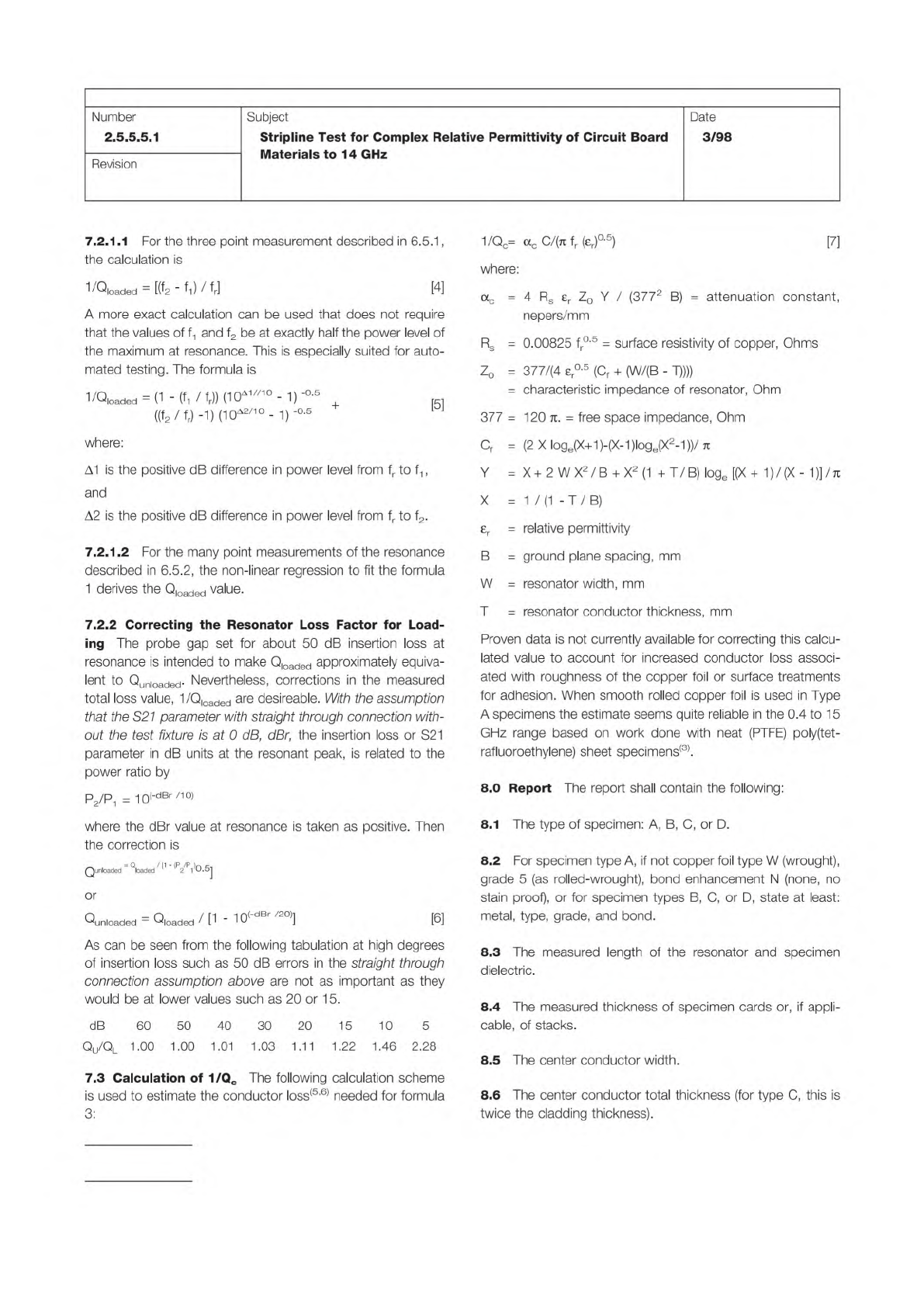
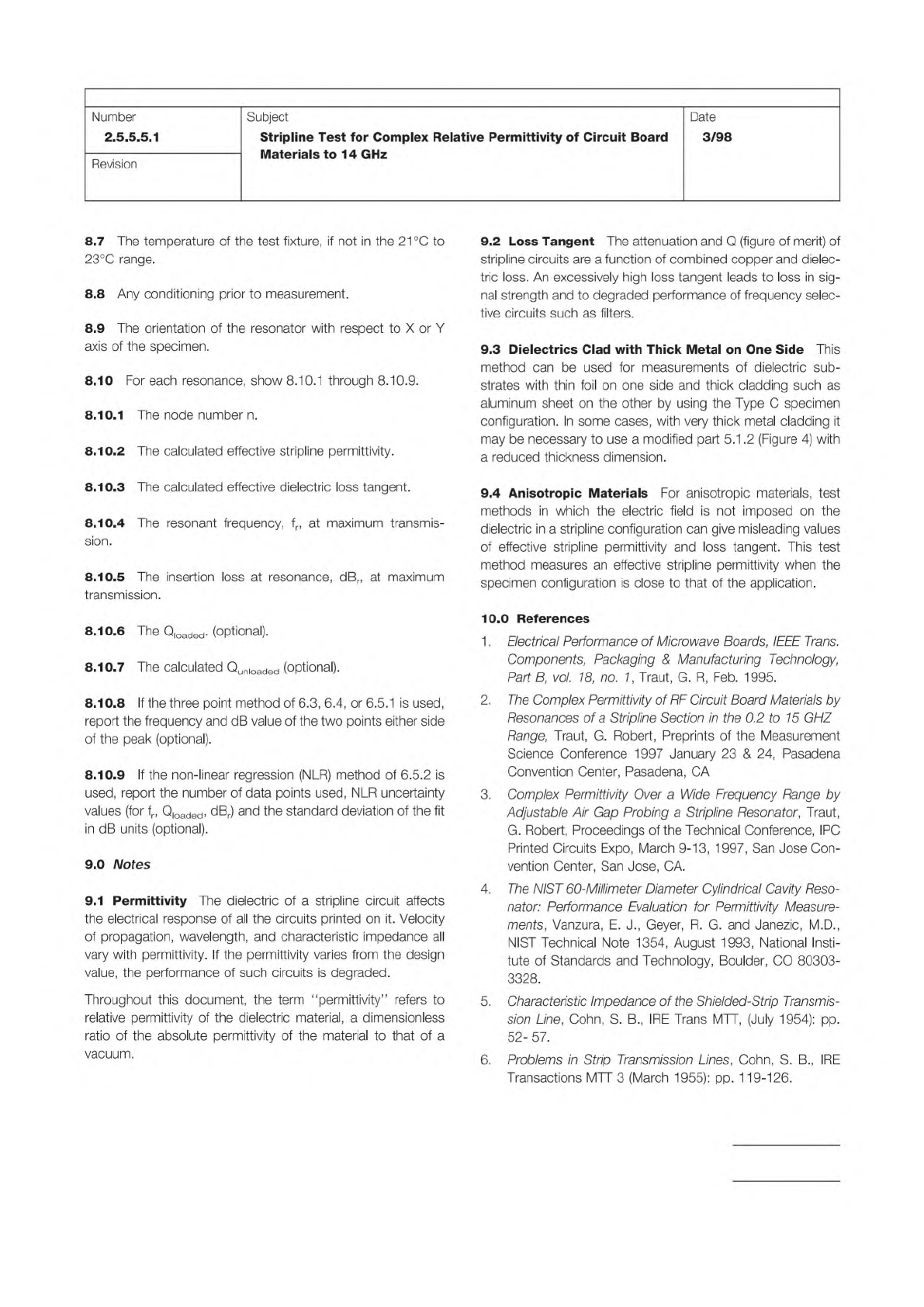
IPC-TM-650 Page 1 1 of 1 1 Number 2.5.5.5.1 Revision Subject Stripline Test for Complex Relative Permittivity of Circuit Board Materials to 14 GHz Date 3/98 8.7 The temperature of the test fixture, if not in the 21 to 23…
IPC-TM-650
Page 10 of 11
Number
2.5.5.5.1
Revision
Subject
Stripline
Test
for
Complex
Relative
Permittivity
of
Circuit
Board
Materials
to
14
GHz
Date
3/98
7-2.1
.1
For
the
three
point
measurement
described
in
6.5.1
,
the
calculation
is
1/Q|oaded
=
%
一
i)
/
*]
[4]
A
more
exact
calculation
can
be
used
that
does
not
require
that
the
values
of
and
f2
be
at
exactly
half
the
power
level
of
the
maximum
at
resonance.
This
is
especially
suited
for
auto¬
mated
testing.
The
formula
is
1/Qloaded
=
(
1
-(fl/fr))
(10A1//1°
-
1)
-°-5
.
((f2/fr)-1)(1OA2/1°-1)-°-5
where:
A1
is
the
positive
dB
difference
in
power
level
from
fr
to
and
A2
is
the
positive
dB
difference
in
power
level
from
fr
to
f2.
7.2
.
1.2
For
the
many
point
measurements
of
the
resonance
described
in
6.5.2,
the
non-linear
regression
to
fit
the
formula
1
derives
the
Q|Oaded
value.
7.2
.2
Correcting
the
Resonator
Loss
Factor
for
Load¬
ing
The
probe
gap
set
for
about
50
dB
insertion
loss
at
resonance
is
intended
to
make
Q|Oaded
approximately
equiva¬
lent
to
QUnioaded-
Nevertheless,
corrections
in
the
measured
total
loss
value,
1
/Q|Oaded
are
desireable.
With
the
assumption
that
the
S21
parameter
with
straight
through
connection
with¬
out
the
test
fixture
is
at
0
dB,
dBr,
the
insertion
loss
or
S21
parameter
in
dB
units
at
the
resonant
peak,
is
related
to
the
power
ratio
by
P2/P1
=
10(-dBr/1O)
where
the
dBr
value
at
resonance
is
taken
as
positive.
Then
the
correction
is
Qunloaded
-
^loaded
'
^P2/P?0.5]
or
Qunloaded
=
Qloaded
/
H
-
1
0
(由
/2。)]
[6]
As
can
be
seen
from
the
following
tabulation
at
high
degrees
of
insertion
loss
such
as
50
dB
errors
in
the
straight
through
connection
assumption
above
are
not
as
important
as
they
would
be
at
lower
values
such
as
20
or
15.
dB
60
50
40
30
20
15
10
5
QuQ
1.00
1.00
1.01
1.03
1.11
1.22
1.46
2.28
7.3
Calculation
of
1/QC
The
following
calculation
scheme
is
used
to
estimate
the
conductor
loss(5,6)
needed
for
formula
3:
1/QC=
%C/
(叫
同。5)
[7]
where:
ac
=
4
Rs
£r
Zo
Y
/
(3772
B)
=
attenuation
constant,
nepers/mm
Rs
=
0.00825
fr0-5
=
surface
resistivity
of
copper,
Ohms
Zo
二
377/(4
耳。
$
(Cf
+
(W/(B
-
T))))
二
characteristic
impedance
of
resonator,
Ohm
377
二
120
=
free
space
impedance,
Ohm
Cf
=
(2
X
loge(X+1)-(X-1)loge(X2-1))/
兀
Y
=
X+2
WX2/B
+
X2(1
+T/B)
loge
[(X
+
1)/(X-
1)]/k
X
=
1
/
(1
-
T
/
B)
£r
=
relative
permittivity
B
二
ground
plane
spacing,
mm
W
二
resonator
width,
mm
T
=
resonator
conductor
thickness,
mm
Proven
data
is
not
currently
available
for
correcting
this
calcu¬
lated
value
to
account
for
increased
conductor
loss
associ¬
ated
with
roughness
of
the
copper
foil
or
surface
treatments
for
adhesion.
When
smooth
rolled
copper
foil
is
used
in
Type
A
specimens
the
estimate
seems
quite
reliable
in
the
0.4
to
1
5
GHz
range
based
on
work
done
with
neat
(PTFE)
polytet¬
rafluoroethylene)
sheet
specimens(3).
8.0
Report
The
report
shall
contain
the
following:
8.1
The
type
of
specimen:
A,
B,
C,
or
D.
8.2
For
specimen
type
A,
if
not
copper
foil
type
W
(wrought),
grade
5
(as
rolled-wrought),
bond
enhancement
N
(none,
no
stain
proof),
or
for
specimen
types
B,
C,
or
D,
state
at
least:
metal,
type,
grade,
and
bond.
8.3
The
measured
length
of
the
resonator
and
specimen
dielectric.
8.4
The
measured
thickness
of
specimen
cards
or,
if
appli¬
cable,
of
stacks.
8.5
The
center
conductor
width.
8.6
The
center
conductor
total
thickness
(for
type
C,
this
is
twice
the
cladding
thickness).
IPC-TM-650
Page 11 of 11
Number
2.5.5.5.1
Revision
Subject
Stripline
Test
for
Complex
Relative
Permittivity
of
Circuit
Board
Materials
to
14
GHz
Date
3/98
8.7
The
temperature
of
the
test
fixture,
if
not
in
the
21
to
23℃
range.
8.8
Any
conditioning
prior
to
measurement.
8.9
The
orientation
of
the
resonator
with
respect
to
X
or
Y
axis
of
the
specimen.
8.10
For
each
resonance,
show
8.10.1
through
8.10.9.
8.10.1
The
node
number
n.
8.10.2
The
calculated
effective
stripline
permittivity.
8.10.3
The
calculated
effective
dielectric
loss
tangent.
8.10.4
The
resonant
frequency,
fr,
at
maximum
transmis¬
sion.
8.10.5
The
insertion
loss
at
resonance,
dBr,
at
maximum
transmission.
8.10.6
The
Q|Oaded.
(optional).
8.10.7
The
calculated
Qunioaded
(optional).
8.10.8
If
the
three
point
method
of
6.3, 6.4,
or
6.5.1
is
used,
report
the
frequency
and
dB
value
of
the
two
points
either
side
of
the
peak
(optional).
8.10.9
If
the
non-linear
regression
(NLR)
method
of
6.5.2
is
used,
report
the
number
of
data
points
used,
NLR
uncertainty
values
(for
fr,
Q|Oaded,
dBr)
and
the
standard
deviation
of
the
fit
in
dB
units
(optional).
9
.0
Notes
9.1
Permittivity
The
dielectric
of
a
stripline
circuit
affects
the
electrical
response
of
all
the
circuits
printed
on
it.
Velocity
of
propagation,
wavelength,
and
characteristic
impedance
all
vary
with
permittivity.
If
the
permittivity
varies
from
the
design
value,
the
performance
of
such
circuits
is
degraded.
Throughout
this
document,
the
term
u
permittivity"
refers
to
relative
permittivity
of
the
dielectric
material,
a
dimensionless
ratio
of
the
absolute
permittivity
of
the
material
to
that
of
a
9.2
Loss
Tangent
The
attenuation
and
Q
(figure
of
merit)
of
stripline
circuits
are
a
function
of
combined
copper
and
dielec¬
tric
loss.
An
excessively
high
loss
tangent
leads
to
loss
in
sig¬
nal
strength
and
to
degraded
performance
of
frequency
selec¬
tive
circuits
such
as
filters.
9.3
Dielectrics
Clad
with
Thick
Metal
on
One
Side
This
method
can
be
used
for
measurements
of
dielectric
sub¬
strates
with
thin
foil
on
one
side
and
thick
cladding
such
as
aluminum
sheet
on
the
other
by
using
the
Type
C
specimen
configuration.
In
some
cases,
with
very
thick
metal
cladding
it
may
be
necessary
to
use
a
modified
part
5.1
.2
(Figure
4)
with
a
reduced
thickness
dimension.
9.4
Anisotropic
Materials
For
anisotropic
materials,
test
methods
in
which
the
electric
field
is
not
imposed
on
the
dielectric
in
a
stripline
configuration
can
give
misleading
values
of
effective
stripline
permittivity
and
loss
tangent.
This
test
method
measures
an
effective
stripline
permittivity
when
the
specimen
configuration
is
close
to
that
of
the
application.
10
.0
References
1
.
Electrical
Performance
of
Microwave
Boards,
IEEE
Trans.
Components,
Packaging
&
Manufacturing
Technology,
Part
B,
vol.
18,
no.
7,
Traut,
G.
R,
Feb.
1995.
2.
The
Complex
Permittivity
of
RF
Circuit
Board
Materials
by
Resonances
of
a
Stripline
Section
in
the
0.2
to
15
GHZ
Range,
Traut,
G.
Robert,
Preprints
of
the
Measurement
Science
Conference
1997
January
23
&
24,
Pasadena
Convention
Center,
Pasadena,
CA
3.
Complex
Permittivity
Over
a
Wide
Frequency
Range
by
Adjustable
Air
Gap
Probing
a
Stripline
Resonator,
Traut,
G.
Robert,
Proceedings
of
the
Technical
Conference,
IPO
Printed
Circuits
Expo,
March
9-13,
1997,
San
Jose
Con¬
vention
Center,
San
Jose,
CA.
4.
The
NIST
60-Millimeter
Diameter
Cylindrical
Cavity
斤
eso-
nator:
Performance
Evaluation
for
Permittivity
Measure¬
ments,
Vanzura,
E.
J.,
Geyer,
R.
G.
and
Janezic,
M.D.,
NIST
Technical
Note
1354,
August
1993,
National
Insti¬
tute
of
Standards
and
Technology,
Boulder,
CO
80303-
3328.
5.
Characteristic
Impedance
of
the
Shielded-Strip
Transmis¬
sion
Line,
Cohn,
S.
B.,
IRE
Trans
MTT,
(July
1954):
pp.
52
-
57.
vacuum.
6.
Problems
而
Strip
Transmission
Lines,
Cohn,
S.
B.,
IRE
Transactions
MTT
3
(March
1955):
pp.
119-126.
Note:
Material in this Test Methods Manual was voluntarily established by Technical Committees of IPC. This material is advisory only
and its use or adaptation is entirely voluntary. IPC disclaims all liability of any kind as to the use, application, or adaptation of this
material. Users are also wholly responsible for protecting themselves against all claims or liabilities for patent infringement.
Equipment referenced is for the convenience of the user and does not imply endorsement by IPC.
Page 1 of 23
r
ASSOCIATION
CONNECTING
/
ELECTRONICS
INDUSTRIES
®
221
5
Sanders
Road
Northbrook,
IL
60062-6135
IPC-TM-650
TEST
METHODS
MANUAL
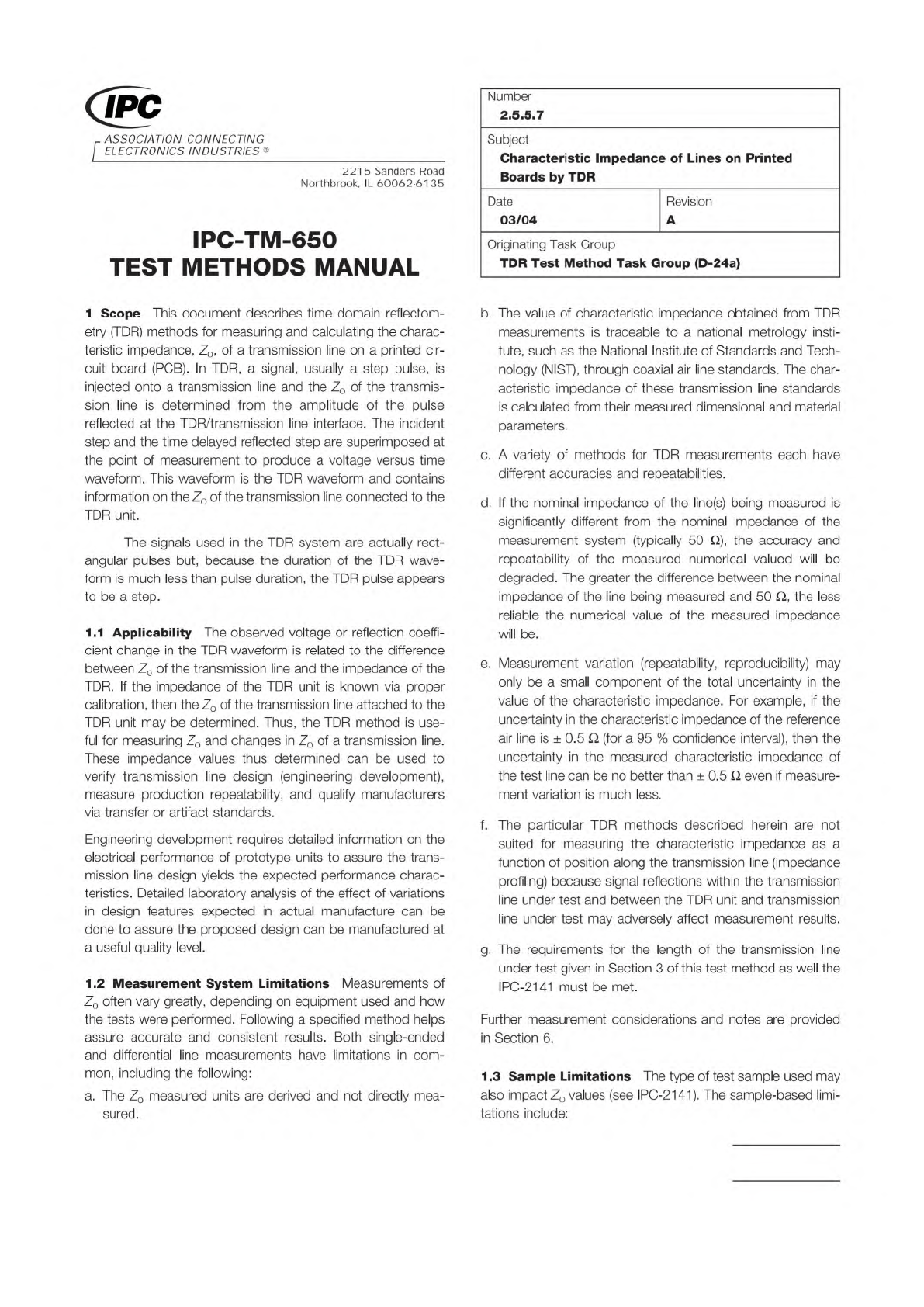
1
Scope
This
document
describes
time
domain
reflectom-
etry
(TDR)
methods
for
measuring
and
calculating
the
charac¬
teristic
impedance,
Zo,
of
a
transmission
line
on
a
printed
cir¬
cuit
board
(PCB).
In
TDR,
a
signal,
usually
a
step
pulse,
is
injected
onto
a
transmission
line
and
the
Zo
of
the
transmis¬
sion
line
is
determined
from
the
amplitude
of
the
pulse
reflected
at
the
TDR/transmission
line
interface.
The
incident
step
and
the
time
delayed
reflected
step
are
superimposed
at
the
point
of
measurement
to
produce
a
voltage
versus
time
waveform.
This
waveform
is
the
TDR
waveform
and
contains
information
on
the
Zo
of
the
transmission
line
connected
to
the
TDR
unit.
The
signals
used
in
the
TDR
system
are
actually
rect¬
angular
pulses
but,
because
the
duration
of
the
TDR
wave¬
form
is
much
less
than
pulse
duration,
the
TDR
pulse
appears
to
be
a
step.
1.1
Applicability
The
observed
voltage
or
reflection
coeffi¬
cient
change
in
the
TDR
waveform
is
related
to
the
difference
between
Zo
of
the
transmission
line
and
the
impedance
of
the
TDR.
If
the
impedance
of
the
TDR
unit
is
known
via
proper
calibration,
then
the
Zo
of
the
transmission
line
attached
to
the
TDR
unit
may
be
determined.
Thus,
the
TDR
method
is
use¬
ful
for
measuring
Zo
and
changes
in
Zo
of
a
transmission
line.
These
impedance
values
thus
determined
can
be
used
to
verify
transmission
line
design
(engineering
development),
measure
production
repeatability,
and
qualify
manufacturers
via
transfer
or
artifact
standards.
Engineering
development
requires
detailed
information
on
the
electrical
performance
of
prototype
units
to
assure
the
trans¬
mission
line
design
yields
the
expected
performance
charac¬
teristics.
Detailed
laboratory
analysis
of
the
effect
of
variations
in
design
features
expected
in
actual
manufacture
can
be
done
to
assure
the
proposed
design
can
be
manufactured
at
a
useful
quality
level.
1.2
Measurement
System
Limitations
Measurements
of
Zo
often
vary
greatly,
depending
on
equipment
used
and
how
the
tests
were
performed.
Following
a
specified
method
helps
assure
accurate
and
consistent
results.
Both
single-ended
and
differential
line
measurements
have
limitations
in
com¬
mon,
including
the
following:
a.
The
Zo
measured
units
are
derived
and
not
directly
mea¬
sured.
Number
2.5.5.7
Subject
Characteristic
Impedance
of
Lines
on
Printed
Boards
by
TDR
Date
Revision
03/04
A
Originating
Task
Group
TDR
Test
Method
Task
Group
(D-24a)
b.
The
value
of
characteristic
impedance
obtained
from
TDR
measurements
is
traceable
to
a
national
metrology
insti¬
tute,
such
as
the
National
Institute
of
Standards
and
Tech¬
nology
(NIST),
through
coaxial
air
line
standards.
The
char¬
acteristic
impedance
of
these
transmission
line
standards
is
calculated
from
their
measured
dimensional
and
material
parameters.
c.
A
variety
of
methods
for
TDR
measurements
each
have
different
accuracies
and
repeatabilities.
d.
If
the
nominal
impedance
of
the
line(s)
being
measured
is
significantly
different
from
the
nominal
impedance
of
the
measurement
system
(typically
50
Q),
the
accuracy
and
repeatability
of
the
measured
numerical
valued
will
be
degraded.
The
greater
the
difference
between
the
nominal
impedance
of
the
line
being
measured
and
50
Q,
the
less
reliable
the
numerical
value
of
the
measured
impedance
will
be.
e.
Measurement
variation
(repeatability,
reproducibility)
may
only
be
a
small
component
of
the
total
uncertainty
in
the
value
of
the
characteristic
impedance.
For
example,
if
the
uncertainty
in
the
characteristic
impedance
of
the
reference
air
line
is
±
0.5
Q
(for
a
95
%
confidence
interval),
then
the
uncertainty
in
the
measured
characteristic
impedance
of
the
test
line
can
be
no
better
than
土
0.5
Q
even
if
measure¬
ment
variation
is
much
less.
f.
The
particular
TDR
methods
described
herein
are
not
suited
for
measuring
the
characteristic
impedance
as
a
function
of
position
along
the
transmission
line
(impedance
profiling)
because
signal
reflections
within
the
transmission
line
under
test
and
between
the
TDR
unit
and
transmission
line
under
test
may
adversely
affect
measurement
results.
g.
The
requirements
for
the
length
of
the
transmission
line
under
test
given
in
Section
3
of
this
test
method
as
well
the
IPC-2141
must
be
met.
Further
measurement
considerations
and
notes
are
provided
in
Section
6.
1
.3
Sample
Limitations
The
type
of
test
sample
used
may
also
impact
Zo
values
(see
IPC-2141).
The
sample-based
limi¬
tations
include: