IPC-TM-650 EN 2022 试验方法--.pdf - 第593页
T a ble 1 Metal Relative Conductivity G Relative Permeability u Properties of V a rious Metals at 150 KHz Properties of V arious Metals at 400 MHz Absorption Loss in db A Magnetic Reflection Loss in db R H Electric Reflect…
IPC-TM-650
Number
Subject Date
Revision
Page 2 of 5
2.5.15
Guidelines
and
Test
Methods
for
RFI-EMI
Shielding
of
Flat
Cable
10/86
A
Induction
fields
are
either
high-
or
low-impedance
fields.
A
high-impedance
field
is
defined
as
a
field
whose
impedance
is
higher
than
the
impedance
of
the
dielectric
in
which
it
exists.
A
low-impedance
field
has
an
impedance
lower
than
the
impedance
of
the
dielectric.
High-impedance
fields
are
asso¬
ciated
with
a
voltage
source
and
most
of
their
energy
is
con¬
tained
in
their
electric
component,
while
low-impedance
fields
are
associated
with
a
current
source
and
most
of
their
energy
is
contained
in
the
magnetic
component.
1.2.2
Shield
Impedance
An
important
parameter
associ¬
ated
with
these
radiating
fields
is
the
characteristic
imped¬
ance,
which
is
the
ratio
of
the
electric
to
magnetic
field
com¬
ponents.
For
a
plane
wave
in
free
space,
the
characteristic
impedance
is
377
ohms,
and
correspondingly
for
intense
electric
or
high
impedance
fields,
it
is
greater
than
377
ohms,
and
for
strong
magnetic
or
low
impedance
fields,
it
is
less
than
377
ohms.
The
difference
in
characteristic
impedance
between
an
incident
field
and
a
shield
is
directly
proportional
to
the
reflection
losses.
The
characteristic
impedance
of
a
shield
varies
with
the
material's
permeability,
conductivity,
and
frequency.
Shield
impedances
are
generally
low
at
low
fre¬
quencies
and
increase
directly
with
frequency.
Since
at
all
fre¬
quencies,
electric
(E)
fields
are
high
impedance
and
magnetic
(H)
fields
are
low
impedance,
the
corresponding
reflection
losses
are
high
for
electric
fields
at
low
test
frequency
and
low
or
poor
for
magnetic
fields
at
the
same
test
frequency.
As
test
frequencies
increase,
the
impedance
mismatches
decrease
for
electric
fields
(decrease
in
RE)
and
increase
for
magnetic
fields
(increase
in
RH).
The
absorption
losses
for
both
electric
and
magnetic
fields
increase
with
frequency.
It
can
be
con¬
cluded
from
this
that
good
shielding
effectiveness
against
pre¬
dominantly
electric
fields
can
be
obtained
with
most
high
con¬
ductivity
shielding
materials.
At
low
frequencies,
Re
losses
are
so
high
that
small
absorption
losses
may
be
neglected
and,
at
high
frequencies,
even
though
most
of
the
transmitted
energy
is
coupled
to
the
shield,
absorption
losses
are
high
enough
for
adequate
shielding
if
all
nonconductive
openings
in
the
shield
are
eliminated.
Shielding
against
magnetic
fields
presents
a
different
situation
at
low
frequencies,
where
absorption
and
reflection
(RH)
losses
are
small.
Here,
uniform
100%
shielding
is
essential
and
in
most
cases
ferromagnetic,
highly
perme¬
able
materials
are
employed
to
increase
absorption
losses.
At
high
frequencies,
both
reflection
and
absorption
losses
are
high,
and
shielding
effectiveness
is
good
for
magnetic
fields.
Table
1
shows
properties
of
various
metals
at
150
KHz
and
400
MHz
and
the
corresponding
absorption
loss
in
db.
The
significance
of
this
table
is
to
show
the
necessity
for
highly
permeable
materials
to
shield
against
low
frequency
magnetic
fields.
3
Test
Specimen
None
4
Equipment/Apparatus
None
5
Procedure
None
6
Notes
6.1
Shielding
effectiveness
is
usually
determined
more
pre¬
cisely
by
measurement
than
by
calculation,
especially
when
100%
shielding
is
impractical.
To
obtain
the
attenuation
capa¬
bility
of
a
shielding
material
about
a
flat
cable,
it
is
more
prac¬
tical
to
test
a
cable
system
for
its
susceptibility
to
radiated
energy.
Figure
1
shows
a
test
setup
designed
to
measure
shielding
effectiveness
in
a
flat
cable
for
electric
and
magnetic
radiating
fields.
Two
1
.5
m
cable
specimens,
one
shielded
and
one
unshielded,
are
terminated
in
their
characteristic
impedance
at
the
generator
source
end
and
attached
through
a
coaxial
switch
to
a
field
intensity
meter
(or
similar
device)
at
the
other
end.
These
two
cable
samples
are
mounted
and
suspended
2.5
cm
above
a
conducting
ground
plane
and
7.5
cm
to
either
side
of
a
bare
unshielded
copper
wire
(see
Figure
2).
This
radiating
copper
wire
is
connected
at
one
end
to
a
RF
signal
generator
and
is
terminated
at
the
opposite
end
in
either
a
short
or
non-radiating
open
circuit.
6.2
When
the
bare
wire
is
open
circuited,
the
majority
of
the
radiated
field
is
electric,
and
when
it
is
short
circuited,
mag¬
netic
fields
dominate.
Since
the
cables
are
only
7.5
cm
away
from
the
radiating
source,
electric
and
magnetic
shielding
effectiveness
can
be
measured
separately
at
frequencies
up
to
approximately
4
GHz.
It
is
assumed
that
if
a
shield
is
effec¬
tive
under
these
conditions,
it
will
be
equally
effective
against
plane
wave
radiation.
6.3
Four
readings
must
be
taken
at
each
test
frequency.
First
the
voltage
pick-up
in
the
unshielded
specimen
is
observed
and
is
used
as
the
reference
level
for
the
voltage
measurement
on
the
shielded
line.
The
shielding
effectiveness
in
decibels
is
given
by:
S
=
20
log
VUA/S
where:
Vu
=
voltage
induced
into
unshielded
cable
Vs
=
voltage
induced
into
shielded
cable
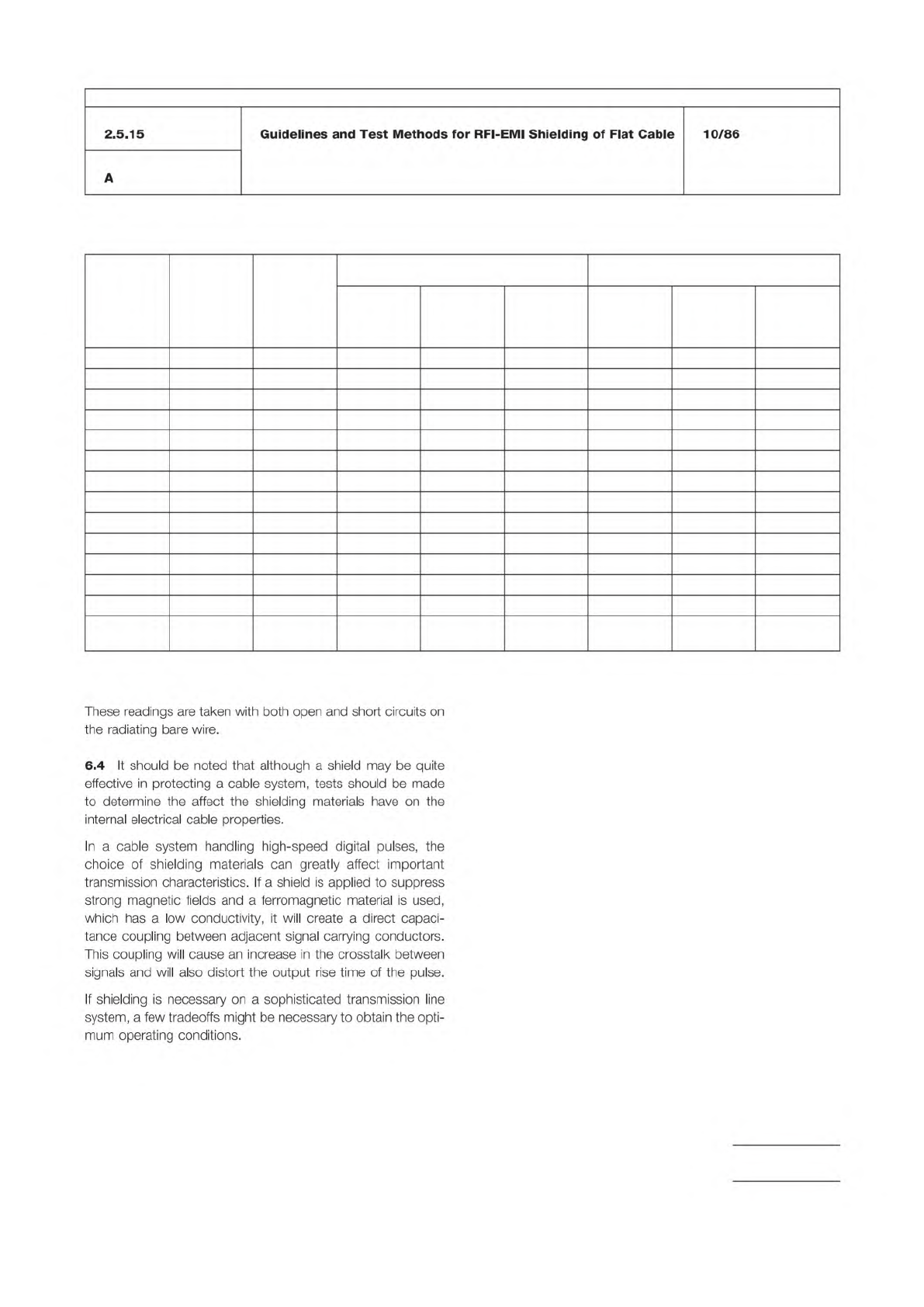
Table 1
Metal
Relative
Conductivity
G
Relative
Permeability
u
Properties
of Various Metals
at 150 KHz
Properties of Various Metals
at 400 MHz
Absorption
Loss in db
A
Magnetic
Reflection
Loss in db
R
H
Electric
Reflection
Loss in db
R
E
Absorption
Loss in db
A
Magnetic
Reflection
Loss in db
R
H
Electric
Reflection
Loss in db
R
E
Silver 1.05 1 1.34 34.7 198.5 6.92 48.9 155.7
Copper 1.00 1 1.31 34.5 198.3 6.76 48.7 155.5
Gold 0.70 1 1.09 32.9 196.7 5.65 47.1 154.0
Aluminum 0.61 1 1.02 32.4 196.1 5.28 46.6 153.4
Magnesium 0.38 1 0.80 30.3 194.1 4.17 44.5 151.3
Cadmium 0.23 1 0.63 28.1 191.9 3.24 42.3 149.1
Nickel 0.20 1 0.58 27.5 191.3 3.02 41.7 148.5
Iron 0.17 1,000 17.06 1.07 160.6 88.14 11.8 117.8
Tin 0.15 1 0.50 26.3 190.0 2.62 40.5 147.3
Steel, 1045 0.10 1,000 13.10 0.0001 158.3 67.6 9.8 115.5
Lead 0.08 1 0.37 23.6 187.3 1.91 37.7 144.5
Mu-Metal 0.03 80,000 64.13
*
7.3 134.0 331.17 0.93 91.2
Permalloy 0.03 80,000 64.13
*
7.3 134.0 331.17 0.93 91.2
Stainless
Steel
0.02 1,000 5.85 -1.3 151.3 30.23 4.2 108.5
*
Valid only if incident field does not saturate metal.
Calculations are for a 0.0025 mm thick shield 2.5 cm away from the radiating source.
IPC-TM-650
Number
Subject Date
Revision
Page 3 of 5
2.5.15
Guidelines
and
Test
Methods
for
RFI-EMI
Shielding
of
Flat
Cable
10/86
A
These
readings
are
taken
with
both
open
and
short
circuits
on
the
radiating
bare
wire.
6.4
It
should
be
noted
that
although
a
shield
may
be
quite
effective
in
protecting
a
cable
system,
tests
should
be
made
to
determine
the
affect
the
shielding
materials
have
on
the
internal
electrical
cable
properties.
In
a
cable
system
handling
high-speed
digital
pulses,
the
choice
of
shielding
materials
can
greatly
affect
important
transmission
characteristics.
If
a
shield
is
applied
to
suppress
strong
magnetic
fields
and
a
ferromagnetic
material
is
used,
which
has
a
low
conductivity,
it
will
create
a
direct
capaci¬
tance
coupling
between
adjacent
signal
carrying
conductors.
This
coupling
will
cause
an
increase
in
the
crosstalk
between
signals
and
will
also
distort
the
output
rise
time
of
the
pulse.
If
shielding
is
necessary
on
a
sophisticated
transmission
line
system,
a
few
tradeoffs
might
be
necessary
to
obtain
the
opti¬
mum
operating
conditions.
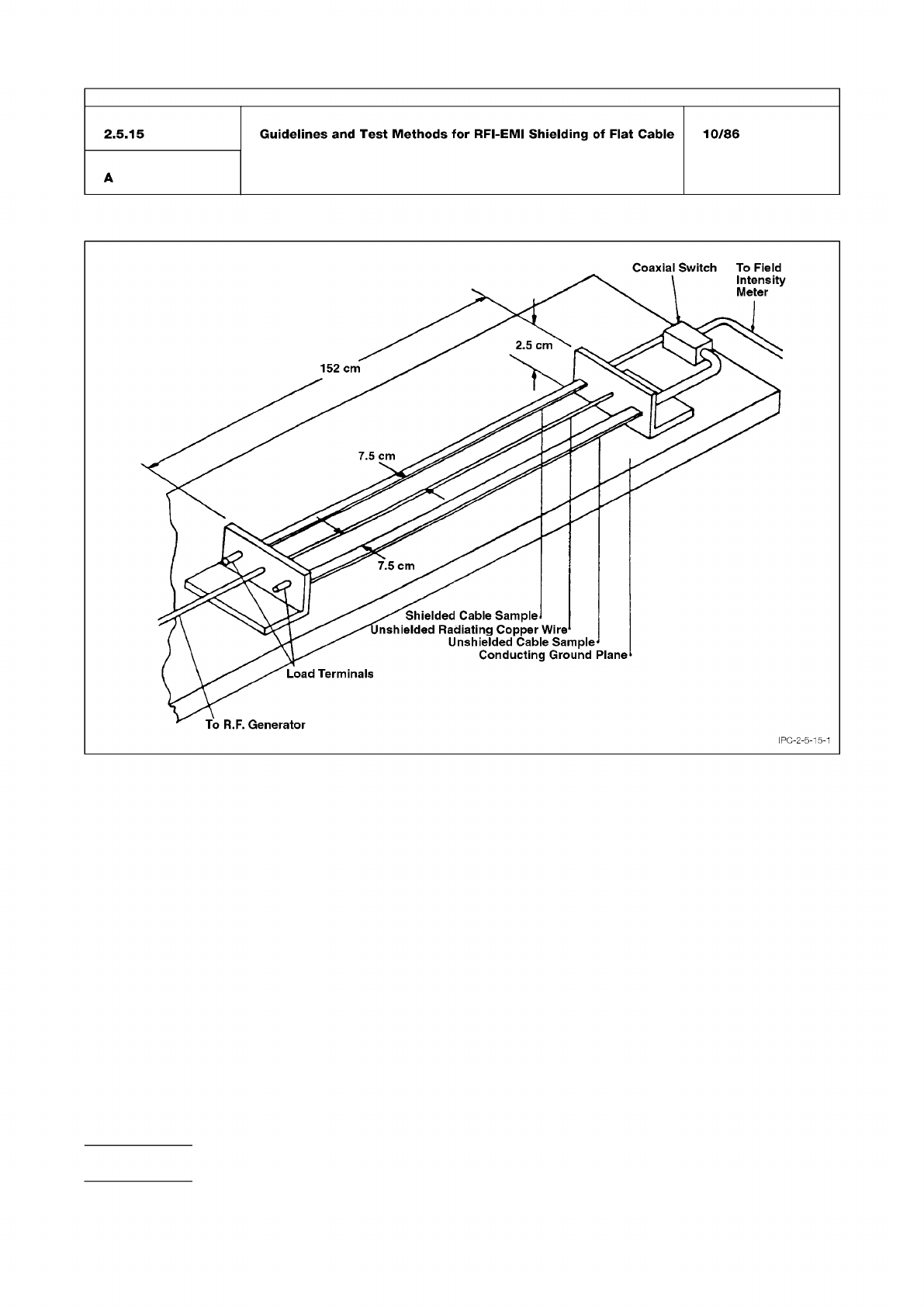
Figure 1 Shielding Effectiveness Test Setup
IPC-TM-650
Number
Subject Date
Revision
Page 4 of 5
10/86
2.5.15
Guidelines
and
Test
Methods
for
RFI-EMI
Shielding
of
Flat
Cable
A