IPC-TM-650 EN 2022 试验方法--.pdf - 第167页
NOTE: NOTE: IPC-TM-650 Page 3 of 4 Number 2.3.25.1 Revision Subject Ionic Cleanliness Testing of Bare PWBs Date October 2000 Between measurements, rinse the cell with deionized water and leave the cell soaking in virgin …
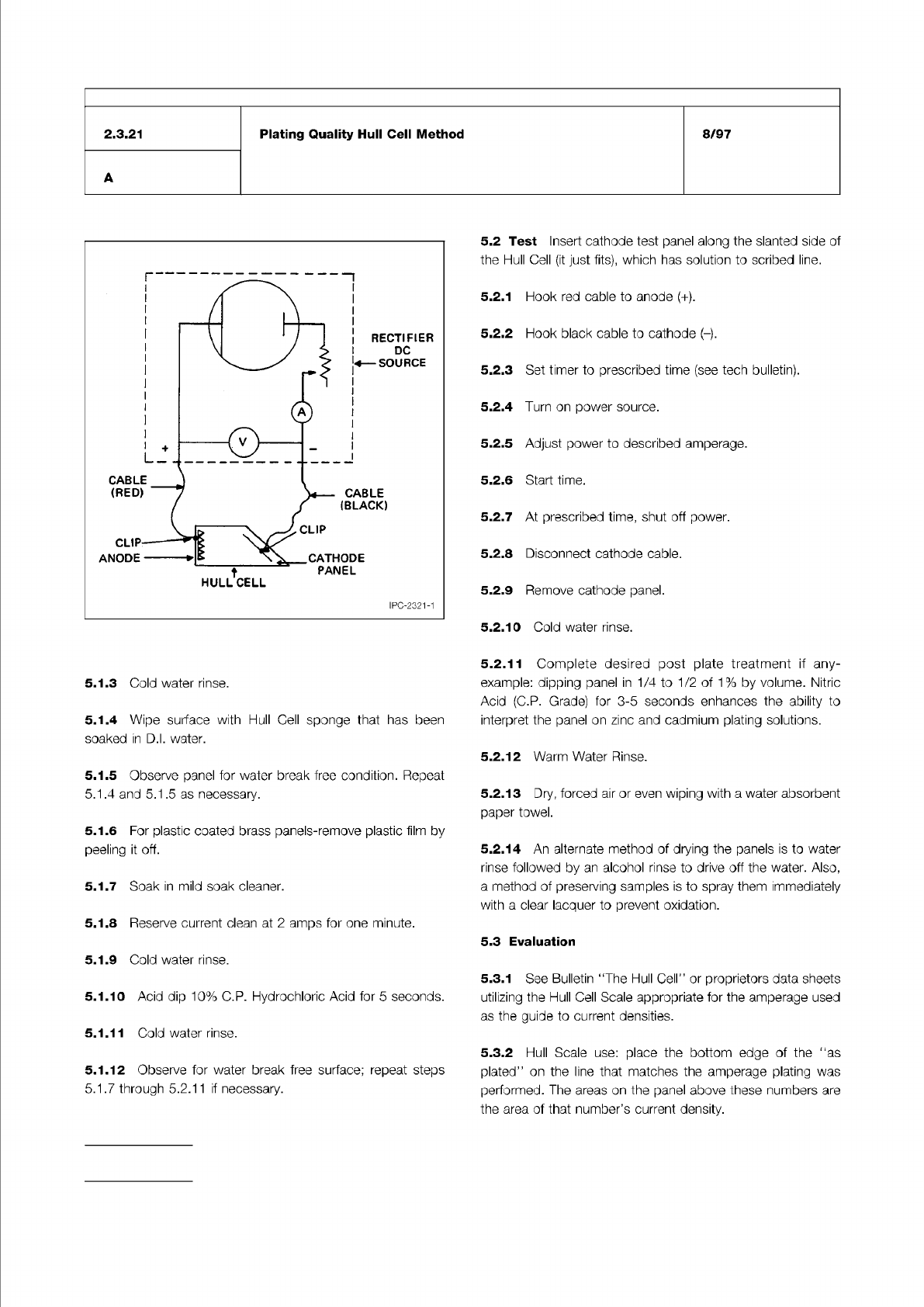
Figure 1 Hull Cell Hook Up
IPC-TM-650
Number
Subject Date
Revision
Page 2 of 3
2.3.21
Plating
Quality
Hull
Cell
Method
8/97
A
5.1.3
Cold
water
rinse.
5.1.4
Wipe
surface
with
Hull
Cell
sponge
that
has
been
soaked
in
D.l.
water.
5.1.5
Observe
panel
for
water
break
free
condition.
Repeat
5.1
.4
and
5.1
.5
as
necessary.
5.1.6
For
plastic
coated
brass
panels-remove
plastic
film
by
peeling
it
off.
5.1.7
Soak
in
mild
soak
cleaner.
5.1.8
Reserve
current
clean
at
2
amps
for
one
minute.
5.1.9
Cold
water
rinse.
5.1.10
Acid
dip
10%
C.P.
Hydrochloric
Acid
for
5
seconds.
5.1.1
1
Cold
water
rinse.
5.1.12
Observe
for
water
break
free
surface;
repeat
steps
5.1
.7
through
5.2.1
1
if
necessary.
5.2
Test
Insert
cathode
test
panel
along
the
slanted
side
of
the
Hull
Cell
(it
just
fits),
which
has
solution
to
scribed
line.
5.2.1
Hook
red
cable
to
anode
(+).
5.2.2
Hook
black
cable
to
cathode
(-).
5.2.3
Set
timer
to
prescribed
time
(see
tech
bulletin).
5.2.4
Turn
on
power
source.
5.2.5
Adjust
power
to
described
amperage.
5.2.6
Start
time.
5.2.7
At
prescribed
time,
shut
off
power.
5.2.8
Disconnect
cathode
cable.
5.2.9
Remove
cathode
panel.
5.2.10
Cold
water
rinse.
5.2.1
1
Complete
desired
post
plate
treatment
if
any-
example:
clipping
panel
in
1
/4
to
1
/2
of
1
%
by
volume.
Nitric
Acid
(C.P.
Grade)
for
3-5
seconds
enhances
the
ability
to
interpret
the
panel
on
zinc
and
cadmium
plating
solutions.
5.2.12
Warm
Water
Rinse.
5.2.13
Dry,
forced
air
or
even
wiping
with
a
water
absorbent
paper
towel.
5.2.14
An
alternate
method
of
drying
the
panels
is
to
water
rinse
followed
by
an
alcohol
rinse
to
drive
off
the
water.
Also,
a
method
of
preserving
samples
is
to
spray
them
immediately
with
a
clear
lacquer
to
prevent
oxidation.
5.3
Evaluation
5.3.1
See
Bulletin
1(The
Hull
Cell"
or
proprietors
data
sheets
utilizing
the
Hull
Cell
Scale
appropriate
for
the
amperage
used
as
the
guide
to
current
densities.
5.3.2
Hull
Scale
use:
place
the
bottom
edge
of
the
(1as
plated"
on
the
line
that
matches
the
amperage
plating
was
performed.
The
areas
on
the
panel
above
these
numbers
are
the
area
of
that
number's
current
density.
NOTE:
NOTE:
IPC-TM-650
Page 3 of 4
Number
2.3.25.1
Revision
Subject
Ionic
Cleanliness
Testing
of
Bare
PWBs
Date
October
2000
Between
measurements,
rinse
the
cell
with
deionized
water
and
leave
the
cell
soaking
in
virgin
extract
solution.
Never
use
a
dry
cell
as
this
is
bad
technique.
5.2.2.4
Using
the
linear
relationship
formed
in
5.2.1
.6,
determine
the
concentration
of
sodium
chloride
correspond¬
ing
to
the
conductivity
reading.
Use
the
equation
given
below
to
determine
the
total
micrograms
of
sodium
chloride
equiva¬
lence
per
square
centimeter
(pg
NaCI
Eq.
/cm2)
Using
the
nomogram:
Conductivity
of
Unknown
一
Concentration
of
Unknown
Concentration
Volume
of
Extract
Solution
(pg/liter)
x
(liter)
Extracted
Surface
Area
(cm2)
二
pg
NaCI
Eq.
/cm2
5.2.2.5
If
the
conductivity
of
the
unknown
solution
is
outside
of
the
bounds
represented
on
the
existing
nomogram,
then
continue
the
technique
used
to
generate
the
nomogram
(see
5.2.1)
until
the
bounds
contain
the
conductivity
of
the
unknown
solution.
5.3
Measurement
-
Static
ROSE
Tester
Method
This
section
was
developed
using
an
Omegameter
600SMD
with
a
1
0,000
mL
cell.
Make
appropriate
changes
to
the
procedure
to
accommodate
other
static
ROSE
testers.
5.3.1
Perform
a
system
verification
check.
5.3.2
Set
the
instrument
to
an
appropriate
amount
of
sol¬
vent
volume.
A
target
solution
level
should
be
1.5
mL
for
one
cm2
of
board
surface.
It
is
not
necessary
to
cover
the
spray
jets
(if
applicable).
If
the
lid
is
on
the
test
cell,
the
C02
mixing
is
minimized.
5.3.3
Enter
the
appropriate
surface
area
into
the
instrument.
5.3.4
To
allow
for
the
volume
of
solvent
that
is
to
be
added,
the
instrument
setup
volume
will
be
set
at
the
minimum
vol¬
ume
(e.g.,
2300
mL)
plus
the
volume
of
solution
in
the
extrac¬
tion
bag
(e.g.,
100
mL).
Dwell
time
or
run
time:
2
minutes
Pass
/
Fail
Value:
None
Begin
the
test
and
follow
the
test
prompts.
Remove
the
cell
cover.
5.3.5
Carefully
open
the
test
bag
and
quickly
pour
the
extract
solution
into
the
test
cell.
To
minimize
CO2
absorption,
the
addition
should
be
made
as
quickly
as
possible
and
the
cell
cover
quickly
replaced.
5.3.6
The
instrument
should
very
quickly
reach
equilibrium
(10-15
seconds)
and
then
should
remain
essentially
unchanged
for
the
remainder
of
the
two
minute
run.
5.3.7
Log
the
reading
in
total
pg
of
sodium
chloride
equiva¬
lence
per
cm2.
5.3.8
Static
ROSE
Calculation
Example:
Testing
a
bare
board,
10
cm
x
20
cm
[3.9
in
x
7.9
in]
Surface
area
is
1
0
cm
x
20
cm
x
2
=
400
cm2
[62
in2]
Bag
size
should
be
about
1
5
cm
x
30
cm
[5.9
in
x
12
in]
or
larger
Extract
solution
would
be
about
620
mL
ROSE
volume
input
to
4620
mL
(4000
mL
to
cover
sprays
and
620
mL
from
extraction)
ROSE
tester
cell
volume
set
to
4000
mL
Run
time
-
2
minutes
5.4
Measurement
-
Dynamic
ROSE
Tester
Method
5.4.1
Perform
a
system
verification
check.
5.4.2
Program
the
instrument
with
the
appropriate
surface
area
of
the
board.
5.4.3
Cycle
the
instrument
to
the
beginning
cleanliness
point.
5.4.4
Carefully
open
the
test
bag
and
quickly
pour
the
extract
solution
into
the
test
cell.
To
minimize
CO2
absorption,
the
addition
should
be
made
as
quickly
as
possible
and
the
cell
cover
quickly
replaced.
5.4.5
When
the
instrument
completes
the
test,
log
the
read¬
ing
in
total
pg
of
sodium
chloride
equivalence
per
cm2.
6
Notes
6.1
The
background
for
this
test
method
may
be
found
in
technical
papers:
11
Rationale
and
Methodology
for
a
Modified
Resistivity
of
Sol¬
vent
Extract
Test
Method/'
Philip
W.
Wittmer,
I
PC
1995
Fall
Meeting
Proceedings,
S13-4.
IPC-TM-650
Page 4 of 4
Number
2.3.25.1
Subject
Ionic
Cleanliness
Testing
of
Bare
PWBs
Date
October
2000
Revision
“Ionic
Cleanliness
of
LPISM
Circuit
Boards,"
Hank
Sanftle-
ben,
IPO
1995
Fall
Meeting
Proceedings,
S13-3.
6.2
IPC-HDBK-001
"Handbook
and
Guide
to
the
Require¬
ments
for
Soldered
Electrical
and
Electronic
Assemblies
to
Supplement
ANSI/J-STD-001
"
is
another
source
for
under¬
standing
ROSE
testing
in
general.
6.3
This
method
may
also
be
known
as
the
modified-ROSE
test.
This
test,
due
to
its
longer
extraction
time
and
higher
extraction
temperature,
has
demonstrated
better
correlation
with
the
total
ion
determination
by
ion
chromatography
than
IPC-TM-650,
Test
Method
2.3.25,
Detection
and
Measure¬
ment
of
Ionizable
Surface
Contaminants
by
Resistivity
of
Sol¬
vent
Extract
(ROSE)
Method.
However,
as
a
bulk
contamina¬
tion
measurement
method,
it
cannot
distinguish
individual
ion
species.
6.4
From
an
analytical
standpoint,
the
dip
probe
method
is
preferred
as
more
repeatable
than
the
automated
ROSE
testers
and
avoids
many
of
the
test
inaccuracies
(e.g.,
C02
absorption
from
spray
agitation)
inherent
in
those
instruments.
It
should
be
stressed
that
the
dip
probe
method
is
an
electro¬
lytic
conductivity
measurement
and
must
be
temperature-
compensated.
6.5
The
dip
probe
calibrations
can
be
run
at
multiple
tem¬
peratures
and
a
family
of
curves
generated,
widening
the
test
window
for
use
with
this
method.
Higher
temperatures,
how¬
ever,
will
lead
to
a
faster
2-propanol
evaporation
rate.
The
test
can
also
be
run
with
more
dilute
concentrations,
prepared
by
series
dilution.
6.6
Conductivity
cells
have
a
“constant”
value.
Measured
readings
must
be
multiplied
by
this
constant.
Exposure
to
harsh
chemicals
may
alter
the
constant,
making
a
re-calibration
necessary.
Do
not
allow
the
probe
used
for
this
procedure
to
contact
sticky,
oily,
or
resinous
liquids
(e.g.,
flux).
6.7
This
procedure
is
intended
to
be
a
process
control
aid
and
as
such,
no
pass-fail
criteria
is
stated.
It
is
expected
that
the
fabricator/assembler
will
determine,
with
their
customer,
the
necessary
pass-fail
criteria
for
their
product
by
this
method.
6.8
This
method
is
best
suited
for
monitoring
and
control
of
a
previously
optimized
process
and
should
not
be
used
to
generate
acceptance
data
unless
part
of
a
larger
correlation
study.
Values
generated
with
this
method
should
be
corre¬
lated
to
acceptable
electrical
performance
if
used
for
accep¬
tance.
6.9
Kapak™
500
Series
Bags
can
be
obtained
from:
Kapak
Corporation
5305
Parkdale
Drive
Minneapolis,
MN
55416
800-527-2557
www.kapak.com
A
secondary
source
of
Kapak™
or
Scotchpak™
polyester
bags
or
pouches
can
be
obtained
from:
VWR
International
1310
Goshen
Parkway
West
Chester,
PA
1
9380
Orders:
1-800-932-5000
Web
Orders:
www.vwrsp.com
If
an
alternative
to
the
Kapak™
bag
or
Scotchpak™
is
desired,
the
bag
must
have
the
following
characteristics:
•
No
extractable
ionic
material
in
75%
2-propanol
/
25%
DI
water
at
80℃
[1
76°F]
for
60
minutes
•
0.01
cm
[0.0039
in]
wall
thickness
minimum
•
Heat
sealable
or
mechanical
seal
6.10
There
is
some
concern
regarding
ROSE
tester
cell
size.
Testing
a
2
cm
x
2
cm
[0.79
in
x
0.79
in]
board
in
a
20,000
mL
cell
causes
such
a
severe
dilution
as
to
cause
the
signal
to
be
lost
in
the
noise.
A
recommended
cell
size
is
5000
mL
or
less.
Smaller
cell
volumes
will
allow
for
a
more
measurable
result.
If
a
smaller
cell,
or
running
with
a
smaller
test
volume,
are
not
an
option,
then
the
number
of
bare
boards
can
be
increased,
all
extracted
separately,
and
the
extract
solutions
all
tested
at
once.
6.1
1
When
testing
hybrids
or
microelectronics,
be
aware
that
2-propanol
stored
in
glass
containers
can
leach
out
materials
such
as
sodium,
borates,
and
silica.
2-propanol
stored
in
plastic
containers
does
not
have
such
a
leaching
problem.