IPC-TM-650 EN 2022 试验方法--.pdf - 第428页
Figure 1 Special T est Fixture for Di electric Constant and Dissipation Factor M easurements IPC-TM-650 Number Subject Date Revision Page 2 of 2 2.5.5.2 Dielectric Constant and Dissipation Factor of Printed Wiring Board …
The Institute for Interconnecting and Packaging Electronic Circuits
2215 Sanders Road • Northbrook, IL 60062
Material in this Test Methods Manual was voluntarily established by Technical Committees of the IPC. This material is advisory only
and its use or adaptation is entirely voluntary. IPC disclaims all liability of any kind as to the use, application, or adaptation of this
material. Users are also wholly responsible for protecting themselves against all claims or liabilities for patent infringement.
Equipment referenced is for the convenience of the user and does not imply endorsement by the IPC.
Page 1 of 2
IPC-TM-650
TEST
METHODS
MANUAL
1
.0
Scope
This
test
method
is
to
determine
the
dielectric
constant
and
dissipation
factor
of
raw
printed
wiring
board
material
at
1
MH
乙
2
.0
Applicable
Documents
None
3
.0
Test
Specimens
Each
specimen
shall
be
50.8
±
0.076
mm
[2.0
±
0.003
in]
in
diameter
by
thickness
of
laminate
or
substrate
material.
Remove
copper
of
metal-clad
specimens
by
etching
using
standard
commercial
practices.
At
least
three
specimens
are
required.
4
.0
Equipment/Apparatus
4.1
Meter
A
1
MHz
Digital
LCR
Meter,
Hewlett
Packard
Mdl
4271
A
or
equivalent.
4.2
Test
Fixture
Hewlett
Packard
Mdl
1
6022A
test
fixture
or
equivalent.
4.3
Specimen
Holder
A
special
specimen
holder
made
as
shown
in
Figure
1.
This
holder
is
designed
to
be
compatible
with
the
H/P
test
fixture,
Mdl
1
6022A.
4.0
Procedure
5.1
Preparation
5.1.1
Prepare
the
specimens
as
specified
in
paragraph
3.0.
5.1.2
Calculate
the
effect
thickness
(inches)
=
0.01942
x
Mass
Density
Mass
=
Measured
weight
in
grams
Density
=
Grams
per
cubic
cm
(as
per
ASTM-D-792,
Method
1A)
5.1.3
Coat
both
sides
of
specimens
with
one
uniform
coat¬
ing
of
silver
conductive
paint.
5.1.4
Air-dry
the
specimens
until
dry
to
touch,
then
oven-dry
at
50°
±
2
℃
for
1
/2
hour
and
cool
in
a
desiccator.
Number
2.5.5.2
Subject
Dielectric
Constant
and
Dissipation
Factor
of
Printed
Wiring
Board
Material
—
Clip
Method
Date
Revision
12/87
A
Originating
Task
Group
N/A
5.1.5
Punch
or
machine
a
25.4
mm
[1
.0
in]
diameter
disc
from
the
50.8
mm
[2.0
in]
specimens.
(Assure
that
there
is
no
carry
over
of
the
paint
from
one
side
to
the
other.)
5.1.6
Condition
the
25.4
mm
[1
.0
in]
specimens
for
a
mini¬
mum
of
40
hours
at
23°
±
5
℃
at
a
relative
humidity
of
50%.
5.2
Testing
5.2.1
Turn
meter
on
and
allow
to
warm
up
for
60
minutes
minimum.
5.2.1.
1
Set
the
controls
on
the
meter
as
follows:
Function
-
C-D
Range
-
Manual
Trigger
-
Internal
Rate
-
FCW
Test
Signal
Level
-
Low
5.2.1.
2
Connect
the
cables
for
the
test
fixture
to
the
appro¬
priate
connectors.
5.2.2
Plug
the
special
specimen
holder
into
the
test
fixture.
5.2.3
The
digital
display
on
the
meter
will
show
the
capaci¬
tance
value
and
the
dissipation
factor
of
the
unknown
dielec¬
tric
specimen.
5.3
Calculation
5.3.1
Dielectric
Constant
The
dielectric
constant
shall
be
determined
by
using
the
following
formula:
K
=
―
—
—
0.225
A
K
=
Dielectric
constant
C
=
Capacitance
reading
from
Mdl
4271
A
Meter
A
=
Area
of
a
1
-inch
disc
(square
inches)
t
=
Effective
thickness
(inches)
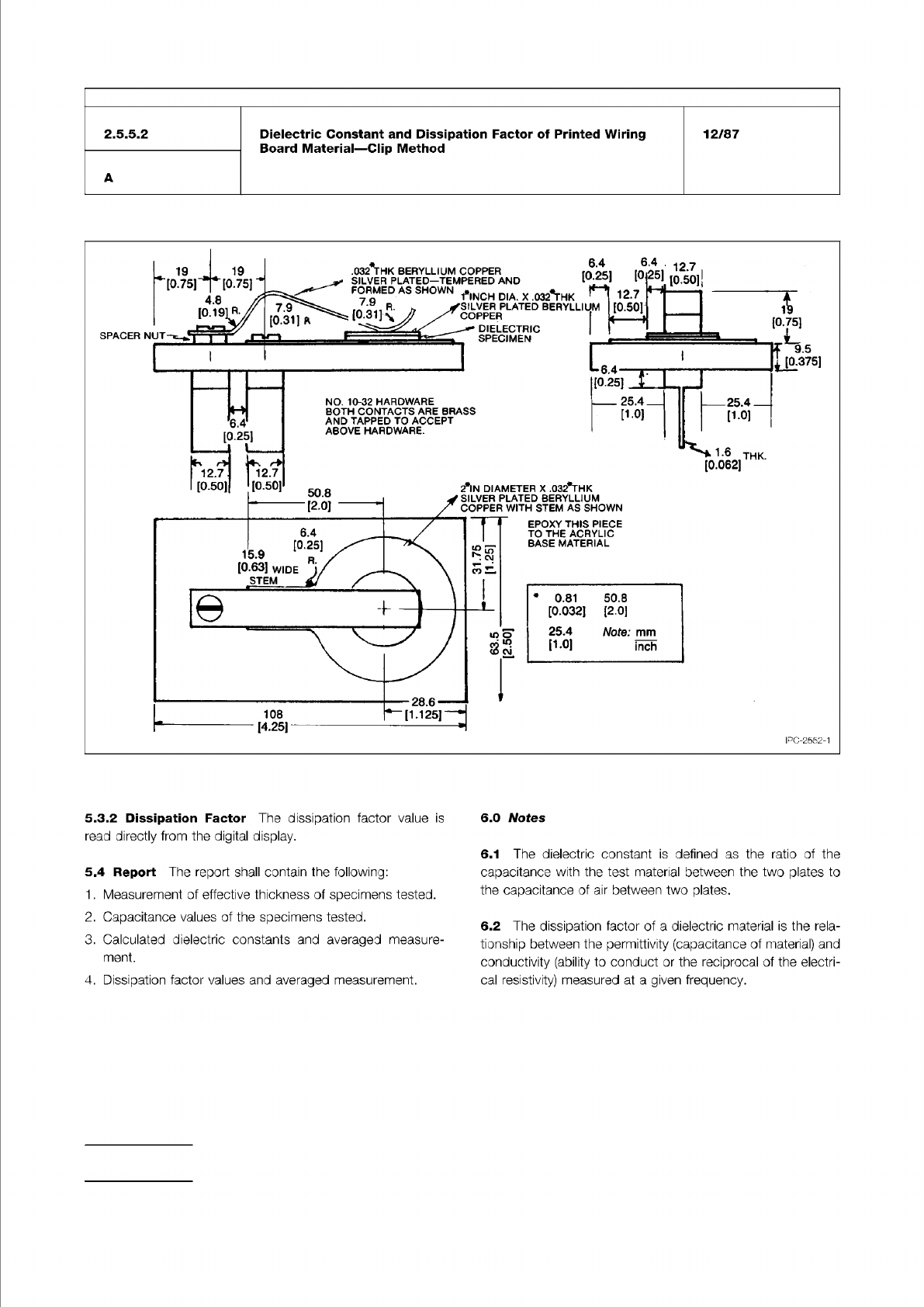
Figure 1 Special Test Fixture for Dielectric Constant and Dissipation Factor Measurements
IPC-TM-650
Number
Subject Date
Revision
Page 2 of 2
2.5.5.2
Dielectric
Constant
and
Dissipation
Factor
of
Printed
Wiring
Board
Material
—
Clip
Method
12/87
A
Q32,HK
BERYLLIUM
C
SILVER
PLATED—
TEMP
FORMED
AS
SHOWN
俞
7
融/
/
r
SPACER
N(
I
T
q
I
I
I
6.4
).2E
NO.
10-32
HARDWARE
BOTH
CONTACTS
ARE
BRAS
AND
TAPPED
TO
ACCEPT
ABOVE
HARDWARE.
K
•I
L-
12.7
[0.50]
K
C
12.7
[0.50]
50.8
2’
ys
Zc
卬
5
.
1
[0
6.4
一
[0.25]
/
5.9
r
/
•63]
WIDE
i/
y
STEM
Q
/
e
)
7
108
L25
—
[1.125]
—
r
k
J
r
COPPER
J
>ERED
AND
W
*INCH
DIA.
X
.032*THK
SILVER
PLATED
BERYLLIU
TOPPER
x
DIELECTRIC
SPECIMEN
5.4
.25
I
6
1
[0
12.7
[0.50]
.4
,
[2
7
巴哉。
11
tl~L
中
L
[0.
M
HO\
PIE
YLI
UAL
f
9.5
1
[0.375]
SS
力
N
DIA
SILVER
:
OPPEF
工
1
9
2
METER
X
.03
落
HK
'LATED
BERYLLIU
WITH
STEM
AS
S
EPOXY
THIS
TO
THE
ACR
BASE
MATEF
25]
丁
_25.4
—
[1.0)
WN
CE
二
1
1
阳
T
[01062]THK
I
*
0.81
50.8
[0.032]
[2.0]
&
|
25.4
Note:
mm
卷
I
[10]
麻
IPC-2552-1
5.3.2
Dissipation
Factor
The
dissipation
factor
value
is
read
directly
from
the
digital
display.
5.4
Report
The
report
shall
contain
the
following:
1
.
Measurement
of
effective
thickness
of
specimens
tested.
2.
Capacitance
values
of
the
specimens
tested.
3.
Calculated
dielectric
constants
and
averaged
measure¬
ment.
4.
Dissipation
factor
values
and
averaged
measurement.
6.0
Notes
6.1
The
dielectric
constant
is
defined
as
the
ratio
of
the
capacitance
with
the
test
material
between
the
two
plates
to
the
capacitance
of
air
between
two
plates.
6.2
The
dissipation
factor
of
a
dielectric
material
is
the
rela¬
tionship
between
the
permittivity
(capacitance
of
material)
and
conductivity
(ability
to
conduct
or
the
reciprocal
of
the
electri¬
cal
resistivity)
measured
at
a
given
frequency.
The Institute for Interconnecting and Packaging Electronic Circuits
2215 Sanders Road • Northbrook, IL 60062
Material in this Test Methods Manual was voluntarily established by Technical Committees of the IPC. This material is advisory only
and its use or adaptation is entirely voluntary. IPC disclaims all liability of any kind as to the use, application, or adaptation of this
material. Users are also wholly responsible for protecting themselves against all claims or liabilities for patent infringement.
Equipment referenced is for the convenience of the user and does not imply endorsement by the IPC.
Page 1 of 4
IPC-TM-650
TEST
METHODS
MANUAL
1
.0
Scope
1.1
Purpose
This
method
is
suitable
for
determining
the
volume
permittivity,
(dielectric
constant)
and
loss
tangent
(dis¬
sipation
factor)
of
insulating
materials
at
1
MHz.
It
is
not
dependent
on
either
direct
or
indirect
measurement
of
speci¬
men
thickness
and
therefore
is
very
useful
for
thin
films
and
laminates
but
may
also
be
used
on
specimens
up
to
approxi¬
mately
6.35
mm
[0.25
in]
thick.
It
is
useful
for
all
ranges
of
permittivity
and
for
loss
tangent
as
low
as
0.0005
providing
the
range
and
accuracy
of
the
bridge
used
are
adequate.
1.2
Description
of
Method
The
two
fluid
method
utilizes
air
as
one
fluid
and
a
suitable
liquid,
normally
Dow
200
1
.0CS
silicone
fluid,
as
the
second.
Using
an
established
value
for
the
permittivity
of
air,
the
values
for
the
permittivity
of
the
fluid
and
the
sample
may
easily
be
calculated.
The
cell
spacing
is
fixed
during
all
readings
but
does
not
need
to
be
known
accu¬
rately
for
the
series
of
readings
required.
Since
specimens
do
not
require
any
electrodes
to
be
applied
and
since
many
specimens
can
be
measured
at
one
time
without
changing
any
spacings
or
machine
settings,
the
method
is
not
only
very
accurate
but
very
rapid.
The
method
has
been
used
for
measurement
of
PTFE
and
epoxy
glass
laminates
and
flexible
films,
e.g.,
polyimide.
Reproducibility
lab
to
lab
is
excellent
for
permittivity
provided
minimal
precautions
are
observed
and
bridge
accuracy
is
appropriate.
On
most
materials,
the
effects
of
small
changes
in
moisture
or
temperature
are
larger
than
any
error
due
to
the
method.
Lab
to
lab
correlation
on
stable
material
such
as
PTFE
have
shown
results
to
be
consistently
within
0.005
or
(0.20%).
2
.0
Applicable
Document
3
.0
Test
Specimens
Number
2.5.5.3
Subject
Permittivity
(Dielectric
Constant)
and
Loss
Tangent
(Dissipation
Factor)
of
Materials
(Two
Fluid
Cell
Method)
Date
12/87
Revision
C
Originating
Task
Group
N/A
3.1
Number
Unless
otherwise
specified
in
the
material
specification,
one
specimen
is
adequate
for
materials
which
are
uniform,
e.g.,
unreinforced
plastics.
For
woven
reinforced
materials
where
resin
content
may
vary,
at
least
2
specimens,
representing
the
thinnest
and
thickest
part
of
the
sample,
should
be
tested.
For
material
with
random
reinforcement,
a
minimum
of
three
specimens
from
the
edge
and
center
of
the
sheet
are
recommended
to
characterize
variation
within
the
sheet.
3.2
Form
Individual
specimens
shall
be
81
.3
mm
±
1.3
mm
x
81
.3
to
101
.6
mm
[3.2
in
±
0.05
in
x
3.2
in
to
4.0
in]
x
thick¬
ness.
For
materials
under
0.254
mm
[0.010
in],
individual
specimens
should
be
stacked
to
a
minimum
of
0.381
mm
[0.015
in]
to
maximize
accuracy.
Thinner
specimen
buildups
may
be
used
if
the
correlation
with
the
0.381
mm
[0.015
in]
specimen
is
within
the
required
accuracy
for
the
particular
equipment,
cell
spacing
and
material
being
tested.
3.3
Foil
Clad
Materials
All
foil
clad
materials
shall
have
the
metal
cladding
completely
removed
by
etching
and
shall
be
rinsed
and
dried
prior
to
conditioning.
3.4
Marking
Mark
each
specimen
in
the
upper
left
corner
with
an
engraving
pencil
or
an
ink
which
is
not
soluble
in
the
Dow
Corning
200
fluid.
4
.0
Apparatus/Materials
4
J
1
MHz
Capacitance
Bridge
with
0-200
(or
0-1
00)
pf
range.1
4.2
Cell
Balsbaugh
LD-32
or
equivalent
(see
Figure
1)
three
terminal
cell.
Note:
For
accuracy
of
1
%
or
better,
room
tem¬
perature
must
not
vary
more
than
1
℃
during
measurements.
Temperature
control
is
necessary
if
laboratory
variation
exceeds
these
limits.
1
.
Capacitance
Bridge
—
Suggested
is
Boonton
76A
automatic
capacitance
bridge.
This
model
has
adequate
capacitance
range
and
adequate
conductance
resolu¬
tion
(0.001
microsiemen)
to
permit
measurement
of
dissipation
factors
down
to
approximately
0.0005.
Other
bridges,
e.g.,
Boonton
75D,
are
also
adequate
for
low
loss
materials
and
some
other
bridges
may
be
suitable
for
higher
loss
materials,
such
as
epoxy
where
dissipation
factors
exceed
0.01
and
resolution
of
0.01
microsiemen
or
even
0.1
microsiemen
may
be
adequate.
2.
Balsbaugh
LD-3
Gillian
and
Co,,
Watertown,
MA,
(617)
624-5688
or
Zincast
Corporation,
44
Homestead
Ave.,
Stanford,
CT
06902,
(203)
359-0109