00191413-01.pdf - 第102页
3 Desktop (Root W indow) User Manual Line Computer UNIX 3.2 Desktop User Interface Software Version 501.xx 01/99 Issue 3 - 32 - Full access If this b utton is a ctivated this mea ns that the user has fu ll acc ess to the…

User Manual Line Computer UNIX 3 Desktop (Root Window)
Software Version 501.xx 01/99 Issue 3.2 Desktop User Interface
3 - 31
"FILE" Menu
- Reset
This functions is used to reset the assignments of access rights to function groups, as specified in the
setting area, to the settings of the default account.
- Close
The configuration window closes.
If data or settings were modified, a corresponding dialog box is displayed containing a query as to
whether the changes are to be saved.
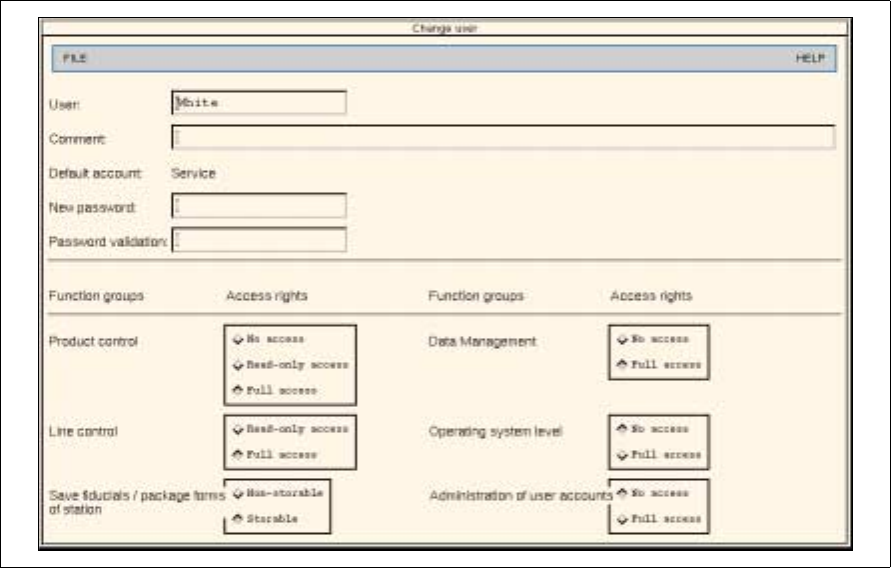
The configuration window is subdivided into the editing and the setting area.
- The user data are entered into the editing area.
NOTE
If no password has been defined, an appropriate message will be displayed upon exiting the configu-
ration window (see page 3 - 26).
- The allocations of access rights to function groups are specified in the setting area (see description
below).
Access rights - setting options
The line computer applications are arranged by function groups. Each function group can be assigned an
access right.
The assignment is effected by activating the applicable button.
- No access
If this button is activated, this signifies that the user has no right to access the function group. This
means that the respective application cannot be started, or that the associated menu function is
disabled.
NOTE
If a user change is carried out, any open applications (except for MaDaMaS and error displays) will
be closed immediately and corresponding messages will be displayed.
If a setup changeover action is in progress, the user change will not be performed. The changeover
action must first be completed or aborted for the user change to be able to take place.
If the configuration window for setting up a new user account without template is called up, the
access rights are, by default, set to "No access" or "Non-storable" for all function groups (except for
"Line operation").
- Read-only access
If this button is activated, this means that the user has read-only access to the function group. This
means that the respective application can be started, but no change of the data is possible. (The but-
tons and editing fields are dimmed or grayed-out).
3 Desktop (Root Window) User Manual Line Computer UNIX
3.2 Desktop User Interface Software Version 501.xx 01/99 Issue
3 - 32
- Full access
If this button is activated this means that the user has full access to the function group. The user is
able to execute all functions of the respective application without any restrictions.
- Non-storable
If this button is activated this means that the user has no access to the "Save fiducials / package forms
of station" function group. The user cannot store in the line computer any fiducials and package forms
that were taught at the station.
- Storable
If this button is activated this means that the user has full access to the "Save fiducials / package
forms of station" function group. The user can store in the line computer fiducials and package forms
taught at the station.
Change user account
● In the view area of the "Administration of user accounts" dialog window (see Fig. 3.2.1), click on
the entry containing the user’s name whose account is to be changed.
● Click on USER --> Change user on the menu bar.
The user account configuration window opens (see Fig. 3.2.3).
Fig. 3.2.3 User Account Configuration Window (Example: Change User)
● Make the desired changes.
User Manual Line Computer UNIX 3 Desktop (Root Window)
Software Version 501.xx 01/99 Issue 3.2 Desktop User Interface
3 - 33
NOTE
The user’s name cannot be changed.
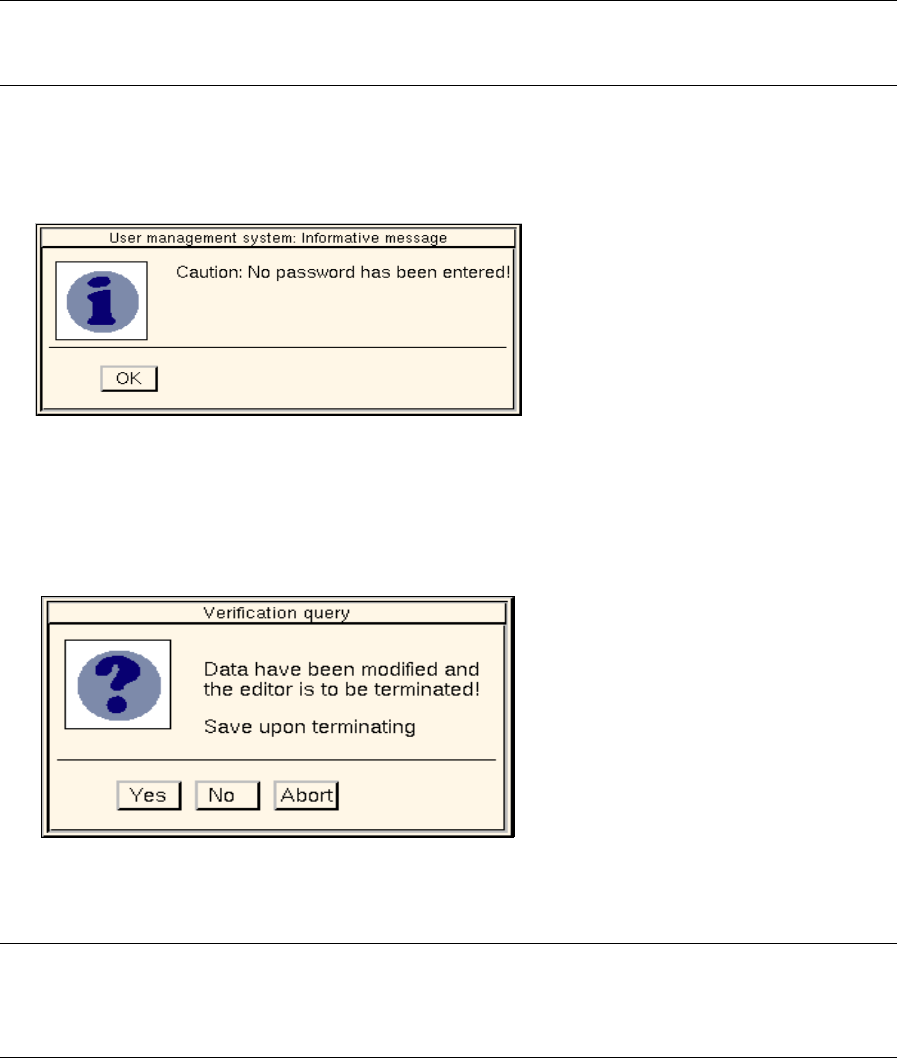
● If an existing password is to be deleted, click on the "New password" editing field and press the
RETURN key. The following dialog box opens.
● Click on OK to confirm your entry. The dialog box closes.
● Once all required entries or changes have been made, click on FILE --> Exit on the menu bar.
The following dialog box is displayed.
● Click on Yes.
The dialog box and the configuration window close.
NOTE
If no password has been specified for the user account, a message telling you that no password has
been entered will be displayed again after the configuration window has been closed (see above).
● Click on OK.
The dialog box closes.
● Click on FILE --> Exit on the menu bar of the "Administration of user accounts" dialog window
(see Fig. 3.2.1). The dialog window closes.