00191413-01.pdf - 第98页
3 Desktop (Root W indow) User Manual Line Computer UNIX 3.2 Desktop User Interface Software Version 501.xx 01/99 Issue 3 - 28 ● Close the dialog box by c licking on OK . The accoun t of the currently logged- on user is a…
User Manual Line Computer UNIX 3 Desktop (Root Window)
Software Version 501.xx 01/99 Issue 3.2 Desktop User Interface
3 - 27
"FILE" Menu
- Save to diskette
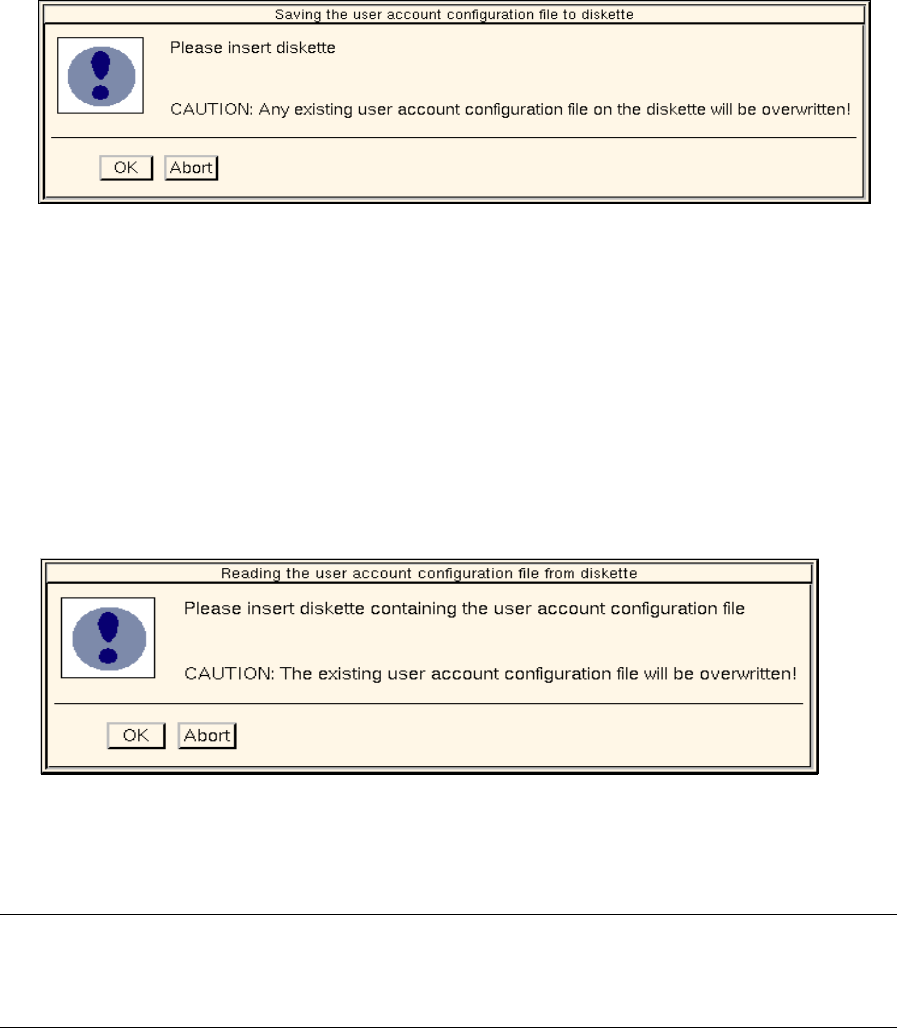
This function is used to save the user account configuration file to diskette. The data of any existing
configuration file on the diskette will be overwritten.
● Click on FILE --> Save to diskette.
The following dialog box opens.
● Insert the diskette into the floppy disk drive and close the dialog box by clicking on OK.
The configuration file is saved to the diskette.
- Read from diskette
This function is used to read a user account configuration file from diskette and to copy it to the hard
disk. The configuration file already existing on the hard disk will be overwritten.
From this point onward, only those user accounts (users including access rights) are valid that have
been read in from the configuration file.
● Click on FILE --> Read from diskette.
The following dialog box opens.
● Insert the diskette containing the desired configuration file into the floppy disk drive and close the
dialog box by clicking on OK.
The configuration file is now read in and copied to the hard disk.
NOTE
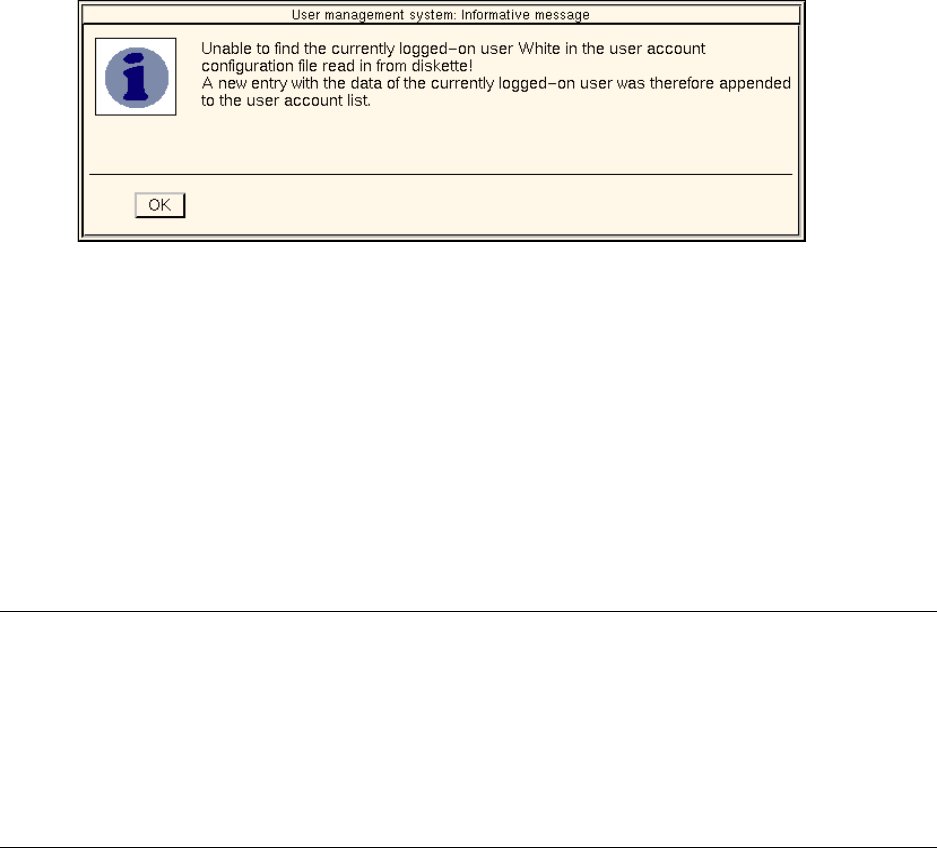
If the user account of the currently logged-on user is not contained in the configuration file to be
copied, the following dialog box is displayed.
3 Desktop (Root Window) User Manual Line Computer UNIX
3.2 Desktop User Interface Software Version 501.xx 01/99 Issue
3 - 28
● Close the dialog box by clicking on OK.
The account of the currently logged-on user is automatically added to the list of user accounts of
the new configuration file.
- Print
This function is used to output the data of the user account configuration file to the default printer.
- Close
The "Administration of user accounts" dialog window closes.
NOTE
Upon switchover of the data storage system (see chapt. 4, section 4.2.1.1) the user account configuration
file valid for the particular system will be read in.
If the account of the currently logged-on user is not contained in this configuration file, the above dialog
box will be displayed.
If no user account configuration file exists in the new data storage system, an error message is displayed
and the currently used configuration file will continue to be used.

User Manual Line Computer UNIX 3 Desktop (Root Window)
Software Version 501.xx 01/99 Issue 3.2 Desktop User Interface
3 - 29
"USER" Menu
- New user
This function is used to set up an account for a new user.
● The further procedure to be followed is described on page 3 - 30.
- Delete user
This function is used to delete a user account from the user account list .
● Select the user account to be deleted in the view area.
● Click on USER --> Delete user.
Prior to the deletion operation, a dialog box is displayed with a verification query as to whether
you really want to delete the selected user account.
● Click on OK to confirm the deletion.
The dialog box closes, and the user account is no longer contained in the account list.
- Change user
This function allows you to change the description, the password and the access right settings of a
user account.
● The further procedure to be followed is described on page 3 - 32.
- Reset user to default account
This menu function allows the settings of the access rights assigned to the function groups to be reset
to the settings of the default account provided such an account exists for the selected user.
NOTE
If a user account was set up with the aid of a default account (see page 3 - 30), the name of the
default account is displayed in the "Default account" column next to the user’s name (see Fig. 3.2.1).
● In the view area click on the entry containing the user’s name whose account is to be reset to the
default account.
● On the menu bar, click on USER --> Reset user to default account.
The settings of the access rights assigned to the function groups are reset to the settings of the
default account.
If no default account is available (i.e. it has been deleted), a corresponding message is displayed.