00191413-01.pdf - 第341页
User Manual Line Computer UNIX 11 Production Tools / Optimization Software Version 501.xx 01/99 Issue 11.4 Optimization Dialog 11 - 21 Menu Bar The menu ba r contai ns the menus „F ILE“, „SER VICES“ a nd „HELP “. The „SE…
11 Production Tools / Optimization User Manual Line Computer UNIX
11.4 Optimization Dialog Software Version 501.xx 01/99 Issue
11 - 20
11.4.2 Main Window of Optimization Dialog
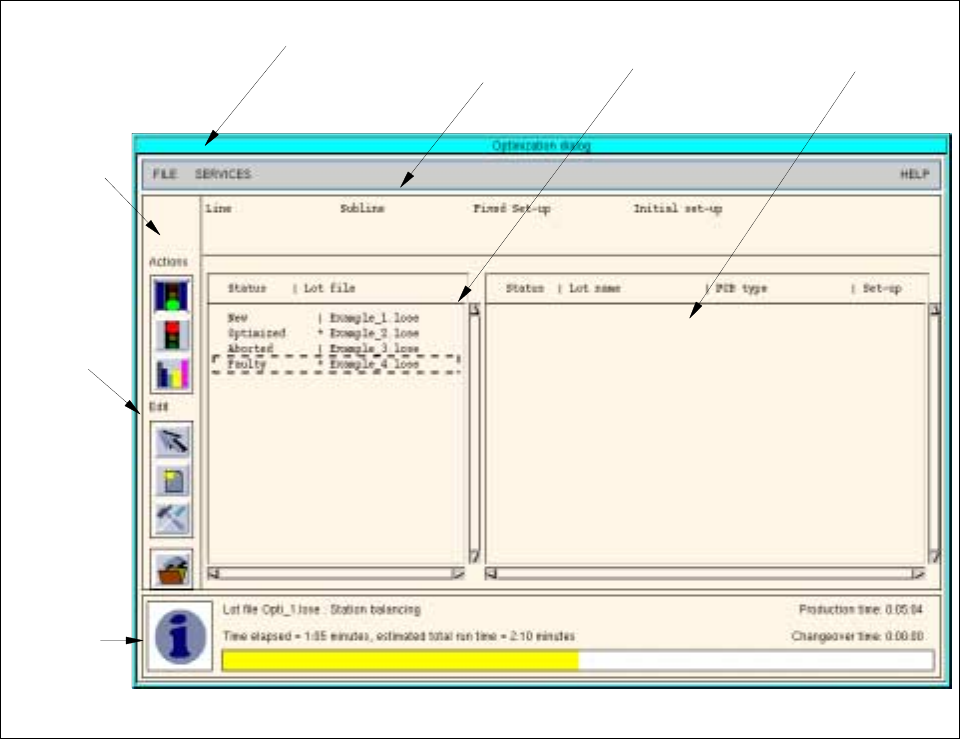
Set-Up Optimization is operated from the main window of the Optimization Dialog.
Fig. 11.4.1 Main Window of Optimization Dialog
The main window of the Optimization Dialog is subdivided into the following areas.
- Menu bar
- Field „Basic optimization data“
- Selection field „Lot file“
- Selection field „Jobs“
- Command area „Actions“
- Command area „Editing“
- Info box
menu bar field
„Basic optimization
selection field
„Jobs“
info box
command
area
„Editing“
command
area
„Actions“
selection field
„Lot file“
data“

User Manual Line Computer UNIX 11 Production Tools / Optimization
Software Version 501.xx 01/99 Issue 11.4 Optimization Dialog
11 - 21
Menu Bar
The menu bar contains the menus „FILE“, „SERVICES“ and „HELP“.
The „SERVICES“ menu is described in section 11.4.3.
NOTE
The functions and operation of the menus „FILE“ and „HELP“ are similar to those in other application
programs of the line computer and are described in detail in chapt. 2 „General Information on Using
the Program“.
Field „Basic Optimization Data“
In this field, the basic optimization data are displayed, i.e. information on which line, subline and fixed set-up
or initial set-up were defined for the given lot file in Job Control (see chapt. 14).
Selection field „Lot file“
The "Lot file" selection field contains a listing of all lot files and their current status.
The following statuses exist:
- Optimized: optimization of lot file is complete, can be returned to the job list.
- New: newly created lot file.
- In progr.: the lot file is in the process of being optimized.
- Being checked: A producibility check is being performed for all jobs of a lot file.
- Waiting: the scheduled lot file is in the waiting queue.
- Faulty: the optimization process for the given lot file has been aborted by the program
on account of encountered errors.
- Aborted: the optimization run of the lot file has been aborted manually.
Files for which job parameters are defined (see section 11.4.3.3), are identified by a *.
Selection field „Jobs“
The „Jobs“ selection field contains a listing of the jobs of a selected lot file. They are displayed with their lot
names (= job name), the associated PCB type and the setup determined by optimization. Their current status
is displayed as well.
Various states exist:
- tP: a producibility check is being performed for this job.
- E: a fault was identified for this job during the producibility check.
- R: the producibility check has been successfully completed.

11 Production Tools / Optimization User Manual Line Computer UNIX
11.4 Optimization Dialog Software Version 501.xx 01/99 Issue
11 - 22
Command area „Actions“
In the "Actions“ command area, the icons are displayed by means of which the following actions can be
performed:
- starting the Optimization,
- aborting the Optimization and
- displaying the Optimization results.
For a detailed description of the icons refer to section 11.4.4.
Command area „Editing“
In the "Editing" command area, the icons are displayed by means of which the following actions can be
performed:
- selecting,
- creating,
- editing and
- displaying directories.
For a detailed description of the icons refer to section 11.4.5.
Info box
In the info box, a yellow bar is displayed to indicate graphically the progress of the optimization process for a
given lot file. A display is provided informing you for which lot file the optimization is being performed. In the
right portion of the Info box, the production time and setup changeover time for the setups calculated during
the optimization run are displayed. As the optimization process progresses, these times become more favorable
until the optimum setup with the shortest production time and changeover time is found. The optimization
process covers the following phases:
- Start: optimization is started.
- Read-in data: the data are checked for consistency.
- Clustering: several jobs are combined into setup clusters.
- Station balancing: a time-optimized setup is calculated.
- Track allocation: the setups for the individual stations are calculated.
- Creation of setups: the setups are created.
- Quit: the setups are saved.