Programming_mail.pdf - 第248页
V- 58 Programming Manual Part V Inspection Data 5.3.2 Do Inspection for Not Placed Only inspect missing component for arbitrarily selected components. If there is no component, the result will be OK. This is used when in…
V-57
Programming Manual
Part V Inspection Data
5.3.1 Skip Inspection
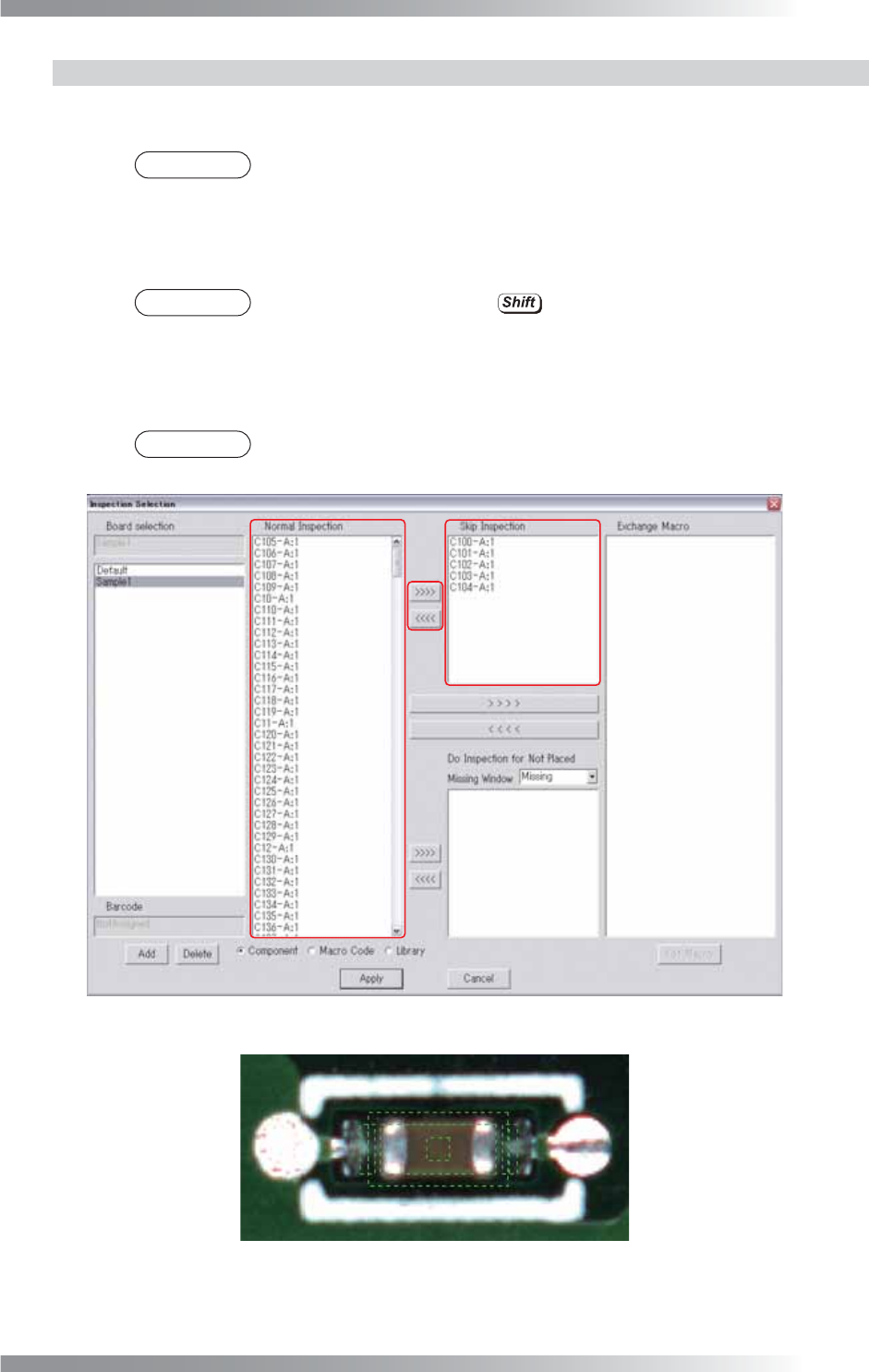
Skips arbitrarily selected components. The function is useful if components are missing as PCB
version differs. Display the skip inspection component as the green dotted line.
NOTE
In case that use BF-RP1 (optional system), inspection result of skip inspection component
is not sent to BF-RP1.
Step1: Select Skip inspection component from the Normal Inspection list-box.
NOTE
Select components by pressing to select a number of components.
Step2: Press >>>> to move components to the Skip Inspection list-box. The components in the
Skip Inspection list-box will not be inspected.
NOTE
Select components from the Skip Inspection list-box and press <<<< to release
the Skip Inspection setting.
Figure 5-7 Skip Inspection Setting
Figure 5-8 Skip Inspection Component (Green Dotted Line)
V-58
Programming Manual
Part V Inspection Data
5.3.2 Do Inspection for Not Placed
Only inspect missing component for arbitrarily selected components. If there is no component, the
result will be OK. This is used when inspecting whether components which do not have to be mounted
on certain versions of PCB are mounted or not.
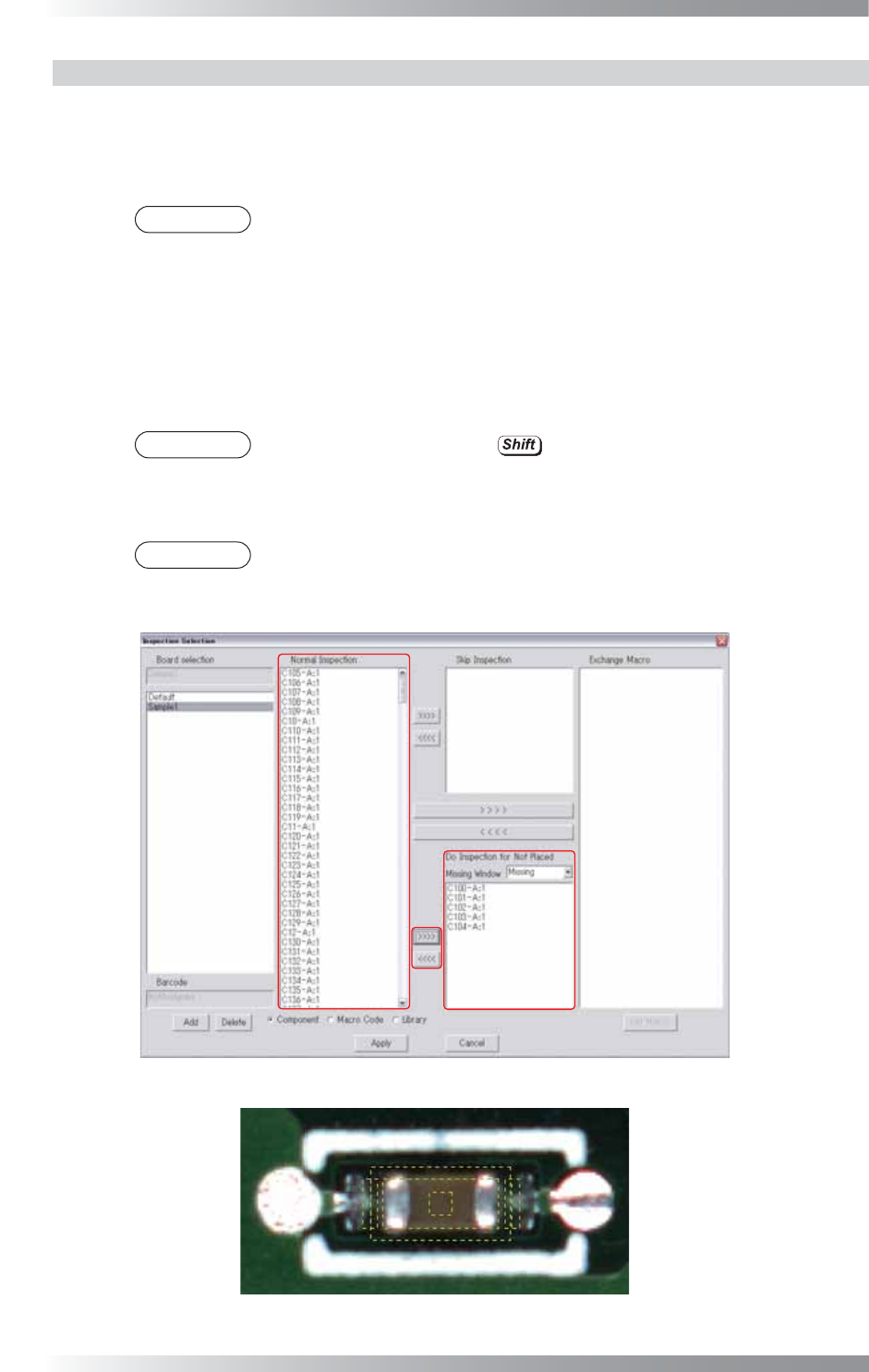
Display the Do Inspection for Not Placed component as the yellow dotted line.
NOTE
If BF-RP1 (optional system) is used, NG will be reported to BF-RP1 as the inspection
result when detecting components are mounted through the Do Inspection for Not
Placed inspection (NG type: Not Placed).
Step1: Select Missing from the Missing Window drop-down list.
Step2: Select a component to apply Do Inspection for Not Placed from the Normal Inspection
list-box.
NOTE
Select components by pressing to select a number of components.
Step3: Press >>>> to move components to the Do Inspection for Not Placed list-box.
NOTE
Select components from the Do Inspection for Not Placed list-box and press <<<<
to release the Do Inspection for Not Placed setting.
Figure 5-9 Do Inspection for Not Placed Setting
Figure 5-10 Do Inspection for Not Placed Component (Yellow Dotted Line)
V-59
Programming Manual
Part V Inspection Data
5.3.3 Exchange Macro
Apply arbitrarily macro to arbitrarily selected components. Because libraries can be made for each
macro, multiple libraries can be applied to the same component.
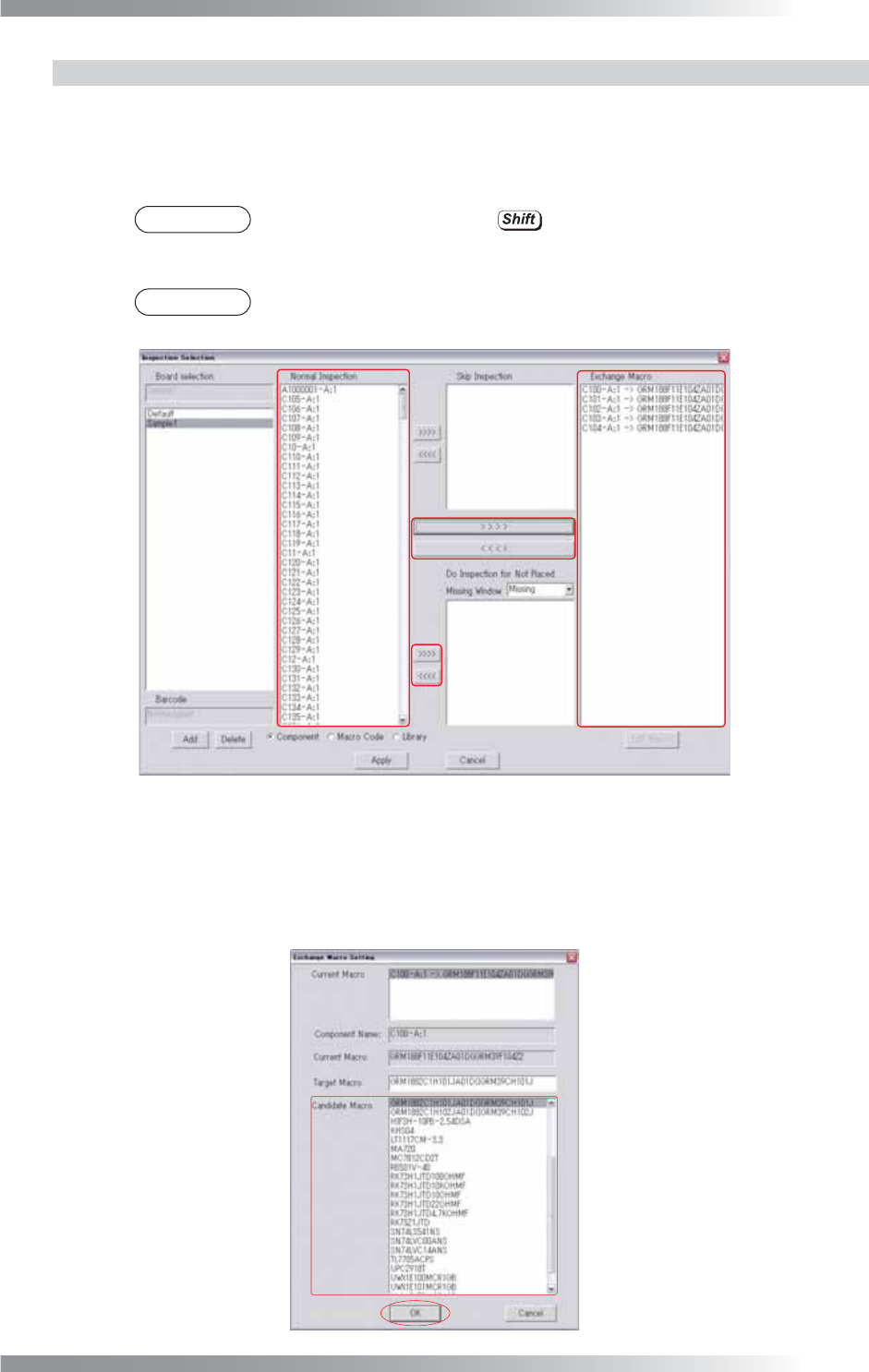
Step1: Select a component whose macro should be changed from the Normal Inspection list-box.
NOTE
Select components by pressing to select a number of components.
Step2: Press > > > > to move components to the Exchange Macro list-box.
NOTE
Select components from the Exchange Macro list-box and press < < < < to release
the Exchange Macro setting.
Figure 5-11 Exchange Macro Setting
Step3: Select a macro from the Exchange Macro list-box and press Edit Macro.
Step4: The dialog shown in Figure 5-12 appears. Select a macro from the Candidate Macro list-
box and press OK.
Figure 5-12 Exchange Macro Setting