Programming_mail.pdf - 第79页
III- 5 Programming Manual Part III Inspection Algorithm Step12: Press TB Set and OK . Step13: Press Mask once to remove the mask. Figure 1-6 Remove Mask Step14: Press the black-white button in the upper side of Sample , …
III-4
Programming Manual
Part III Inspection Algorithm
Step5: The Mask window appears.
Adjust the window size to surround the entire component body (including electrodes).
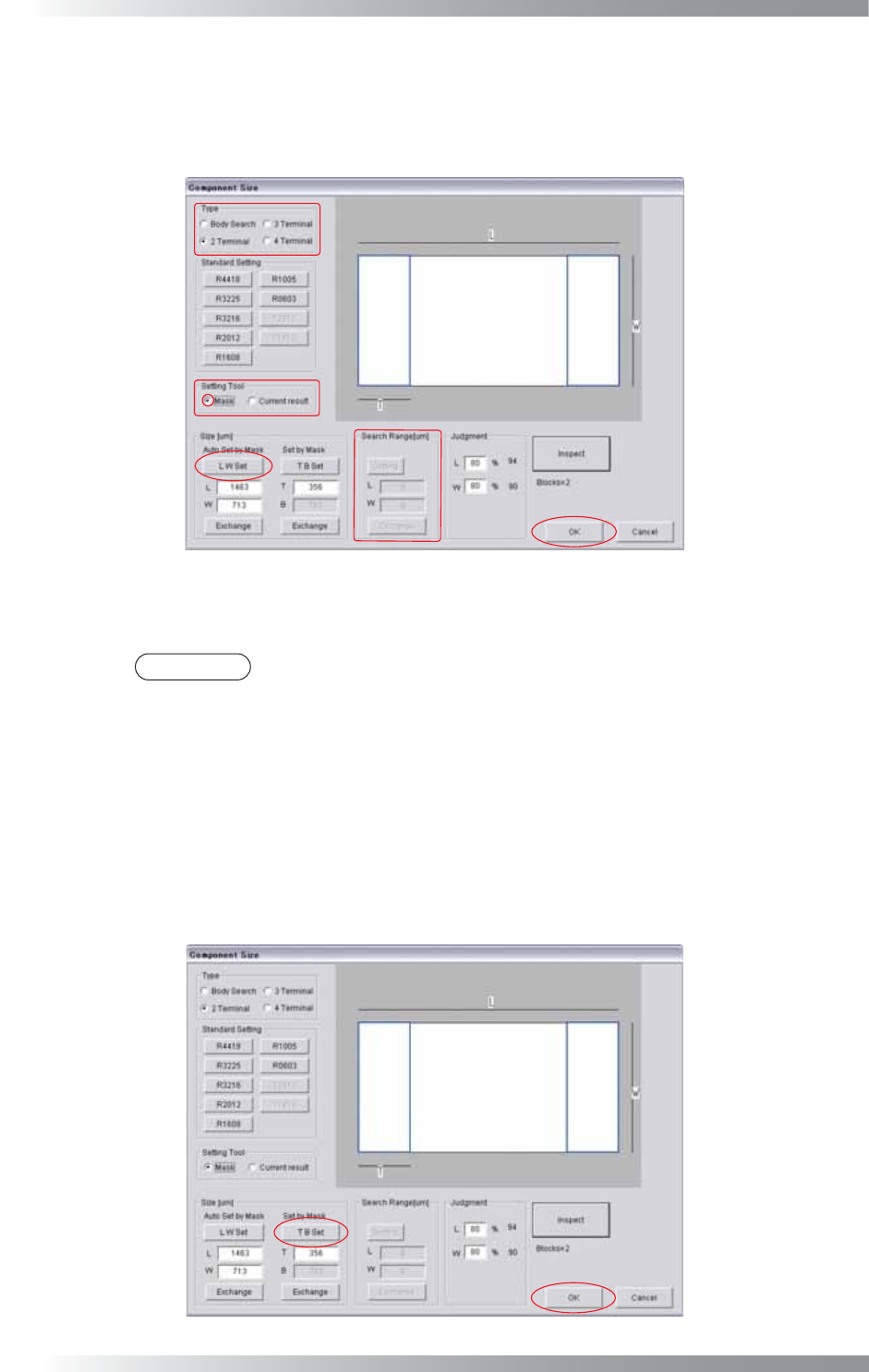
Step6: Press Set on the right side of Algorithm. The dialog shown in Figure 1-4 appears.
Figure 1-4 LW Setting
Step7: Select a component type from Type.
NOTE
If 4 Terminal is selected, the Search Range setting is required.
Step8: Check Mask in Setting Tool.
Step9: Press LW Set and OK.
Step10: The Mask window appears.
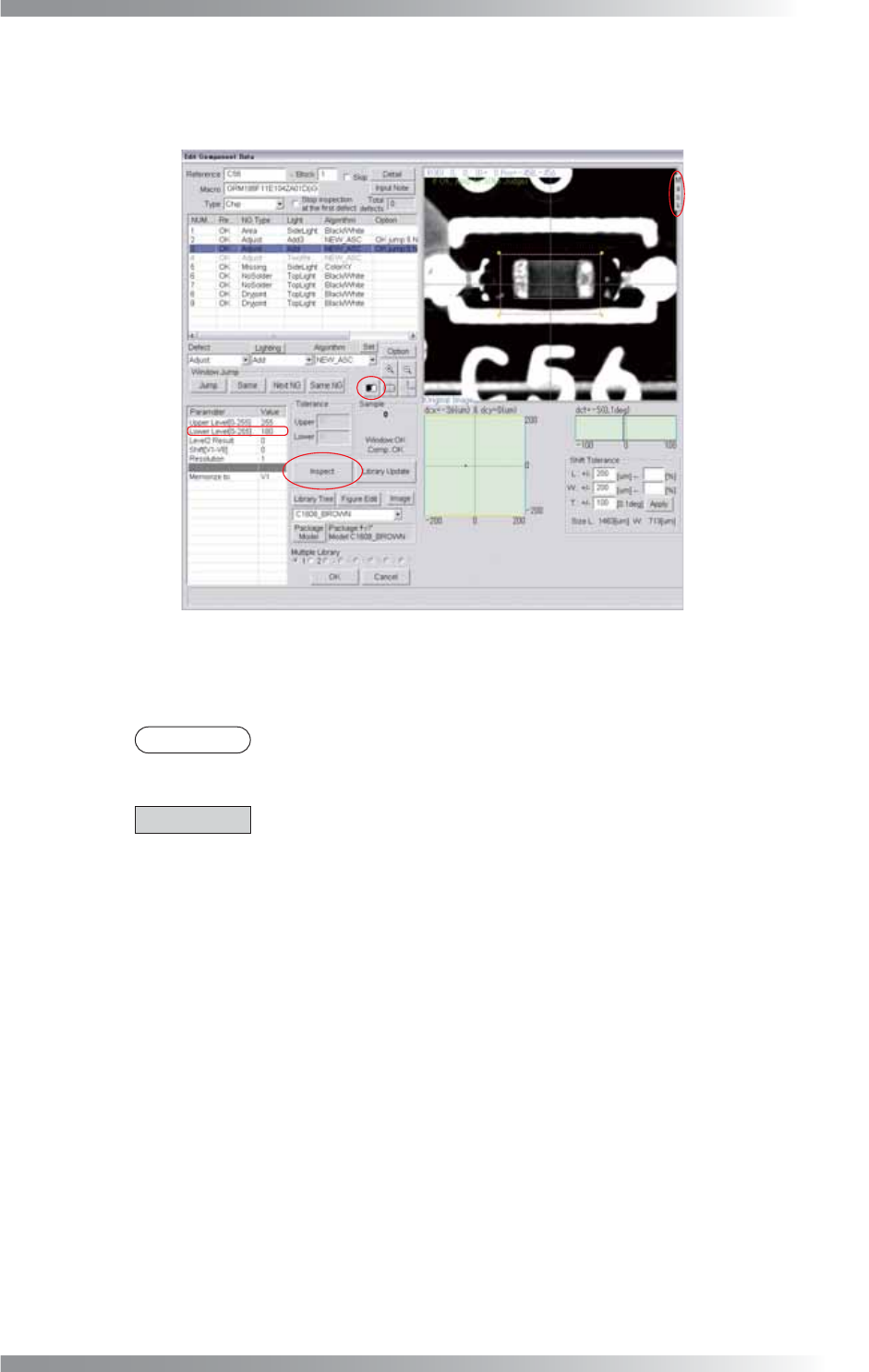
Adjust the window size to surround the electrodes on the one side.
Step11: Press Set on the right side of Algorithm. The dialog shown in Figure 1-5 appears.
Figure 1-5 TB Setting
III-5
Programming Manual
Part III Inspection Algorithm
Step12: Press TB Set and OK.
Step13: Press Mask once to remove the mask.
Figure 1-6 Remove Mask
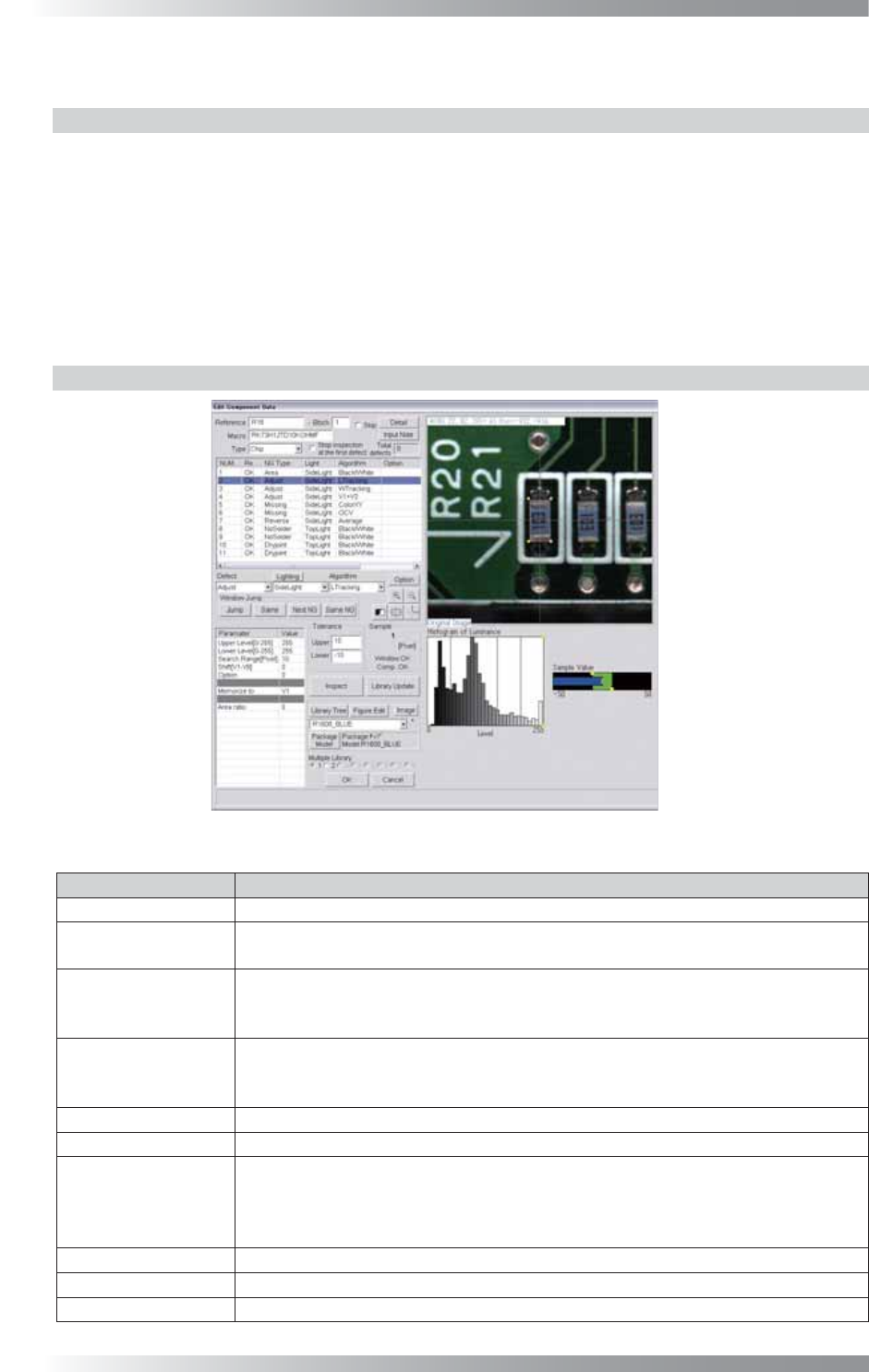
Step14: Press the black-white button in the upper side of Sample, and make sure that searching
electrode is successful.
NOTE
Readjust the Lower Level value if the search is not successful.
Step15: Enter V1 into the Memorize to fi eld.
CAUTION
Register the inspection result in the Memorize to fi eld.
Any value from V1 to V8 is available.
Enter it in the appropriate fi eld to refl ect the result to other algorithms.
Step16: Press Inspect. If the search is successful, the pink window surrounding the component’s
body appears.
III-6
Programming Manual
Part III Inspection Algorithm
1.2 LTracking / WTracking
1.2.1 Inspection Overview
LTracking / WTracking is the algorithm to correct misalignments between CAD data and actual
component positions. The actual component positions are automatically searched based on
brightness differences between a PCB and components and LTracking / WTracking corrects
misalignments (X axis, Y axis). LTracking should be used to correct longitudinal direction misalignments
of inspection windows. WTracking should be used to correct lateral direction misalignments of
inspection windows. LTracking / WTracking is suitable for chip components whose electrodes are
visually unclear or IC components.
1.2.2 Parameter Setting
Figure 1-7 LTracking / WTracking
Parameter Description
Lighting Select a lighting that displays component edges visually clear.
Algorithm
Select LTracking or WTracking
(refer to 1.2.4 Difference between LTracking and WTracking).
Upper Level[0-255],
Lower Level[0-255]
If a component brightness level is lower than a PCB, enter 0 in Upper Level and
Lower Level. If a component brightness level is higher than a PCB, enter 255 in
Upper Level and Lower Level
.
Search Range[Pixel]
Default is 10. Enter the bigger value to enlarge the search range. However, if Search
Range is too large, the calculation time might become longer or a PCB pattern might
be mis-recognized as a component.
Shift[V1-V8] Enter 0.
Option Enter 0.
Memorize to
Enter V1, V2, and V3 to each three Adjust window. Register amount of the
longitudinal misalignment as V1, amount of the lateral misalignment as V2. These
two amounts are added to calculate V3 by using algorithm V1+V2.
Enter V3 in the Shift fi eld to refl ect this amount of misalignment to other algorithms.
Area ratio Enter 0.
Upper, Lower Enter the same value of Search Range to ± fi eld.
Sample
Shows amount of a misalignment.
Table 1-2 Parameter of LTracking / WTracking