sh030051g.pdf - 第161页
7 - 4 7. SPECIAL ADJUSTMENT FUNCTIONS POINT "Filter OFF" enables a return to the factory-set initial value. When adaptive tuning i s executed, vibrat ion sound increase s as an excitation signal is forcibly app…
7 - 3
7. SPECIAL ADJUSTMENT FUNCTIONS
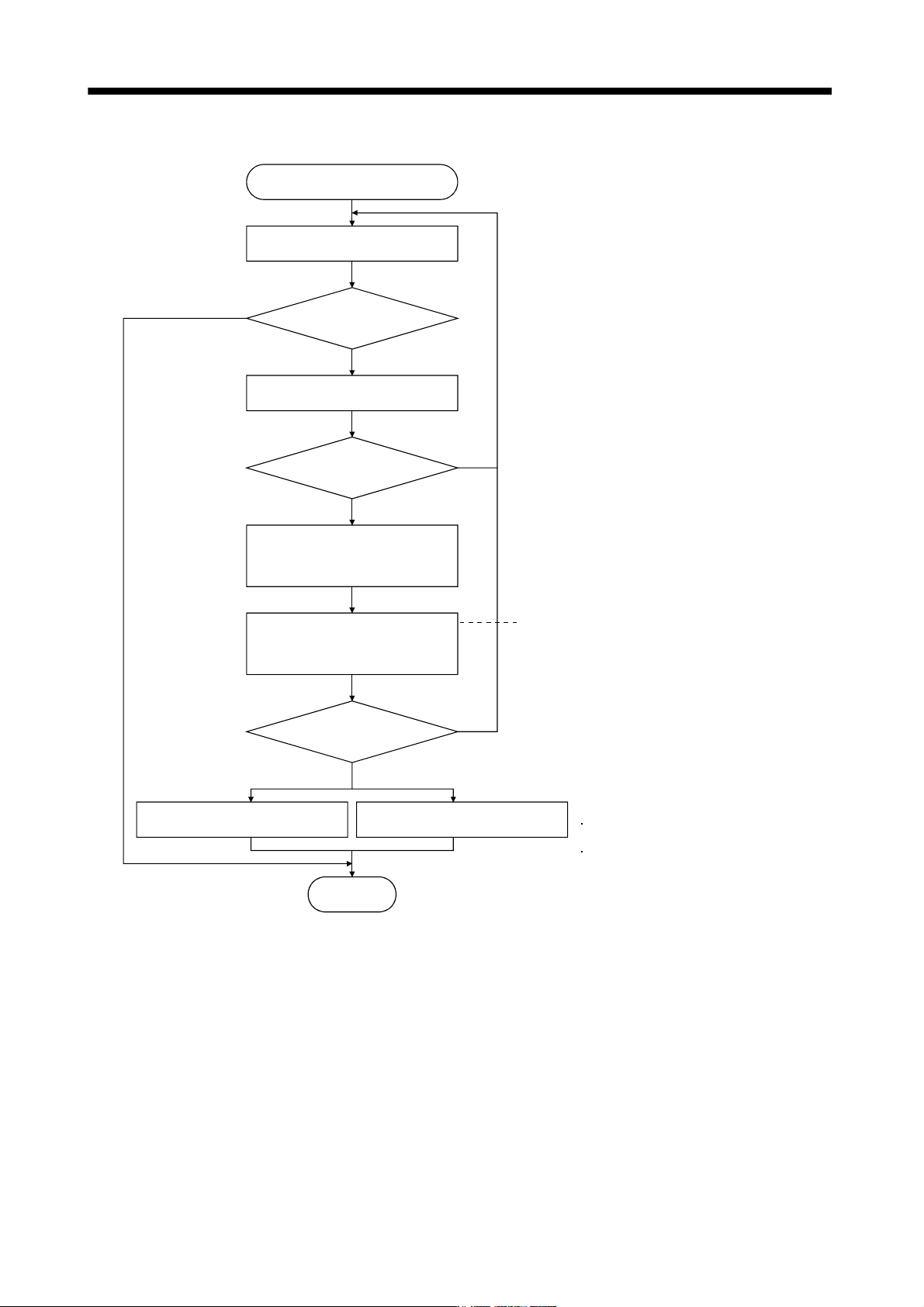
(3) Adaptive tuning mode procedure
The response has increased to the
machine limit.
The machine is too complicated to
provide the optimum filter.
Factor
Adaptive tuning adjustment
Operation
Is the target response
reached?
Tuning ends automatically after the
predetermined period of time.
(Parameter No.PB01 turns to "0002"
or "0000".)
Decrease the response until vibration
or unusual noise is resolved.
End
Yes
No
No
Yes
Increase the response setting.
Has vibration or unusual noise
occurred?
Has vibration or unusual noise
been resolved?
Using the machine analyzer, set the
filter manually.
Yes
No
Execute or re-execute adaptive
tuning. (Set parameter No.PB01 to
"0001".)
If assumption fails after tuning is executed at
a large vibration or oscillation, decrease the
response setting temporarily down to the
vibration level and execute again.
7 - 4
7. SPECIAL ADJUSTMENT FUNCTIONS
POINT
"Filter OFF" enables a return to the factory-set initial value.
When adaptive tuning is executed, vibration sound increases as an excitation
signal is forcibly applied for several seconds.
When adaptive tuning is executed, machine resonance is detected for a
maximum of 10 seconds and a filter is generated. After filter generation, the
adaptive tuning mode automatically shifts to the manual mode.
Adaptive tuning generates the optimum filter with the currently set control
gains. If vibration occurs when the response setting is increased, execute
adaptive tuning again.
During adaptive tuning, a filter having the best notch depth at the set control
gain is generated. To allow a filter margin against machine resonance,
increase the notch depth in the manual mode.
7.3 Machine resonance suppression filter
(1) Function
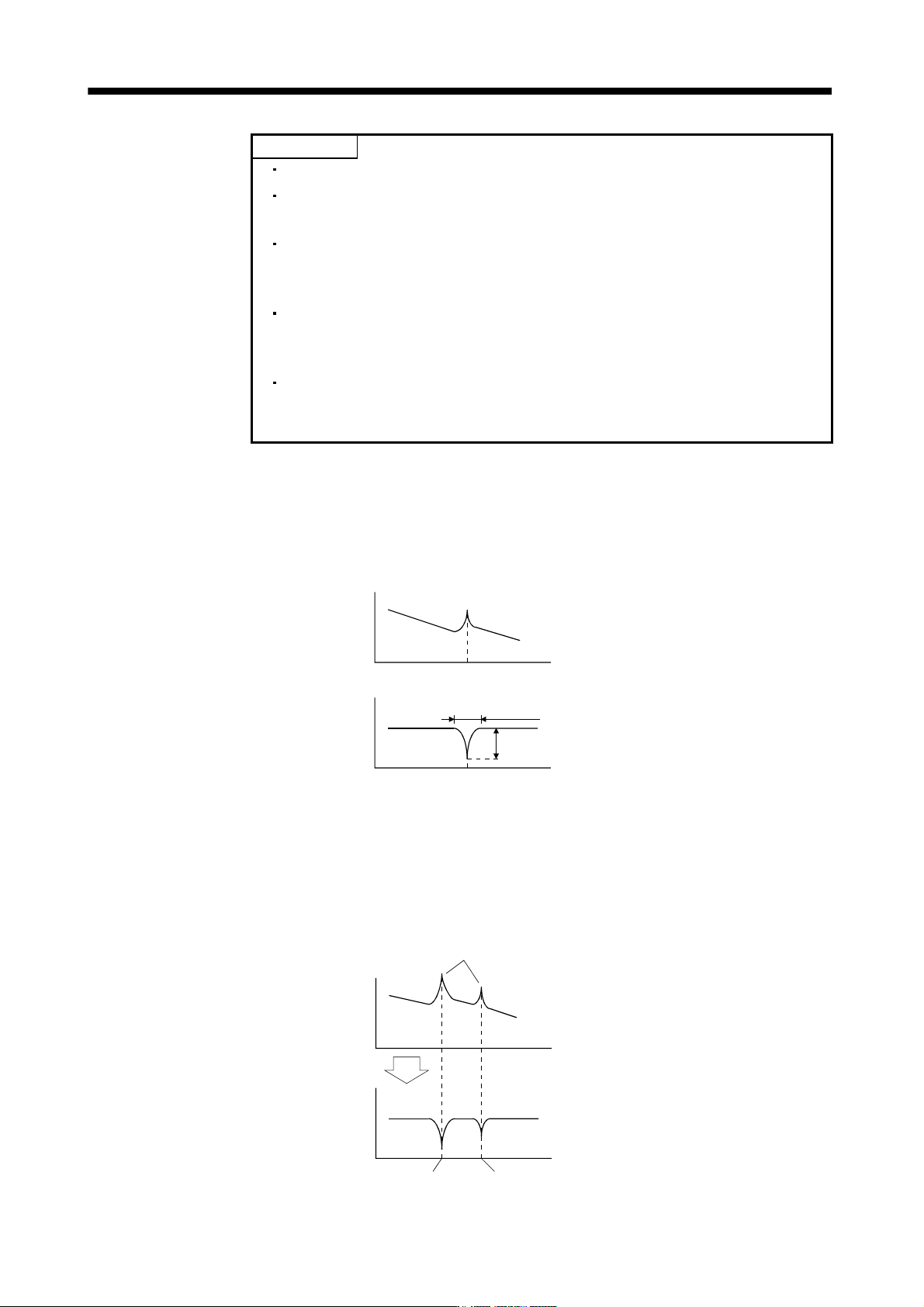
The machine resonance suppression filter is a filter function (notch filter) which decreases the gain of the
specific frequency to suppress the resonance of the mechanical system. You can set the gain decreasing
frequency (notch frequency), gain decreasing depth and width.
Mechanical
system
response
level
Machine resonance point
Frequency
Notch
depth
Notch frequency
Frequency
Notch width
Notch depth
You can use the machine resonance suppression filter 1 (parameter No.PB13, PB14) and machine
resonance suppression filter 2 (parameter No.PB15, PB16) to suppress the vibration of two resonance
frequencies. Execution of adaptive tuning in the filter tuning mode automatically adjusts the machine
resonance suppression filter. When adaptive tuning is ON, the adaptive tuning mode shifts to the manual
mode after the predetermined period of time. The manual mode enables manual setting using the machine
resonance suppression filter 1.
Mechanical
system
response
level
Machine resonance point
Frequency
Notch
depth
Parameter No.PB01,
PB13, PB14
Parameter No.PB15,
PB16
Frequency

7 - 5
7. SPECIAL ADJUSTMENT FUNCTIONS
(2) Parameters
(a) Machine resonance suppression filter 1 (parameter No.PB13, PB14)
Set the notch frequency, notch depth and notch width of the machine resonance suppression filter 1
(parameter No.PB13, PB14)
When you have made adaptive filter tuning mode (parameter No.PB01) "manual mode", set up the
machine resonance suppression filter 1 becomes effective.
POINT
The machine resonance suppression filter is a delay factor for the servo
system. Hence, vibration may increase if you set a wrong resonance
frequency or a too deep notch.
If the frequency of machine resonance is unknown, decrease the notch
frequency from higher to lower ones in order. The optimum notch frequency is
set at the point where vibration is minimal.
A deeper notch has a higher effect on machine resonance suppression but
increases a phase delay and may increase vibration.
A deeper notch has a higher effect on machine resonance suppression but
increases a phase delay and may increase vibration.
The machine characteristic can be grasped beforehand by the machine
analyzer on the MR Configurator. This allows the required notch frequency
and depth to be determined.