sh030106u.pdf - 第523页
15. USIN G A DI REC T DRIV E MOTOR 15 - 20 15.4.3 Dyna mic br ake char acter istics CAUTION The coasti ng dis tance is a t heoretic ally c alculate d val ue that does not consid er factors suc h as fricti on. The calcul …
15. USING A DIRECT DRIVE MOTOR
15 - 19
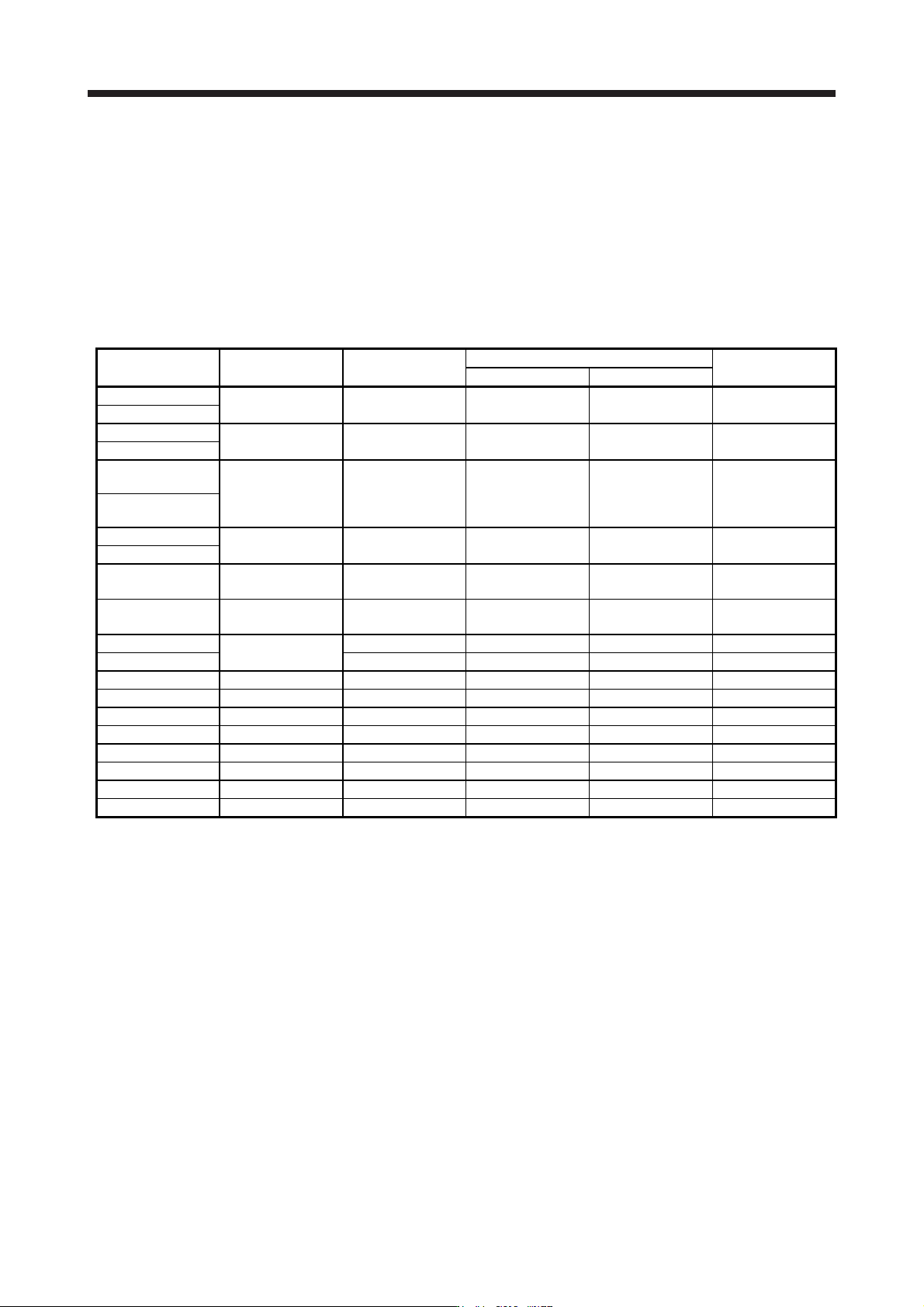
15.4.2 Power supply capacity and generated loss
Table 15.1 indicates servo amplifiers' power supply capacities and losses generated under rated load. For
thermal design of an enclosed type cabinet, use the values in the tables in consideration for the harshest
conditions with regard to the environment and operation pattern. The actual amount of generated heat will be
intermediate between values at rated torque and servo-off according to the duty used during operation.
When the direct drive motor is run at less than the rated speed, the power supply capacity will be smaller
than the value in the table, but the servo amplifier's generated heat will not change.
Table 15.1 Power supply capacity and generated loss per direct drive motor
Direct drive motor Servo amplifier
Power supply
capacity [kVA]
Servo amplifier-generated heat [W]
Area required for
heat dissipation [m
2
]
At rated output With servo-off
TM-RG2M002C30
MR-J4-20B(-RJ)
MR-J4-20B1(-RJ)
0.25 25 15 0.5
TM-RU2M002C30
TM-RG2M004E30
MR-J4-20B(-RJ)
MR-J4-20B1(-RJ)
0.5 25 15 0.5
TM-RU2M004E30
TM-RG2M004E30
(Note)
MR-J4-40B(-RJ)
MR-J4-40B1(-RJ)
0.7 35 15 0.7
TM-RU2M004E30
(Note)
TM-RG2M009G30
MR-J4-40B(-RJ)
MR-J4-40B1(-RJ)
0.9 35 15 0.7
TM-RU2M009G30
TM-RFM002C20
MR-J4-20B(-RJ)
MR-J4-20B1(-RJ)
0.25 25 15 0.5
TM-RFM004C20
MR-J4-40B(-RJ)
MR-J4-40B1(-RJ)
0.38 35 15 0.7
TM-RFM006C20
MR-J4-60B(-RJ)
0.53 40 15 0.8
TM-RFM006E20 0.46 40 15 0.8
TM-RFM012E20 MR-J4-70B(-RJ) 0.81 50 15 1.0
TM-RFM018E20 MR-J4-100B(-RJ) 1.3 50 15 1.0
TM-RFM012G20 MR-J4-70B(-RJ) 0.71 50 15 1.0
TM-RFM048G20 MR-J4-350B(-RJ) 2.7 90 20 1.8
TM-RFM072G20 MR-J4-350B(-RJ) 3.8 110 20 2.2
TM-RFM040J10 MR-J4-70B(-RJ) 1.2 50 15 1.0
TM-RFM120J10 MR-J4-350B(-RJ) 3.4 90 20 1.8
TM-RFM240J10 MR-J4-500B(-RJ) 6.6 160 25 3.2
Note. This combination increases the rated torque and the maximum torque.
15. USING A DIRECT DRIVE MOTOR
15 - 20
15.4.3 Dynamic brake characteristics
CAUTION
The coasting distance is a theoretically calculated value that does not consider
factors such as friction. The calculated distance is longer than the actual distance.
If the braking distance is not longer than the calculated value, a moving part may
crash into the stroke end, causing a dangerous situation. Install an anti-crash
mechanism such as an air brake or an electric/mechanical stopper such as a
shock absorber to reduce the shock of moving parts.
POINT
Do not use dynamic brake to stop in a normal operation as it is the function to
stop in emergency.
For a machine operating at the recommended load to motor inertia ratio or less,
the estimated number of usage times of the dynamic brake is 1000 times while
the machine decelerates from the rated speed to a stop once in 10 minutes.
Be sure to enable EM1 (Forced stop 1) after the direct drive motor stops when
using EM1 (Forced stop 1) frequently in other than emergency.
(1) Dynamic brake operation
(a) Calculation of coasting distance
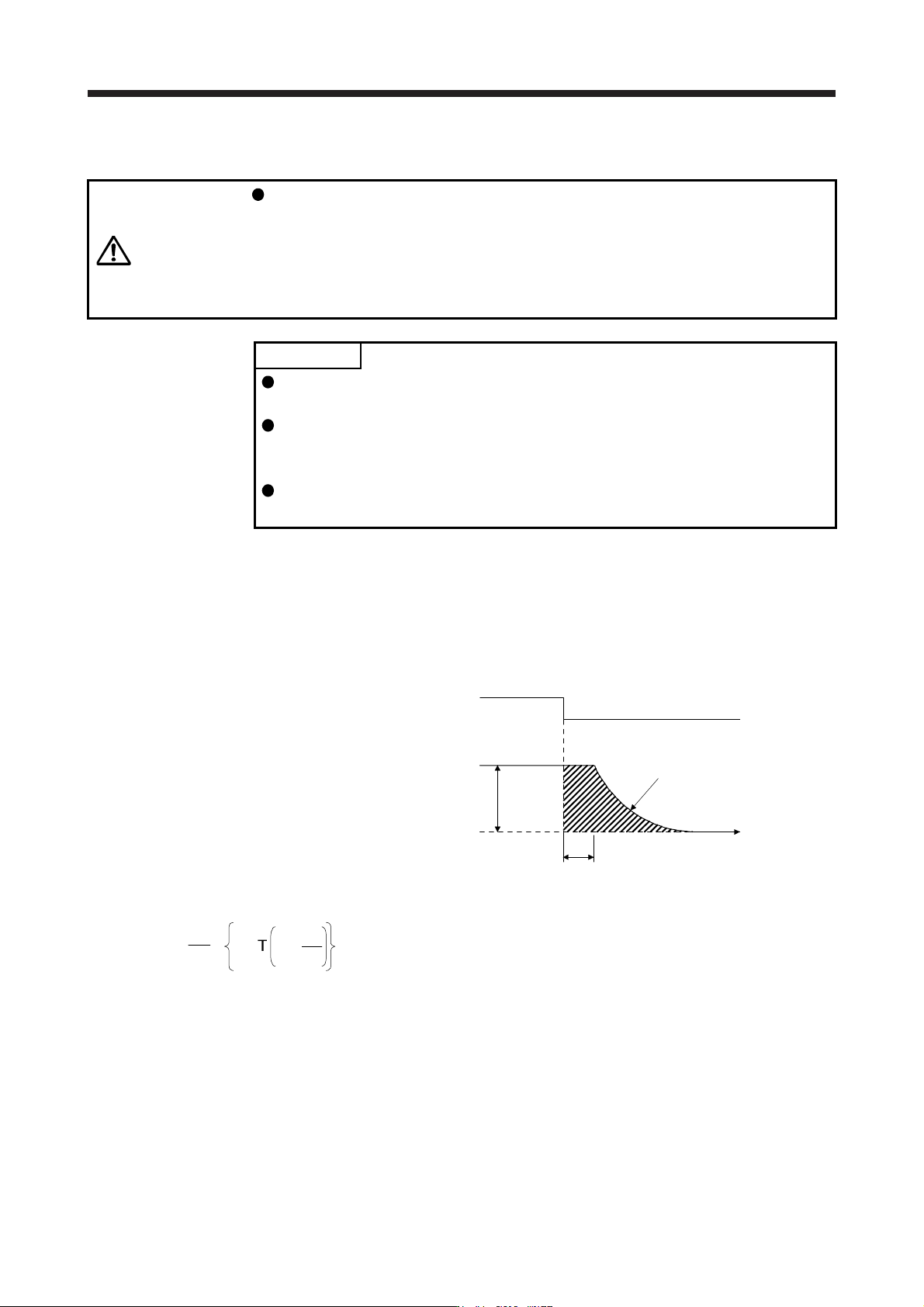
Fig. 15.3 shows the pattern in which the servo motor comes to a stop when the dynamic brake is
operated. Use equation 15.1 to calculate an approximate coasting distance to a stop. The dynamic
brake time constant τ varies with the direct drive motor and machine operation speeds. (Refer to (1)
(b) in this section.)
Dynamic brake
time constant τ
Time
t
e
V0
ON
OFF
EM1 (Forced stop 1)
Machine
speed
Fig. 15.3 Dynamic brake operation diagram
L
max
=
60
V
0
•
J
M
t
e
+1 +
J
L
······················································································ (15.1)
L
max
: Maximum coasting distance [mm]
V
0
: Machine's fast feed speed [mm/min]
J
M
: Moment of inertia of direct drive motor [kg•cm
2
]
J
L
: Load moment of inertia converted into equivalent value on direct drive motor rotor [kg•cm
2
]
τ: Dynamic brake time constant [s]
t
e
: Delay time of control section
There is internal relay delay time of about 10 ms.
[s]
15. USING A DIRECT DRIVE MOTOR
15 - 21
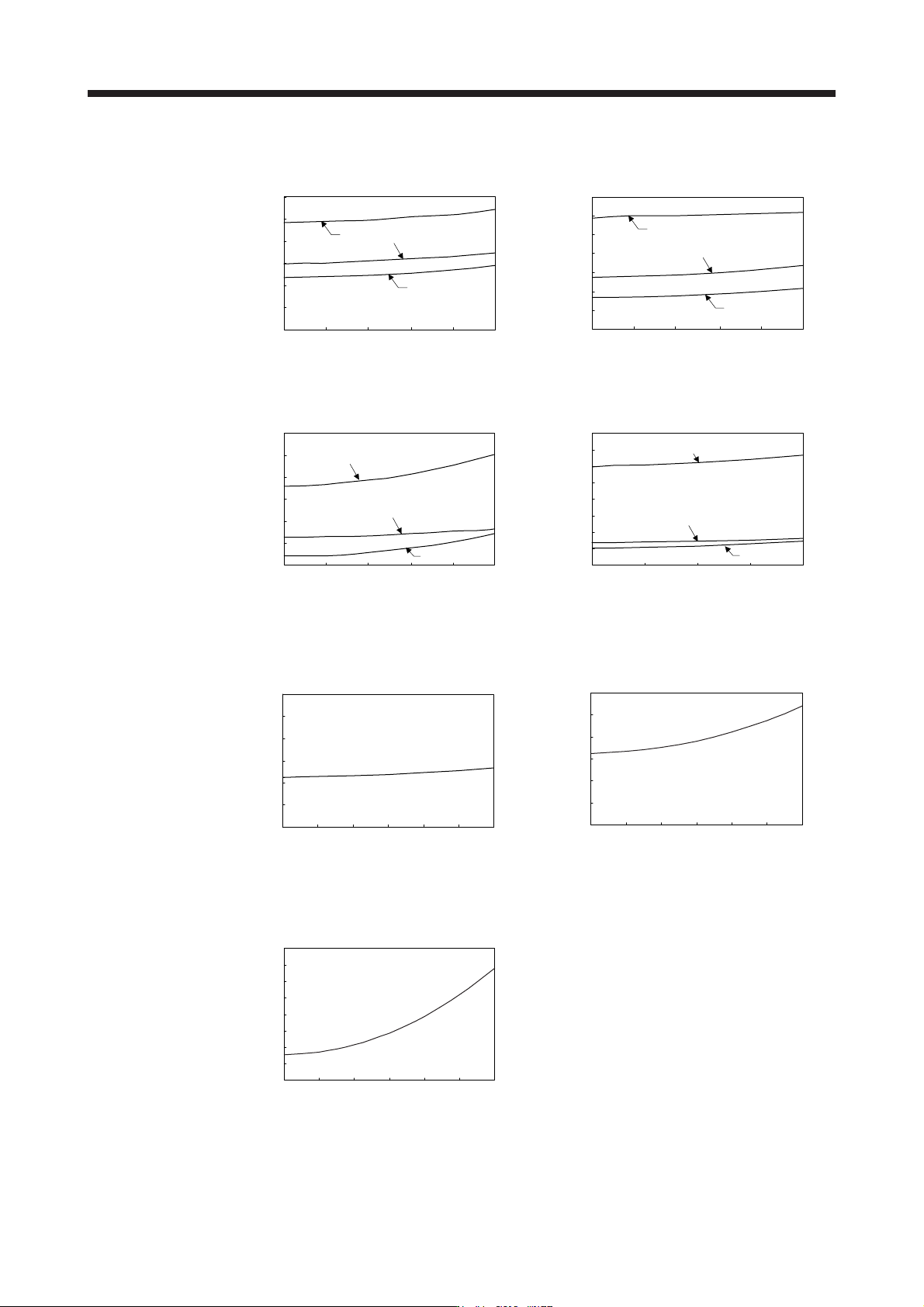
(b) Dynamic brake time constant
The following shows necessary dynamic brake time constant τ for equation 15.1.
Speed [r/min]
0
0 100 200
5
15
20
25
30
300 400 500
006
004
10
002
Time constant τ [ms]
0
0 100 200
70
300 400 500
012
006
018
10
20
30
40
50
60
Speed [r/min]
Time constant τ [ms]
TM-RFM_C20 TM-RFM_E20
0
0
10
30
40
50
60
20
100 200 300 400 500
Speed [r/min]
072
048
012
Time constant τ [ms]
0
0
60
50 100 150 200
70
80
50
40
30
20
10
Speed [r/min]
120
040
240
Time constant τ [ms]
TM-RFM_G20 TM-RFM_J10
0
0
25
30
20
15
10
5
0 100 200 300 400 500 600
Speed [r/min]
Time constant τ [ms]
0
0
5
15
20
25
30
10
0 100 200 300 400 500 600
Speed [r/min]
Time constant τ [ms]
TM-RG2M002C30
TM-RU2M002C30
TM-RG2M004E30
TM-RU2M004E30
0
0
60
70
80
50
40
30
20
10
0 100 200 300 400 500 600
Speed [r/min]
Time constant τ [ms]
TM-RG2M009G30
TM-RU2M009G30