sh030106u.pdf - 第645页
APPENDIX App. - 14 App. 5.8.3 Wir ing CN9 and CN10 co nnectors Handle w ith the too l with c are when c onnectin g wires . (1) Wire strip (a) Us e wires with s ize of AWG 24 t o 20 (0.22 mm 2 to 0.5 mm 2 ) (rec ommen ded…
APPENDIX
App. - 13
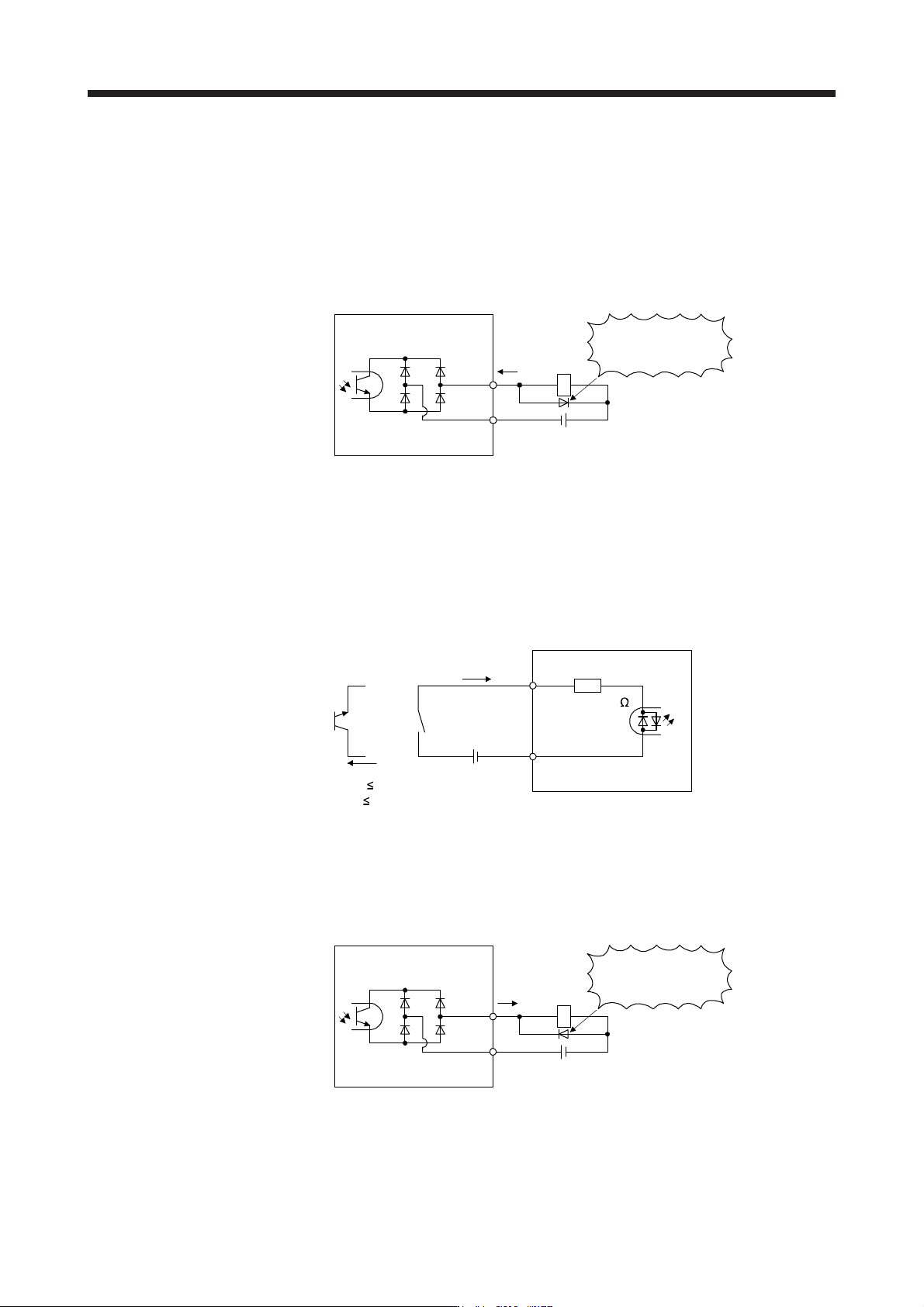
(b) Digital output interface DO-1
This is a circuit in which the collector of the output transistor is the output terminal. When the output
transistor is turned on, the current will flow to the collector terminal.
A lamp, relay, or photocoupler can be driven. Install a diode (D) for an inductive load, or install an
inrush current suppressing resistor (R) for a lamp load. (Rated current: 40 mA or less, maximum
current: 50 mA or less, inrush current: 100 mA or less) A maximum of 2.6 V voltage drop occurs in
the MR-J3-D05.
If polarity of diode is
reversed, MR-J3-D05
will malfunction.
(Note) 24 V DC ± 10%
200 mA
MR-J3-D05
SDO2B+,
etc.
SDO2B-,
etc.
Load
Note. If the voltage drop (maximum of 2.6 V) interferes with the relay operation, apply high
volta
g
e
(
maximum of 26.4 V
)
from external source.
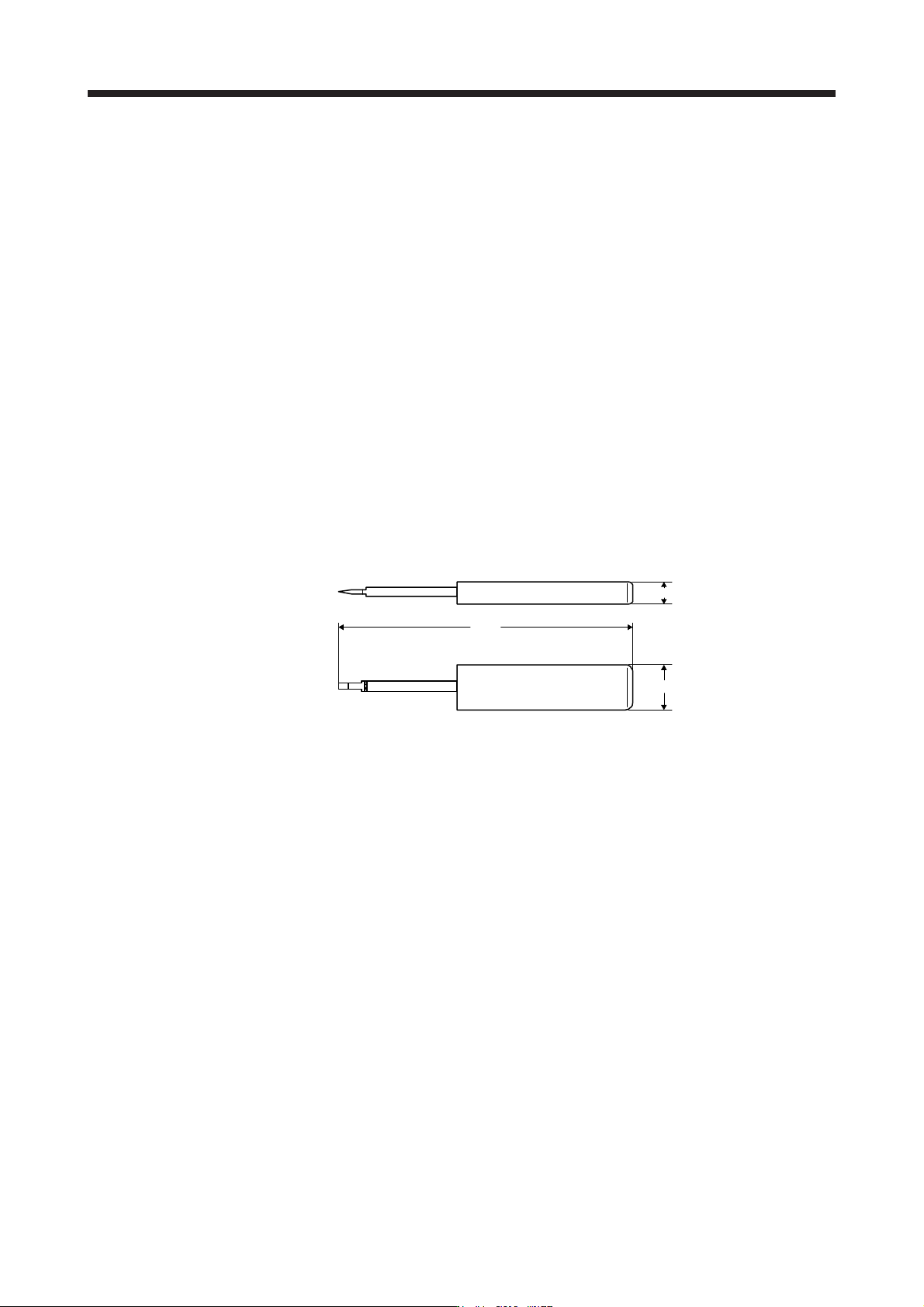
(2) Source I/O interfaces (CN9, CN10 connector)
(a) Digital input interface DI-1
This is an input circuit whose photocoupler anode side is the input terminal. Transmit signals from
source (open-collector) type transistor output, relay switch, etc.
V
CES
1.0 V
I
CEO
100 µA
Approximately 5 mA
24 V DC ± 10%
200 mA
Switch
SRESA-,
etc.
MR-J3-D0
5
SRESA+,
etc.
Approx. 5.4 k
(b) Digital output interface DO-1
This is a circuit in which the emitter of the output transistor is the output terminal. When the output
transistor is turned on, current will be applied from the output to a load. A maximum of 2.6 V voltage
drop occurs in the MR-J3-D05.
MR-J3-D05
If polarity of diode is
reversed, MR-J3-D05
will malfunction.
(Note) 24 V DC ± 10%
200 mA
Load
SDO2B+,
etc.
SDO2B-,
etc.
Note. If the voltage drop (maximum of 2.6 V) interferes with the relay operation, apply high
volta
g
e
(
maximum of 26.4 V
)
from external source.
APPENDIX
App. - 14
App. 5.8.3 Wiring CN9 and CN10 connectors
Handle with the tool with care when connecting wires.
(1) Wire strip
(a) Use wires with size of AWG 24 to 20 (0.22 mm
2
to 0.5 mm
2
) (recommended electric wire: UL1007)
and strip the wires to make the stripped length 7.0 mm ± 0.3 mm. Confirm the stripped length with
gauge, etc. before using the wires.
(b) If the stripped wires are bent, loose or too thick due to twisting too much, fix the wires by twisting
lightly, etc. Then, confirm the stripped length before using the wires. Do not use excessively
deformed wires.
(c) Smooth out the wire surface and stripped insulator surface.
(2) Connecting wires
Before connecting wires, be sure to pull out the receptacle assembly from the header connector. If wires
are connected with inserted connector, the connector and the printed board may malfunction.
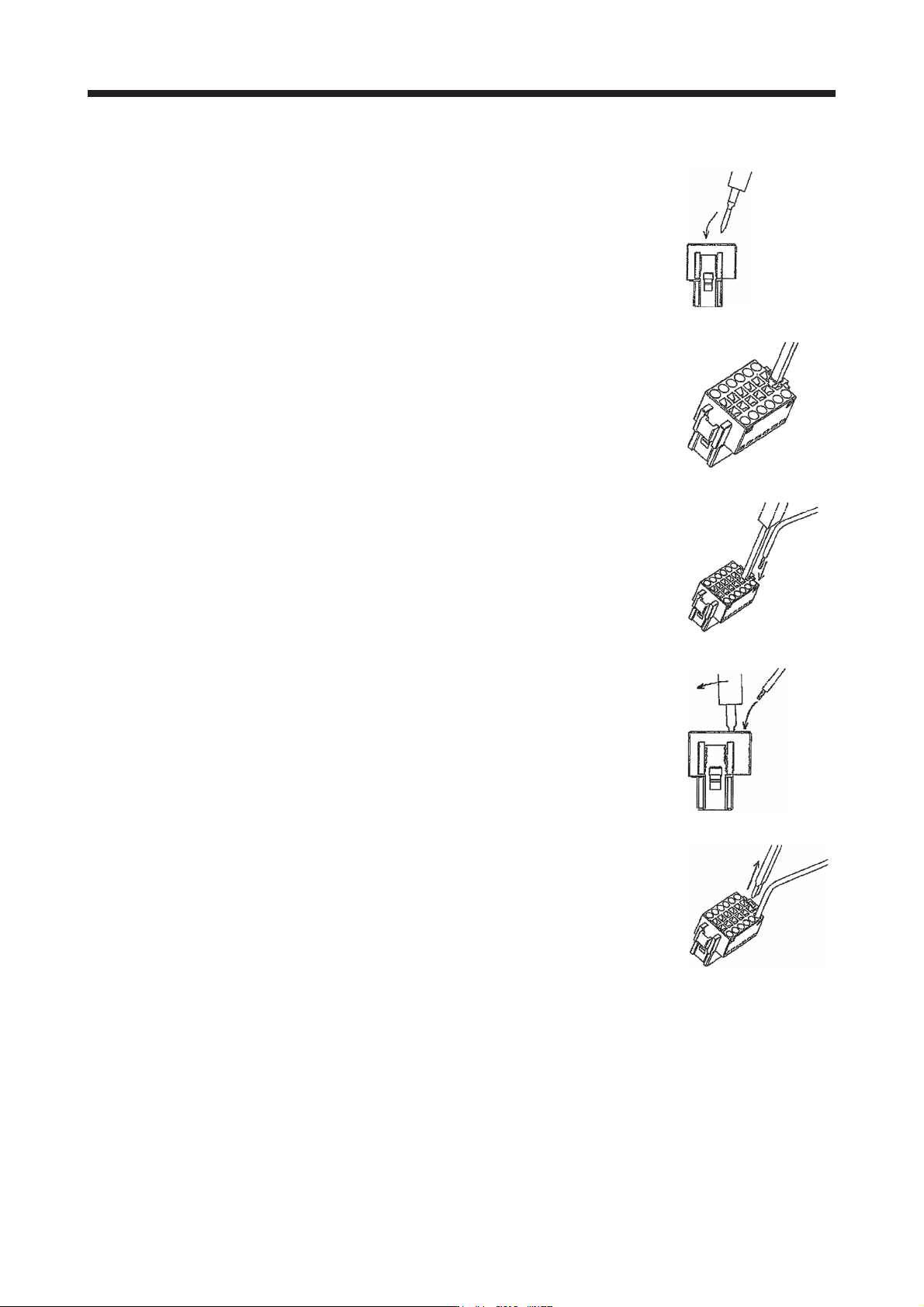
(a) Using extraction tool (1891348-1 or 2040798-1)
1) Dimensions and mass
[Unit: mm]
100
15
7
Mass: Approx. 20 g
APPENDIX
App. - 15
2) Connecting wires
a) Confirm the model number of the housing, contact and tool to be used.
b) Insert the tool diagonally into the receptacle assembly.
c) Insert the tool until it hits the surface of the receptacle assembly. At this
stage, the tool is vertical to the receptacle assembly.
d) Insert wires in the wiring hole till the end. The wires should be slightly
twisted in advance to prevent it from being loose.
It is easy to insert the wire if the wire is inserted diagonally while twisting
the tool.
e) Remove the tool.