3OM-1075-002.pdf - 第92页
(2) Creation of Placement Data (P-data) T abl 3B31 P-No. X [mm] Y [mm] Z H [mm] Fdr . No. C S HD PU Comment V 1X 1 Y 1 Z 1 + 0.00 X X X - - 2 0 C 1 00 2X 2 Y 2 Z 2 + 0.00 X X X - - 1 0 C 2 00 3 000.00 000.00 000 ° 00’ + …
3.5 Repetitive Patterns (Block Sorting Enabled)
Follow the same procedure as described in "3.4 Repetitive Patterns
(Unit P.C.B. B.B.R. Enabled)" except for "Placement Data (P-data)".
(1) Information on Pattern Program Creation
••
••
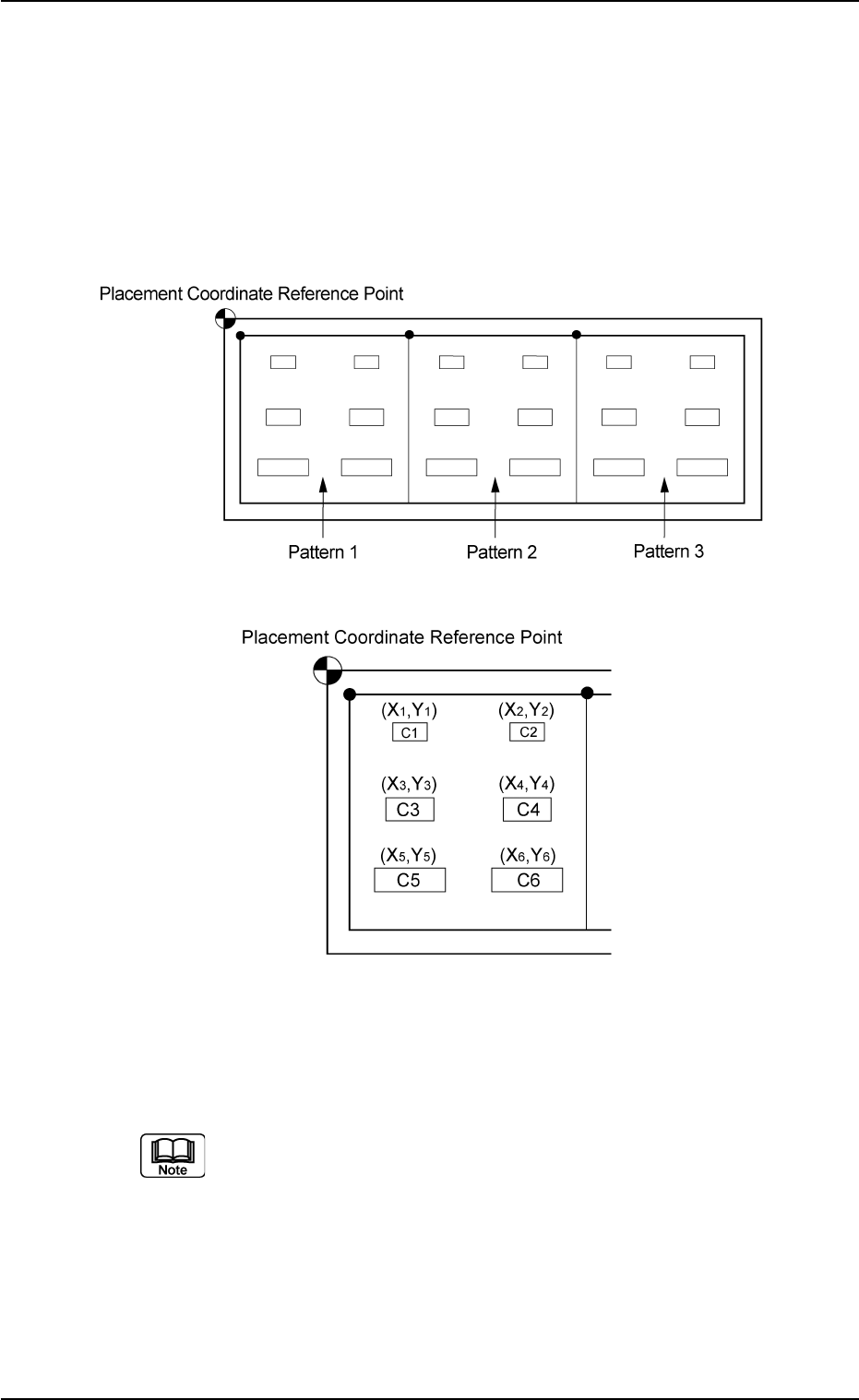
• Example of Patterns
Fig. 3B135 General View
Fig. 3B136 Pattern 1 (Magnified View)
••
••
• Method of Block Sorting
The following describes the method of block sorting according to the
outside diameters of the nozzles.
(a) Outside Diameters of Nozzles
After the nozzle IDs in the placement feeder location data
are confirmed, the outside diameters are examined, using
the nozzle type data of the nozzle data.
(b) Nozzle Type Data
When the [SYSTEM] button on the main menu bar is
pressed, the "SYSTEM SEL." menu opens. Select the
[NOZZLE DT] button.
Press the "Nozzle Data" tab in the "Nozzle Data" window.
0206-002 2-72
AHB01EDTP
3.5 Repetitive Patterns (Block Sorting Enabled)
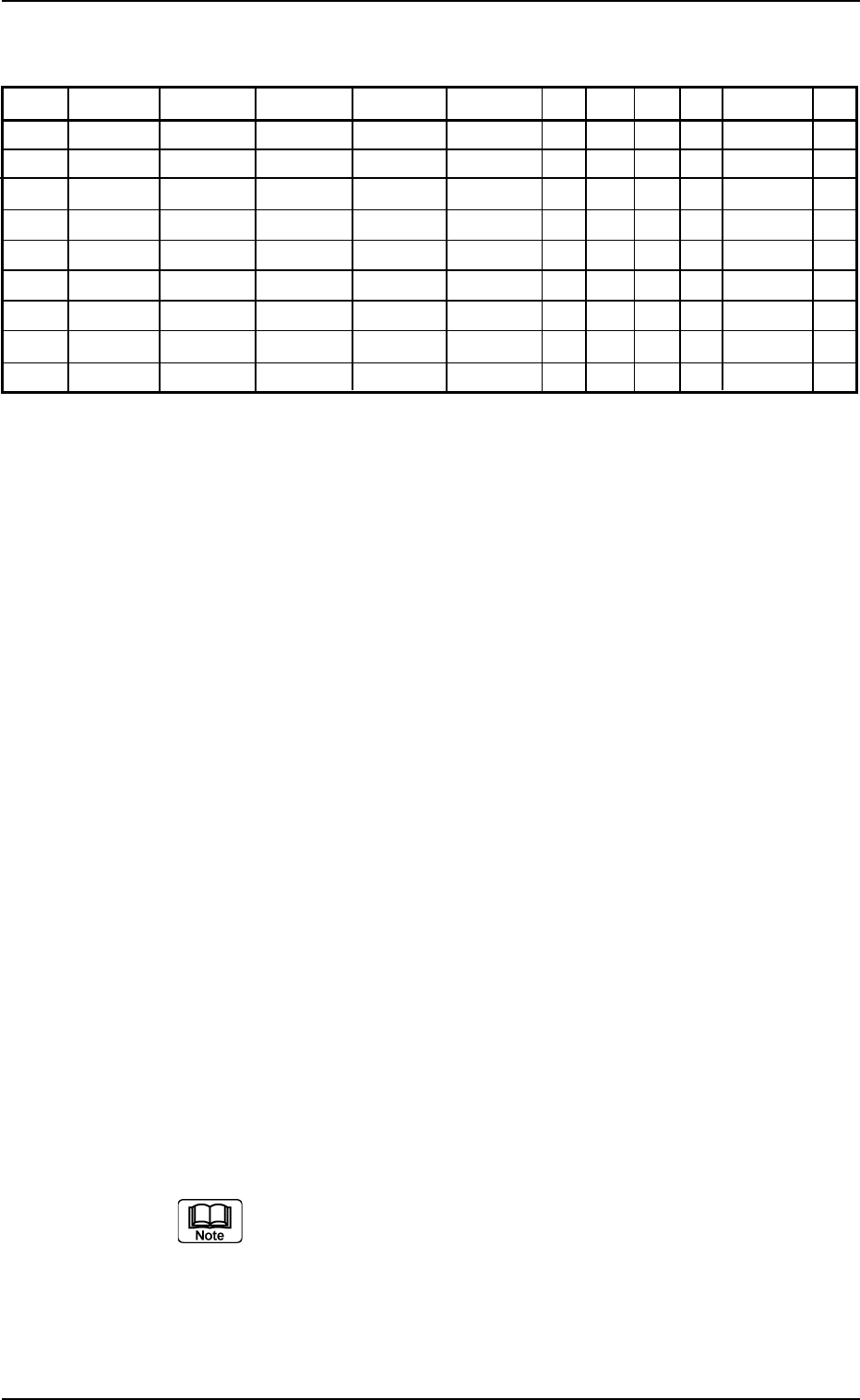
(2) Creation of Placement Data (P-data)
Tabl 3B31
P-No. X [mm] Y [mm] Z H [mm] Fdr. No. C S HD PU Comment V
1X
1
Y
1
Z
1
+0.00 XXX - - 2 0 C1 00
2X
2
Y
2
Z
2
+0.00 XXX - - 1 0 C2 00
3 000.00 000.00 000°00’ +0.00 000 1 - 0 0 00
4X
3
Y
3
Z
3
+0.00 XXX - - 2 0 C3 00
5X
4
Y
4
Z
4
+0.00 XXX - - 1 0 C4 00
6 000.00 000.00 000°00’ +0.00 000 2 - 0 0 00
7X
5
Y
5
Z
5
+0.00 XXX - - 2 0 C5 00
8X
6
Y
6
Z
6
+0.00 XXX - - 1 0 C6 00
9 000.00 000.00 000°00’ +0.00 000 P - 0 0 00
Procedure
(2-1) Classify the components that require the same outside diam-
eters of the nozzles into one group.
Set the grouped components that require the smallest outside
diameter (nozzle) in the smallest P-No. step.
In the above example, C1 and C2 are set in P-Nos. 1 and 2.
(2-2) Set "1" in the "C" text box of P-No. 3 and "0" (zero) in the other
text boxes of the step line.
This step is regarded as a delimit of one group.
Notes: (a) No components are placed for the delimit step.
(b) Any number (0 to 9) can be used as a control com-
mand.
"1" is used in the above example.
(2-3) Keep the same procedure to make each step as follows.
• Set "C3" and "C4" in the "Comment" text boxes of P-Nos. 4
and 5.
• Set "2" in the "C" text box of P-No. 6 and "0" (zero) in the
other text boxes of the step line.
• Set "C5" and "C6" in the "Comment" text boxes of P-Nos. 7
and 8.
(2-4) Create the last step in the same way as a normal program. Be
sure to set "P" as a control command in the "C" text box.
Note: Actual component placement will be made in almost the
reverse sequence as explained below.
Up to 20 groups can be created in one pattern program.
3.5 Repetitive Patterns (Block Sorting Enabled)
0206-003 2-73 AHB01EDTP

Order of Component Placement
Pattern 1 (C1ÆC2) Æ Pattern 2 (C1ÆC2) Æ Pattern 3 (C1ÆC2)
ÆPattern 3 (C3ÆC4) Æ Pattern 2 (C3ÆC4) Æ Pattern 1 (C3ÆC4)
Æ Pattern 1 (C5ÆC6) Æ Pattern 2 (C5ÆC6) Æ Pattern 3 (C5ÆC6)
Æ
Placement Data (O-data)
Follow the normal procedure to create this data.
3.5 Repetitive Patterns (Block Sorting Enabled)
0206-002 2-74 AHB01EDTP