CP643 系统参考.pdf - 第121页
1.12.10 Board Check Conditions When automatic operation or step operation is started, movement to the board check position takes place and a board check is carried out under the following circumstances. 1. At restart aft…
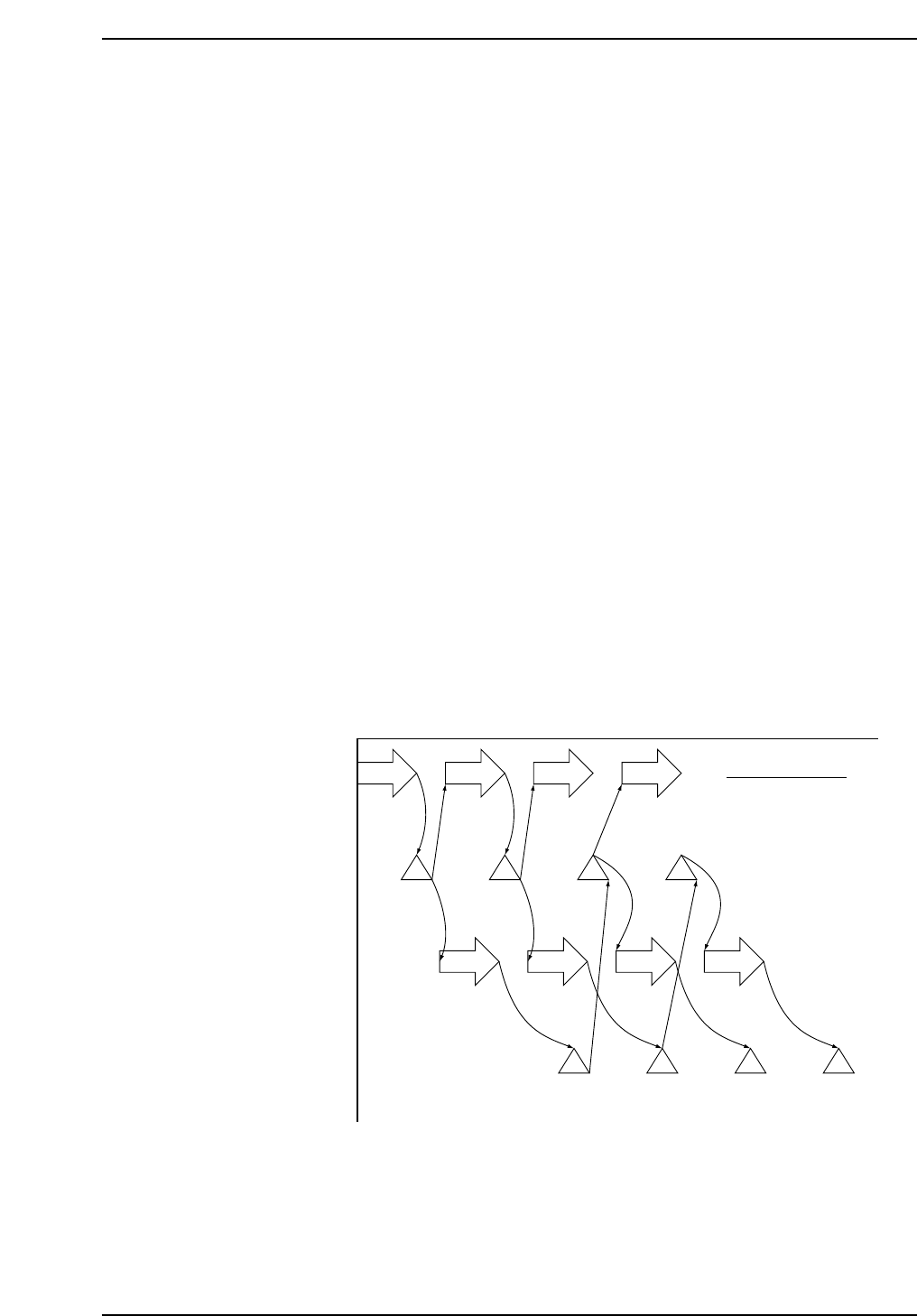
1.12.9 Mark Acquisition Overlap
Mark acquisition operation specifications
The mark vision processing time is utilized for moving the XY-table to the next mark
read position during vision processing.
For example, if four marks are to be read the operation sequence would be as follows.
[1] Movement to mark 1 position.
[2] After moving to mark 1, the mark 1 image is acquired.
[3] Mark 1 vision processing is carried out.
[3] Movement to the next mark 2 position.
[4] After moving to mark 2, the mark 2 image is acquired.
[5] Mark 2 vision processing is carried out.
[5] Movement to the next mark 3 position.
[6] After moving to mark 3, the mark 1 vision processing result is received.
[7] Mark 3 image is acquired.
[8] Mark 3 vision processing is carried out.
[8] Movement to the next mark 4 position.
[9] After moving to mark 4, the mark 2 vision processing result is received.
[10] Mark 4 image is acquired.
[11] Mark 4 vision processing is carried out.
[12] Since there is no next mark, the mark 3 and 4 vision processing results are received.
However, the above mentioned overlap processing is limited to continuous fiducial/
block skip marks. When processing a fiducial mark after a global skip mark or block
skip mark, determination as to whether the next mark needs to be read or not is made
after the result of the global skip mark or block skip mark is received.
In addition, for a block skip mark that references a fiducial mark, movement to the
intended position takes place after the referenced fiducial mark acquisition result is
received.
Z-axis height when reading marks
Mark acquisition and board check were carried out at the Z0 height until now but as a
result of a change in the mark camera and board check sensor installation positions,
mark acquisition is now carried out at the position defined by “Z0 - PCB thickness - 5.0
mm”.
XY-axes movement
Mark acquisition
(Image acquisition)
Vision processing
Vision processing
result received
[6]
Mark1
[9]
Mark2
[12]
Mark3
[12]
Mark4
[3]
Mark1
[5]
Mark2
[8]
Mark3
[11]
Mark4
[2]
Mark1
[4]
Mark2
[7]
Mark3
[10]
Mark4
[1]
Mark1
[3]
Mark2
[5]
Mark3
[8]
Mark4
For four marks
CP643S2036A
Part 2 Chapter 1 Basic Operation
Edition 1.1 2-1-63 CP643E System Reference

1.12.10 Board Check Conditions
When automatic operation or step operation is started, movement to the board check
position takes place and a board check is carried out under the following circumstances.
1. At restart after an emergency stop.
2. At restart after selection of the I/O check command.
3. At restart after XY-table board unclamping (excluding unclamping that takes place in
the context of a series of operations such as when a board is replaced).
4. When the power is turned on.
5. At restart after loader command selection (excluding the loading position command).
6. At restart after a change in the operation mode.
Product, Idle, Simulate
7. If the number of boards being managed by the software differs from the board check
result and the F6 key is used to temporarily quit automatic operation.
8. If an error occurs during board transport or changeover that has caused automatic
operation to be quit.
1.12.11 Placement Check Function
Using the live image display of the mark camera, an image of the placed parts can be
output to the image processing monitor and the parts placement status can be checked
visually.
Checking of placed parts is performed using the following procedure.
[1] Set the placement check function.
[2] Terminate board production.
[3] Check placed parts. (Page PCK)
[4] Continue production.
Setting the placement check function
Prior to terminating board production (before performing the final placement sequence),
select [PLT CHK STOP] (see page 150).
When desiring to cancel this setting, select one of the other production modes (see page
150).
Board production after setting the function
If the placement check functions is set, "Plmt Chk" is displayed in Status (P Mode) and
"Placement check stop processing" is displayed in the Help area. After production is
terminated, the placement check command (Page PCK) automatically becomes effective.
Part 2 Chapter 1 Basic Operation
Edition 1.1 2-1-64 CP643E System Reference
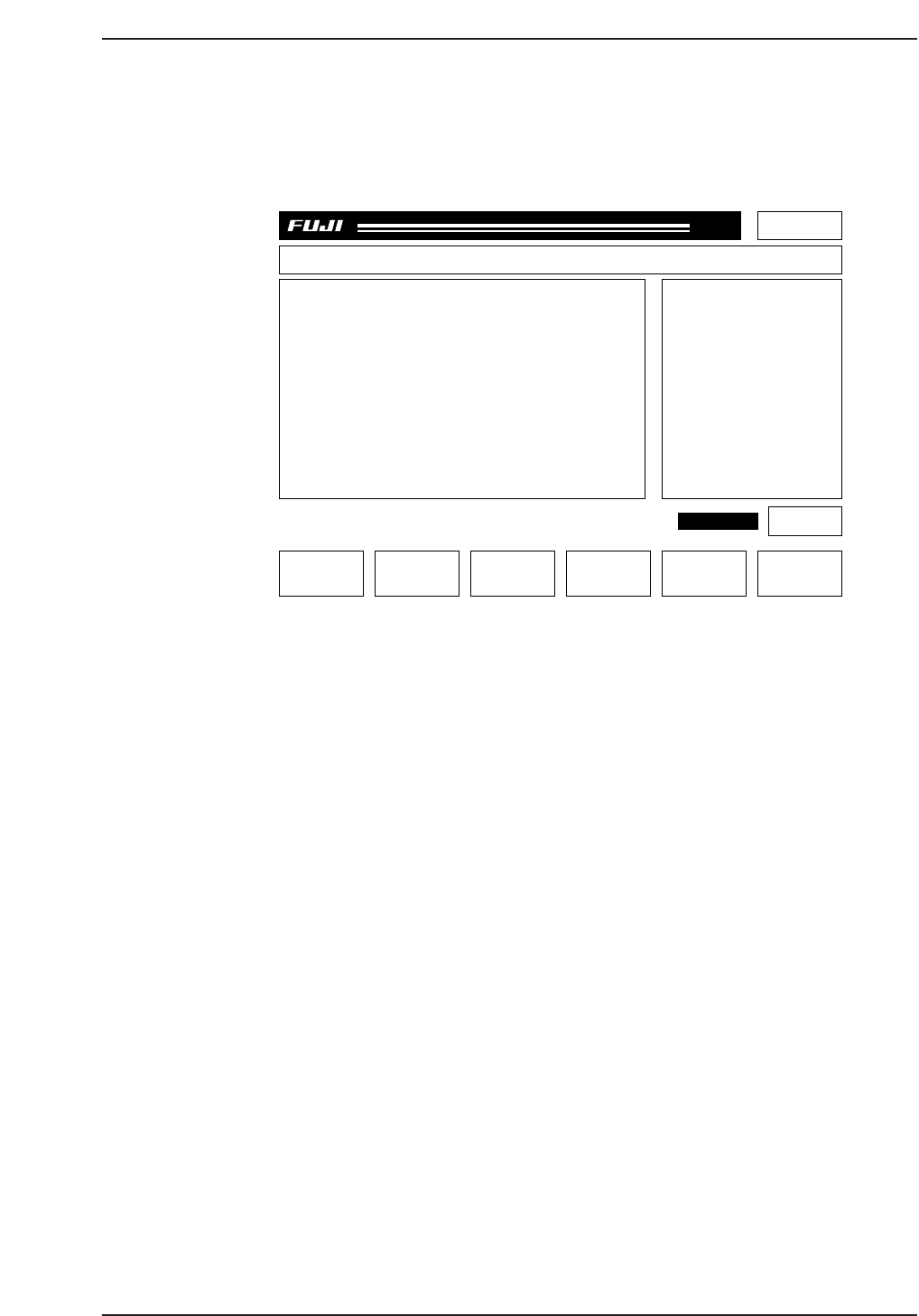
Placement check screen (Page PCK)
The "Page PCK" screen is shown below.
In the first area, information on the sequence currently displayed in the monitor is shown
(only for parts that have already been placed). Whenever any of the data are unspecified,
a "*" is displayed instead of a numerical value.
F1: GAIN/OFFSET This executes the Gain/Offset command for the mark camera. The
Proper Data values are not changed by this command. This is
effective only when in Page PCK.
F2: CAM ORG POS If pressed continuously, the cam shaft is returned to its origin
position.
F4: SEQ. NO Carries out sequence number specification.
F6: RECOVER Terminates the placement check and returns to Page 100.
START switch: This blinks if the cam shaft is at the origin position and the process
has not been completed up to the final sequence. If the START
switch is pressed, the XY table moves in the sequence order.
Resuming Production after Completing the Placement Check
When the placement check has been completed, production returns to the normal
continuous production (P Mode: Product). If the START switch is pressed, the board
was checked is unloaded, and a new board is loaded. The placement check function is
not automatically effective upon completion of board loading.
Part 2 Chapter 1 Basic Operation
Edition 1.1 2-1-65 CP643E System Reference
Page PCK
Off line
SPEC.CP6 Prod 0000 Sche 00000
V1.58
000000000000
000000000000
jog X Y C
GAIN/OFFSET CAM ORG POS SEQ. NO
CP6OA037
RETURN
PLMT CHECK
Sequence info.
Seq. No :****
X [um] :******
Y [um] :******
Q [deg] :******
D No. :***
Comment :
P mode Plmt Chk
Recovery 3 times
T mode Joint
STATUS