CP643 系统参考.pdf - 第137页
6. Open the Sequence Data in the relevant program. 7. At the beginning of the sequence, insert the same number of lines as the number of blocks. 8. Specify the following setting items at the inserted lines: Block#: Enter…
<for MCS>
[Program] Mark_data
Mark_data Type Ptn B/W CCD L/S Scan Size_a Size_b Size_c Size x Size_y
-----------------------------------------------------------------------------------------------------------------
001 B 00 B 150 – 200 100 000 50 100 100
[Program] N_Data
N_Data B W D X Y Q
-----------------------------------------------------------------------------------------------------------------
001 1 B 1 -2000 1000 0.00 : Block 1, block skip mark 1
input
002 2 B 1 -6000 1000 0.00 : Block 2, block skip mark 2
input
<For F4G>
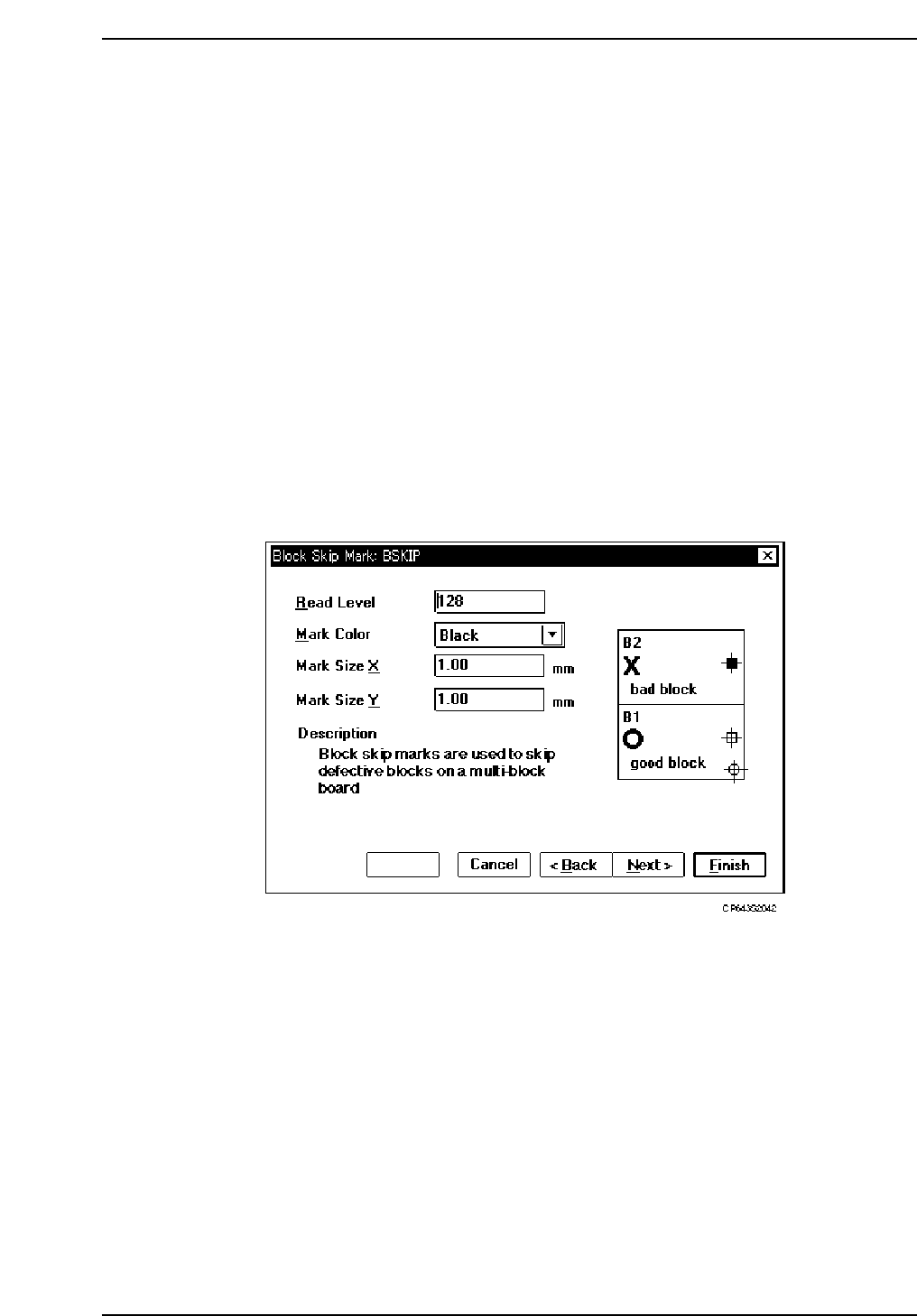
1. Start the GUE (Graphical Editor).
2. Create new Mark Data.
3. Select a Block Skip Mark as the mark type.
4. Enter the following settings: Read Level, Mark Color, Mark Size X, Mark Size Y.
5. Name and save this data.
Part 2 Chapter 1 Basic Operation
Edition 1.1 2-1-79 CP643E System Reference
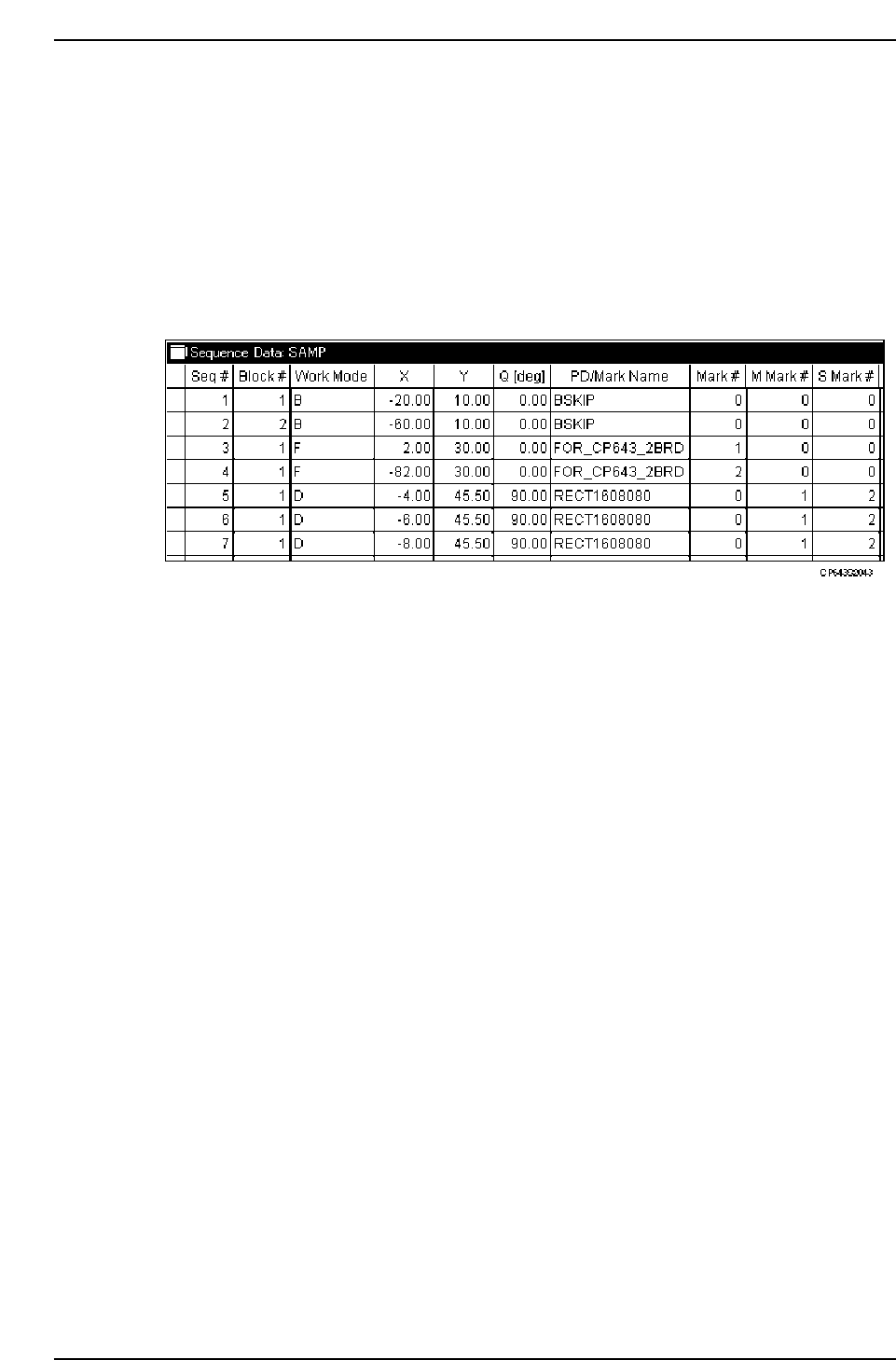
6. Open the Sequence Data in the relevant program.
7. At the beginning of the sequence, insert the same number of lines as the number of
blocks.
8. Specify the following setting items at the inserted lines:
Block#: Enter the block number corresponding to that block skip mark.
Work Mode: Select “B”.
X: Enter the X-coordinate for that block skip mark.
Y: Enter the Y-coordinate for that block skip mark.
PD/Mark Name: Enter the block skip mark name (specified at step 5 above).
9. Overwrite and save the data.
(3) Global Skip Mark
This function has been introduced to control the number of times block skip marks are
read by the machine on a multiblock board. Standard production involves the placing of
all the blocks on a multi-block board, the machine therefore reads all the block skip
marks. In a production situation where the skipping of blocks is rare, a global skip mark
should be used. By using a global skip mark, the machine has only to read one block
skip mark instead of reading all the block skip marks on the board.
• Definition
The global skip mark is defined as the block skip mark with block number 0. (Settings
for standard block skip marks are 1 to 255.)
• Setting a global skip mark
Global skip mark should be placed before block skip marks of 1 ~ n (Place the global
skip mark at the top of the block skip mark reading sequences).
Part 2 Chapter 1 Basic Operation
Edition 1.1 2-1-80 CP643E System Reference

• Global Skip Mark Usage
If the global skip mark is present (the machine detects a global skip mark), the machine
proceeds to read all the block skip marks and skips blocks as necessary.
If the global skip mark is not present (the machine does not detect a global skip mark),
the machine proceeds with the placing of parts on all the blocks without reading the
block skip mark of each block.
• Proper Data Settings
It is necessary to make the following Proper data settings to enable the global skip
mark function.
11. Machine_Status A: ???? ???? X??? ????
X: "1" to enable the global skip function
X: "0" to disable the global skip function
• The following restrictions apply when using the global skip function.
It is not possible to skip or cancel the global skip mark (skip mark with block 0) at the
machine using commands. If the Proper data item "Machine_Status A" is set to "0" (at
the bit indicated above) and a production program including a global skip mark is
used, the machine still reads the specified global skip mark area, however the global
skip mark is not processed.
If multiple global skip marks have been set, the first mark is the mark which is treated
as the global skip mark. Any global skip marks after this are ignored.
(4) Board Check Function Using Block Skip Marks
If there is even one block skipped as a result of block skip mark recognition, the XY-table
will move to the loading position and the RESET button will be enabled. When the
RESET button is enabled, the block skip board can be replaced or cleared off.
After RESET is pressed the START button will be enabled. If the START button is then
pressed, fiducial mark and block skip mark acquisition will start again from the
beginning.
This function is premised on the idea that several small boards are loaded on a pallet and
that one board is considered as a block. In addition, if board replacement is carried out
after the machine stops, it must be possible for a board to be replaced with the pallet in
the clamped status. This is not necessary if a board is cleared off.
This is an optional function. It can be enabled by setting the third bit in the Proper data
item Machine_Status_A to “1”.
Machine_Status_A ???? ???? ???? ?1??
If even one block is skipped as a result of block skip mark recognition, the following
screen will be displayed.
Part 2 Chapter 1 Basic Operation
Edition 1.1 2-1-81 CP643E System Reference