CP643 系统参考.pdf - 第146页
1.20.2 Next Device Operation Herein is an explanation of how the Next Device function operates. 1. In the production program, a device number (D) from which parts are to be picked is set in Sequence data. This is the ori…
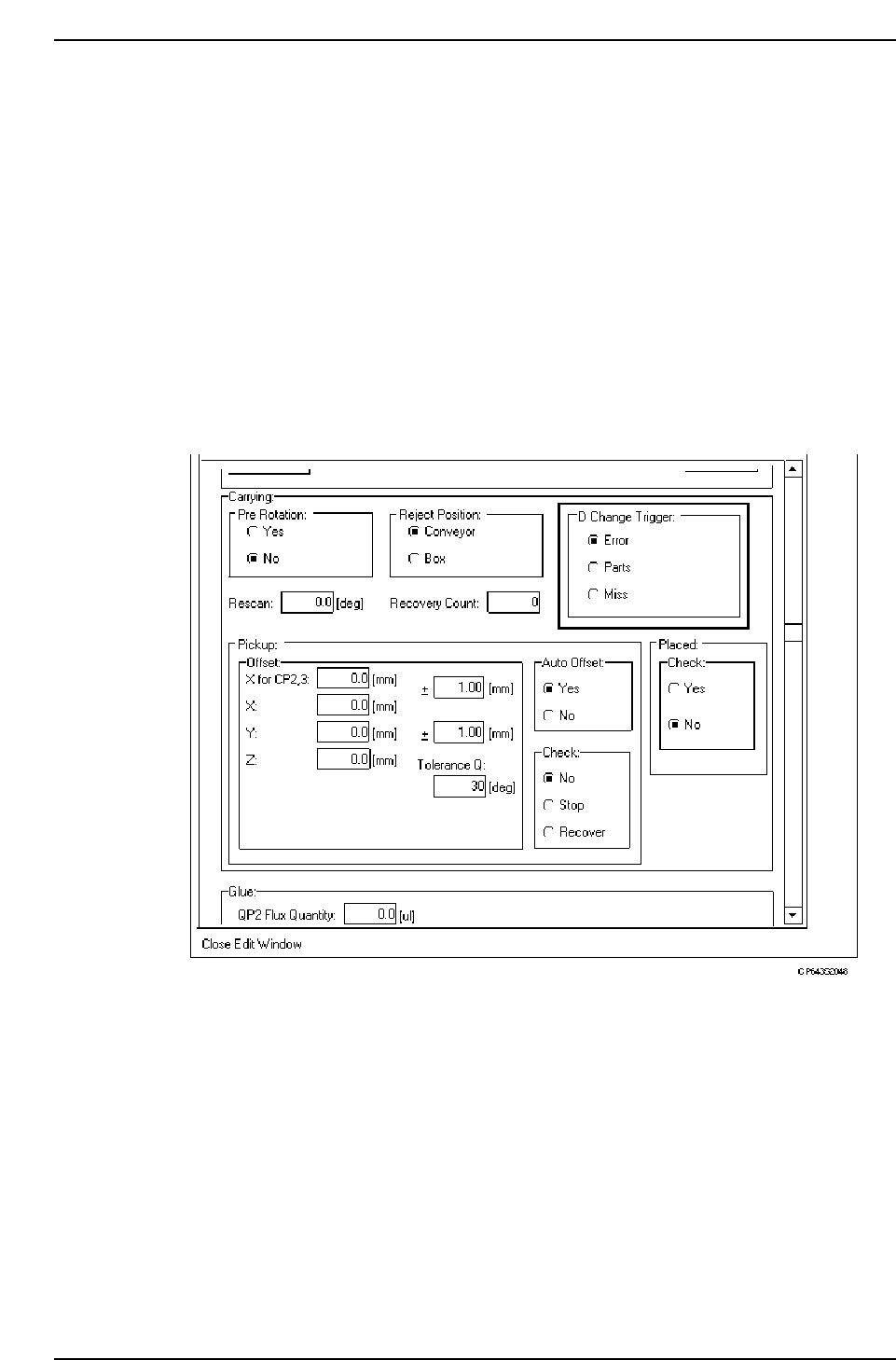
<For MCS>
[PART DATA] Carrying data
20. D_change_trigger Error, Parts, Miss
Error: The device or device table will change when the device is out of parts, not
picking properly or experiencing a vision processing error.
Parts: The device or device table will change only when the current device is out of
parts.
Miss: The device or device table will change only when the device is out of parts or
not picking properly.
<For F4G>
1. Start the VPD.
2. Open the Part Type Data in the relevant part data.
3. At the [Carrying] - [D type Trigger] item, specify a setting in the same manner as in
MCS systems (see above).
Part 2 Chapter 1 Basic Operation
Edition 1.1 2-1-88 CP643E System Reference

1.20.2 Next Device Operation
Herein is an explanation of how the Next Device function operates.
1. In the production program, a device number (D) from which parts are to be picked is
set in Sequence data. This is the original device.
2. When the original device is out of parts, it will change to the device number set in
“Next” of Device data (D_data).
3. After that, when parts run out again, if the number in “Next” is not the original
device, it will go to that device.
4. If the number specified in "Next" is not the original device and there are no parts on
this feeder, and if the final next device is out of parts, automatic operation will be
interrupted.
Note: For further information on the Next Device function refer to the MCS/2H Operation Manual
or F4G User’s Manual.
1.20.3 Points to Remember When Using Next Device
When setting next devices a loop must be set. This loop can use up to 30 devices.
Part 2 Chapter 1 Basic Operation
Edition 1.1 2-1-89 CP643E System Reference

Notes:
Part 2 Chapter 1 Basic Operation
Edition 1.1 2-1-90 CP643E System Reference