YV180X_Ope_E.pdf - 第236页
5 -160 EPD8013110 Operation Chapter 5 5 Creating the PCB data 4 Select the sorting order . Move the cursor to “ Upper Dir ” and select the sorting order with the [INS], [DEL] or [Space] keys. Select “ Upper Dir ” when yo…
5
-159
EPD8013110
Operation
Chapter 5
5
Creating the PCB data
13.3 Data sort
You can sort the mount data in ascending or descending order according to
the selected conditions.
1 Open the Mount Information screen.
2 Select the DATA SORT command.
1. Press the [ESC] key, select <2/1/C1 EDITOR ASSISTANT> and press the
[ENTER] key.
The EDITOR ASSISTANT submenu box appears.
2. Select “DATA SORT” and press the [ENTER] key.
The SORT ITEM box appears.
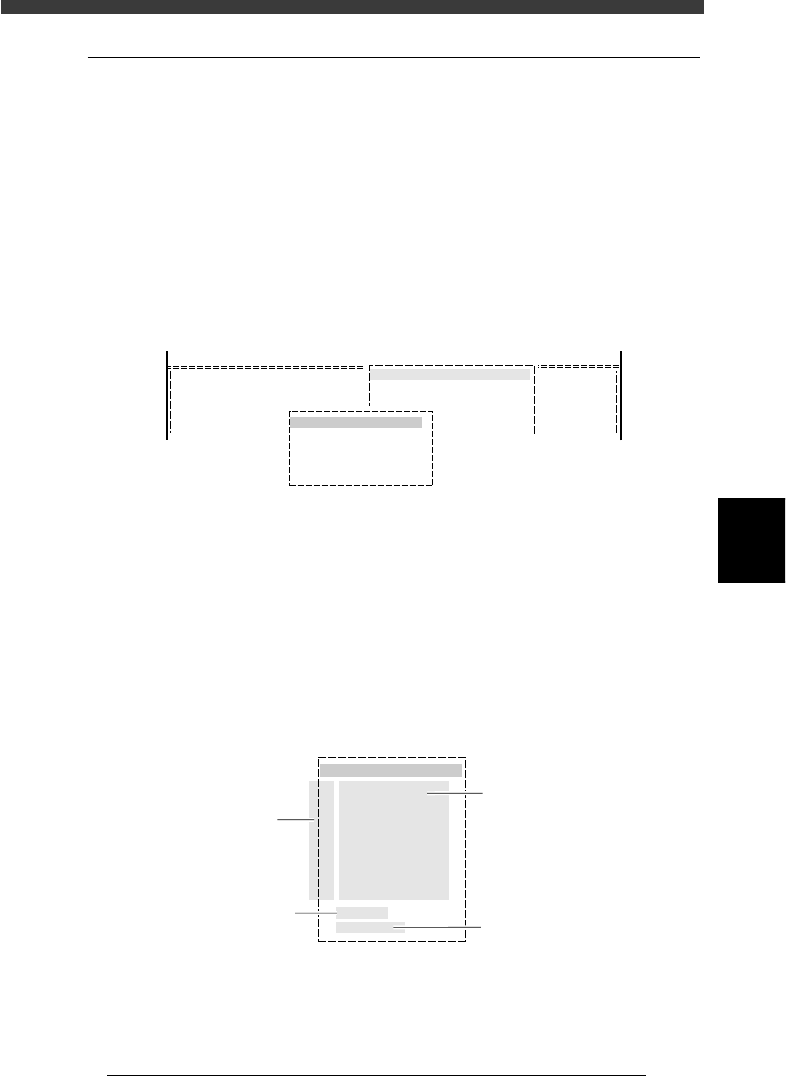
DATA SORT command
27577-C0-00
<COMMAND_LIST>
R1608
R2125
R3216
1
2
3
C/EDIT_TOOL
C1 EDITOR ASSISTANT
EDITOR ASSISTANT
DATA SORT
30
Exec
3 Specify the sorting conditions.
Here you must specify the sorting conditions (sorting items and their
priority). Numbers listed in the SORT ITEM box indicate the sorting
priority, with the highest priority at No.1 and the lowest at No. 9, so you
can specify up to 9 items.
1. Line up the cursor with No.1 in the SORT ITEM box.
2. Use the [INS], [DEL] or [Space] keys to select the sorting item.
3. Specify other sorting items as needed, by moving the cursor to No. 2
and then the subsequent numbers.
SORT ITEM box
27578-C0-00
SORT ITEM
1 Comp
2 SignOfLandPattern
3 Non
4 Non
5 Non
6 Non
7 Non
8 Non
Upper Dir
Execute
Use [INS], [DEL] or [Space]
keys to make selection
Use [INS] or [DEL] key
to make selection
Sorting priority
Press [ENTER] to execute
data sort

5
-160
EPD8013110
Operation
Chapter 5
5
Creating the PCB data
4 Select the sorting order.
Move the cursor to “Upper Dir” and select the sorting order with the [INS],
[DEL] or [Space] keys.
Select “Upper Dir” when you want to sort the data in the ascending order
(from A to Z for alphabet characters or from 0 to a larger number), and
select “Lower Dir” when you want to sort it in the descending order.
5 Run the sorting.
Move the cursor to “Execute” and press the [ENTER] key.
The sorting will now start according to the selected conditions.
n
NOTE
If you do not want to save the sorted data, select <D9 ABORT PCB DATA> when you exit
the <EDIT_DATA> mode.
c
CAUTION
The results obtained with the <DATA_GENERATOR> command will be lost by data
sorting.

Chapter 6
Using various functions
1. Overview 6-3
2. Using the block repeat function 6-4
2.1 Creating the block repeat data .................................................................... 6-5
2.2 Block conversion ....................................................................................... 6-9
2.2.1 Executing the block conversion 6-10
2.2.2 Reconverting to the block repeat data 6-12
3. Creating the user database 6-14
3.1 Copying from the component or mark information ................................... 6-15
3.2 Copying from the YAMAHA database ....................................................... 6-17
4. Static component information 6-20
4.1 Registering the static component information ...........................................6-21
4.2 Static component matching ......................................................................6-22
5. Using the fiducial functions 6-24
5.1 PCB fiducial and block fiducial functions .................................................6-25
5.2 Local fiducial functions ............................................................................ 6-27
5.2.1 Point fiducial and local fiducial functions 6-29
5.2.2 4-point fiducial 6-32
6. Using the badmark functions 6-36
6.1 PCB badmark and block badmark ............................................................ 6-37
6.1.1 Operation flow 6-38
6.1.2 Registering the badmark information 6-39
6.2 Local badmark ......................................................................................... 6-40
6.3 Creating the badmark information ............................................................6-43
7. Self production control 6-47
8. Alternative component function 6-51
8.1 Multiplying the component data .............................................................. 6-52
8.2 Optimizing the feeder set positions .......................................................... 6-54
8.3 Alternative component number ................................................................6-55
8.4 Component switching flow ...................................................................... 6-56
9. Pattern matching 6-57
9.1 Pattern registration ................................................................................... 6-58
9.2 Using the pattern matching data ............................................................... 6-65
Chapter 6 explains useful functions that allow you to create or edit
data more efficiently.