Q170226E01.pdf - 第180页
No.2 parts cassette Transfer chuck No.1 parts cassette Cover Bolt B Timing pulley (motor side) Timing pulley (ball screw side) timing belt 5.25 Feeder Carriage Origin Position Check and Adjustment SERVICE MANUAL RH5 5.25…

RH5
5.24 Selector Unit Guide Pin Height Adjustment
SERVICE MANUAL
5.24−4
DA3SEC−83−9G0−A0
= MEMO =
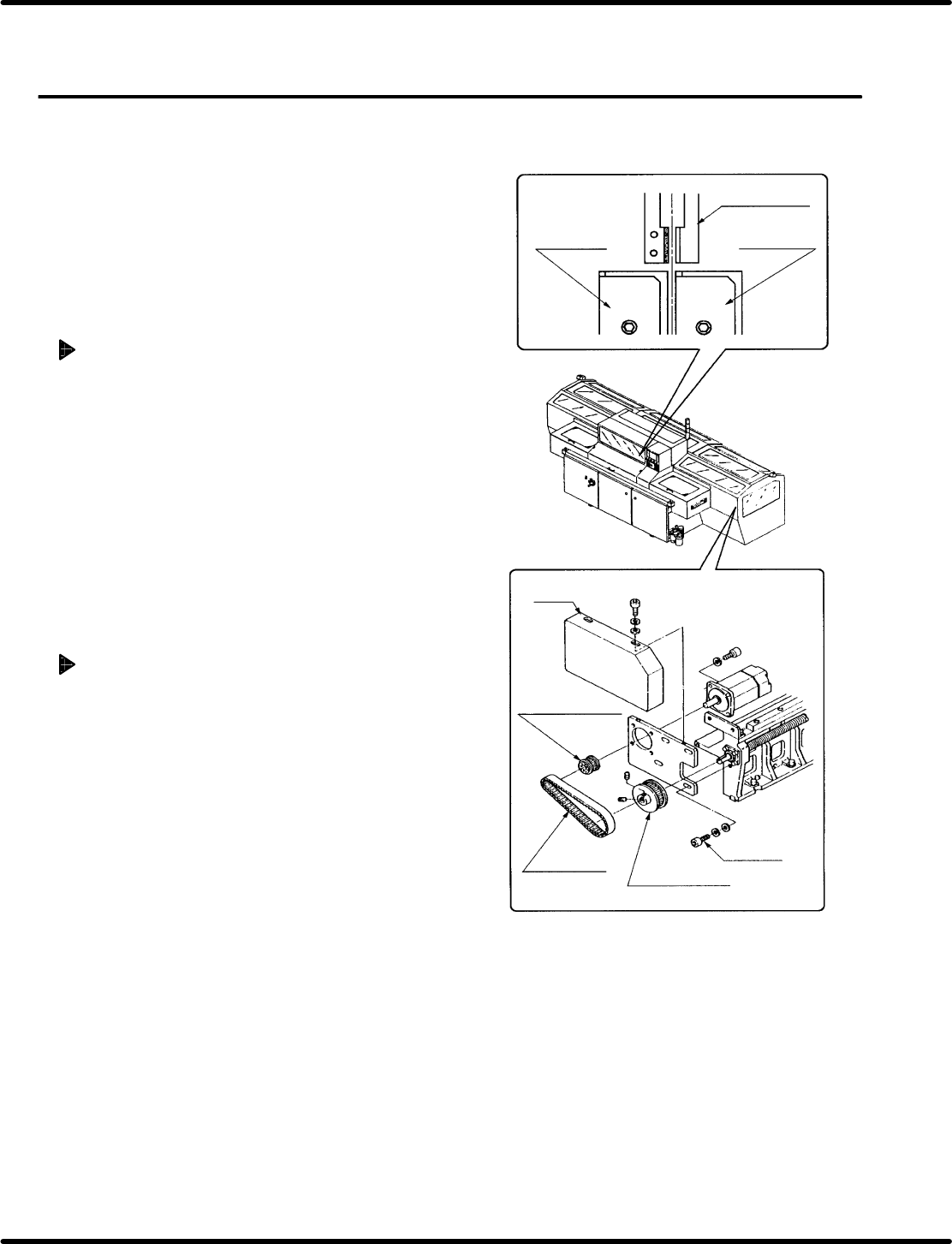
No.2 parts
cassette
Transfer chuck
No.1 parts
cassette
Cover
Bolt B
Timing pulley
(motor side)
Timing pulley
(ball screw side)
timing belt
5.25 Feeder Carriage Origin Position Check and Adjustment
SERVICE MANUAL
RH5
5.25−1
DA3SEC−83−9H0−A0
5.25 Feeder Carriage Origin Position Check and
Adjustment
DA3SEC−83−9H0−A0
Sentence No.
When to perform
x When leads of cut parts are bent.
x When insertion errors occur frequently.
Required tools
x Allen wrench
x Screwdriver
Origin position check
1. Turn the hand wheel until the cam shaft
is at approximately the 0q position on the
digital sequence timer.
2. Return the parts feeder to its origin in
manual mode.
3. From the rear of the machine, check the
midpoint between to the No. 1 and No. 2
parts cassettes (parts feeding side) is at
the center of the transfer chuck.
Origin position adjustment
(When deviation is 1.0 mm or
less.)
1. Set the mode to “SEMI” o “1BLOCK” o
“MANUAL” o “1BLOCK”. Then press
“REQ” o “F6” o “F1” o “F2” in order.
2. Input the amount of deviation to “Z axis
origin offset”.
3. Check the origin position again.

RH5
5.25 Feeder Carriage Origin Position Check and Adjustment
SERVICE MANUAL
5.25−2
DA3SEC−83−9H0−A0
Origin position adjustment (When
deviation is 1.0 mm or more.)
1. Input “0” to “Z axis origin offset”.
2. Change the mode from “MANUAL” to “1BLOCK”
and return the feeder to the origin.
3. Disengage the bolt B (4−M10) and detach the
timing belt.
4. Turn timing pulleys until the origin position is
placed at the center to place the timing belt on
the pulleys. Then retighten the bolt B (4−M10).
5. Perform origin return again to check for
the
origin
position.
=REFERENCE=
Inputting 1.0 mm or more to the “Z axis origin
offset” may cause the Z axis to reach
upper/lower quickly.