KE2010.Instruction Manual.Ver.2.01,Rev.08.pdf - 第547页
7 − 10 7.2.1.2. 3 Del eting a regi stered nozzle T o delete a r egistered nozzle, use the [Reg istered nzl no table] command that is described in Section 7.2. 1.1. (1) Basic Operations ① Select the [File] command on t he…
7 − 9
7.2.1.2.2 Reading nozzle information
The [Read Nzl data [C]] command reads nozzle information from a place (“ini” file
that is for the customized nozzle and stored in the directory
C:¥JUKI¥DATA¥CUSTOM) where a nozzle is installed with the installer on the
Machine Setup menu when you are to use a customized nozzle. See Section
7.2.1.2.1 for the function for reading nozzle information from a floppy disk.
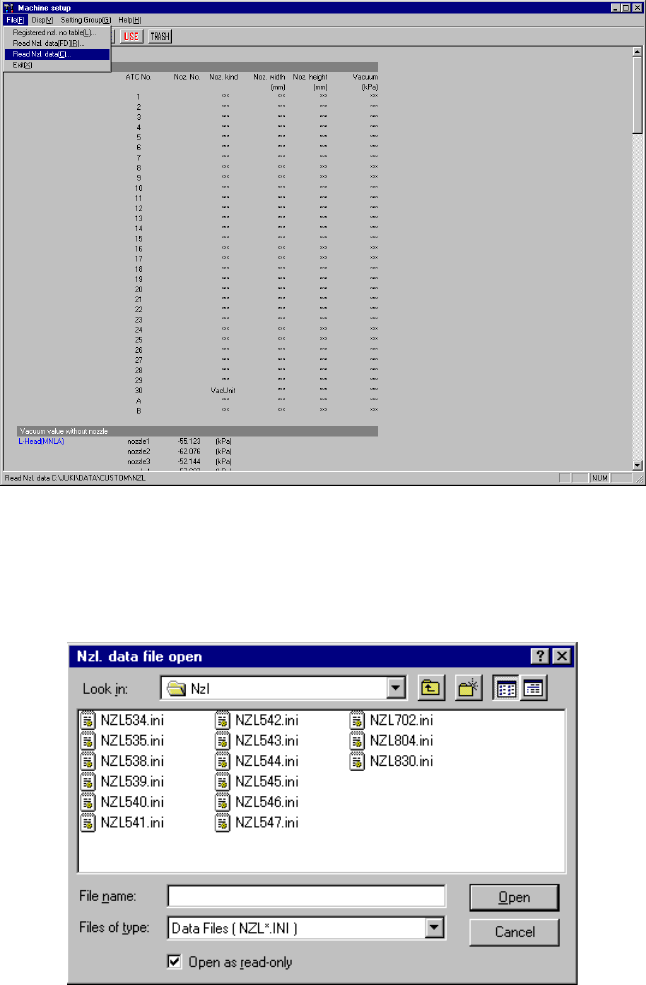
When you select the [File] command on the menu bar, and then the [Read Nzl
data [C]] command on the displayed menu, the system displays the “Nzl. data file
open” dialog box (see Figure 7.2.1.2.5).
Figure 7.2.1.2.5 “Nzl data file open” dialog box (Screen example: KE-2020)
− When this “Nzl data file open” dialog box opens, select the desired file.
“C:¥JUKI¥DATA¥CUSTOM¥NZL” opens by default.
Figure 7.2.1.2.6 “Nzl data file open” dialog box
− Select the desired file and click the <Open> button to register the nozzle.
7 − 10
7.2.1.2.3 Deleting a registered nozzle
To delete a registered nozzle, use the [Registered nzl no table] command that is
described in Section 7.2.1.1.
(1) Basic Operations
① Select the [File] command on the menu bar, and then select the
[Registered nzl no table] command on the displayed menu to open the
necessary dialog box.
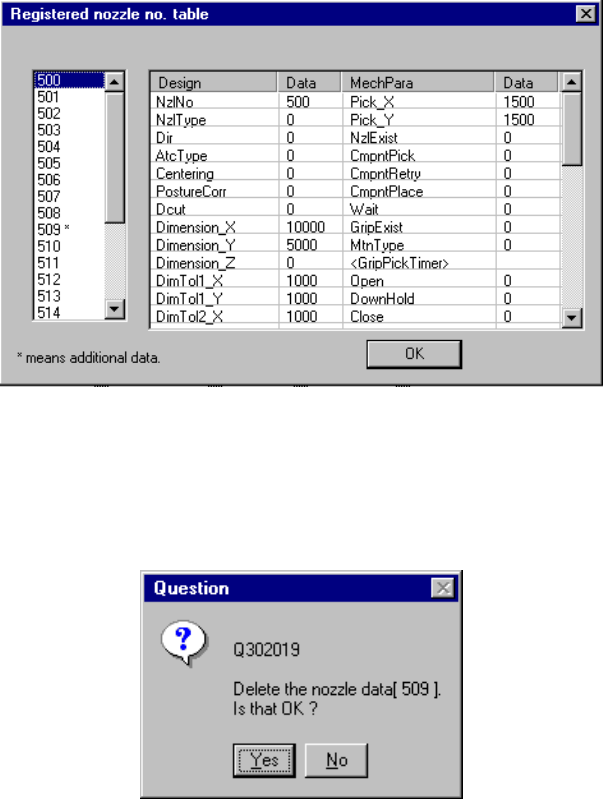
② Select the nozzle number, and press the <DEL> key (see Figure 7.2.1.2.7).
Figure 7.2.1.2.7 “Registered nozzle no. table” dialog box
③ When you click the <Yes> button on the “Question” dialog box, the
selected nozzle is deleted from the registered nozzle number table (see
Figure 7.2.1.2.8).
Figure 7.2.1.2.8 “Question” dialog box
Note: You can delete only additional registered data. You cannot delete any
standard nozzle.
7 − 11
7.2.1.3 Exit
Select [File] on the menu bar, then [Exiting Application], or click the close button (X)
at the upper right corner of the dialog box. The system quits the Machine Setup
menu.
7.2.1.3.1 Saving the settings
Although push buttons <OK>, and <Cancel> and <Apply> are available with each
setup group dialog box, pressing the <OK> or <Apply> button will not save the
data onto the hard disk.
When you change the setting(s) on Setup group dialog box, a dialog box appears
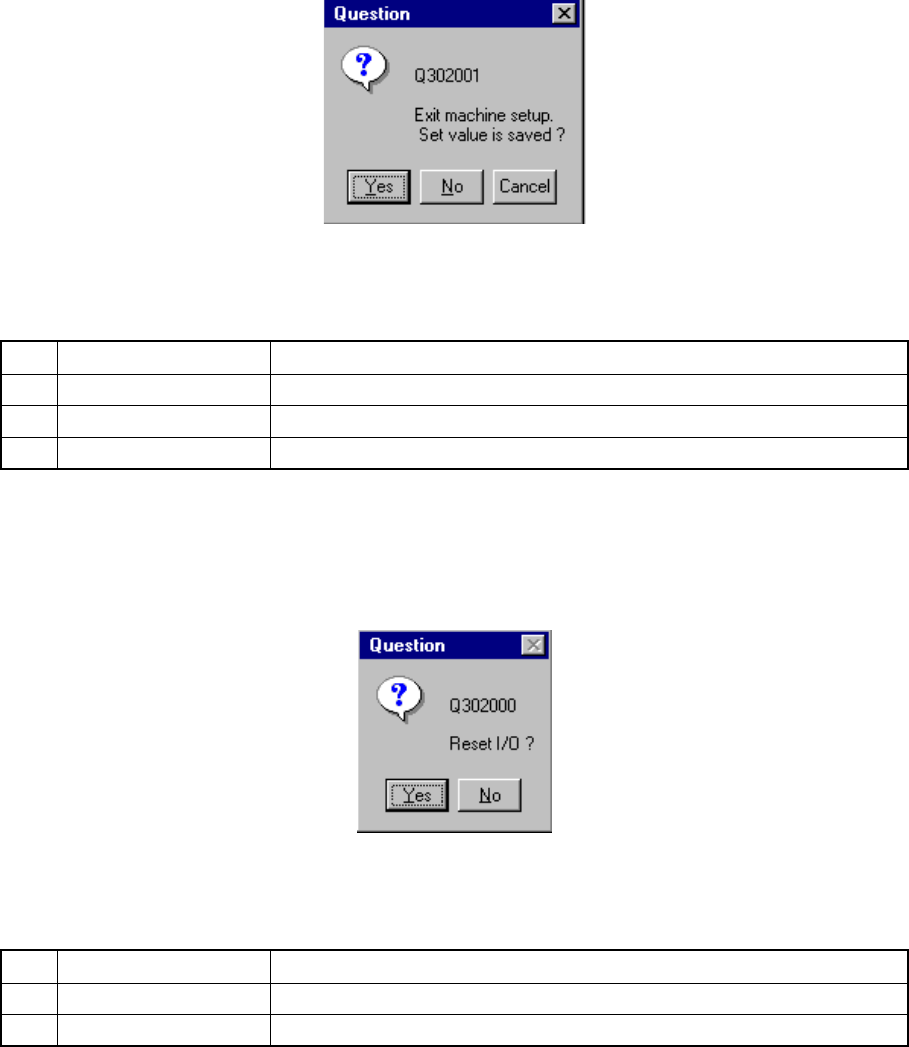
asking you whether to save the setting(s) or not (see Figure 7.2.1.3.1.5). When
you click the <Yes> button, the setting(s) is (are) saved onto the hard disk.
Figure 7.2.1.3.1.5 Save confirmation screen
Table 7.2.1.3.1.1 Save confirmation buttons
No. Button Action
1 Yes Saves the setting data onto the hard disk.
2 No Cancels the setting data.
3 Cancel Cancels the Exiting Application command.
7.2.1.3.2 Setting the safe direction of each I/O
After you select the [Exiting Application] command, the dialog box shown in Figure
7.2.1.3.2.1 appears on the screen.
Figure 7.2.1.3.2.1 “Reset I/O” dialog box
Table 7.2.1.3.2.1 Buttons for setting the safe direction of each I/O
No. Button Action
1 Yes Sets each I/O safe direction, then quits the Machine Setup menu.
2 No Quits the Machine Setup menu without setting each I/O safe direction.