MR8740、MR8741_user_manual_eng_20191016H.pdf - 第117页
4.4 Managing Files 105 4 Chapter 4 Saving/Loading Dat a & Managing Files See the contents of a selected fold er (by opening that folder). You can create a new folder in the currently displayed folder level. 4.4.2 Che…
4.4 Managing Files
104
6
(When [Wave Binary] is the selected save type)
Select whether to save divided files.
Move the flashing cursor to the [Division] item.
Select
See: "About divided saving"(p.104)
(When [Text] is the selected save type)
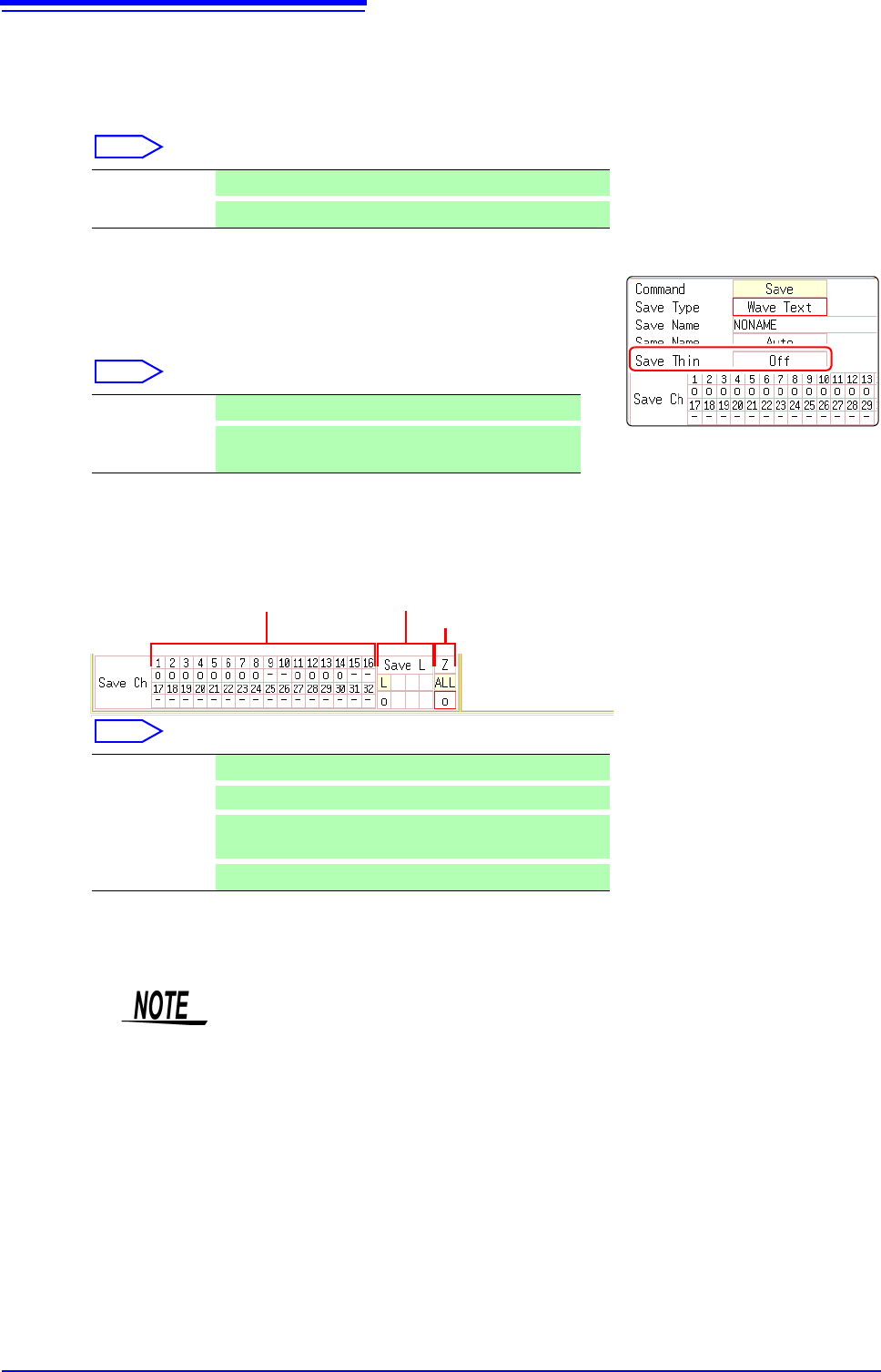
Set the data thinning number.
Move the flashing cursor to the [Save Thin] item.
Select
7
Select the channels to save.
Move the flashing cursor to the save channel item.
Select
8
Execute the save operation.
Select [Exec].
Off Files are not divided when saved.
16M, 32M, 64M
Select the size for Divided Save.
Off Data thinning (sub-sampling) is not carried out.
1/2 to 1/1000
Set the thinning number (out of how many data items to
leave one data item remaining).
- Channel will not be saved.
o
Channel will be saved.
All Ch
Saves waveforms acquired across all channels
(analog, logic, calculated waveforms).
Reset
Return to previous settings.
Analog
Channels
Logic
Channels
Waveform Calculation
(When [Wave Calculation]
is [On])
File name
The maximum number of characters for the [Save Name] string is 123. The
maximum path length including file name is 255 characters.
About divided saving
Large quantities of waveform data can be divided and saved as multiple files.
Saving divided data creates one or more waveform files and an index (IDX) file.
Then by loading the IDX file, the data in the waveform file(s) is loaded as a
batch.
See: "Batch load of waveform data"(p.101)
Other limitations
Text format data cannot be loaded into the instrument.
4.4 Managing Files
105
4
Chapter 4 Saving/Loading Data & Managing Files
See the contents of a selected folder (by opening that folder).
You can create a new folder in the currently displayed folder level.
4.4.2 Checking the Contents of a Folder
(Open a Folder)
Procedure
To open the screen: Right-click and select [FILE]File screen To change the media: (p.84)
1
Move the flashing cursor to the folder whose contents you want
to see.
2
Click [Open Folder].
A list with the folder contents appears.
4.4.3 Creating New Folders
Procedure
To open the screen: Right-click and select [FILE] File screen To change the media: (p.84)
3
1
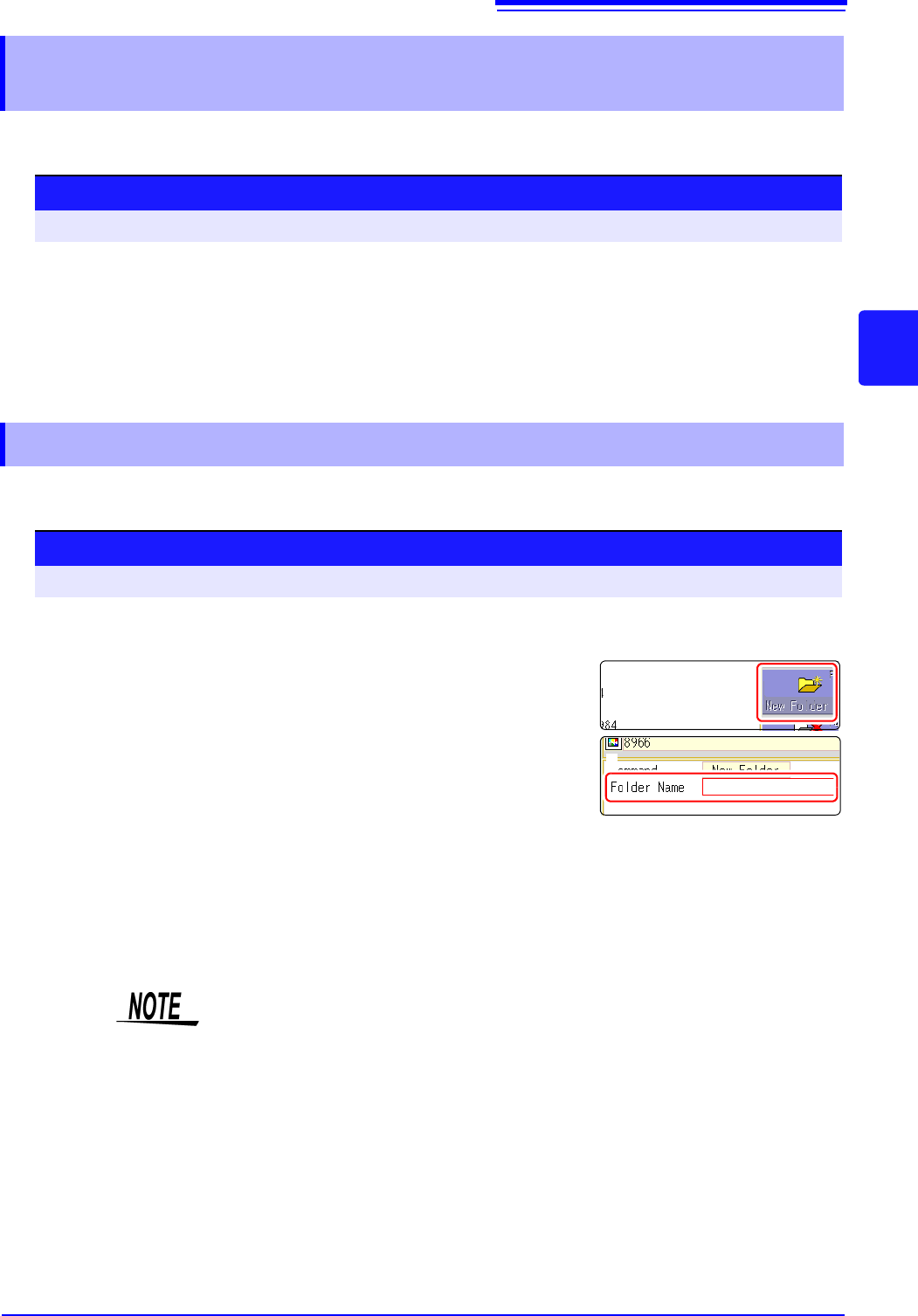
Display a screen with the folder level where you want to create a
new folder.
2
Select [New Folder].
3
Enter [Folder Name].
See: "7.1 Adding Comments" (p.138)
4
Select [Exec].
A new folder is created.
To cancel creating:
Select [Cancel].
2 Select
Folder name
The maximum number of characters for the [Save Name] string is 127. The
maximum path length including folder name is 255 characters.
4.4 Managing Files
106
Delete a file or folder.
4.4.4 Deleting Files & Folders
Procedure
To open the screen: Right-click and select [FILE] File screen To change the media: (p.84)
3. Select
2. Select
1
Select the file or folder you want to delete.
2
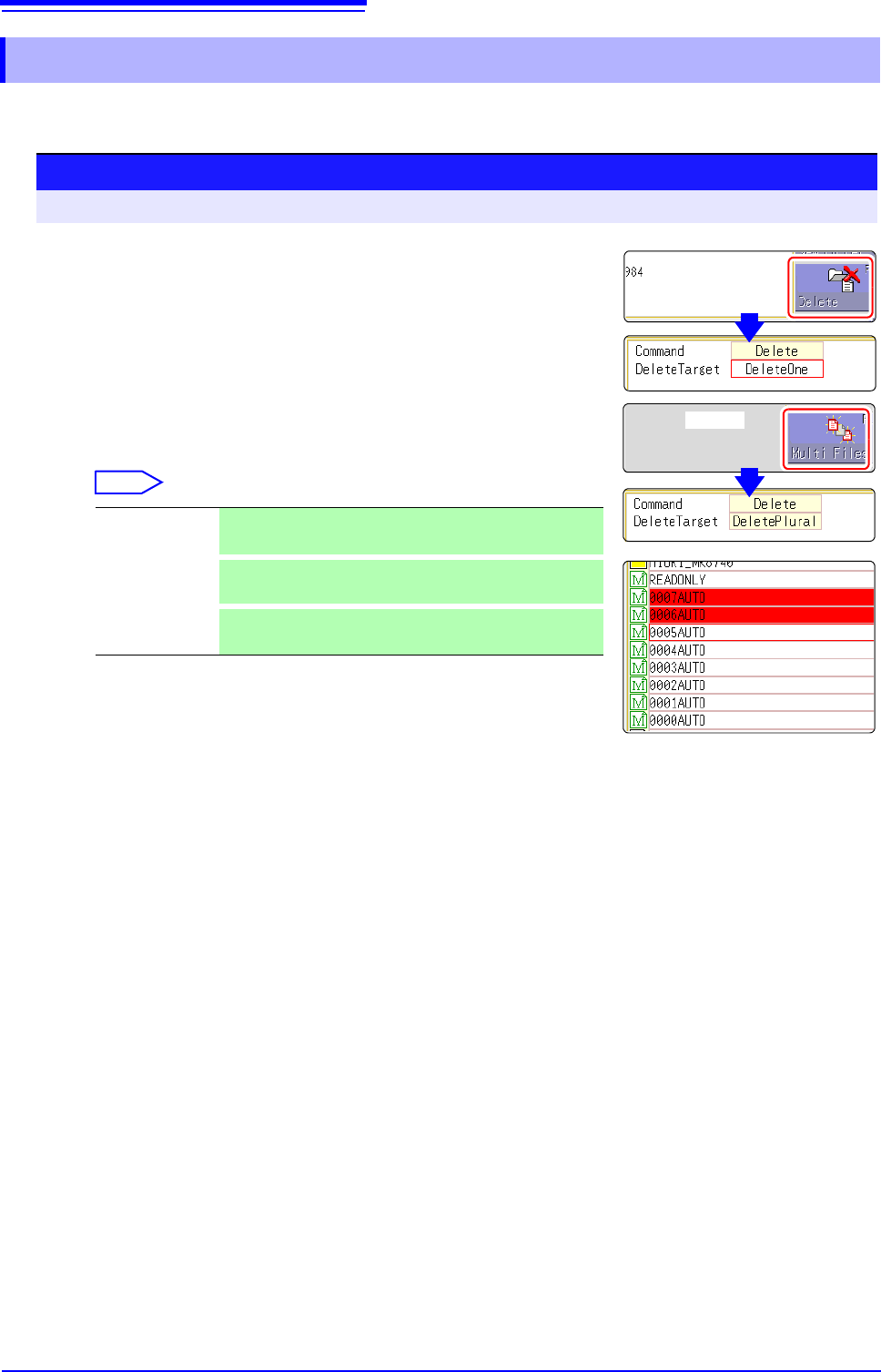
Select [Delete].
[DeleteOne] is shown as [DeleteTarget].
3
(When multiple files are to be deleted)
Select [Multi Files].
[DeletePlural] is shown as deletion target.
Select
Selected files or folders are shown in red (see illustration at right).
4
Select [Exec].
The selected files or folders are deleted.
To cancel deleting:
Select [Cancel].
Slct/Deslct Select the individual file or folder at the cursor.
If something is currently selected, the selection is cleared.
Slct/Deslct All
Select all files or folders. If something is currently selected,
the selection is cleared.
Rev Slct
Currently selected files or folders are deselected, and cur-
rently not selected files or folders are selected.