MR8740、MR8741_user_manual_eng_20191016H.pdf - 第204页
8.3 Triggering by Analog Signals 192 The steps for making settings and selecting th e type of analog trigger are de scribed below. The Trigger settings window ( [An alog T rg.] sheet) is used. An analog trigger cannot be…
8.2 Setting the Trigger Mode
191
7
Chapter 8 Trigger Settings
8
Set whether to continue to accept triggers after measuring.
If all trigger sources are disabled (Off, with no trigger setting), measurement starts immediately
(free-running).
Description Available selections depend on the function.
To Stop Measuring:
Click [STOP] in the right-click menu.
Click once: recording stops at the end of the specified recording length.
Click twice: recording stops immediately.
When the trigger mode is set to [Repeat]
During the processing interval from the end of recording until entering the next
trigger standby condition (Auto Save, waveform display processing, numerical
calculation), triggering will not be accepted.
8.2 Setting the Trigger Mode
Procedure
To open the screen: Right-click and select [DISP] Waveform screen
1
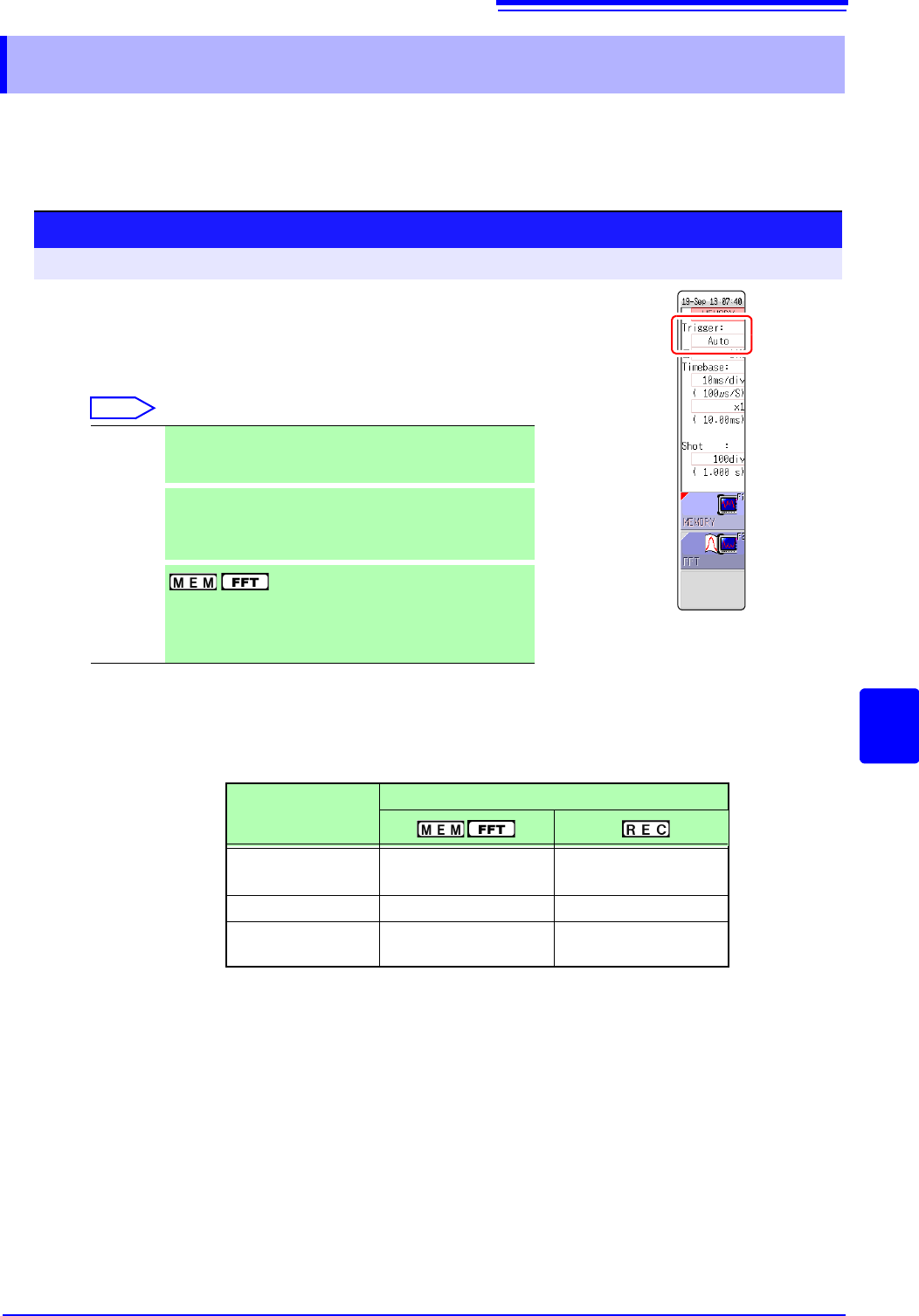
Move the flashing cursor to the [Trigger] item.
2
Select the trigger mode.
Select
Single
Only one trigger is recognized. After measurement is start-
ed, once a trigger is applied, a waveform is recorded for the
specified recording length, and measurement then stops.
Repeat
Triggers are accepted continuously.
When no trigger is applied, the instrument enters the Trig-
ger Wait state. Click [STOP] to stop measuring. (See be-
low)
Auto
Triggers are accepted continuously.
If no trigger is applied within about one second, a waveform
of the specified recording length is automatically recorded.
Click [STOP] to stop measuring.
Trigger Mode
Function
Single
OO
(default setting)
Repeat OO
Auto
O
(default setting)
×
8.3 Triggering by Analog Signals
192
The steps for making settings and selecting the type of analog trigger are described below.
The Trigger settings window ([Analog Trg.] sheet) is used. An analog trigger cannot be set for the
channel of MR8990 Digital Voltmeter Unit.
8.3 Triggering by Analog Signals
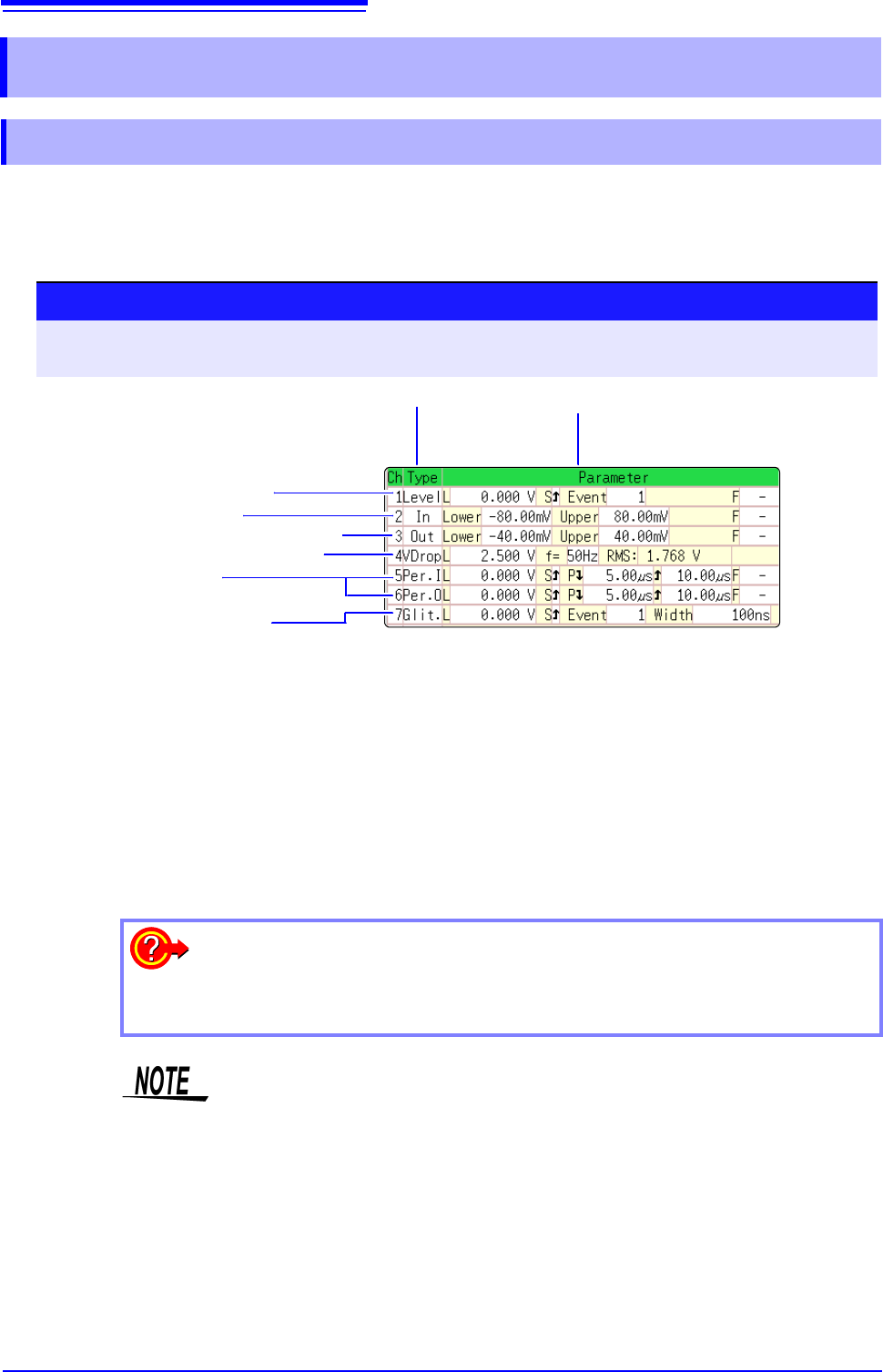
8.3.1 Analog Trigger Settings and Types
Procedure
To open the screen: Right-click and select [DISP] Waveform screen Right-click and select [TRIG.SET]
Trigger settings window ([Analog Trg.] sheet)
1
Move the flashing cursor to the [Type] item of the channel for which to make
the setting.
2
Select the trigger type from the GUI displayed on the screen.
3
Use the mouse to move the flashing cursor to the parameter item.
4
Set the parameter value from the GUI displayed on the screen.
1 3
1. Level Trigger (p.193)
2. In-Window Trigger
Out-of-Window Trigger (p.193)
3. Voltage Sag Trigger (p.194)
4. In-Period Trigger
Out-of-Period Trigger (p.194)
5. Glitch Trigger (p.195)
To copy the setting to another channel
The Trigger settings window ([Analog Trig] sheet) can be used to copy a setting.
See:"7.8 Copying settings to other channels (calculation No.) (Copy function)" (p.160)
• When the FFT function is used and [Reference] item on the [Status] sheet is
set to [From Memory], an analog trigger cannot be set.
• Only the level trigger and window trigger can be set for the channel of the
MR8990 Digital Voltmeter Unit. The voltage drop trigger, periodic trigger and
glitch trigger cannot be set.
8.3 Triggering by Analog Signals
193
7
Chapter 8 Trigger Settings
8
1. Level Trigger ________________________________________________
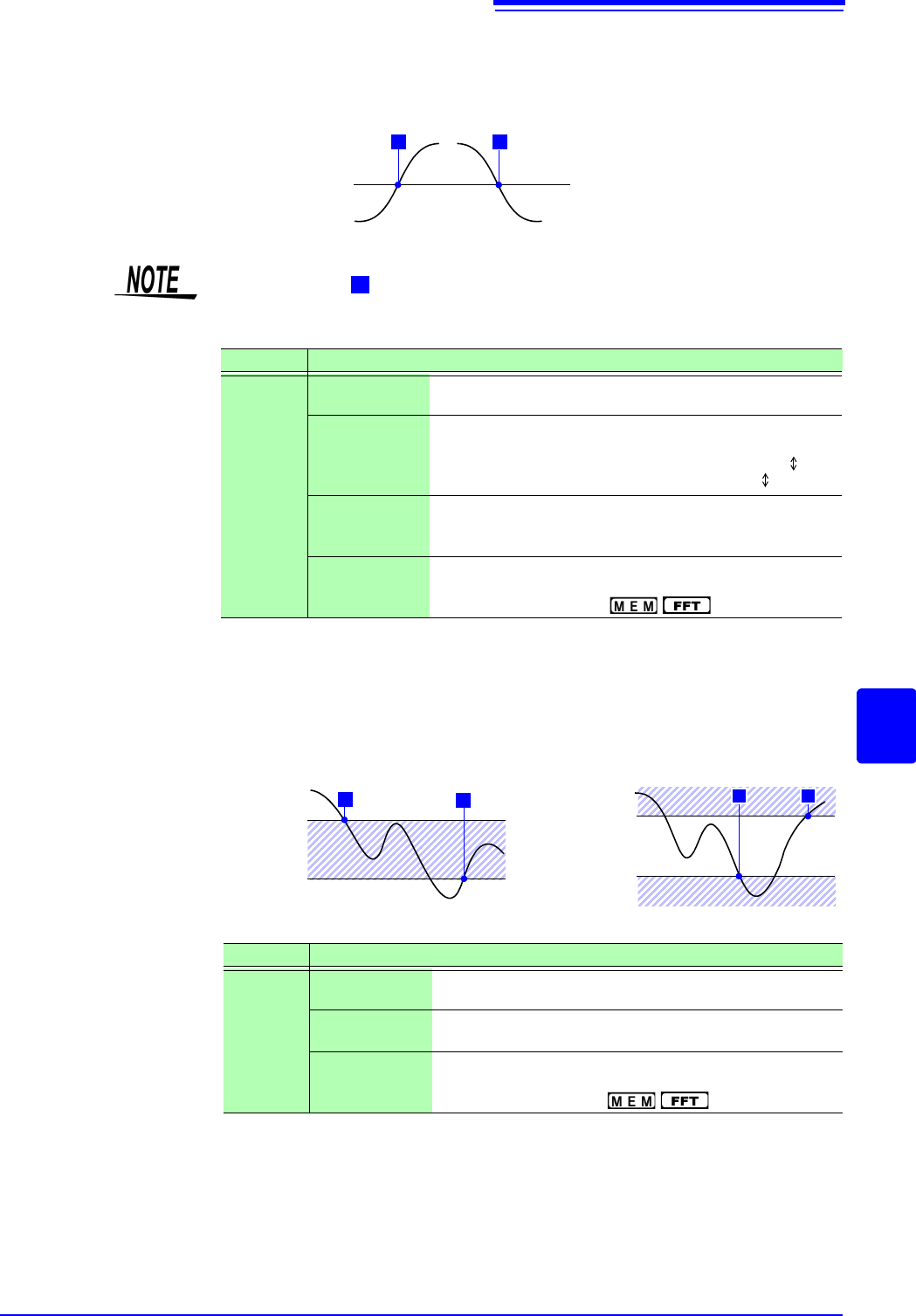
A trigger is applied when an input signal crosses the specified trigger level
(threshold voltage).
2. In-Window Trigger, Out-of-Window Trigger _______________________
Upper and lower limit values are set for the trigger level, and triggering occurs
when the input signal enters this range (In) or leaves this range (Out).
Trigger Level
Input Waveform
Trigger Slope:
[
]
T
T
[ ]
In this manual, indicates a "trigger point", as the time at which a trigger is
applied.
T
Type Parameters
[Level]
[L] (Level)
Sets the level (voltage value) for the trigger. (The setting
can be made in 1/50 increments.)
[S] (Slope)
Determines whether triggering occurs when the signal
crosses the threshold (trigger level) on the upslope (rising
edge) or on the downslope (falling edge). With the [ ] set-
ting, triggering occurs in either direction.) ( )
[Event]
The number of signal rising edge (or falling edge) events is
counted, and triggering occurs when the Event number set
here is exceeded. (1 to 4000)
[F] (Filter)
Triggering occurs when the trigger criteria are met within
the specified filter width. This is useful to prevent spurious
triggering due to noise. ( : Off, 0.1 - 10 div)
Upper Threshold
Lower Threshold
T
T
Upper Threshold
Lower Threshold
T
T
(In)
(Out)
Type Parameters
[In]
or
[Out]
[Lower]
Set the lower limit value.
(The setting can be made in 1/50 increments.)
[Upper]
Set the upper limit value.
(The setting can be made in 1/50 increments.)
[F] (Filter)
Triggering occurs when the trigger criteria are met within
the specified filter width. This is useful to prevent spurious
triggering due to noise. ( : Off, 0.1 - 10 div)