MR8740、MR8741_user_manual_eng_20191016H.pdf - 第244页
10.2 Settings for Waveform Calcula tion 232 Waveform calculation results are displayed o n the Waveform screen. 5 When finish ed entry, select [Con firm] . The entered equation is displayed in the [Equation] field. The s…
10.2 Settings for Waveform Calculation
231
9
Chapter 10 Waveform Calculation Functions
10
10.2 Settings for Waveform Calculation
1
Procedure
To open the screen: Right-click and select [STATUS] [Wave Calc] sheet
1
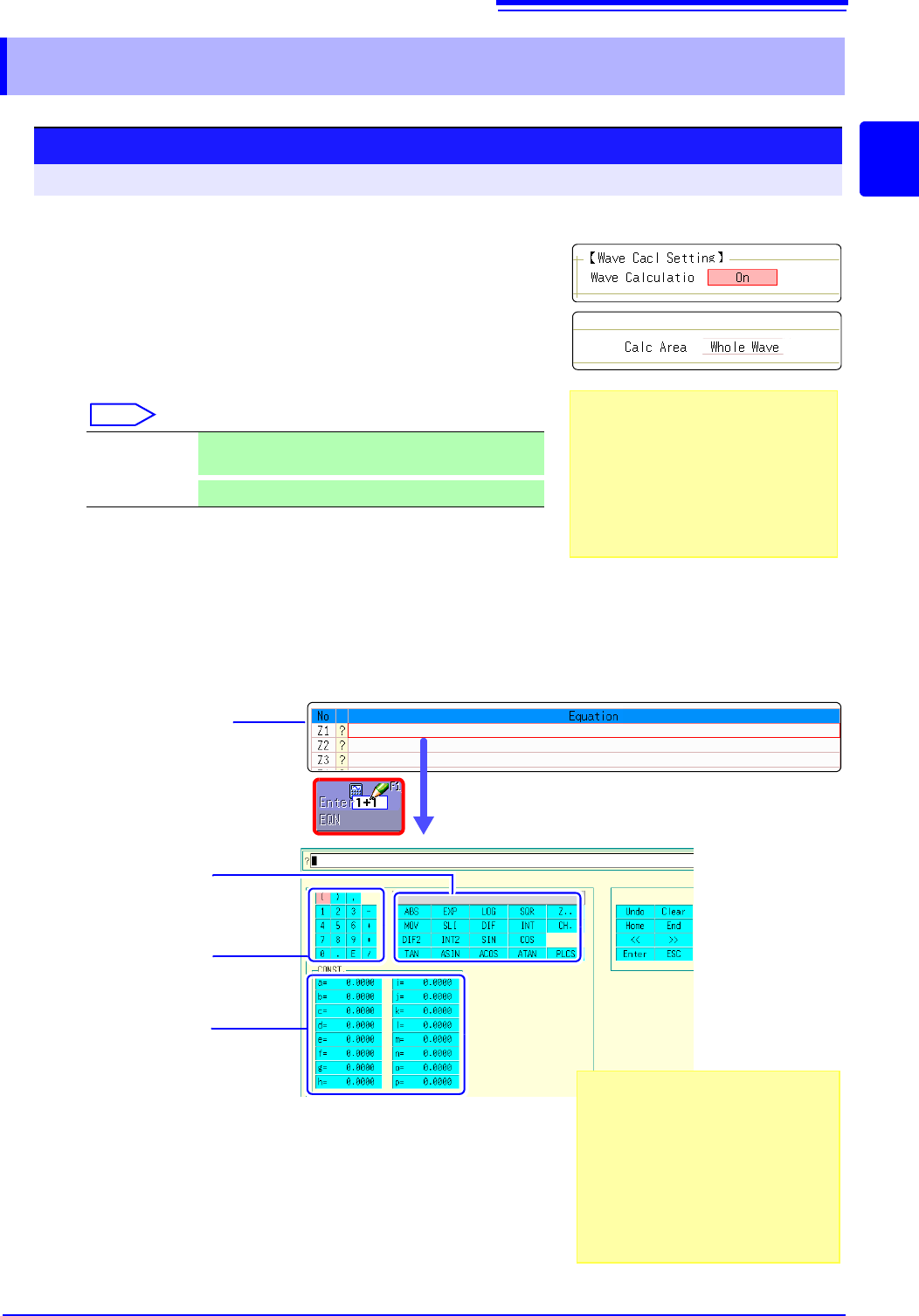
Enable the Waveform Calculation function.
Move the flashing cursor to the [Wave Calculation] item,
and select [On].
2
Specify the waveform calculation range.
Move the flashing cursor to the [Calc Area] item.
Select
See: "6.2 Specifying a Waveform Range (A/B Cursor)" (p.124)
3
Perform calculation settings.
Move the flashing cursor to the [Equation] column of the
calculation to be set and select [Enter EQN].
A dialog is displayed for entering a calculation equation.
4
Select a calculation equation.
See: "Waveform Calculation Example" (p.236)
Whole Wave Applies calculations to the whole waveform. (default
setting)
A-B Wave
Applies calculations to the data between A/B cursors.
.Calculation No.
Enter constants
Constants must have been previ-
ously entered on the [CONST.]
(
p.234)
Enter numerical
values and symbols
Enter calculation
operators
When selecting [A-B Wave], specify the
calculation range using the A/B cursors on
the Waveform screen.
If no measurement data has been ac-
quired by the instrument, first measure
once so that the range can be specified for
calculations to be applied to subsequent
measurements.
If "=" is displayed
The entered calculation equation is syn-
tactically correct.
If "?" is displayed
The equation has a syntax error.
The cursor is placed at the location of the
error to facilitate correction.
• Are parentheses correctly matched?
• Has a multiplication operator "
" been
omitted?
2
10.2 Settings for Waveform Calculation
232
Waveform calculation results are displayed on the Waveform screen.
5
When finished entry, select [Confirm].
The entered equation is displayed in the [Equation] field.
The scale (maximum and minimum vales) of the calculation results
has a default setting of [Auto]. If you want to scale the results, set
the maximum and minimum values under [Manual].
See: "Changing the display method for calculated waveforms" (p.235)
6
(As occasion demands)
Set auto saving (p.88).
7
Execute the calculations.
Applying Calculations to Existing Data
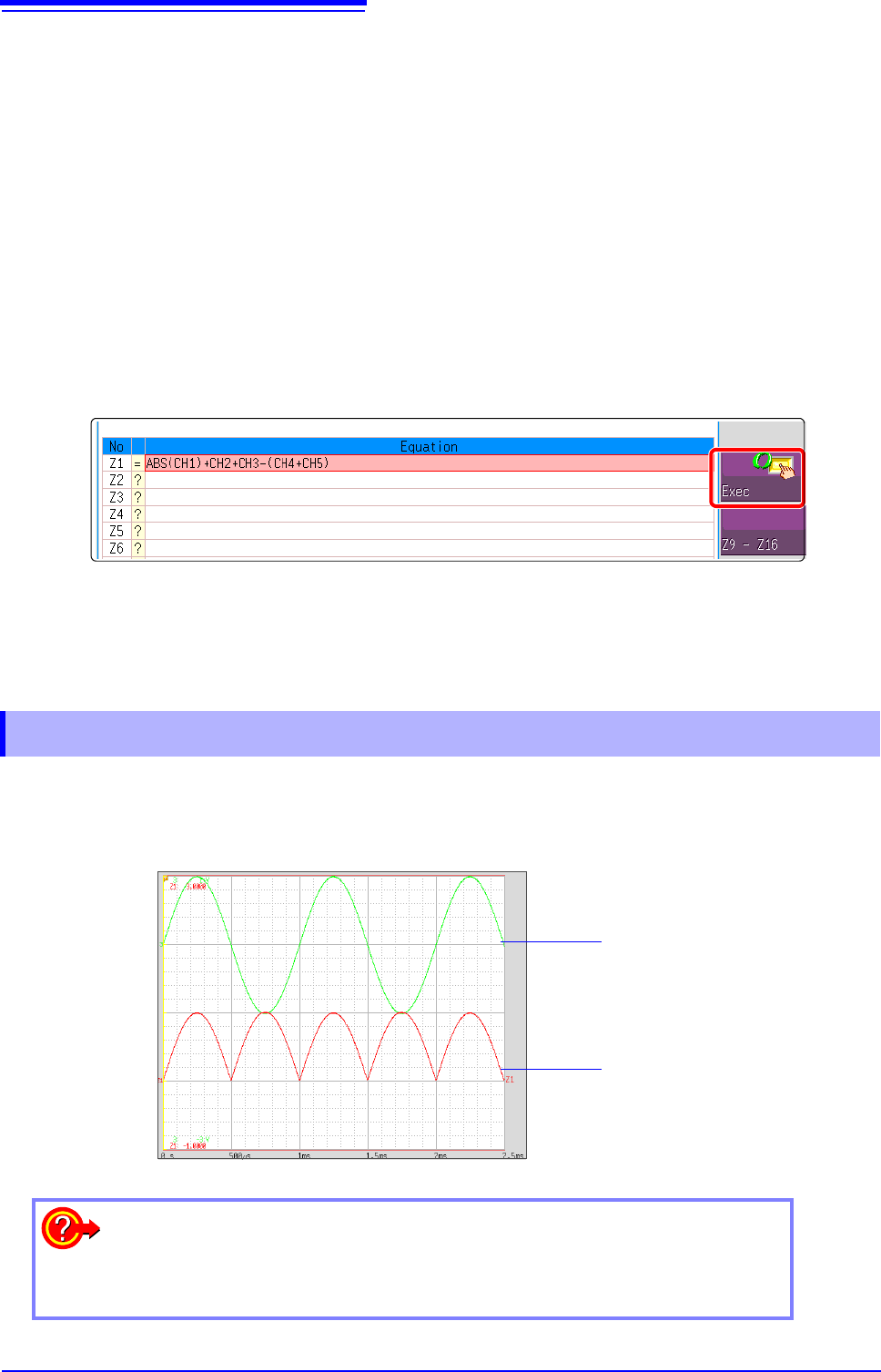
At the [Wave Calc] sheet, select [Exec].
To calculate while measuring
Click [START] to start measurement.
Calculation waveforms are displayed after loading waveforms.
7
10.2.1 Displaying the waveform calculation results
Example: Waveform of the calculated absolute value of the waveform of CH1. Calcu-
lation equation = ABS(CH1)
CH1 Waveform
Absolute Value
Waveform
To copy settings from one calculation to another:
Settings can be copied at the [Wave Calc] sheet.
See: "7.8 Copying settings to other channels (calculation No.) (Copy function)" (p.160)
10.2 Settings for Waveform Calculation
233
9
Chapter 10 Waveform Calculation Functions
10
About calculation equations _____________________________________
Operators
See: "10.3 Waveform Calculation Operators and Results" (p.237)
Entering Calculation Equations
• Each entered calculation equation may contain up to 80 characters.
• Each constant in a calculation equation may contain up to 30 digits.
• For multiplication, use [*]. For division, use [/].
• Entering a long, complex formula such as that shown below will cause "?" to
be displayed. Separate the formula into two shorter formulas.
• When dividing by 0, an overflow value is output.
(For positive values, +9.9999E+29. For negative values, -9.9999E+29.)
• The result of calculation Z
i
can be used in other calculation equations. How-
ever, the Z
n
th equation can only refer to the results of equations up to Z
n-1
.
(Example: Equation Z
4
can include the results of equations Z
1
through Z
3
.)
Using the MOV, SLI, DIF and DIF2 operators in an equation
The number # after a comma within parenthesis (_,#) for each operation is set to
the calculation operator.
When calculation results overflow (OVER)
• The value that indicated by the A/B cursor is not a correct value.
• When [Scale] is set to [Auto], waveforms appear at the top or bottom edge of
the screen. This makes calculation result overflow obvious.
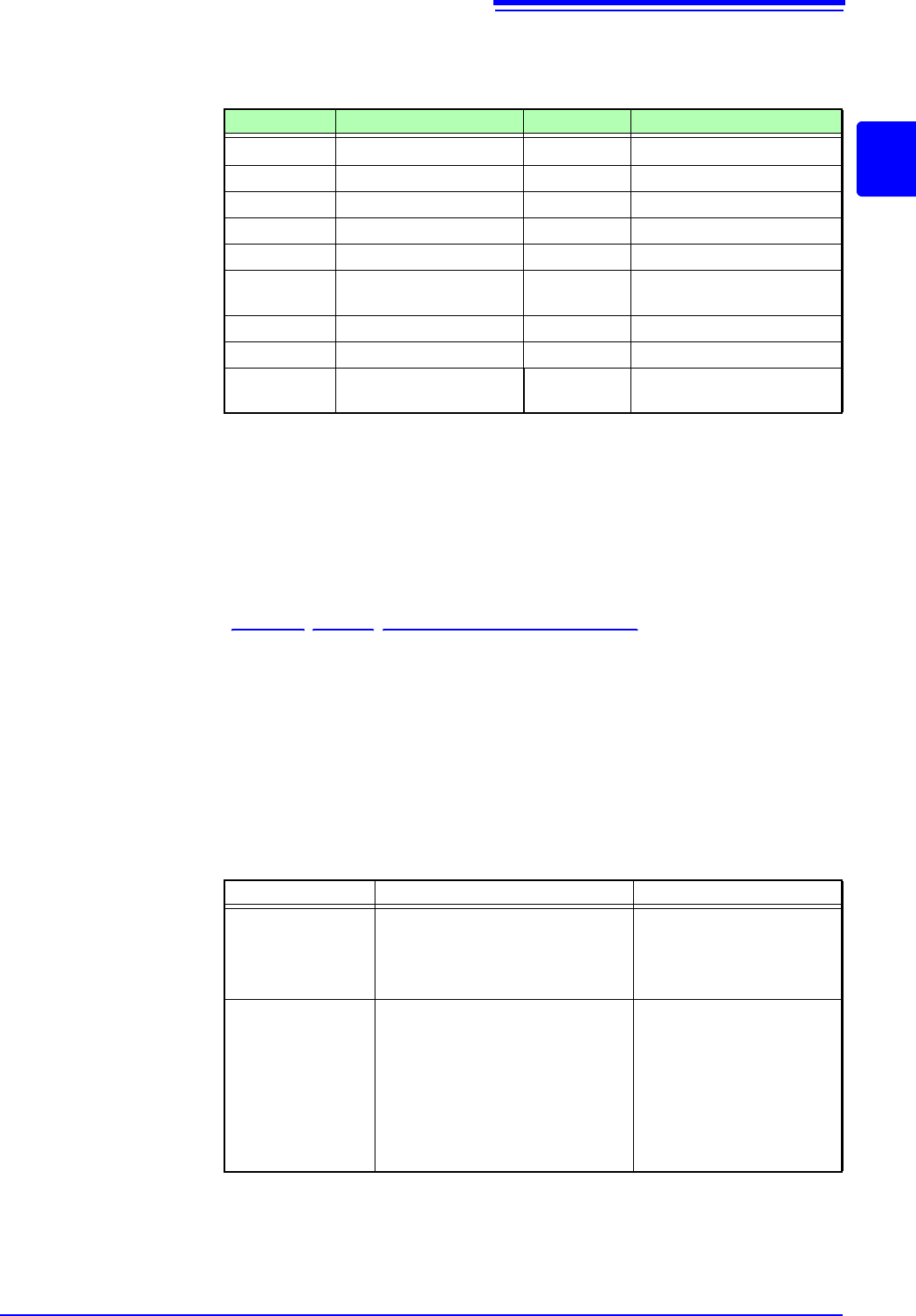
Operator Name Operator Name
ABS Absolute Value DIF2 2
nd
Derivative
EXP Exponent INT2 2
nd
Integral
LOG Common Logarithm SIN Sine
SQR Square Root COS Cosine
MOV Moving Average TAN Tangent
SLI Movement parallel to the
time axis
ASIN Inverse Sine
DIF 1
st
Derivative ACOS Inverse Cosine
INT 1
st
Integral ATAN Inverse Tangent
PLCS Digital Voltmeter Unit PLC de-
lay time shift
ABS(CH1)+CH2*CH3-(CH4+CH5)*ABS(CH4)/DIF(CH1, 1)
12 3
Operator Setting Choice Setting Examples
MOV
(Moving Average)
SLI
(Parallel Movement)
Set the number of points to move.
Setting Range
MOV (Moving Average): 1 to 5000
SLI: -5000 to 5000
Calculate the 10-point mov-
ing average of CH1:
MOV(CH1,10)
DIF
(Derivative)
DIF2
(2nd Derivative)
Specify the sampling interval for dif-
ferentiation.
"1" is normally acceptable, but this
should be set larger to capture fluc-
tuation values of slowly changing
waveforms.
DIF and DIF2 Setting Range: 1 to
5000
Differentiate CH2 using a 20-
point sampling interval:
DIF(CH2,20)