MR8740、MR8741_user_manual_eng_20191016H.pdf - 第20页
Operating Precau tions 8 Follow these precautions to ensure safe operation a nd to obtain the full benefits of the vario us functions. Install ing To prevent overheating, be sure to leav e the specified clearances around…
Safety Information
7
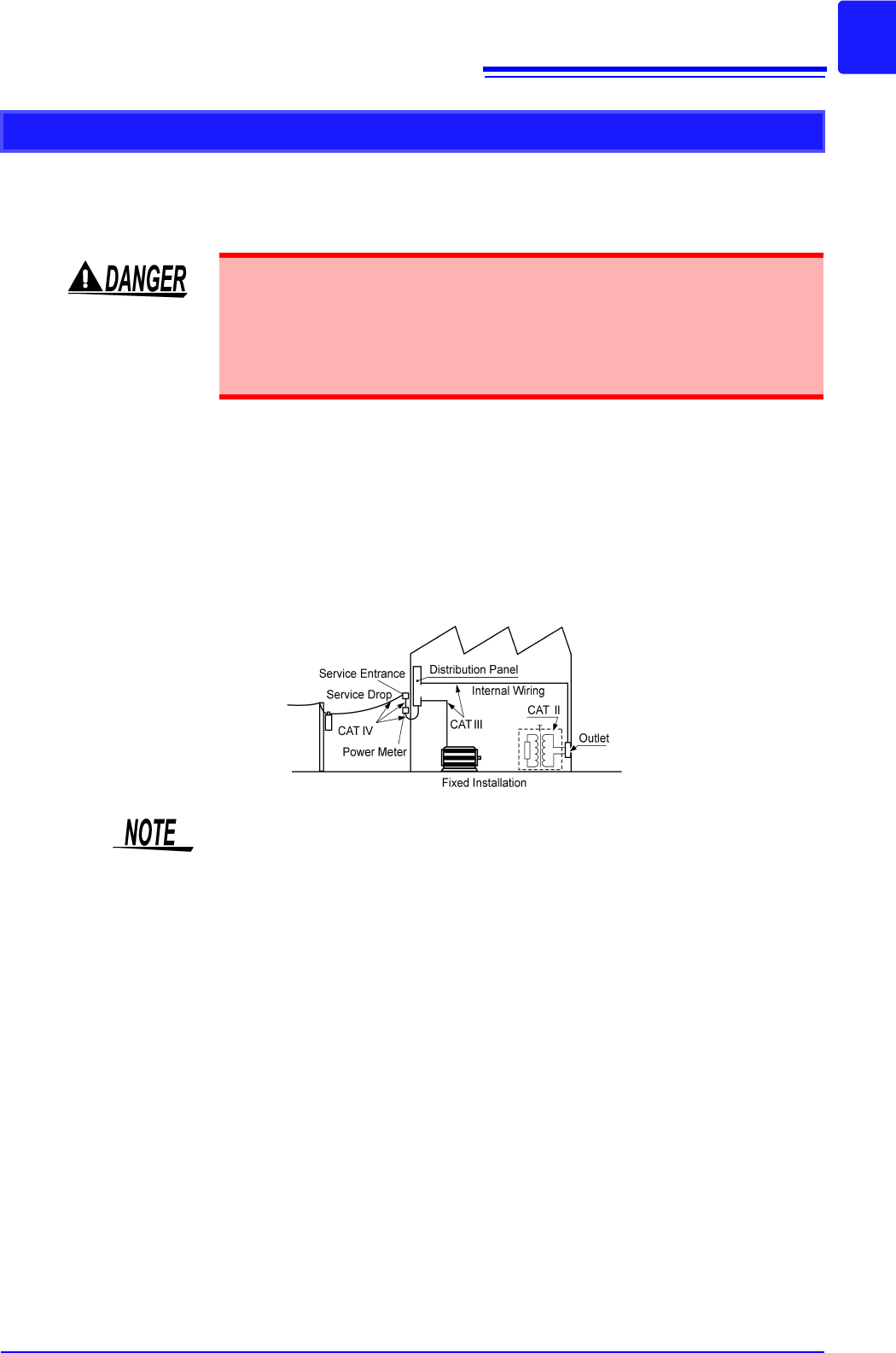
To ensure safe operation of measuring instruments, IEC 61010 establishes
safety standards for various electrical environments, categorized as CAT II to
CAT IV, called measurement categories.
CAT II When directly measuring the electrical outlet receptacles of the primary
electrical circuits in equipment connected to an AC electrical outlet by a
power cord (portable tools, household appliances, etc.)
CAT III When measuring the primary electrical circuits of heavy equipment
(fixed installations) connected directly to the distribution panel, and feed-
ers from the distribution panel to outlets
CAT IV When measuring the circuit from the service drop to the service
entrance, and to the power meter and primary overcurrent protection
device (distribution panel)
Measurement categories
• Using a measuring instrument in an environment designated with a higher-
numbered category than that for which the instrument is rated could result in
severe accidents, and must be carefully avoided.
• Using a measuring instrument that has no category rating in an environment
designated with the CAT II to CAT IV category could result in severe accidents,
and must be carefully avoided.
The applicable measurement category is determined by the module being used.
Refer to "17.6 Specifications of Modules" (p.352).
Operating Precautions
8
Follow these precautions to ensure safe operation and to obtain the full benefits of the various functions.
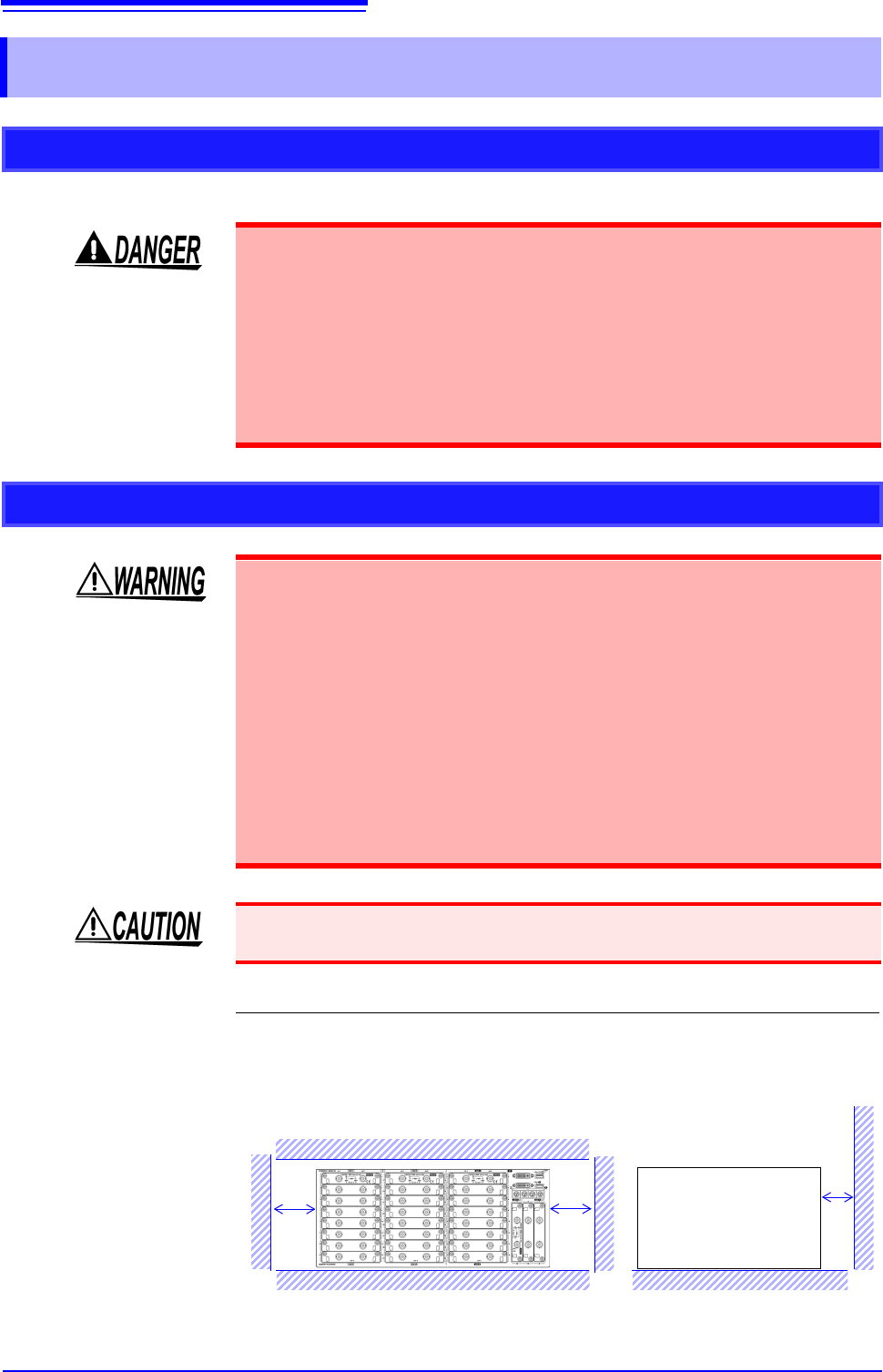
Installing To prevent overheating, be sure to leave the specified clearances around the unit.
• The instrument should be operated only with the bottom side downwards.
• Vents must not be obstructed.
• Do not install the instrument at a slanted angle.
When mounting the instrument in a system rack, make sure the operating tem-
perature range of the instrument will not be exceeded.
Operating Precautions
Before Use
If connection cables or instrument are damaged, there is a risk of electric shock.
Before using the instrument, perform the following inspection.
• Before using the instrument, check that the insulation of the connection cables
is not damaged and that no metal parts are exposed. Using the instrument
under such conditions could result in electric shock. Replace the connection
cable with those specified by our company.
• Verify that it operates normally to ensure that no damage occurred during stor-
age or shipping. If you find any damage, contact your authorized Hioki distribu-
tor or reseller.
Installing the instrument and modules
Installing the instrument and modules in inappropriate locations may cause a
malfunction of instrument or may give rise to an accident. Avoid the following
locations:
• Exposed to direct sunlight or high temperatures
• Exposed to corrosive or combustible gases
• Exposed to a strong electromagnetic field or electrostatic charge
• Near induction heating systems (such as high-frequency induction heating sys-
tems and IH cooking equipment)
• Susceptible to vibration
• Exposed to water, oil, chemicals, or solvents
• Exposed to high humidity or condensation
• Exposed to high quantities of dust particles
Do not place the instrument on an unstable table or an inclined place. Knockin-
gover or dropping the instrument can damage the instrument.
Rear
At least 5 cm
At least 5 cm on the left and right sides
Operating Precautions
9
Handling the Instrument and Modules
• Do not exceed the range of the specifications and the rated value of the cable
or the module. Otherwise, the instrument may be damaged or may produce
heat, resulting in personal injury.
The maximum rated voltage to earth does not change when an attenuator or
similar is used at the input. Take the connection method into consideration and
make sure that the rating is not exceeded.
• To avoid electric shock, do not remove the instrument’s cover and the module
case.
The internal components of the instrument carry high voltages and may
become very hot during operation.
• It is recommended to measure the secondary side of a distribution panel with
the U8974 High Voltage Unit. Do not connect the connection cords on the pri-
mary side of the distribution panel because an unrestricted current flow can
damage the connection cords and facilities if a short-circuit occurs.
• Each channel of Model U8979 Charge Unit has the BNC terminal and minia-
ture connector terminal with the common ground. Do not connect cords with
each of the terminals simultaneously to avoid a short-circuit.
• Setting the measurement mode to [PreAmp] allows Model U8979 Charge Unit
to constantly provide power (3.5 mA, 22 V) to sensors. Set any measurement
mode other than [PreAmp] or tum off the instrument before connecting a sen-
sor or probe with a BNC terminal to avoid an electric shock or damage to the
measurement target.
• To avoid electric shocks, confirm that the instrument is turned off and the con-
nection cables are disconnected before removing or replacing a module.
• To avoid electric shocks, do not operate the instrument with a module
removed.
To use the instrument after removing a module, install a blank panel over the
opening of the removed module.
• To prevent instrument damage or electric shocks, use only the screws for
securing the module in place that shipped with the instrument.
If you lose any screw or find that any screws are damaged, please contact
your Hioki distributor for a replacement.
• Model U8979 Charge Unit has miniature connectors with the maximum input
charge of ±500 pC (for six higher-sensitivity range) or ±50,000 pC (for six
lower-sensitivity range). Inputting a charge that exceeds these value causes
damage to the instrument.
• Use an acceleration sensor with a built-in pre-amplifier that conforms to the
specification of Model U8979 (3.5 mA, 22 V). Using a inapplicable sensor may
cause damaging itself.
• To avoid damage to the instrument, protect it from physical shock when trans-
porting and handling. Be especially careful to avoid physical shock from drop-
ping.
• The mounting screws must be firmly tightened or the module may not perform
as specified or may fail.
• To avoid damaging modules, do not touch the module connectors on this
instrument.