MR8740、MR8741_user_manual_eng_20191016H.pdf - 第331页
15.1 LAN Settings and Connection (Before Using FTP/Internet Browser/Command Communications) 319 12 Chapter 15 Connection to a Computer 14 15 You can monitor and contr ol the instrument from a PC by connecting the instru …
15.1 LAN Settings and Connection (Before Using FTP/Internet Browser/Command Communications)
318
Connect the instrument to a PC with a LAN cable as follows.
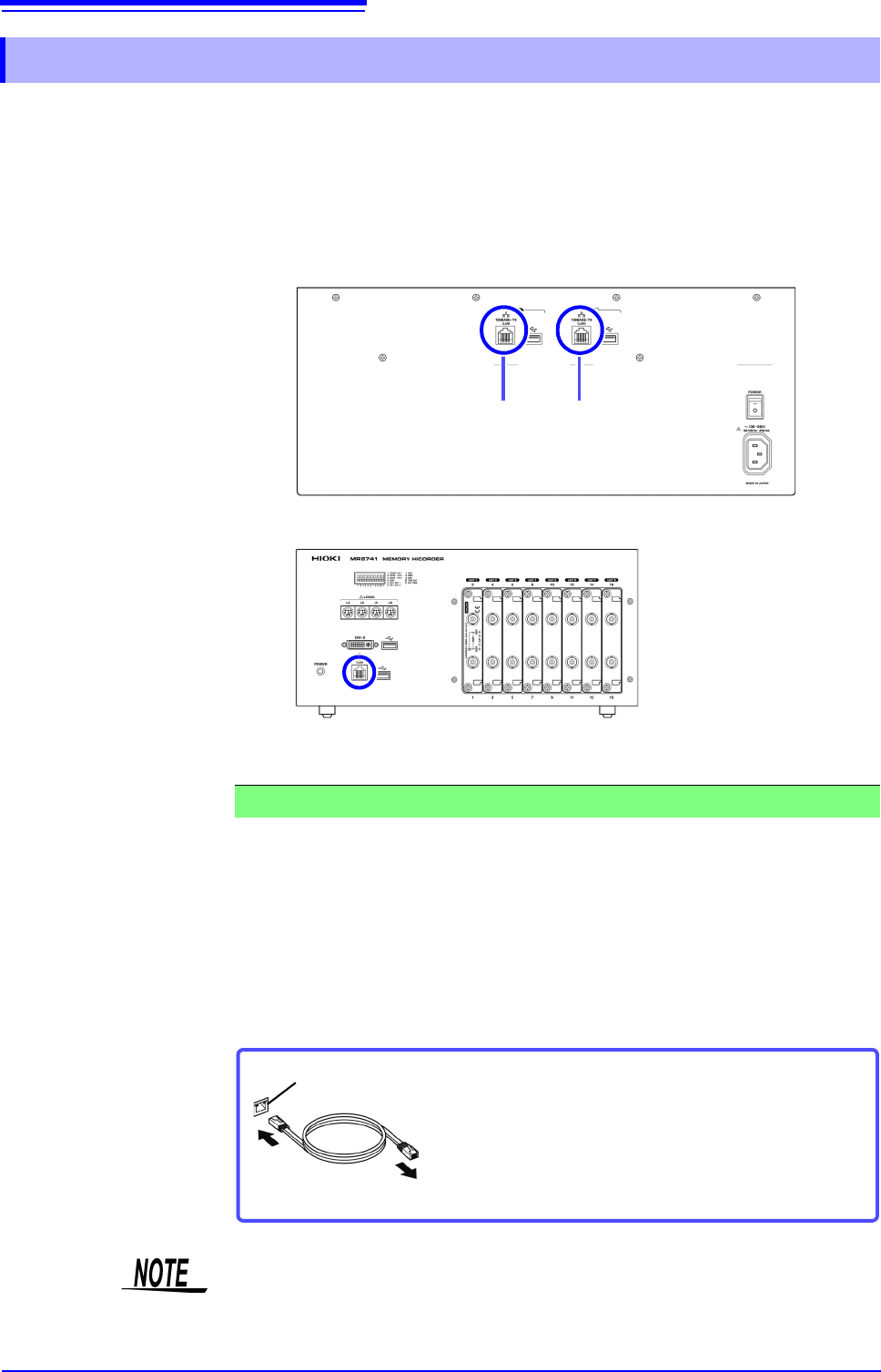
1. Plug the LAN cable (100BASE-TX compliant) into the 100BASE-TX connector
on the rear of the instrument in the case of the MR8740 and on the front of the
instrument in the case of the MR8741.
2. Connect the above LAN cable to the PC. There are two ways to do this.
You can monitor and control the instrument from a PC by connecting the instru-
ment to a hub with LAN cable (100BASE-TX cable).
15.1.2 Connecting Instrument and PC With LAN Cable
MR8740: Rear
MR8741: Front
LAN connec-
tor of block II
LAN connec-
tor of block I
1. Connecting the Instrument to a Network (Connecting the Instrument to a Hub)
Connection cable: Use one of the following.
• 100BASE-TX straight-through cable (maximum length 100 m, commercially
available)
(10BASE-T cable may also be used for 10BASE communications)
• 9642 LAN Cable (option)
100BASE-TX connector
Connect to hub
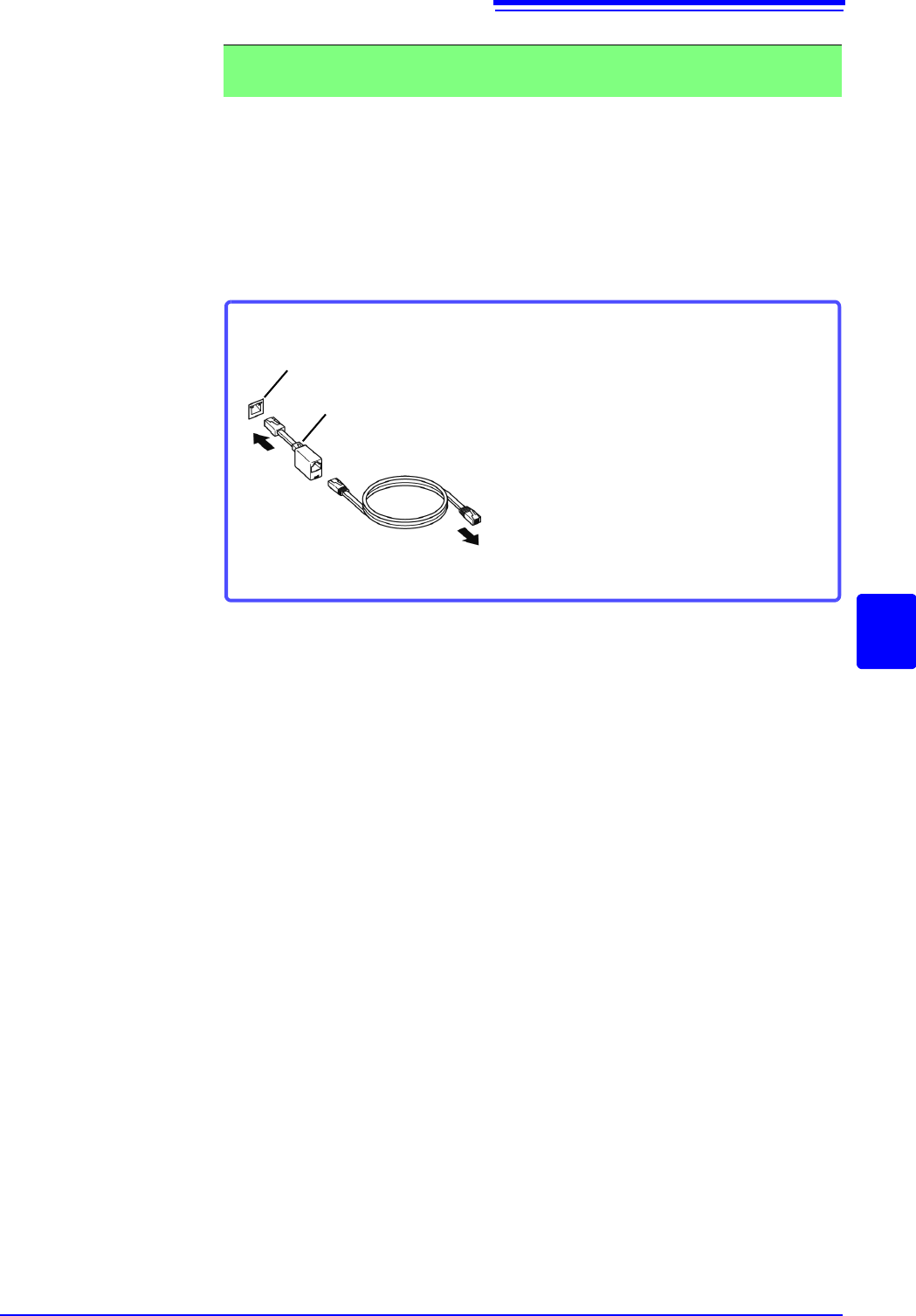
Connect the crossover adapter to the
100BASE-TX connector on the instrument.
In the case of MR8740, control is required for each block.
15.1 LAN Settings and Connection (Before Using FTP/Internet Browser/Command Communications)
319
12
Chapter 15 Connection to a Computer
14
15
You can monitor and control the instrument from a PC by connecting the instru-
ment to the PC with LAN cable (100BASE-TX cable)
This completes the connection procedure.
Files on the instrument can now be accessed from the PC.
See: "15.2 Performing Remote Operations on the Instrument (Use an Internet Browser)"
(p.320)
"15.3 Accessing the Files on the Instrument From a Computer (Using FTP)" (p.327)
"15.5 Controlling the Instrument with Command Communications (LAN)" (p.332)
2. Making 1:1 Connections Between the Instrument and a PC (Connecting the
Instrument to a PC)
Connection cable: Use one of the following.
• 100BASE-TX crossover cable (maximum length 100 m)
• 100BASE-TX straight-through cable with crossover adapter (maximum length
100 m)
• 9642 LAN Cable (option, supplied with crossover adapter)
Connect to PC
100BASE-TX connector
Crossover adapter
Connecting with the 9642 LAN Cable and crossover adapter (supplied)
1 Connect the 9642 LAN Cable to the
supplied crossover adapter.
2 Connect the crossover adapter to the
100BASE-TX connector on the instru-
ment.
3 Connect the 9642 LAN Cable to the
100BASE-TX connector on the PC.
1
3
2
15.2 Performing Remote Operations on the Instrument (Use an Internet Browser)
320
You can perform remote operations on the instrument from a PC by using an Internet browser.
To use an Internet browser, the instrument must be properly set up and connected
via LAN cable to the PC. (p.314), (p.318)
Microsoft
Internet Explorer
8 or later is recommended as the browser.
Set the security level to "Medium". If [REMOTE CONTROL] and [MEMORY
DATA GET] do not work, install JRE from the application disc. And invalidate the
pop-up blok.
1. When you insert the supplied application disc (CD-R) into the CD-ROM drive of
the PC, the top page will automatically be displayed. If the page does not
appear, open the file "index.htm" with your web browser.
2. Select the display language to use. Click on the [English] icon.
3. Click on the [JRE installation] icon.
4. Click on the [Install] icon. Then follow the prompts that appear to complete the
installation.
15.2 Performing Remote Operations on the
Instrument (Use an Internet Browser)
Attempting to control the instrument simultaneously from multiple computers may
result in unintended operation. Use only one computer to perform remote operations.
Installing JRE
15.2.1 Making HTTP Settings on the Instrument
1
2
2
Procedure
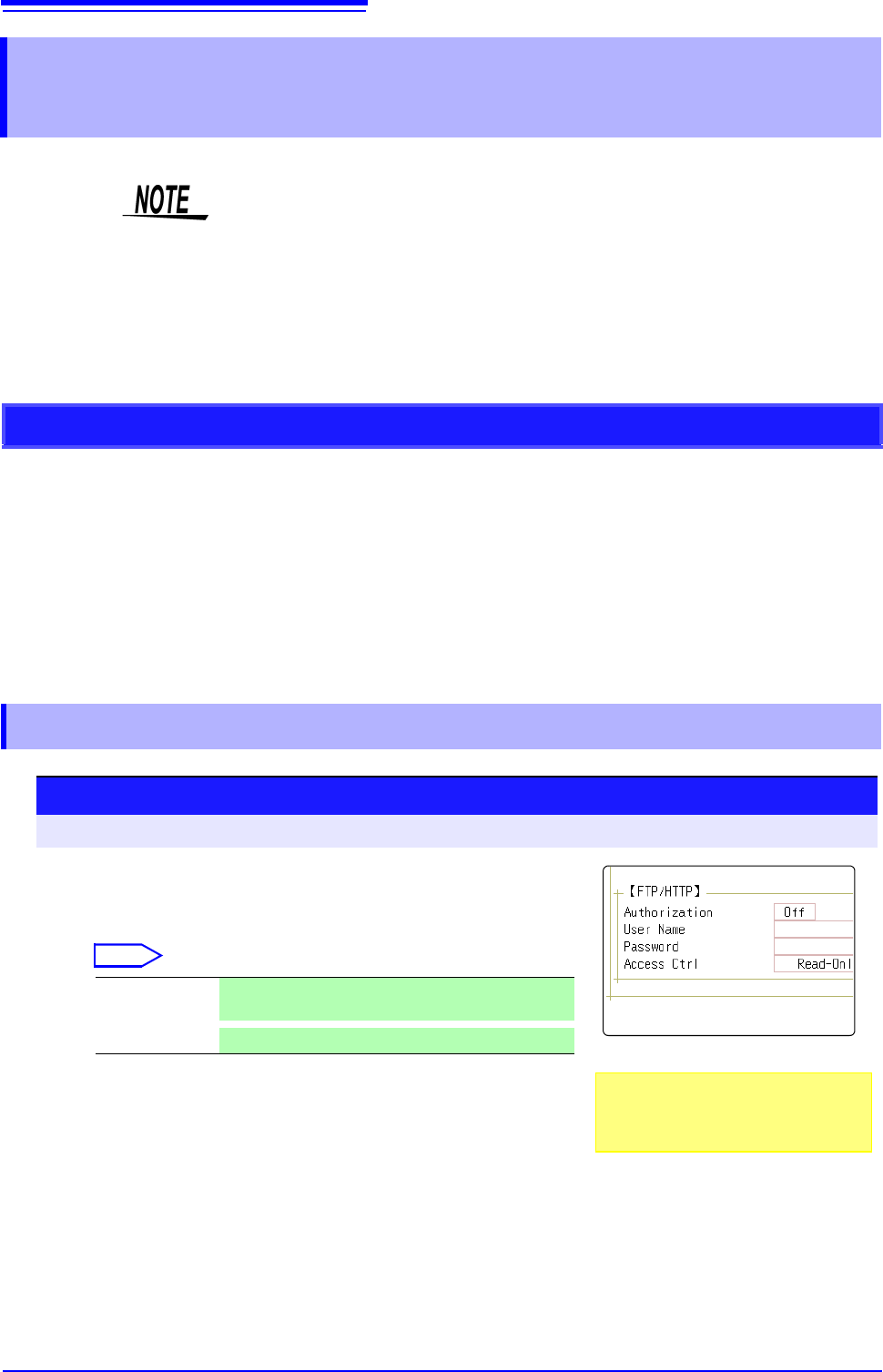
To open the screen: Right-click and select [SYSTEM] [Interface] sheet
1
Make authorization settings.
Move the flashing cursor to the [Authorization] item.
Select
2
(When [On] is selected)
Set the user name and password for authentication.
Move the flashing cursor to the [User Name] and [Pass-
word] items and enter suitable information.
See: "7.1.3 Alphanumeric Input" (p.141)
"Authorization User Name and Password" (p.315)
3
Apply the setting.
Move the flashing cursor to the [Reset] item.
Select [Reflect Set].
The indication "LAN was reconnected" appears at the bottom of the screen.
Off Use the Web server without authorization. (default
setting)
On
Use the Web server with authorization.
The user name and password for au-
thentication are used both for access via
an Internet browser and FTP.