MR8740、MR8741_user_manual_eng_20191016H.pdf - 第187页
7.9 Setting Details of Modules 175 6 Chapter 7 Utility Functions 7 Sensitivity You can enter sensor sensitivity to tw o decimal places. For a charge-output acceleration sensor or n on-TEDS-complia nt sensor, ente r its s…
7.9 Setting Details of Modules
174
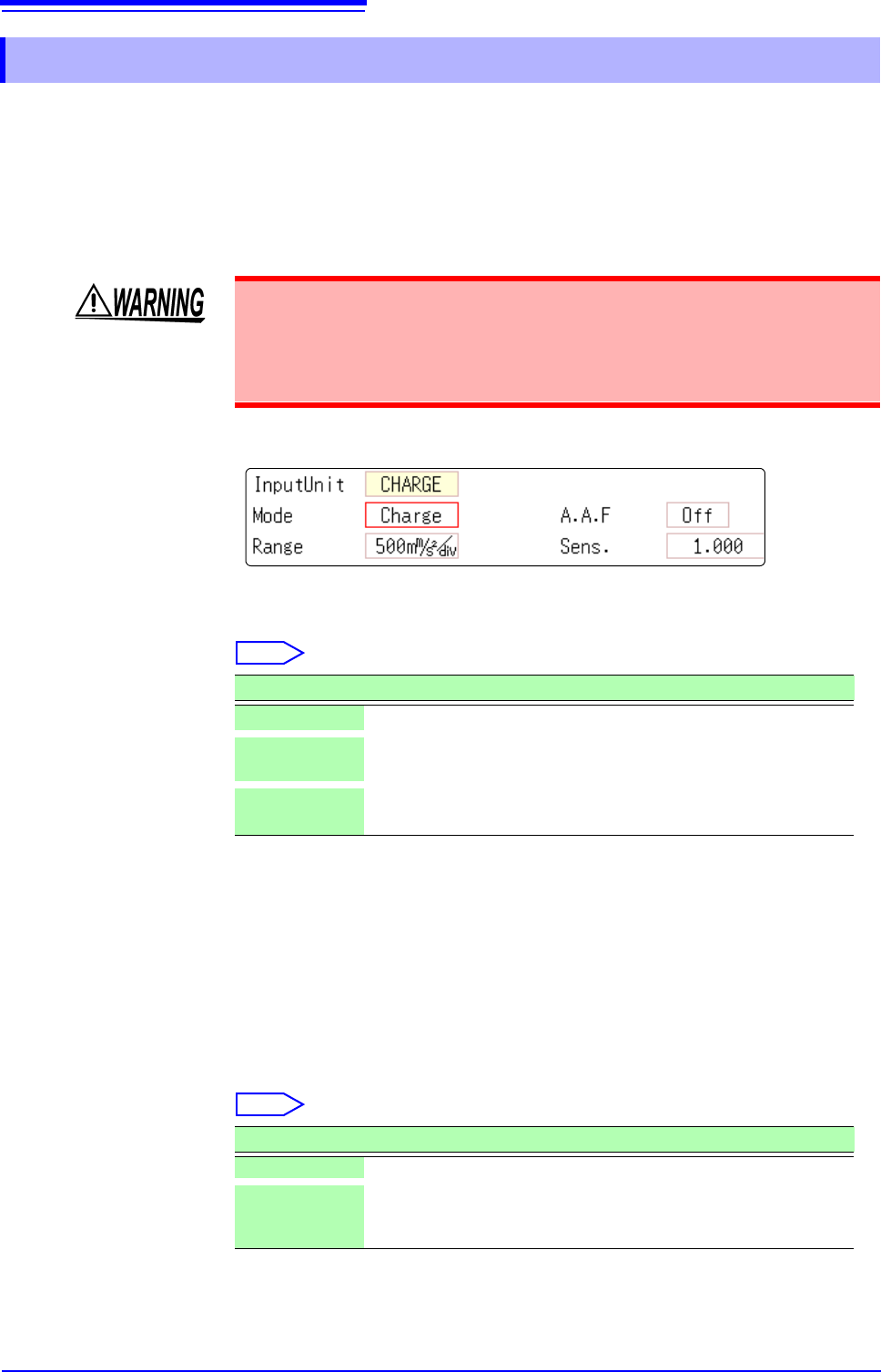
This setting allows you to choose between voltage measurement and accelera-
tion measurement (chargeoutput or built-in pre-amplifier) for a channel.
A channel can measure either one of them.
[Voltage] mode and [PreAmp] mode use BNC connectors, whereas [Charge]
mode uses miniature connectors.
Model U8979 can automatically recognize TEDS-compliant
*
sensors.
*: Transducer electronic data sheet
See: "Opening the [Each Ch] sheet, Making a Channel Selection" (p.161)
Mode Switches the measurement mode.
Select
(When setting mode to [PreAmp])
Move the cursor to the [Sens.] box and execute [TEDS Load].
Acquires sensitivity of a connected sensor. However, the instrument can acquire
sensitivity of TEDS-compliant acceleration sensors with a built-in pre-amplifier
only.
When sensor sensitivity has been acquired, it is automatically set.
A.A.F The anti-aliasing filter can prevent aliasing distortion that may be produced dur-
ing FFT calculation. The cutoff frequency automatically changes according to the
sampling rates or frequency range (for the FFT function) settings.
Select
7.9.10 Setting Model U8979 Charge Unit
Setting the measurement mode to [PreAmp] allows Model U8979 Charge Unit
to constantly provide power (3.5 mA, 22 V) to sensors. Set any measurement
mode other than [PreAmp] or tum off the instrument before connecting a sensor
or probe with a BNC terminal to avoid an electric shock or damage to the mea-
surement target.
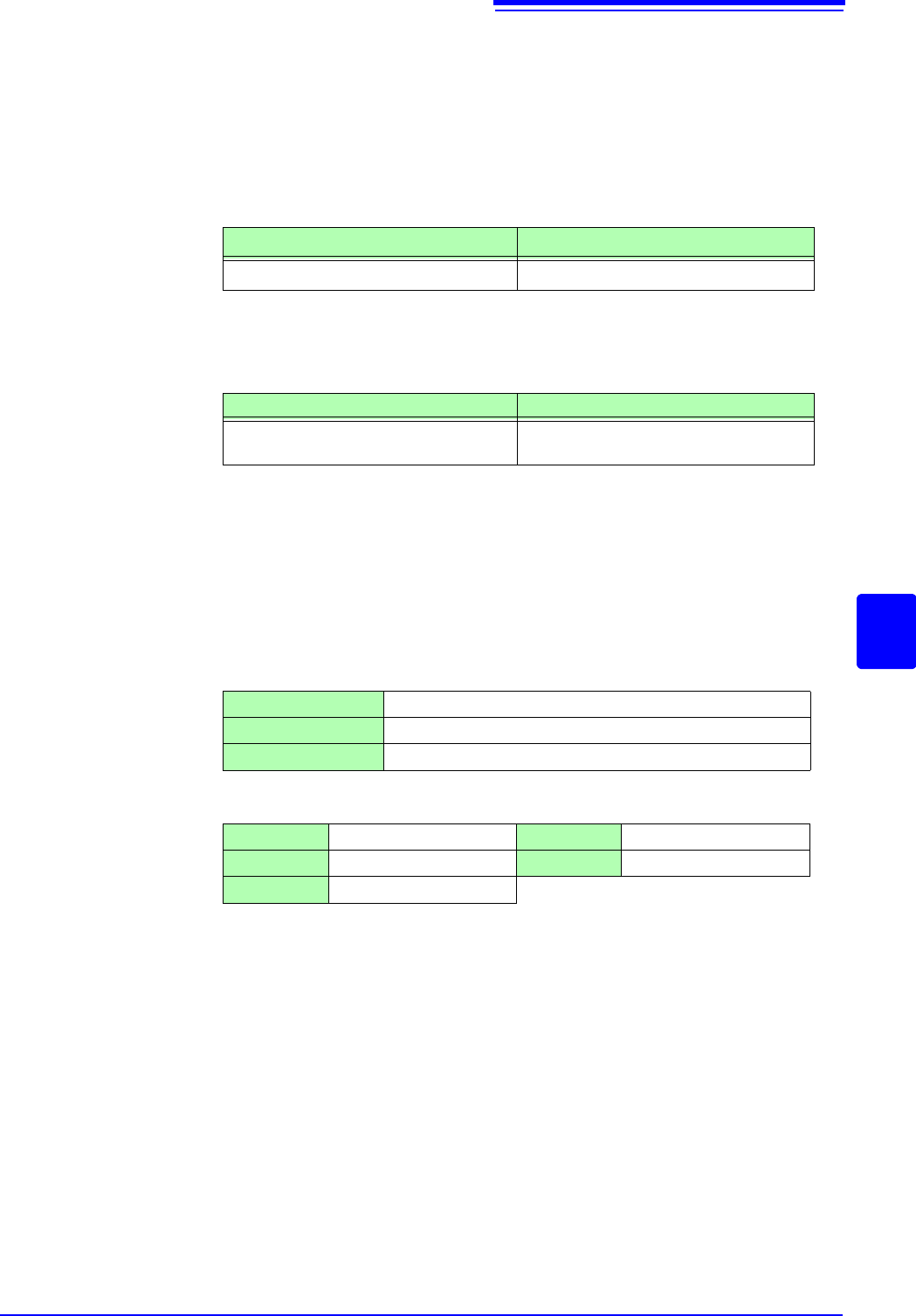
Mode Measurement target Measurement sensitivity
Voltage
Voltage —
Charge
(Default setting)
Charge-output acceleration
sensor
0.1 pC/(m/s
2
) to 10 pC/(m/s
2
)
PreAmp
Acceleration sensor with a
built-in preamplifier
0.1 mV/(m/s
2
) to 10 mV/(m/s
2
)
Selections Description
OFF Disables the anti-aliasing filter. (Default setting)
ON Enables the anti-aliasing filter.
(Disabled when the external sampling is used, or the sampling rate
is set at 100 kS/s or faster)
7.9 Setting Details of Modules
175
6
Chapter 7 Utility Functions
7
Sensitivity You can enter sensor sensitivity to two decimal places. For a charge-output
acceleration sensor or non-TEDS-compliant sensor, enter its sensitivity marked
on the sensor, which represents sensitivity per meter per second squared.
Setting example for sensor sensitivity
Example 1 For a sensor with its sensor sensitivity per meter per second
squared marked
Example 2 For a sensor with its sensor sensitivity per gee (G) marked.
For a sensor with its sensitivity marked, enter a quotient of the marked sensitivity
divided by 9.8 m/s
2
.
To convert a unit from meter per second squared into gee (G)
The instrument measure charge quantities per meter per second squared. You
can convert such charge quantities into those per gee (G) using the scaling func-
tion.
See: "7.4 Converting Input Values (Scaling Function)" (p.148)
Configure the scaling setting as follows;
Example 1 Specifying a conversion ratio
Example 2 Specifying two points
Sensor sensitivity (setting value)
1.08 pC/(m/s
2
)1.08
Sensor sensitivity (setting value)
For sensor sensitivity of 64 pC/G
64.0 / 9.8 = 6.53061... pC/(m/s
2
)
6.531 (to two decimal places)
Ratio 0.1020E+00 (= 1/9.8)
Offset 0.0000E+00
Units G
Input1 9.8000E+00 Scale1 1.0000E+00
Input2 0.0000E+00 Scale2 0.0000E+00
Units G
7.9 Setting Details of Modules
176
When using an out-of-setting-range current sensor
You can use an out-of-setting-range current sensor using the scaling function.
See: "4.2.2 Automatically Saving Waveforms" (p.88)
Sensitivity Multiply the sensor sensitivity of a sensor to be used by a certain value to allow a
product to fall within the setting range (0.1 to 10), and enter the product.
Scaling Configure the scaling setting so that a scaling ratio is the same value as the
number you multiplied the sensor sensitivity by.
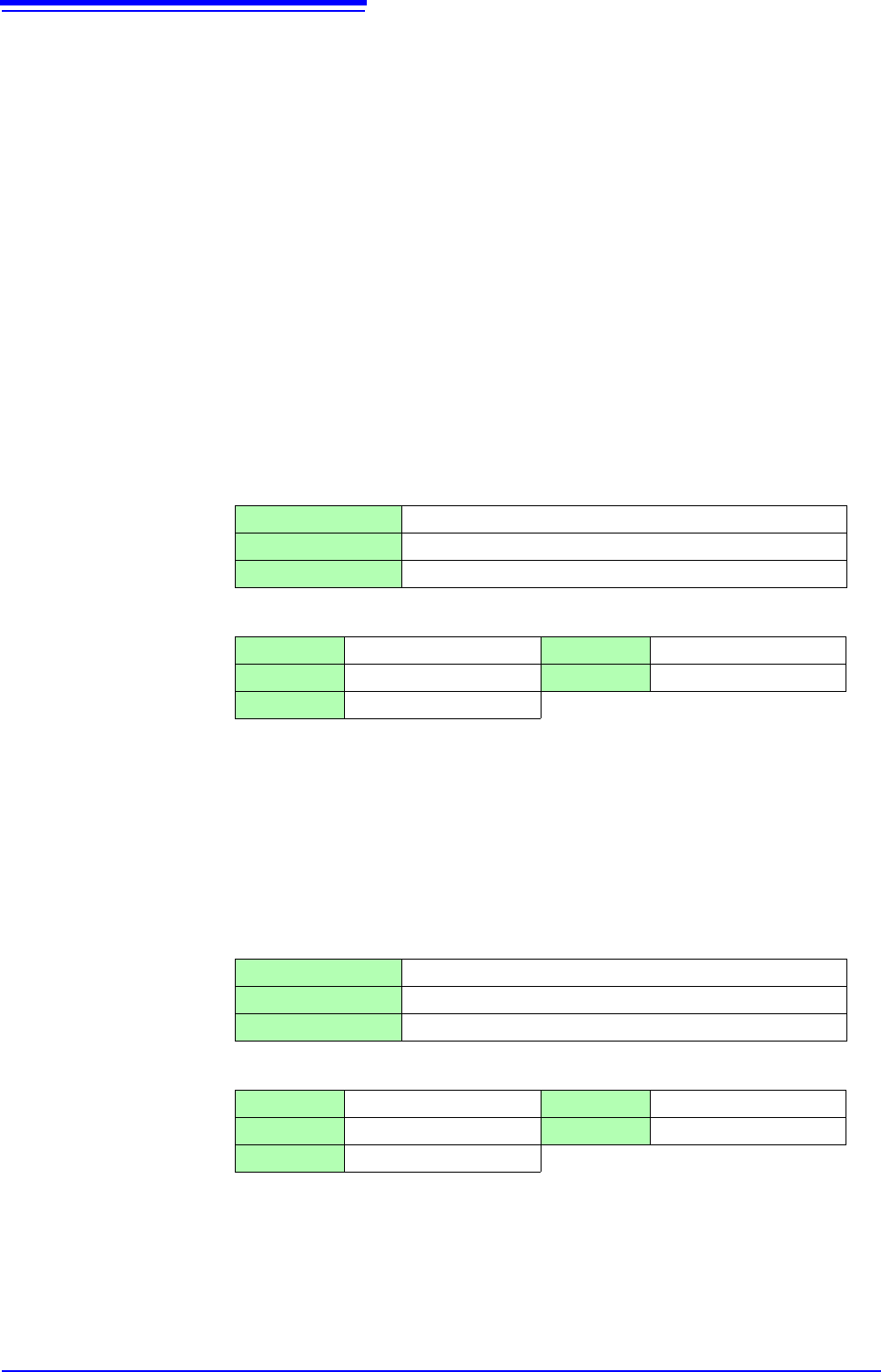
Example 1 For sensor sensitivity of 23.4 pC/(m/s
2
)
Specify 10 pC/(m/s
2
), which results from multiplying the sensor sensitivity by
1/2.34, as the sensor sensitivity.
To display measured values after multiplying them by 1/2.34, configure the scal-
ing setting as follows:
To configure the scaling setting using the conversion ratio method
To configure the scaling setting using the 2-point method
Example 2 For sensor sensitivity of 0.05 pC/(m/s
2
)
Specify 0.1 pC/(m/s
2
), which results from multiplying the sensor sensitivity by
two, as the sensor sensitivity.
To display measured values after multiplying them by two, configure the scaling
setting as follows:
To configure the scaling setting using the conversion ratio method
To configure the scaling setting using the 2-point method
Ratio 0.4274E+00 (= 10/23.4)
Offset 0.0000E+00
Units m/s
2
Input1 2.3400E+00 Scale1 1.0000E+00
Input2 0.0000E+00 Scale2 0.0000E+00
Units m/s
2
Ratio 2.0000E+00 (= 0.1/0.05)
Offset 0.0000E+00
Units m/s
2
Input1 0.0500E+00 Scale1 1.0000E+00
Input2 0.0000E+00 Scale2 0.0000E+00
Units m/s
2