MR8740、MR8741_user_manual_eng_20191016H.pdf - 第207页
8.3 Triggering by Analog Signals 195 7 Chapter 8 T rigger Settings 8 5. Glitch T rigger( only ) ___________________ ________________ Triggering o ccurs when the input signal crosses the trigger level (threshold volt- age…
8.3 Triggering by Analog Signals
194
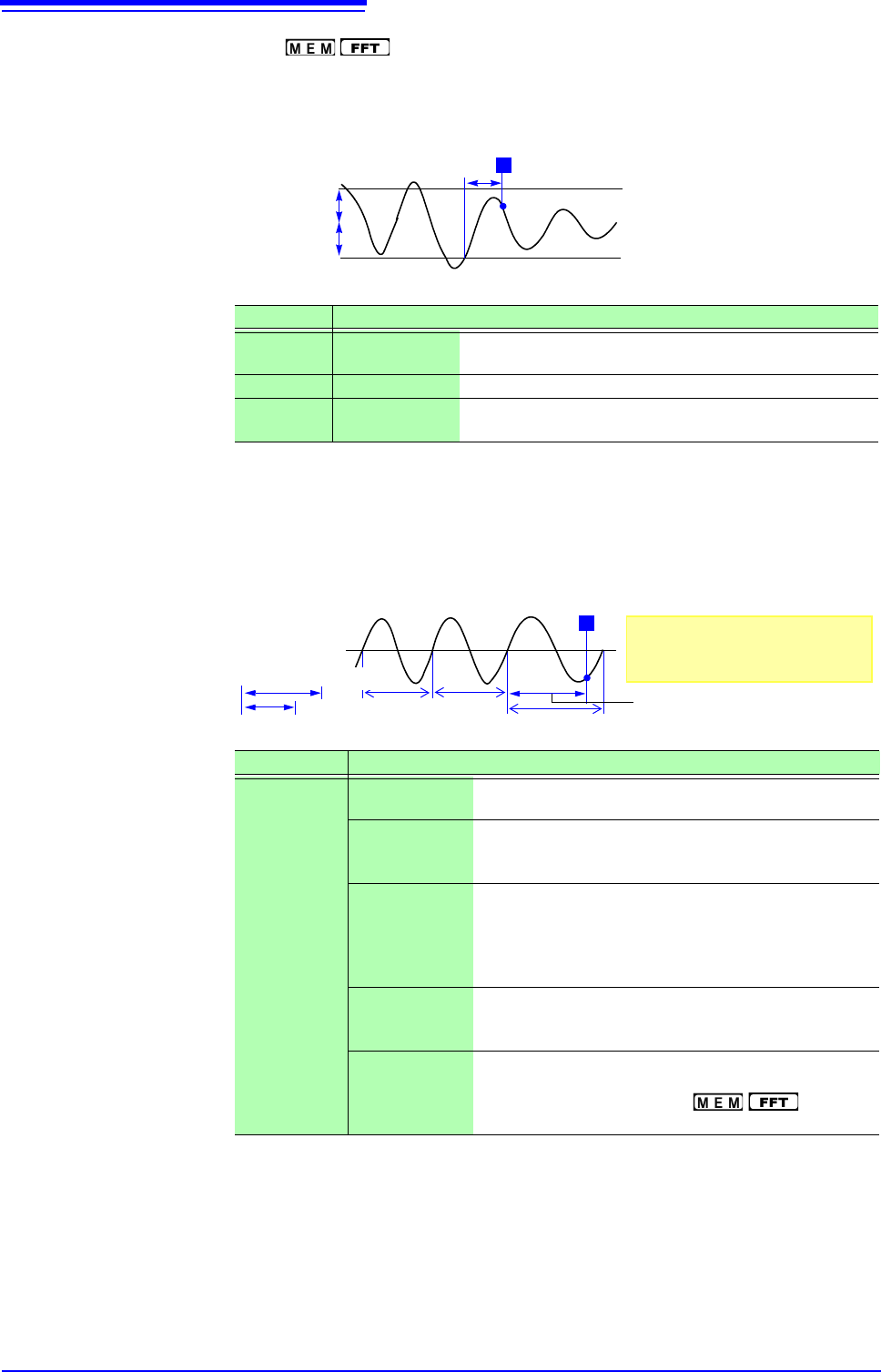
3. Voltage Sag Trigger ( only) _____________________________
Triggering occurs when the voltage peak drops below a preset level for more
than half a cycle. The allowable time axis range is 20 s - 50 ms/div.
4. In-Period Trigger, Out-of-Period Trigger__________________________
The rising edge and falling edge cycle of the reference voltage is measured, and
triggering occurs when the cycle enters the preset range (In) or leaves the preset
range (Out).
See: "Description" (p.196)
*1: Changes in sync with the time axis range.
Type Parameters
[VDrop]
[L] (Level) Sets the level (voltage value) for the trigger. (The setting
can be made in 1/50 increments.)
[f=] (Frequency) Select 50 or 60 Hz.
RMS:
(actual value)
It is an aim of the actual value. Changes in sync with the
level setting.
T
1/2 Period
Trigger Level
Type Parameters
[Per.I]
or
[Per.O]
[L] (Level) Sets the level (voltage value) for the trigger. (The setting
can be made in 1/50 increments.)
[S] (Slope) Determines whether triggering occurs when the signal
crosses the threshold (trigger level) on the upslope (ris-
ing edge) or on the downslope (falling edge). ()
[P]
(Period lower
limit)
*1
Available settings are 0 and more than 5 times the sam-
pling frequency. Settings higher than the upper limit val-
ue are not accepted. (When the setting is 0, the lower
limit is disregarded, and triggering occurs only on the
upper limit.)
[]
(Period upper
limit)
*1
The setting range extends to 20,000 times the sampling
frequency. Lower settings than the lower limit value are
not accepted.
[F] (Filter) Triggering occurs when the trigger criteria are met with-
in the specified filter width. This is useful to prevent spu-
rious triggering due to noise. ( : Off, 0.1 -
10 div)
Within Period
Range
Out of Period Range
T
Reference
Voltage Level
Period Upper Limit
Period Upper Threshold
Period Lower Limit
About the Trigger Point
The trigger point occurs one sam-
ple after the criterion is met.
8.3 Triggering by Analog Signals
195
7
Chapter 8 Trigger Settings
8
5. Glitch Trigger( only) ___________________________________
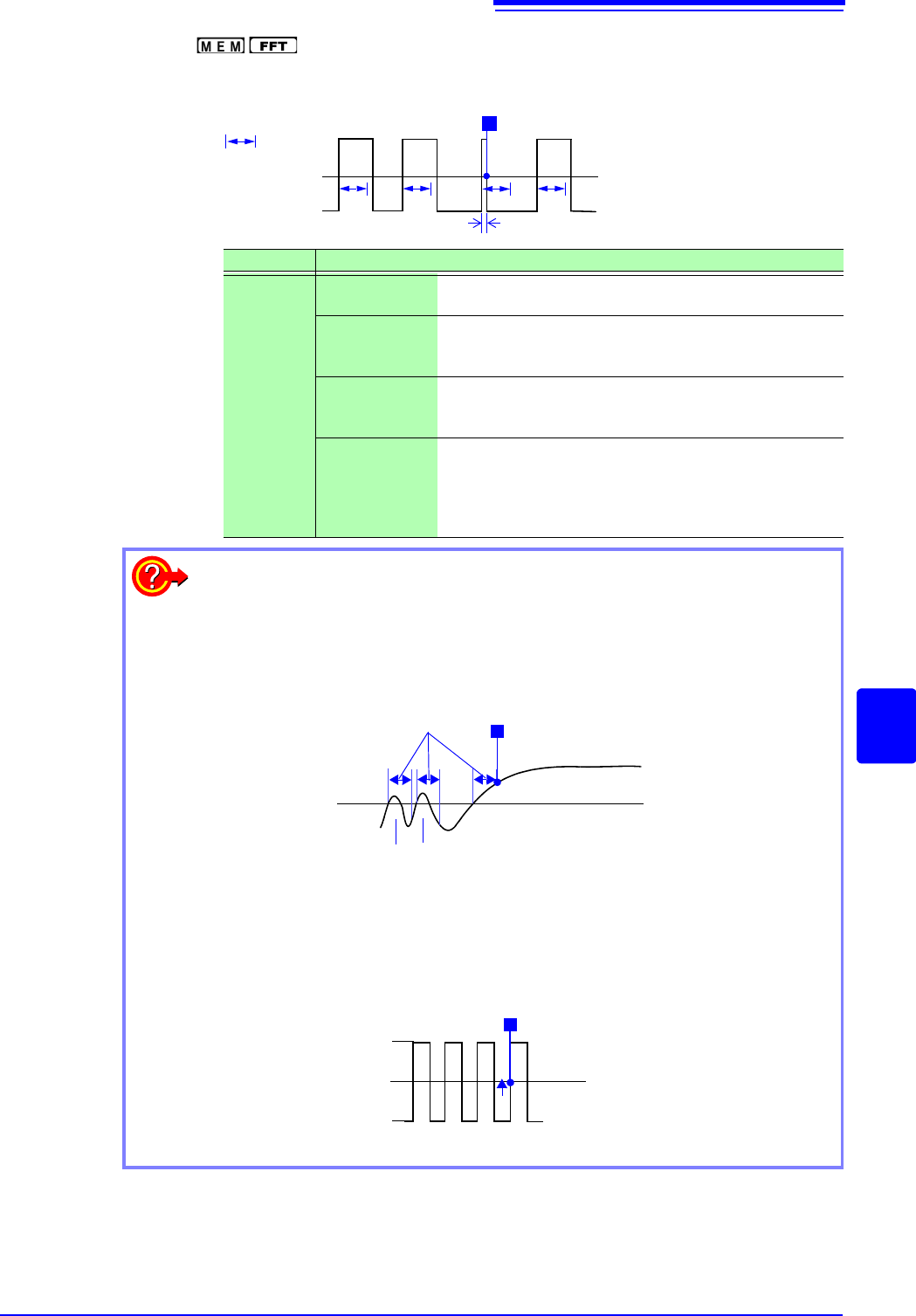
Triggering occurs when the input signal crosses the trigger level (threshold volt-
age) if its pulse width is shorter than the specified width.
Suppressing Noise Effect
Noise near the trigger level can erroneously increment the event count. Set the trig-
ger filter to avoid such effects.
Type Parameters
[Grit.]
[L] (Level) Sets the level (voltage value) for the trigger. (The setting
can be made in 1/50 increments.)
[S] (Slope) Determines whether triggering occurs when the signal
crosses the threshold (trigger level) on the upslope (rising
edge) or on the downslope (falling edge). ()
[Event]
The number of signal rising edge (or falling edge) events
is counted, and triggering occurs when the Event number
set here is exceeded. (1 to 4000)
[Width] Sets the pulse width (time) that is used to determine a
glitch. Triggering occurs when the width is lower than this
value. (The available setting range depends on the sam-
pling frequency. Lower limit: sampling frequency x 2, up-
per limit: sampling frequency x 4000)
Glitch Width
Trigger Level
Input Waveform
Trigger Slope: [
]
T
When Using Noisy Signals for Triggering
Method 1: Enable the trigger filter
By setting the filter width to prevent triggering on noise, triggering occurs only
when the trigger criteria continue to be met for at least the specified width
(interval).
Method 2: Setting an Event Count
If triggering occurs too frequently, an event count can be specified so that a
trigger is accepted only after the specified number of trigger events has
occurred.
Trigger Level
The noise does not cause triggering.
T
Trigger Point
Filter Width
2.5 V
5 V
0 V
Trigger Level
T
1234
Example: When the event count is set to [4] (Slope: )
Event Count
8.3 Triggering by Analog Signals
196
Description About period range settings
The period range settings for period triggering depend on the sampling period
(sampling rate). (Changing the timebase also changes the period setting range.)
The sampling rate setting can be verified on the Status screen - Status sheet.
The upper threshold of the period range cannot be set below the lower threshold,
and vice-versa.
Lower threshold: can be set either to zero, or to at least five times the sampling
period.
Upper threshold: can be set to no more than 2,000 times the sampling period.
To apply a trigger when the frequency increases (shorter period) above the
upper threshold:
Set the period trigger type to [Per.I], and the lower threshold to [0]. The lower
threshold is ignored, and triggering occurs when the frequency exceeds that cor-
responding to the upper threshold.
To apply a trigger when the frequency decreases (longer period) below the upper
threshold:
Set the period trigger type to [Per.O], and the lower threshold to [0]. The lower
threshold is ignored, and triggering occurs when the frequency drops below that
corresponding to the upper threshold.
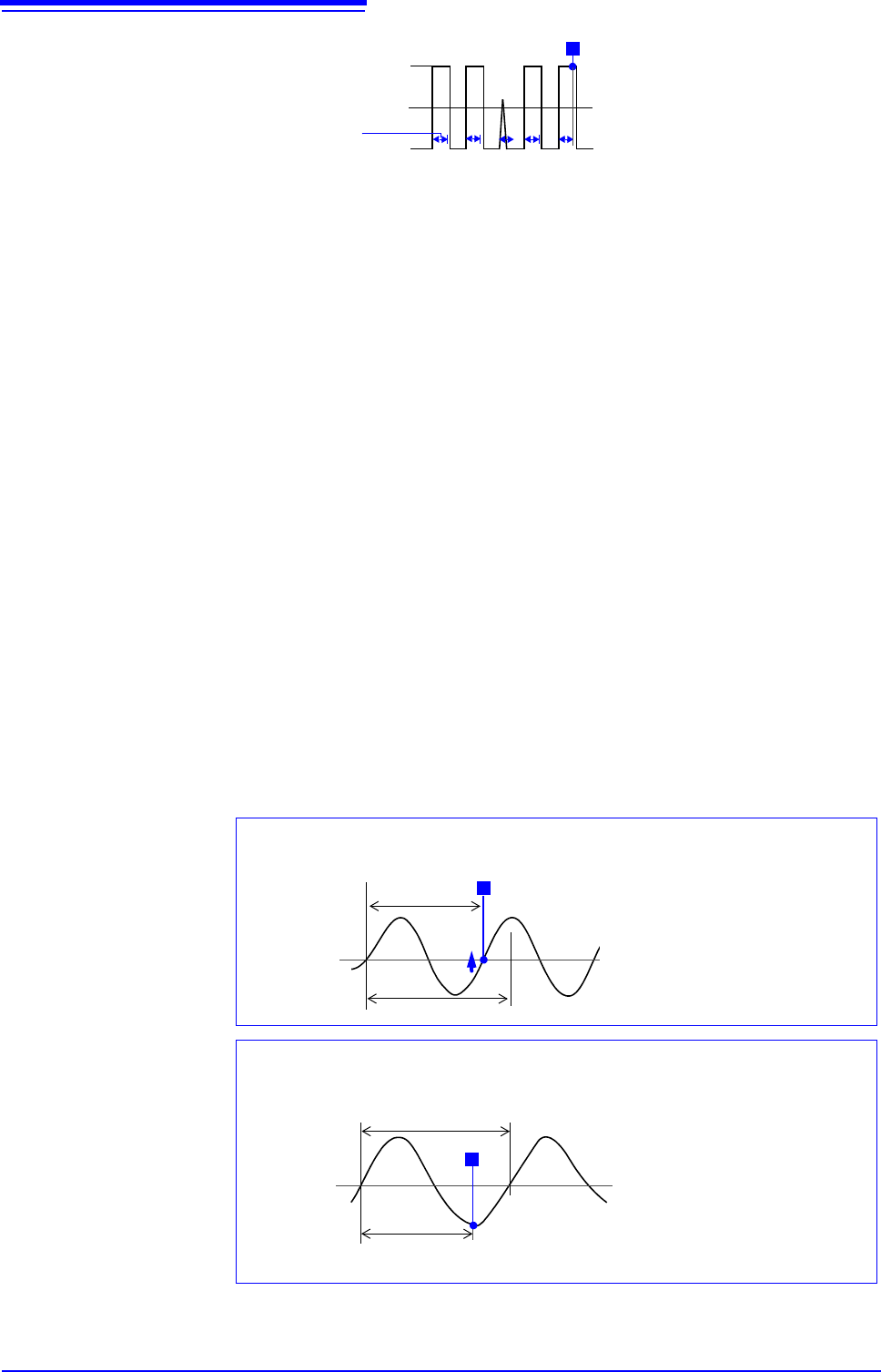
About the trigger point of the Out-of-Period trigger
Triggering occurs when the period of sequential crossings of the specified refer-
ence voltage exceeds the period range.
The point at which triggering occurs depends on the specified period range and
the period of the measured signal.
2.5 V
5 V
0 V
Trigger Level
T
12 34
Event Count
x
Filter Width
Reference
Voltage Level
Lower Threshold
Input Signal
Period
T
Triggering occurs when the rising
edge ( trigger slope) of the input
signal crosses the reference volt-
age level, before reaching the low-
er period threshold.
When the input signal period is shorter than the specified lower threshold
(Trigger Slope:
)
Reference
Voltage Level
Upper Threshold
Input Signal
Period
T
Triggering occurs when the upper
threshold period is reached, be-
fore the rising edge ( trigger
slope) of the input signal crosses
the reference voltage level.
Therefore, the trigger point is de-
termined by the upper threshold
of the period range.
When the input signal period is longer than the specified upper threshold
(Trigger Slope:
)