MR8740、MR8741_user_manual_eng_20191016H.pdf - 第258页
11.2 Display Settings 246 Difference Between Dead Times During Normal and Memory Division Recording When Auto Save is set for continuous trigge ring [Repeat] Dead Times Times during which sampling is inhibited due to int…
11.2 Display Settings
245
10
Chapter 11 Memory Division Function
11
Getting Details on Each Block:
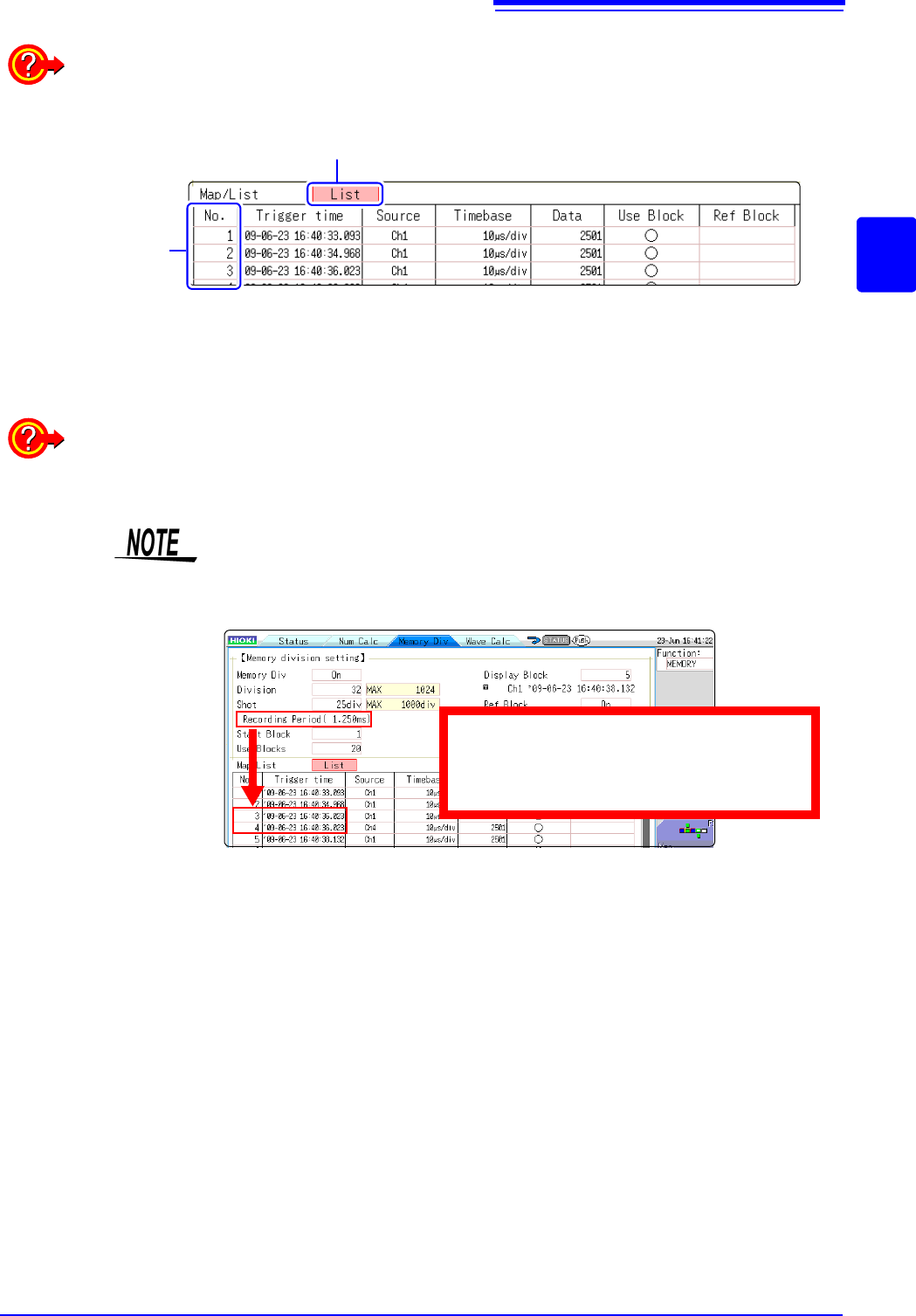
The trigger time and measurement status of each block can be viewed on the list.
Move the flashing cursor to the [Map/List] , and select [List].
Block No.
A block can be selected with the mouse.
You can move the flashing cursor to the Reference Block column to set a block’s on/off state as a
Reference Block.
To switch block waveforms on the Waveform screen:
To be able to select the block you want to see, click [WAVE] in the right-click menu at the Wave-
form screen and switch Pos to Block.
See: "6.8 Seeing Block Waveforms" (p.136)
• When displaying memory division blocks as a list, blocks may have the same
trigger times. This occurs because the minimum resolution of the clock used
by this unit is 1/128th of a second (7.8125 ms) and measurement occurs dur-
ing this interval.
• If triggers occur continuously within an interval shorter than 500 s, the
displayed trigger time may indicate a time slower than reality.
Example:
The recording time is 1.25 ms and the trigger
times of No. 3 and No. 4 blocks may be the
same.
11.2 Display Settings
246
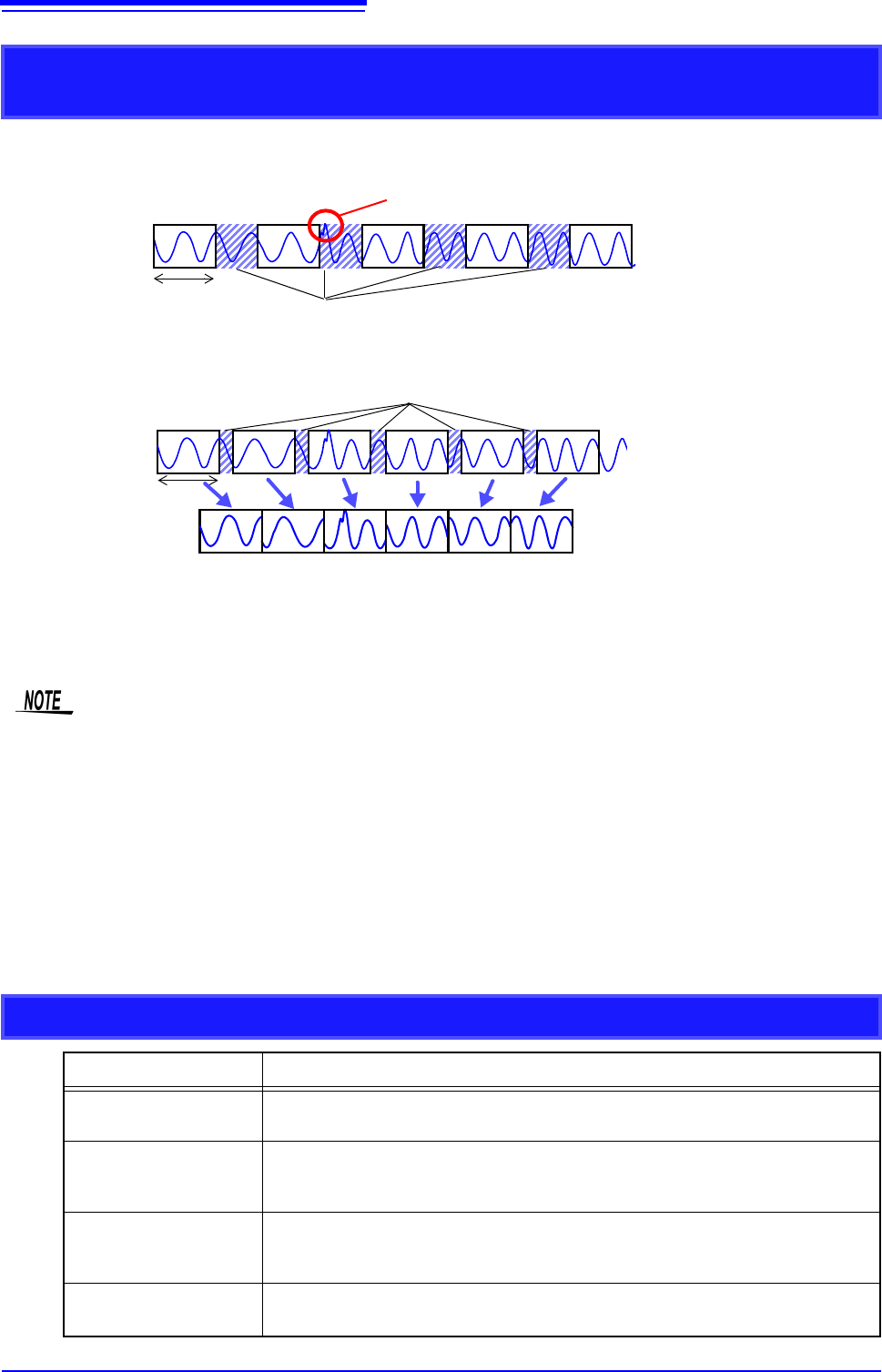
Difference Between Dead Times During Normal and Memory Division
Recording
When Auto Save is set for continuous triggering [Repeat]
Dead Times
Times during which sampling is inhibited due to internal processing or saving
Recording
Length
Anomalous phenomena occurring during dead times are not detected.
When the Trace Waveform Display is disabled (Off) during Memory Division
recording
12 34 56
Recording
Length
Dead Times
The waveform data of each recording length is recorded in one block.
When recording with Memory Division, dead time is shorter than with normal recording.
• The dead time (time where no sampling occurs between blocks) of memory division is as follows.
5 s/div to 20 s/div: 1 to 8 samples
Time axis slower than 50 s/div: 1 samples
Note: Dead time lengthens during numerical calculation or waveform calculation, or when the
time axis is 5 to 20 s/div and tracking waveform display is [On].
• When measuring with an 8970 Freq Unit, dead time is approximately 230 ms. When measuring
in integral value ([Count]) mode, there are cases when the last data in the previous block
remains in the first part of the block.
• When tracking waveform display is [Off], the roll mode function cannot be used, even when roll
mode is enabled (not Off).
• When triggering occurs very often, clicking [STOP] may not stop measurement until enough data
has been acquired to fill the blocks specified for use.
Auto Save for Memory Division Recording
Measuring conditions Auto Save
With Numerical calcula-
tion ON
Auto Save is performed every time one block is measured. When Tracking wave
display is ON, Waveform is also displayed.
When time axis is 5 to 20
s/div with Tracking wave
display ON.
Auto Save and Waveform Display are performed every time one block is measured.
When time axis is 5 to 20
s/div with Tracking wave
display OFF.
Auto Save is performed after all blocks are measured.
Other than above
Auto Save is performed simultaneously with measuring. When Tracking wave dis-
play is ON, Waveform is also displayed.
12.1 Overview and Features
247
11
Chapter 12 FFT Function
12
FFT analysis can only be used with the FFT function.
The FFT (Fast-Fourier Transform) functions provide frequency analysis of input signal data.
Use these functions for frequency analysis of rotating objects, vibrations, sounds and etc.
For details, refer to "Appendix 4 FFT Definitions" (p.A13).
Analysis can be performed on data as it is being measured, on pre-existing analog waveform data previ-
ously acquired with the Memory function, and on data output from waveform calculations.
When Model 8968 High Resolution Unit or Model U8979 Charge Unit, each of which is equipped with the
anti-aliasing filter, is used, the cut-off frequency can be set automatically by linking with the frequency
range setting.
Major Features
•FFT analysis frequency range: 133 mHz to 8 MHz
•FFT Analysis Modes (16 types)
* Not available when using external sampling.
For phase spectra, only the required phase information is highlighted and displayed.
See:"12.3.8 Emphasizing Analysis Results (phase spectra only)" (p.259)
so, when performing FFT analysis with the instrument connected to a sound level or vibration meter, scal-
ing by dB can be set from the Channel Settings screen if you want to read values directly in calibrated
units of measurement.
See:"Scaling" (p.266)
Refer to the "17.2.3 FFT Function" (p.346) for FFT function specifications.
FFT Function
Chapter 12
12.1 Overview and Features
• Storage Waveform • Cross-power Spectrum
• Histogram • Impulse Response
• Linear Spectrum • Coherence Function
• RMS Spectrum • Phase Spectrum
• Power Spectrum • Auto-correlation Function
• Power Spectrum Density* • Cross-correlation Function
• LPC analysis (Power Spectrum
Density)
*
• 1/1 Octave Analysis*
• Transfer Function • 1/3 Octave Analysis*
To suppress the effects of aliasing distortion
• We recommend using Model 8968 High Resolution Unit that are equipped with anti-aliasing filter-
ing to suppress the effects of aliasing distortion when sampling.
• FFT analysis cannot be performed for MR8990 Digital Voltmeter Unit.
See: Aliasing Distortion and Anti-Aliasing Filters
"Appendix 4 FFT Definitions" (p.A13)