MR8740、MR8741_user_manual_eng_20191016H.pdf - 第293页
12.8 FFT Analysis Modes 281 11 Chapter 12 FFT Function 12 W aveform Example LPC (Power Spectrum Density ) When the spectr um shape is complex and h ard to compreh end with either linear or power spectra, a rough spectrum…
12.8 FFT Analysis Modes
280
Waveform Example
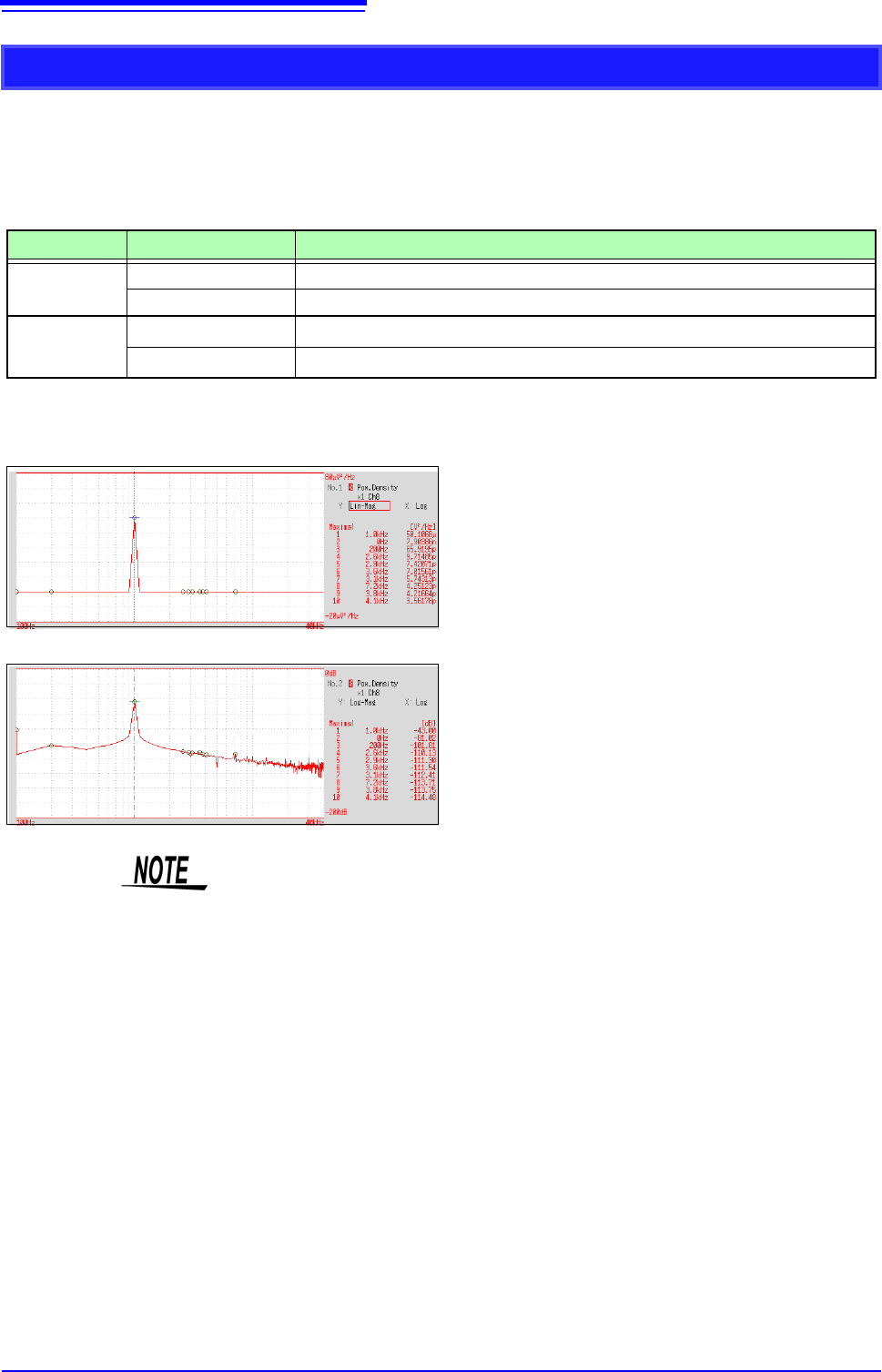
Power Spectrum Density
Indicates the power spectrum density of the input signal with only the amplitude component
included. This is the power spectrum divided by the frequency resolution.
Main uses:
To acquire a power spectrum with 1-Hz resolution for highly irregular waveforms such as white noise
See: About the Functions"12.8.2 Analysis Mode Functions" (p.293)
Axis Display Type Description
X axis
Linear Frequency is displayed with equal spacing
Log Frequency display of logarithm interval
Y axis
Lin-Mag
Analysis values are displayed linearly.
Log-Mag(logarithm)
Analysis values are displayed as dB values. (0 dB reference value: 1eu
2
/Hz)*
* eu: engineering units that are currently set are the standard (e.g., when the unit settings is volts, 0 dB = 1 V
2
/Hz)
Normal display
X axis: Log
Y axis: Lin-Mag
Normal display
X axis: Log
Y axis: Log-Mag
Not available with external sampling enabled.
12.8 FFT Analysis Modes
281
11
Chapter 12 FFT Function
12
Waveform Example
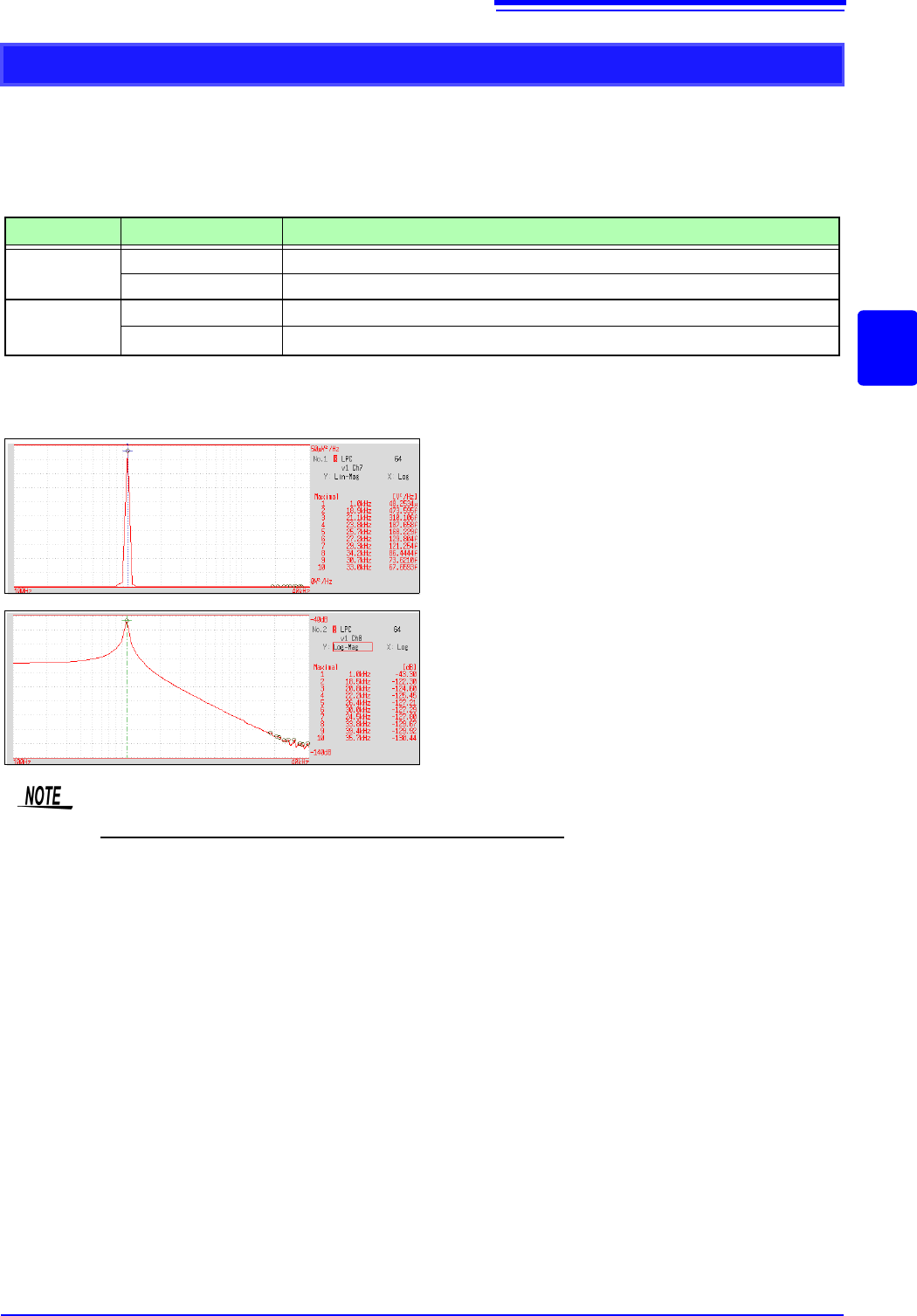
LPC (Power Spectrum Density )
When the spectrum shape is complex and hard to comprehend with either linear or power spectra, a
rough spectrum structure can be obtained.Main uses:
To obtain a spectral envelope using statistical methods
See: About the Functions"12.8.2 Analysis Mode Functions" (p.293)
Axis Display Type Description
X axis
Linear Frequency is displayed with equal spacing
Log Frequency display of logarithm interval
Y axis
Lin-Mag The analysis data is displayed linearly.
Log-Mag(logarithm)
Analysis values are displayed as dB values. (0 dB reference value: 1eu
2
/Hz)*
* eu: engineering units that are currently set are the standard (e.g., when the unit settings is volts, 0 dB = 1 V
2
/Hz)
X axis: Log
Y axis: Lin-Mag
X axis: Log
Y axis: Log-Mag
• Always specify the order (from 2 to 64). Higher orders can expose finer spectral details.
• Amplitude values provided by LPC are not always the same as the power spectrum density.
• If an error occurs during analysis, no waveform is displayed.
• Noise-like phenomena can strongly affect the spectrum shape.
12.8 FFT Analysis Modes
282
Waveform Example
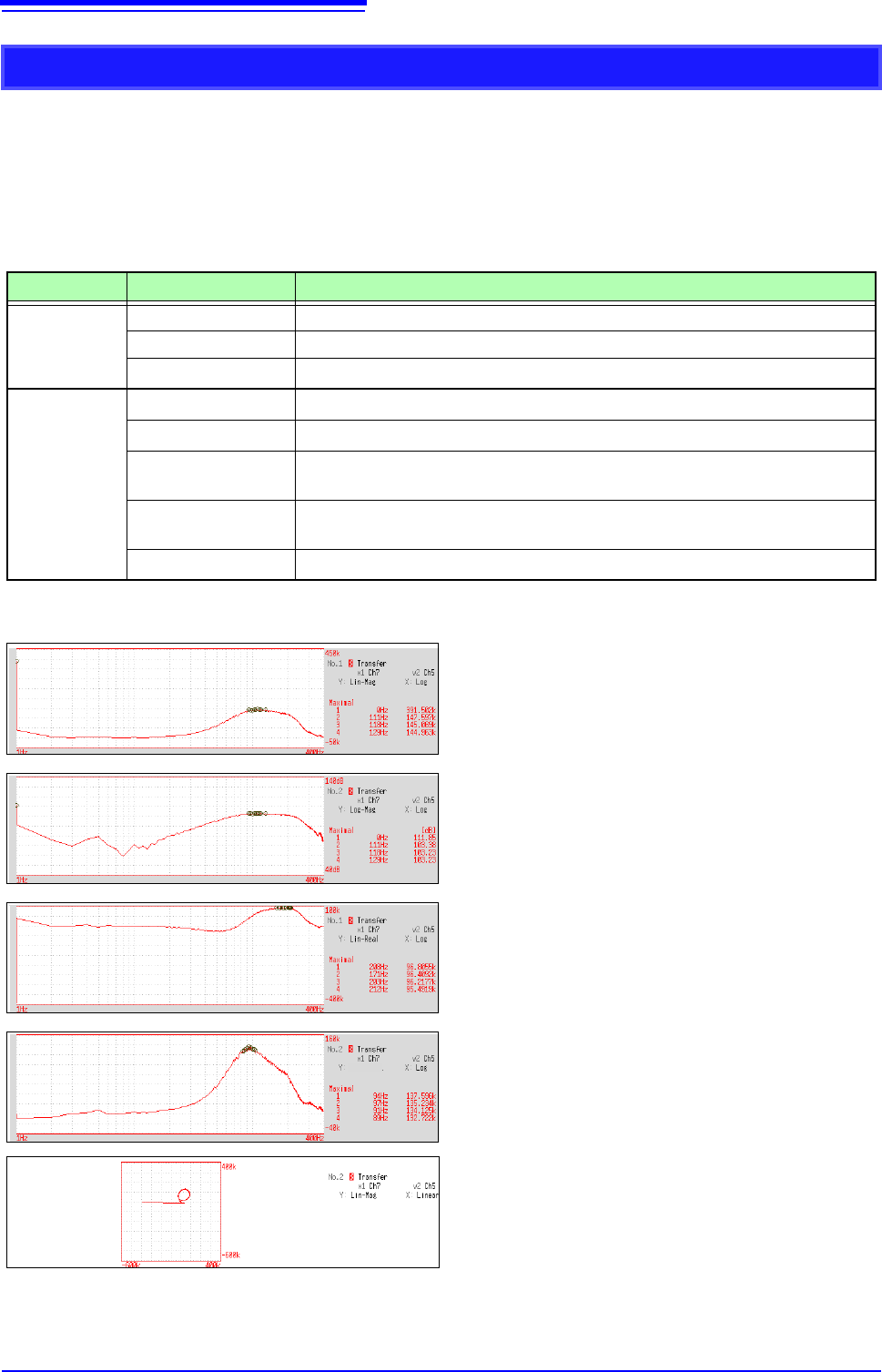
Transfer Function
From the input and output signals, the transfer function (frequency characteristic) of a measurement
system can be obtained. It can also be displayed as a Nyquist plot.
Main uses:
• To inspect a filter’s frequency characteristic
• To inspect the stability of a feedback control system (using the Nyquist plot)
• To inspect the resonance characteristic of an object using an impulse hammer and pick-up sensor
See: About the Functions"12.8.2 Analysis Mode Functions" (p.293), "Linear Time-Invariant Systems" (p.A14)
Axis Display Type Description
X axis
Linear Frequency is displayed with equal spacing
Log Frequency display of logarithm interval
Nyquist display
Displays the real-number component of the input-output ratio.
Y axis
Lin-Mag
Displays the input-output ratio linearly (dimensionless units).
Log-Mag(logarithm)
Displays the input-output ratio as dB values.
Lin-Real
Displays the real-number component of the input-output ratio (dimensionless
units).
Lin-Imag
Displays the imaginary component of the input-output ratio (dimensionless
units).
Nyquist display
Displays the imaginary component of the input-output ratio.
Normal display
X axis: Log
Y axis: Lin-Mag
Normal display
X axis: Log
Y axis: Log-Mag
Normal display
X axis: Log
Y axis: Lin-Real
Normal display
X axis: Log
Y axis: Lin-Imag
Lin-Imag
Nyquist display